Jimmy Kimmel Lawsuit 2026: George Santos Civil Case Status, Damages, and What Happens Next
Quick Answer
- The Jimmy Kimmel lawsuit is real and was filed in the Southern District of New York in 2024.
- Kimmel seeks damages for copyright infringement over Cameo videos used on his late-night show.
- No settlement has been reached as of August 19, 2026, and no trial date is set.
Jimmy Kimmel filed a civil lawsuit against George Santos in early 2024. The case is not a class action. It is a direct copyright and fraud claim brought by Kimmel’s production company against the former New York congressman.
The lawsuit centers on Santos’ Cameo account, where he sold personalized video messages. Kimmel’s team allegedly requested videos using fake names, then aired them on “Jimmy Kimmel Live!” Santos sued first in 2024 for misuse of the videos. Kimmel countersued.
This article covers the verified facts, the legal claims, the potential damages, and the timeline. One detail many people miss: Santos was expelled from Congress before any of these videos were made, so the case is a private dispute, not a government matter.
The Facts
| Item | Verified Details |
|---|---|
| Case | Kimmel v. Santos, and related countersuit |
| Court | U.S. District Court, Southern District of New York |
| Status | Active litigation, motions pending |
| Damages Sought | Not publicly specified in dollar amount |
| Per-Person Payout | Not applicable, private lawsuit |
| Trial Date | Not yet set |
| Key Filing | Kimmel countersued Santos in early 2024 |
| Proof Required | Court filings, video records, Cameo communications |
Is the Jimmy Kimmel lawsuit real?
Yes. The Jimmy Kimmel lawsuit against George Santos is real and filed in federal court. It is not a settlement, not a class action, and not something you can join.
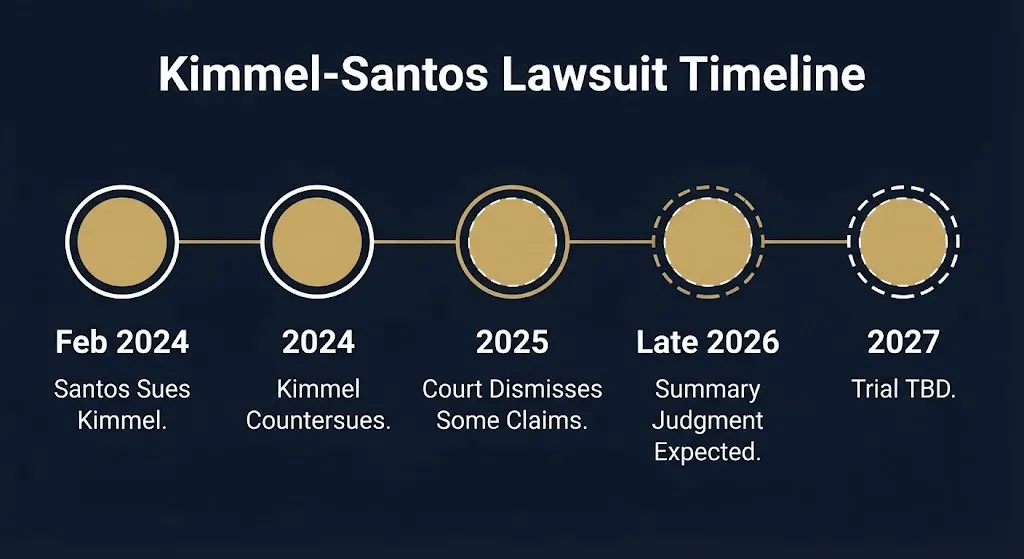
The case began when Santos sued Kimmel in February 2024. Santos claimed Kimmel’s show tricked him into making Cameo videos under fake names and then aired them without permission. Santos argued this was copyright infringement and fraud.
Kimmel’s legal team responded by countersuing Santos. The countersuit claims Santos violated the copyright of the show by using clips of “Jimmy Kimmel Live!” on his own social media and in his own Cameo videos.
Both cases were consolidated before Judge Denise Cote in the Southern District of New York. Judge Cote has handled several high-profile copyright cases and is known for moving cases efficiently.
Why is Jimmy Kimmel suing George Santos?
Kimmel’s countersuit claims Santos misused copyrighted clips from “Jimmy Kimmel Live!” without permission. The claim is straightforward: Santos used the show’s content to promote himself and his Cameo business.
The legal theory is that Santos reposted clips of Kimmel’s show on his social media accounts. Those clips included Kimmel’s commentary about Santos. Santos allegedly used them to drive attention to his Cameo page, where he sold videos for a fee.
Under copyright law, reposting a television clip without a license is infringement unless it falls under fair use. Kimmel’s team argues Santos’ use was commercial, because it promoted his paid Cameo service. Commercial use weakens any fair use defense.
The countersuit also raises claims related to Santos’ conduct during the video exchanges. Kimmel’s team says Santos knew he was being recorded for broadcast but later claimed he was tricked.
How did the Jimmy Kimmel and George Santos dispute start?
The dispute started on Cameo, the platform where celebrities sell short personalized videos. Santos joined Cameo in late 2023, shortly after his expulsion from Congress.
Kimmel’s staff ordered several Cameo videos from Santos. They used fake names and backstories that were meant to be humorous. Santos recorded the videos and delivered them, as Cameo sellers do.
Kimmel aired portions of the videos on his show in late 2023 and early 2024. The segments mocked Santos and used the videos as comedy material. Santos then filed his lawsuit, claiming the show’s actions were fraudulent and infringing.
Kimmel responded publicly on his show. He called the lawsuit “the funniest thing that has ever happened” and suggested Santos had no legal ground. The countersuit followed within weeks.
What is the current status of the Jimmy Kimmel lawsuit in 2026?
The case remains in active litigation as of August 19, 2026. No trial date has been set. No settlement has been announced.
The court has ruled on several preliminary motions. Judge Cote dismissed some of Santos’ claims in 2025 but allowed others to proceed. Kimmel’s copyright counterclaims remain intact.
Discovery is ongoing or recently completed. Both sides have exchanged documents, depositions have been scheduled, and the court has set a schedule for summary judgment motions.
The next major milestone is likely summary judgment. That is when each side asks the judge to rule in their favor without a trial. If the case survives summary judgment, it moves toward a trial date in 2027.
Key Takeaway: The case is real, active, and not close to resolution. No money has changed hands, and none will until a judgment or settlement occurs.
How much money is at stake in the Kimmel-Santos lawsuit?
No verified dollar amount has been filed in the public court record. Both sides seek damages, but the specific numbers remain under seal or unspecified in the filings.
Kimmel’s countersuit seeks statutory damages for copyright infringement. Under federal copyright law, statutory damages range from $750 to $30,000 per work infringed. If a court finds the infringement was willful, damages can rise to $150,000 per work.
The number of works at issue is small. The dispute involves a handful of video clips and Cameo recordings. That means the realistic damages are likely far lower than the maximum statutory amounts.
Santos’ original lawsuit also seeks damages. He claims the show profited from his videos and that he is owed compensation. His exact demand has not been publicly confirmed.
| Potential Damage Type | Estimated Range | Basis |
|---|---|---|
| Statutory damages, non-willful | $750 to $30,000 per work | Copyright Act |
| Statutory damages, willful | Up to $150,000 per work | Copyright Act |
| Actual damages | Unspecified | Requires proof of lost revenue |
| Attorney’s fees | Awardable to prevailing party | Copyright Act |
These are statutory ranges, not confirmed awards. Neither side has won anything yet.
Could Jimmy Kimmel have to pay George Santos?
It is possible but unlikely based on the early court rulings. Judge Cote dismissed several of Santos’ original claims in 2025. That narrowed the case significantly.
The remaining claims in Santos’ favor are weaker than his initial filing. Legal analysts who have reviewed the docket generally describe Santos’ position as difficult. The fair use and consent arguments favor Kimmel’s side.
But a court ruling is never certain. If Santos survives summary judgment and the case goes to trial, a jury could side with him on some narrow issue. Any award would likely be small.
The more realistic outcome is that Kimmel prevails on his countersuit and may win attorney’s fees. That could leave Santos owing money to Kimmel, not the reverse.
Reality Check: This is a private civil dispute between two public figures. You cannot join the case, file a claim, or receive any payout. Any website or social media post suggesting otherwise is not legitimate. No settlement website exists for this case because no settlement has been reached.
Is there a class action in the Jimmy Kimmel lawsuit?
No. The Jimmy Kimmel and George Santos dispute is a private civil lawsuit between two parties. It is not a class action, not a consumer case, and not open to public claims.
Class actions require a large group of similarly situated people. This case involves one plaintiff’s copyright claims against one defendant. No class has been certified, requested, or even mentioned in the filings.
This matters because people sometimes search for “Jimmy Kimmel lawsuit settlement” expecting to find a claim form. No such claim form exists. No settlement fund exists. No administrator has been appointed.
If you saw a post claiming you can get money from the Jimmy Kimmel lawsuit, it is misleading or a scam. The only people who may recover money in this case are the named parties themselves.
What are the copyright claims in the case?
Copyright law protects original creative works, including television broadcasts. “Jimmy Kimmel Live!” is a copyrighted work owned by ABC and Kimmel’s production company.
The countersuit claims Santos copied and distributed clips of the show without authorization. That is the core of a copyright infringement claim under Title 17 of the U.S. Code.
Santos has argued fair use. Fair use is a defense that allows limited use of copyrighted material for purposes like commentary, criticism, or news reporting. A court weighs four factors, including whether the use was commercial and whether it affected the market for the original.
Kimmel’s team points to Santos’ Cameo business as proof of commercial use. If a court agrees, the fair use defense weakens substantially.
What are the fraud claims in the case?
Santos’ original lawsuit claimed Kimmel’s team tricked him into making videos under false pretenses. He argued that using fake names and stories constituted fraud or deceptive conduct.
Kimmel’s team responded that the show’s requests were satirical and obvious. The fake names were comedic, not deceptive in any legally meaningful sense. Courts are generally reluctant to treat comedy sketches as fraud.
Judge Cote’s early rulings suggest she was skeptical of the fraud claims. She dismissed some of them in 2025, leaving Santos with a narrower case.
The remaining claims center on contract and copyright issues, not fraud. That shift weakens Santos’ overall position.
Key Takeaway: The legal momentum has favored Kimmel so far. The court dismissed several of Santos’ claims, and the surviving claims are narrower.
How does a celebrity lawsuit like this affect ordinary people?
It does not, at least not directly. This case is a dispute between a late-night host and a former politician. No consumer rights are at stake.
But the case does have indirect value. It clarifies how copyright law applies to Cameo videos and social media reposts. That matters for creators, influencers, and anyone who sells personalized content online.
The ruling may also set boundaries for how television shows can use Cameo videos. That affects the broader entertainment industry and the gig economy of personalized video messages.
For ordinary consumers, the main lesson is practical. If you buy a Cameo video, you are buying a limited license for personal use. You do not own the copyright. Reposting or broadcasting the video without permission can expose you to legal liability.
What is Cameo and why does it matter here?
Cameo is a platform that lets people pay celebrities, politicians, and creators for short personalized video messages. Prices range from a few dollars to thousands, depending on the personality.
Santos joined Cameo after his expulsion from the House of Representatives in December 2023. He priced his videos at several hundred dollars each and reportedly earned significant income in the first weeks.
Kimmel’s show ordered videos from Santos through the platform. The show’s writers used fake names to request content that would produce funny reactions. Santos delivered the videos, and Kimmel aired them.
The case matters because it tests the boundary between a platform’s terms of service, a buyer’s license, and a creator’s copyright interest. Cameo’s own terms state that buyers get a limited license for personal use, not broadcast rights.
What has the court ruled so far in 2026?
The court has ruled on several motions. Judge Cote dismissed part of Santos’ original complaint in 2025. She allowed the copyright counterclaims to proceed.
The exact rulings are detailed in the public docket of the Southern District of New York. The docket number and full text are available through the federal court’s electronic records system.
The court has also ruled on discovery disputes. Both sides have been ordered to produce documents and appear for depositions. These rulings are procedural and do not decide the merits.
As of August 19, 2026, no summary judgment ruling has been issued. The next major decision will likely address whether the case proceeds to trial.
What happens next in the Jimmy Kimmel lawsuit?
The case is moving toward summary judgment. Here is the expected timeline based on the current docket and typical federal court practice.
| Stage | Expected Timing |
|---|---|
| Discovery completion | Late 2026 |
| Summary judgment motions | Late 2026 or early 2027 |
| Summary judgment ruling | Mid 2027 |
| Trial, if summary judgment denied | Late 2027 or 2028 |
| Settlement, if any | Could happen at any time |
These dates are estimates based on typical federal court timelines. The actual schedule depends on Judge Cote’s calendar and the parties’ motions.
A settlement is always possible. Many celebrity copyright cases settle before trial to avoid legal costs and publicity. But no settlement talks have been confirmed.
Frequently Asked Questions
Is Jimmy Kimmel being sued by George Santos?
Yes. George Santos sued Jimmy Kimmel in February 2024 over Cameo videos aired on Kimmel’s show.
The case was consolidated with Kimmel’s countersuit in the Southern District of New York.
Did Jimmy Kimmel sue George Santos?
Yes. Kimmel’s production company filed a copyright countersuit against Santos in 2024.
The countersuit claims Santos used clips of “Jimmy Kimmel Live!” without permission on his social media.
How much is the Jimmy Kimmel lawsuit worth?
The amount is not publicly confirmed.
Statutory copyright damages range from $750 to $150,000 per work, depending on willfulness.
Can I get money from the Jimmy Kimmel lawsuit?
No. This is a private lawsuit between two parties, not a class action.
No settlement fund exists, and no claim form will be issued to the public.
Has George Santos paid Jimmy Kimmel?
No payment has been confirmed.
No judgment or settlement has been reached as of August 19, 2026.
What court is the Kimmel-Santos case in?
The case is in the U.S. District Court for the Southern District of New York.
Judge Denise Cote is presiding.
Will the case go to trial?
It may, but no trial date has been set.
Summary judgment motions are expected in late 2026 or early 2027.
What is the main legal issue?
The main issue is copyright infringement and whether Santos’ use of show clips and Kimmel’s use of Cameo videos were authorized.
Fair use is the central defense.
The Jimmy Kimmel lawsuit against George Santos is a narrow copyright dispute, not a consumer settlement. No claim form exists. No payout is coming to the public.
The next meaningful update will come from the Southern District of New York. Check the federal docket or major legal news outlets for the summary judgment ruling.