Structured Settlement Loan 2026: Cash Out Options, Real Costs, and What to Watch For
Quick Answer
- A structured settlement loan lets you sell future payments for a lump sum, but you lose value in the exchange.
- You may receive 50 to 80 cents on the dollar after discount rates and fees.
- Most states require court approval before any structured settlement transfer becomes legal.
A structured settlement loan is not really a loan. It is a sale of your future structured settlement payments in exchange for a lump sum today. The buyer, usually a structured settlement funding company, pays you now and collects your future payments.
You may be considering this because you need cash for medical bills, housing, or debt. The trade is simple: you get less total money than you would receive over time. The company profits from the difference.
This article covers the real costs, the legal process, the top companies, and the alternatives. One surprising fact: the industry’s own lobbying arm says most sellers regret the decision within a year.
The Facts
| Item | Verified Details |
|---|---|
| Product | Structured settlement payment sale |
| Typical Discount Rate | 9% to 18% annually |
| Typical Cash Received | 50 to 80 cents per future dollar |
| Court Approval | Required in most states |
| Approval Time | 30 to 90 days on average |
| Major Companies | J.G. Wentworth, Peachtree, Oasis, Fairfield |
| Regulator | State insurance departments and courts |
Are structured settlement loans legal?
Yes. Structured settlement payment sales are legal in most states, but they are heavily regulated. Almost every state requires court approval before the transfer takes effect.
The legal framework comes from state structured settlement protection acts. These laws were passed after abuses in the 1990s and early 2000s. They require the buyer to prove the sale is in the seller’s best interest.
A judge reviews the transaction. The judge can deny the sale if the discount rate is excessive or the seller does not have a genuine financial need.
You cannot simply sign a contract and receive money. The court process exists to protect you from yourself, and from predatory buyers.
How does a structured settlement loan work?
A structured settlement loan works like this: you contact a funding company, the company offers a lump sum for a portion of your future payments, and a court must approve the sale.
The company reviews your settlement agreement, your payment schedule, and your financial situation. It then makes an offer based on a discount rate.
The discount rate is the profit the company takes. A typical rate ranges from 9% to 18% annually. That means the longer the payment stream, the less you receive today relative to its total value.
If you sell $100,000 in future payments scheduled over ten years, you might receive $50,000 to $75,000 in cash today. The rest goes to the buyer.
How much cash can I get from my structured settlement?
The cash amount depends on the total value of the payments you sell, the discount rate, and the fees. Most sellers receive 50 to 80 cents for every future dollar.
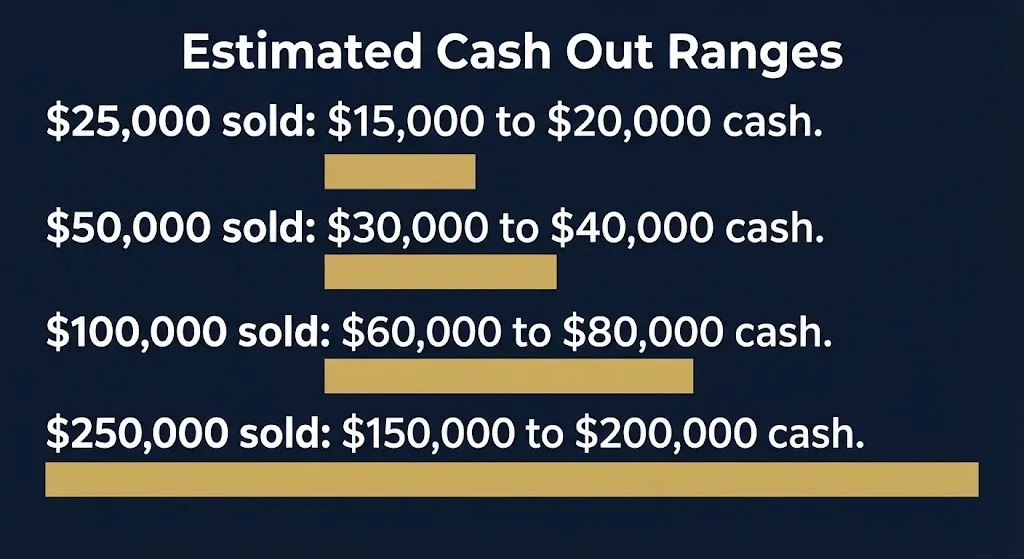
For example, if you sell $50,000 in future payments, you might receive $30,000 to $40,000 today. The exact amount varies by company and state.
The table below shows a typical range.
| Future Payments Sold | Estimated Cash Offer | Effective Loss |
|---|---|---|
| $25,000 | $15,000 to $20,000 | $5,000 to $10,000 |
| $50,000 | $30,000 to $40,000 | $10,000 to $20,000 |
| $100,000 | $60,000 to $80,000 | $20,000 to $40,000 |
| $250,000 | $150,000 to $200,000 | $50,000 to $100,000 |
These ranges are estimates based on industry averages. Actual offers vary by company, state, and the payment schedule.
Key Takeaway: You will always receive less than the total value of your future payments. The discount rate is the price you pay for speed.
What is the difference between a structured settlement loan and a buyout?
A structured settlement loan is a misleading term. Technically, the transaction is a sale or buyout, not a loan. No company lends you money against your settlement.
A loan implies repayment with interest. A buyout means you sell the right to future payments outright. You do not repay the buyer. The buyer simply collects your payments.
Some companies use the word “loan” in marketing because it sounds less intimidating than “sale.” But the legal document you sign is a purchase agreement, not a promissory note.
The distinction matters because a loan can sometimes be cheaper than a sale. A true loan might let you repay and keep your payments. A sale is permanent.
Can I sell only part of my structured settlement?
Yes. Most structured settlement funding companies allow partial sales. You can sell a portion of your payments and keep the rest.
For example, you might sell the next five years of monthly payments and keep the remaining fifteen years. That preserves some future income.
Partial sales are often the smarter choice. They reduce the total amount you lose to discounting while still giving you the cash you need now.
Discuss partial sale options with any company you contact. If a company insists you sell everything, that is a red flag.
What are the top structured settlement loan companies?
The largest structured settlement funding companies include J.G. Wentworth, Peachtree Settlement Funding, Oasis Financial, and Fairfield Funding. Each operates nationally.
These companies advertise heavily on television and online. That visibility does not mean their offers are the best. Discount rates vary, and competition is real.
You should get offers from at least three companies before making any decision. The difference between the highest and lowest offer can be thousands of dollars.
The table below lists major companies and their general focus.
| Company | Known For | Notes |
|---|---|---|
| J.G. Wentworth | Largest advertiser, national reach | Broad product range |
| Peachtree Settlement Funding | Long history, structured settlements | Major buyer |
| Oasis Financial | Also funds pre-settlement advances | Different product line |
| Fairfield Funding | Direct buyer, no broker model | May offer better rates |
This is not an endorsement. Rates change constantly and depend on your specific payment stream.
Reality Check: No legitimate structured settlement buyer will pressure you to sign the same day. Court approval takes weeks. If someone offers instant cash with no court process, that is illegal in most states. The court review exists to protect you, and any company that tries to skip it is breaking the law.
What is the structured settlement approval process?
The approval process is legal and unavoidable. It starts with your application to the funding company and ends with a judge’s sign-off.
Here is the typical path:
- You request a quote from one or more funding companies.
- The company reviews your settlement documents and payment schedule.
- You sign a transfer agreement.
- The company files a petition in your local court.
- The court schedules a hearing, usually within 30 to 60 days.
- The judge reviews the discount rate, your financial need, and the sale terms.
- If approved, the company releases funds within a few days to a few weeks.
The entire process usually takes 30 to 90 days. Faster is rare. Slower happens when courts are backed up.
Why do courts have to approve structured settlement sales?
Courts approve structured settlement sales to prevent exploitation. The laws were written after decades of abuse by companies that bought settlements for pennies on the dollar.
A judge reviews the transaction for fairness. The judge considers the discount rate, the seller’s financial situation, and whether the seller understands the consequences.
The court can deny the sale if the discount rate is too high or the seller does not demonstrate a genuine need. Some states have specific thresholds for acceptable discount rates.
This protection is not perfect, but it is better than the unregulated market that existed before. The court’s involvement is why structured settlement transfers are safer than many other financial products.
What are structured settlement loan alternatives?
Before selling your payments, consider alternatives that preserve more of your settlement value.
A personal loan may be available if you have decent credit. The interest rate on a personal loan is often lower than the effective discount rate on a structured settlement sale.
A home equity loan or line of credit may be cheaper still, if you own a home with equity. The risk is putting your home up as collateral.
Credit counseling and debt negotiation can reduce your monthly obligations without sacrificing future income. Nonprofit credit counselors are available in most states.
If you are selling because of medical debt, negotiate with the hospital first. Many providers offer payment plans or reduce bills for patients who ask.
The table below compares common options.
| Option | Cost | Risk |
|---|---|---|
| Structured settlement sale | 9% to 18% discount rate | Permanent loss of future payments |
| Personal loan | 8% to 25% APR | Debt obligation |
| Home equity loan | 6% to 12% APR | Risk of foreclosure |
| Credit counseling | Free or low cost | None |
| Medical debt negotiation | Free | None |
Key Takeaway: Selling a structured settlement is almost always the most expensive way to get cash. Exhaust cheaper options first.
What are the risks of cashing out a structured settlement?
The biggest risk is losing future financial security. Structured settlements exist to provide long-term income, often for medical needs or lost earning capacity.
When you sell those payments, you trade guaranteed future income for a smaller lump sum today. If the cash runs out, there is no replacement.
The second risk is the discount rate. You are effectively paying 9% to 18% annual interest for the privilege of getting your own money early. That is worse than most credit cards.
The third risk is seller’s remorse. The National Association of Settlement Purchasers has acknowledged that many sellers regret the decision within a year. The money is spent, and the future payments are gone.
You cannot undo a court-approved sale. Once the judge signs the order, the buyer owns your payments.
How do I get the best structured settlement cash offer?
Getting the best offer requires shopping around and understanding the numbers. Never accept the first offer.
Here is a checklist:
- Get quotes from at least three licensed funding companies.
- Ask each company for the total cash amount and the effective discount rate.
- Compare the offers side by side.
- Ask about fees, which can reduce the amount you receive.
- Check each company with your state insurance department.
- Consider selling only part of your payments.
- Consult a financial advisor or attorney before signing.
A small difference in discount rate can mean thousands of dollars. Companies count on you not comparing.
What fees are involved in structured settlement sales?
Fees can reduce your cash payout significantly. Some companies charge application fees, processing fees, or court costs that come out of your proceeds.
Legitimate companies usually cover court costs and take them from the sale proceeds, not charge you upfront. But some add administrative fees that eat into the offer.
Ask for a written breakdown of all fees before you sign. The total cash you receive should be clear and not reduced by surprise charges later.
If a company asks for money upfront, walk away. Legitimate structured settlement buyers do not charge application fees.
When should you not sell a structured settlement?
Do not sell if your need is temporary or speculative. If you want cash for a vacation, a new car, or an investment, the cost is too high.
Do not sell if you rely on the payments for basic living expenses. The loss of future income can create a crisis later.
Do not sell if a cheaper borrowing option exists. A structured settlement sale is almost never the lowest-cost way to raise cash.
Do not sell if you feel pressured. The court process takes weeks, so anyone demanding an immediate decision is not acting in your interest.
Key Takeaway: The only good time to sell is when a genuine financial emergency leaves no cheaper option, and you have fully considered the permanent loss of future income.
What happens after I sign a structured settlement transfer agreement?
After you sign, the funding company files a petition in court. The court sets a hearing and notifies all interested parties, including the insurance company that pays your settlement.
The judge reviews the transaction. You may be asked to attend the hearing, either in person or by phone. The judge will ask about your financial situation and your understanding of the sale.
If the judge approves, the order is entered. The insurance company is notified to redirect the sold payments to the buyer.
You receive your lump sum, usually within a few days to a few weeks after approval. The buyer now owns the payments you sold.
Frequently Asked Questions
Are structured settlement loans a good idea?
They are usually expensive compared to alternatives.
Selling future payments means losing value to discount rates and fees.
How long does it take to cash out a structured settlement?
Most sales take 30 to 90 days from application to approval.
Court scheduling is the biggest factor in the timeline.
Do I need a lawyer to sell my structured settlement?
You are not required to have a lawyer, but it is wise to consult one.
Some states require independent professional advice before approving a sale.
Can I sell my structured settlement without court approval?
No, in most states court approval is required by law.
Any company that offers cash without court approval is operating illegally.
What is the average discount rate on structured settlement sales?
The typical range is 9% to 18% annually.
Lower rates are available if you shop around and negotiate.
Will selling my structured settlement affect my taxes?
The lump sum from selling a structured settlement is generally not taxable.
The original settlement payments are tax-free, and the sale proceeds usually retain that status.
Can I sell annuity payments from a structured settlement?
Yes. Structured settlements are often funded by annuities.
The sale transfers your right to those annuity payments to the buyer.
What if I only want to sell part of my settlement?
Most companies allow partial sales.
Selling a portion preserves some future income and reduces your total loss.
Structured settlement loans are legal, heavily regulated, and expensive. The court approval process protects you, but it cannot undo a bad decision.
If you need cash, shop around. Get multiple quotes. Ask about the discount rate. And talk to a financial advisor before you sign away future income that may be irreplaceable.