How Long to Get Settlement Check After Signing Release: 2026 Timeline
Quick Answer
- Most settlement checks arrive 14 to 30 days after you sign the release and the insurer processes it.
- Class action settlement payments take much longer, often 6 to 12 months after final approval.
- Your attorney must resolve any liens, medical bills, or fee deductions before you receive your portion.
You signed the release. The hard part should be over. But now you are waiting for the check, and no one has told you exactly when it will arrive.
The answer depends on what kind of settlement you have. A personal injury or accident settlement with an insurance company usually takes two to four weeks after the release is signed and returned. A class action settlement takes months, sometimes a year or more.
One fact most people do not know: the clock does not start the day you sign. It starts when the insurance company or claims administrator receives the signed release, processes it, and issues the check. That gap is where most delays happen.
The Facts
| Case | Settlement check processing, general practice |
| Status | Standard industry timeline applies |
| Fund Size | Varies by individual case or class action |
| Est. Per Person | Case-specific, no standard amount |
| Claim Deadline | Not applicable after signing |
| Administrator | Insurance company or court-appointed claims administrator |
| Proof Needed | Signed release, W-9 form, lien resolution documents |
Is the Settlement Check Timeline After Signing a Release Standard?
Yes, there is a standard timeline, but it applies to typical insurance settlements, not every case type. The industry norm is 14 to 30 days from the date the insurer receives your signed release.
The release is a legally binding document. It says you give up all future claims in exchange for the agreed amount. Once you sign it and send it back, the insurer has no legal obligation to pay immediately, but most process payments within a month.
The timeline varies by insurer. Large national carriers like State Farm, Geico, and Progressive often issue checks faster than smaller regional insurers. Government entities and self-insured corporations can take longer.
If your settlement involves a court approval step, like a minor’s settlement or a class action, the timeline is completely different and much longer.
Key Takeaway: The standard insurance settlement check arrives in two to four weeks, but that clock starts when the insurer receives the signed release, not when you sign it.
How Long Does It Take to Get a Settlement Check From an Insurance Company?
Most insurance companies issue settlement checks within 14 to 30 days after receiving a properly signed release. Some pay faster. Some deliberately wait until the end of the allowed window.
The release document includes a date. The insurer is not required to pay before a certain number of days have passed, often 15 days. This built-in delay protects the insurer from stop-payment issues.
Your attorney usually sends the signed release to the insurer by overnight mail or email. The insurer then processes it through their payment department. That department issues the check and sends it to your attorney.
Your attorney deposits the check into a trust account. Then they deduct their fee, pay any outstanding medical liens, and write you a check for the remainder. That internal process adds another 7 to 14 days.
What Happens Between Signing the Release and Getting Paid?
The period between signing and payment involves several steps. Understanding each one helps you see why the process takes weeks, not days.
- You sign the release and any other required documents.
- Your attorney returns the signed release to the insurance company.
- The insurer logs the release and sends it to the payment department.
- The payment department issues the check to your attorney.
- Your attorney deposits the check into a trust account.
- Your attorney negotiates and pays any medical liens or subrogation claims.
- Your attorney deducts their contingency fee and case costs.
- Your attorney writes you a check for your portion.
Each step takes time. The insurer’s internal processing alone can take 10 to 15 business days. Lien negotiations can add weeks if your medical providers or health insurer dispute the amounts.
How Long Does a Class Action Settlement Take to Pay?
Class action settlement payments take much longer than individual settlements. The typical timeline from final approval to payment is 6 to 12 months, and sometimes longer.
After a settlement receives final approval, there is an appeals period. Class members can object, and objectors can appeal the approval. The appeals process alone can take a year or more.
Once all appeals are exhausted, the claims administrator begins distributing funds. That process involves verifying claims, calculating individual payments, and issuing checks or electronic payments.
If you filed a claim in a class action, do not expect a quick check. The claims administrator may process tens of thousands of claims. Distribution can take several months after the fund is released.
| Settlement Type | Typical Payment Time After Signing or Approval |
|---|---|
| Individual insurance settlement | 14 to 30 days |
| Workers compensation settlement | 30 to 60 days after approval |
| Class action settlement | 6 to 12 months after final approval |
| Mass tort settlement | 3 to 12 months after lien resolution |
| Wrongful death settlement | 30 to 60 days after court approval |
Key Takeaway: Class action checks take months because they require final approval, appeals resolution, and mass claims processing, unlike individual settlements.
What Can Delay a Settlement Check After Signing?
Several factors can delay your settlement check even after you sign the release. Some are within your control. Most are not.
The insurance company may be slow. Some insurers have a reputation for dragging out payments as long as legally allowed. There is little you can do except have your attorney follow up.
Lien resolution is the most common real delay. If you have unpaid medical bills, a health insurance lien, or a government lien from Medicare or Medicaid, your attorney must resolve those before distributing your share.
Missing paperwork stops the process. If your W-9 form, release, or other required documents are incomplete, the insurer will not issue payment.
Your attorney’s office may have internal delays. Trust account processing, check writing, and document review all take time.
Why Does My Attorney Hold My Settlement Check?
Your attorney holds your settlement check to resolve obligations before distributing your portion. This is standard practice and required by law in most states.
The check from the insurer is made payable to your attorney’s trust account, not to you directly. This protects the attorney’s fee and ensures liens are paid.
Your attorney must pay outstanding medical liens, health insurance subrogation claims, and any government liens before giving you your money. If they do not, they can face personal liability.
The attorney also deducts their contingency fee and reimburses case costs. Those costs include filing fees, expert witness fees, medical record costs, and deposition expenses.
Only after all deductions does the attorney write you a check. The delay is not your attorney holding your money hostage. It is the legal process working as designed.
How Long After Signing a Release for Settlement Does Direct Deposit Take?
Direct deposit for settlements is becoming more common, but it does not dramatically speed up the process. The same internal processing steps apply.
If your attorney offers direct deposit, the money may arrive a few days faster than a paper check. The insurer still takes 14 to 30 days to issue payment.
The attorney’s trust account requirements mean the money must clear before disbursement. Trust accounts have strict rules about deposit holds and available funds.
Direct deposit also requires you to provide bank account information and sign an authorization form. Some clients are uncomfortable with this, and a paper check is still standard in many firms.
Key Takeaway: Direct deposit saves a few days at the end of the process, but the insurer’s 14 to 30 day processing window remains the main timeline.
What Is the Fastest Way to Get a Settlement Check?
The fastest way to get a settlement check is to complete every document correctly the first time and respond immediately to requests from your attorney or the insurer.
Return the signed release the same day you receive it. Do not let it sit on your kitchen counter for a week. Every day you wait is a day added to the timeline.
Provide your W-9 form and any other requested documents quickly. Incomplete or incorrect forms cause avoidable delays.
Stay in contact with your attorney’s office. Ask for a timeline. Follow up politely but persistently if the check is late.
Avoid third-party settlement funding unless you truly need it. Those companies charge high fees and take a portion of your settlement.
Reality Check
No legitimate insurance company or claims administrator will charge you a fee to release your settlement check. If someone calls claiming they can speed up your payment for a fee, it is a scam. Your attorney’s office is the only source of truth about your check status. Settlement funding companies offer advances, but the fees are steep and the money comes out of your settlement.
How Do I Check the Status of My Settlement Check?
The first place to check is your attorney’s office. They have direct contact with the insurance company or claims administrator and can track the payment.
Ask your attorney for the date the release was sent and the date the insurer confirmed receipt. That gives you a clear starting point for the 14 to 30 day window.
If the check has been issued, ask for the check number and the date it was mailed or deposited. Your attorney should have this information.
For class action settlements, check the official settlement website. The claims administrator posts status updates there.
If you are working directly with an insurer without an attorney, call the adjuster and ask for a payment date. Document every conversation.
What Happens Next
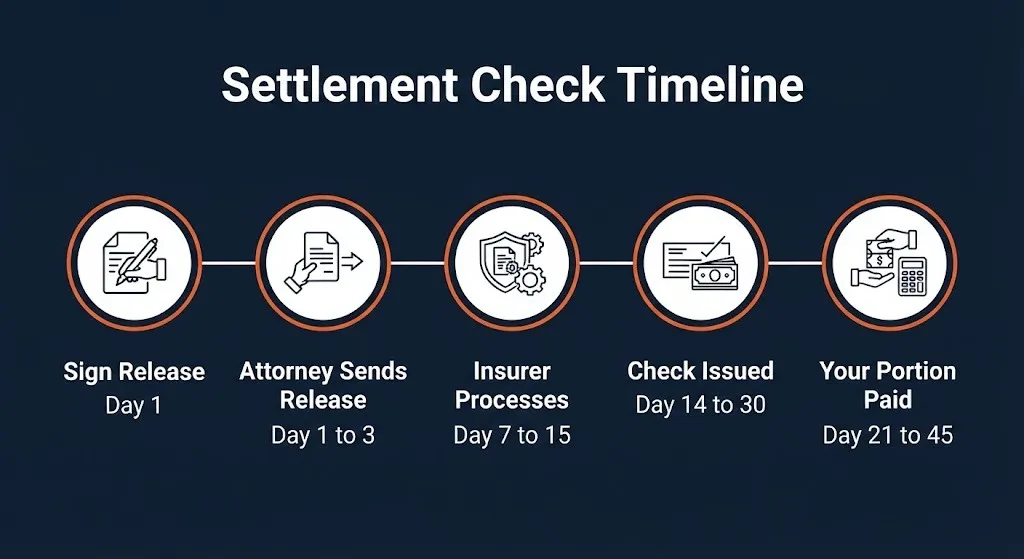
Day 1: You sign and return the release to your attorney.
Day 1 to 3: Your attorney sends the release to the insurer.
Day 7 to 15: The insurer processes the release and approves payment.
Day 14 to 30: The insurer issues the check to your attorney.
Day 21 to 45: Your attorney deposits the check, resolves liens, and distributes your portion.
Frequently Asked Questions
How long does it take to get a settlement check after signing release?
Most checks arrive in 14 to 30 days.
The clock starts when the insurer receives the signed release, not when you sign it.
Can an insurance company delay my settlement check?
Yes, insurers can wait until the end of the allowed processing window.
Some insurers are known for slower payment than others.
Why is my settlement check taking so long?
Lien resolution is the most common reason for delay.
Unpaid medical bills and health insurance claims must be resolved before you get paid.
Do I have to pay taxes on my settlement check?
Most personal injury settlements are not taxable.
But portions for lost wages or punitive damages may be. Consult a tax professional.
What if my attorney is holding my settlement check too long?
Ask for a written accounting of all deductions and the disbursement timeline.
Most delays are legitimate, but you have the right to know where your money is.
Can I get my settlement check direct deposited?
Yes, if your attorney offers that option.
Direct deposit may save a few days but does not change the insurer’s processing time.
How long do class action settlement checks take?
Class action payments usually take 6 to 12 months after final approval.
Appeals and claims processing add significant time.
What is a settlement release?
A release is a legal document where you give up future claims in exchange for the settlement amount.
Signing it means you cannot sue for the same injury or dispute again.
Your settlement check will arrive. The timeline is well-established. For individual insurance cases, expect two to four weeks after the insurer receives your signed release.
For class actions, adjust your expectations to months, not weeks. The single most important date is the day your attorney confirms the insurer received your release. That is when the real clock starts.