Settlement Agreements 2026: What They Mean, How They Work, and How to Read One Before You Sign
Quick Answer
- A settlement agreement is a binding contract that ends a dispute without a trial.
- Most civil settlements are private, so no public database lists every agreement.
- Before signing, you must read the release clause, payment terms, and confidentiality section.
If you searched for “settlement agreements,” you likely just got one. Maybe it arrived by email. Maybe a claims administrator mailed a packet. Maybe your employer put a document in front of you and said sign here. You want to know what you are signing, whether it is fair, and what happens next.
Here is the truth most websites skip. A settlement agreement is a contract. It is not a court order. It is not a guarantee of immediate payment. It is a written deal that ends your legal claim in exchange for something, usually money, and it binds you the moment you sign.
This article explains what settlement agreements really do, what the standard clauses mean, how to spot a bad one, how class action settlements differ from individual ones, and what to expect in 2026 as courts and administrators handle more claims online.
| The Facts | |
|---|---|
| Legal Definition | A binding contract resolving a dispute without trial |
| Governing Law | State contract law, plus any court or agency approval rules |
| Public Database | No national registry for private settlement agreements |
| Class Action Settlements | Must be approved by a judge and published publicly |
| Individual Settlements | Usually confidential, not filed publicly |
| Key Deadline | Set by the agreement itself or court order |
| Official Source | Court docket for class actions, your own agreement for individual cases |
What is a settlement agreement?
A settlement agreement is a written contract in which one party agrees to drop a legal claim in exchange for something of value, usually money. It is the most common way civil lawsuits end. Most cases settle before trial.
The agreement has several standard parts. The parties identify themselves. The claims being released are listed. The payment amount and timeline are set. Confidentiality and non-disparagement clauses may appear. The agreement states that signing it does not mean anyone admits fault.
Once signed, the agreement is binding. You cannot change your mind later unless the agreement itself gives you a revocation period. Some state laws require a waiting period. Some agreements include one. Read carefully.
Settlement agreements are not the same as a judgment. A judgment comes from a judge or jury. A settlement comes from negotiation. Both end the case. But a settlement is a private contract, not a public ruling.
Are settlement agreements legally binding?
Yes, settlement agreements are legally binding contracts. Once both parties sign and any required court approval is granted, the deal is enforceable.
A party that fails to pay under a settlement agreement can be sued for breach of contract. A party that tries to revive a released claim can be blocked by the agreement’s release language.
But not every signed agreement is automatically enforceable. A court may refuse to enforce a settlement that is unconscionable, fraudulent, or signed under duress. A class action settlement also must be approved by a judge before it binds class members.
For individual settlements, enforceability depends on state contract law. You should read the agreement as a contract, not as a court order. The words control the obligations.
What are the standard clauses in a settlement agreement?
The standard clauses in a settlement agreement include the release, payment terms, no admission of liability, confidentiality, and integration. Each clause has a specific job.
Here is a breakdown of the common clauses.
- Release of claims: You give up the legal claims described in the agreement.
- Payment amount and schedule: How much and when you get paid.
- No admission of liability: The paying party says it is not admitting fault.
- Confidentiality: You agree not to discuss the settlement terms.
- Non-disparagement: You agree not to say negative things about the other party.
- Integration clause: The written agreement is the whole deal, no side promises.
- Governing law: Which state’s law controls the agreement.
- Dispute resolution: How disagreements about the agreement get resolved.
Each clause affects your rights. The release is the most important. It defines what you are giving up. Read it twice.
What does a release of claims mean in a settlement agreement?
A release of claims means you give up your right to sue on the claims described in the agreement. It is the core of every settlement. You trade your legal claim for the payment.
The release can be narrow or broad. A narrow release covers only the specific incident or claim being settled. A broad release covers every claim you might have against the other party, including claims you do not know about yet.
Here is the difference.
- Narrow: You release claims arising from the car accident on March 1, 2025.
- Broad: You release all claims of any kind, known or unknown, through the signing date.
Broad releases are common in employment settlements. They are less common in personal injury settlements. Know which one you are signing.
The release language often includes words like “known and unknown,” “from the beginning of time to the date of this agreement,” or “all claims arising out of or related to.” That language is designed to be wide. If you do not understand it, ask.
Key Takeaway: The release clause, not the payment amount, is the most important sentence in any settlement agreement. Read it before you count the money.
How do class action settlement agreements work?
Class action settlement agreements work differently than individual settlements. They must be approved by a judge. They must be described in a public notice. And they bind everyone in the class unless those people opt out.
A class action settlement agreement typically includes a settlement fund, a plan for distributing the money, attorney fees, service awards for named plaintiffs, and a release covering the entire class. The judge reviews the deal to make sure it is fair, reasonable, and adequate.
Once the judge grants preliminary approval, notice goes out. Class members get a window to file a claim, object, or opt out. After the claim deadline passes, the judge holds a final approval hearing. If approved, payments go out after any appeals.
Here is the standard timeline.
- Parties sign the settlement agreement.
- Plaintiff files a motion for preliminary approval.
- Judge grants preliminary approval and sets deadlines.
- Settlement administrator sends notice to class members.
- Class members file claims, objections, or opt outs.
- Final approval hearing.
- If approved, payments are distributed.
Class action settlements are public. You can find them on court dockets and settlement administrator websites.
How do individual settlement agreements differ from class action settlements?
Individual settlement agreements are private contracts between two parties. Class action settlements are public court-approved deals that bind a group.
Here is a comparison table.
| Feature | Individual Settlement | Class Action Settlement |
|---|---|---|
| Court approval required | Usually no | Always yes |
| Public record | Rarely | Yes, on the docket |
| Confidentiality allowed | Often | Rarely, terms are public |
| Opt-out right | Not applicable | Yes, before the deadline |
| Claims administrator | Usually none | Often appointed |
| Payment timeline | Set by contract | Set by court schedule |
If you signed an individual settlement, you are bound by its terms. If you are a class member, you are bound only if you do not opt out and the court approves the deal.
What is a settlement agreement in an employment case?
A settlement agreement in an employment case is a contract between an employer and an employee that resolves a work-related legal claim. It usually includes severance pay, a release of employment claims, and confidentiality or non-disparagement clauses.
Employment settlement agreements are common in discrimination, harassment, wage, and wrongful termination cases. The employee gives up the right to sue on those claims. The employer pays money and avoids litigation.
These agreements often include clauses that are less common in other settlements. Non-compete clauses may appear. Non-disclosure of trade secrets may be restated. The release may be broad, covering all employment-related claims.
Federal law restricts certain terms in employment settlement agreements involving sexual harassment or assault. The Speak Out Act limits pre-dispute non-disclosure clauses. State laws add more rules. Read the agreement with those limits in mind.
Key Takeaway: Employment settlement agreements carry more restrictions and broader releases than most other settlement types. Do not skim the fine print.
Reality Check: No legitimate settlement agreement requires you to pay a fee to receive your payment. No one texts you a settlement offer out of nowhere. Third-party “consultants” who charge to explain a settlement are unnecessary. Read the document yourself or ask a licensed attorney in your state.
What should I look for before signing a settlement agreement?
Before signing a settlement agreement, look for the release scope, payment timeline, tax language, confidentiality obligations, and any revocation period. Those five items control most of your rights.
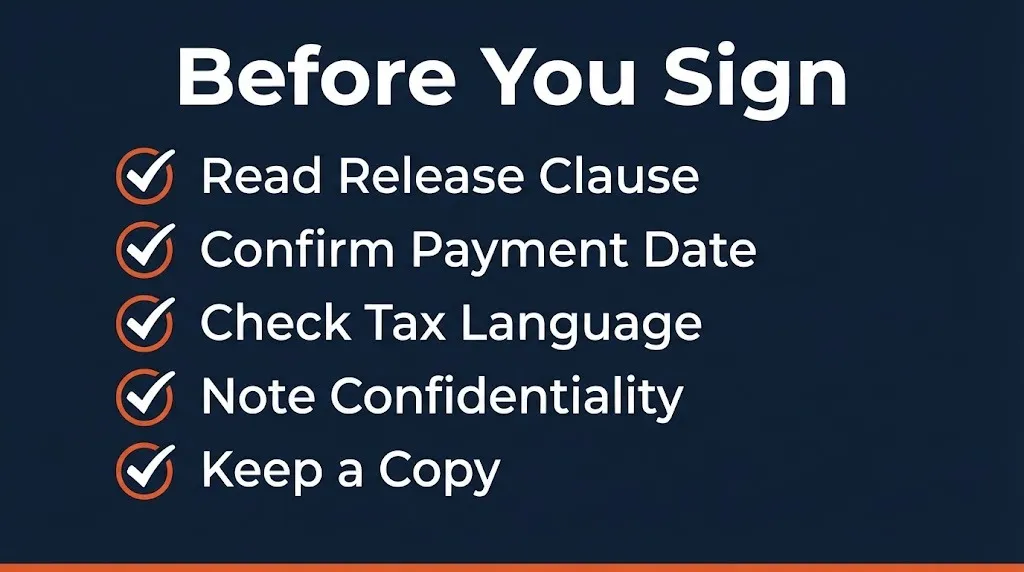
Here is a pre-signing checklist.
- Read the release clause fully.
- Confirm the payment amount and due date.
- Check who pays attorney fees and costs.
- Look for tax reporting language.
- Find the governing law and forum clause.
- Check for a revocation or cooling-off period.
- Confirm what happens if payment is late.
- Note any ongoing obligations like confidentiality or cooperation.
If any term is unclear, ask the other side to clarify in writing. If they refuse, that is a signal. A fair settlement agreement should survive your questions.
Treat the signing process like a home closing. You would not sign mortgage documents without reading them. Do not sign a release without reading it either.
Can I negotiate a settlement agreement?
Yes, you can negotiate a settlement agreement. Everything in it is negotiable until signed. The payment amount, the release scope, the confidentiality terms, the payment date, all of it.
The other side may say the agreement is standard. That usually means it is standard for them, not for you. The first draft of any settlement agreement favors the party who drafted it. Your job is to push back where the terms hurt you.
Common negotiation points include a shorter confidentiality period, a narrower release, faster payment, tax language, and the right to respond truthfully to government investigations.
You can negotiate directly or through a lawyer. If the settlement is large or involves a broad release, a lawyer’s review is worth the cost. Many lawyers offer flat-fee settlement document review.
What happens after I sign a settlement agreement?
After you sign a settlement agreement, the other party typically has a set time to pay. That period is written in the agreement. It might be 30 days, 60 days, or another number.
In a class action, signing is not the final step. The judge still must approve the settlement. Payments go out after final approval and any appeals. That can take months.
In an individual settlement, the timeline is usually shorter. The agreement states when payment is due. If the other side misses the deadline, you may have a breach of contract claim.
Here is the typical post-signing sequence for individual settlements.
- Both parties sign.
- Any revocation period runs.
- The payment deadline arrives.
- Payment is issued by check, wire, or direct deposit.
- The case is dismissed with prejudice.
- The file closes.
Mark the payment date on your calendar. If it passes without payment, act.
Are settlement agreements taxable?
Settlement agreements may be taxable or tax-free depending on what the payment is for. The general rule is that payments for physical injuries or physical sickness are not taxable. Payments for lost wages, emotional distress not tied to physical injury, punitive damages, and interest are taxable.
The IRS looks at the origin of the claim. If the settlement resolves a physical injury claim, the compensatory portion is usually excluded from income. If it resolves an employment claim for lost wages, that portion is taxable as wages.
Here is a simplified table based on IRS guidance.
| Settlement Type | Tax Treatment |
|---|---|
| Physical injury or sickness | Generally not taxable |
| Lost wages | Taxable as income |
| Emotional distress, no physical injury | Taxable |
| Punitive damages | Taxable |
| Interest on settlement | Taxable |
This is a high-level overview, not tax advice. Ask a tax professional about your specific agreement.
What is a confidential settlement agreement?
A confidential settlement agreement is one that requires the parties, usually the plaintiff, to keep the terms and sometimes the existence of the settlement private. The confidentiality clause prohibits discussing the amount, the facts, or the resolution.
Confidentiality is common in employment and business disputes. It is less common in personal injury cases and rare in class actions. Class action settlements are public by default.
The clause may include liquidated damages for breach. If you violate confidentiality, you may owe money back. Read the clause to understand the scope and duration.
Confidentiality does not usually prevent you from reporting a crime, testifying under subpoena, or filing a tax return. But the language matters. Ask before signing if you have doubts.
Key Takeaway: Confidentiality clauses are negotiable. If silence is not something you want to live with, say so before you sign.
What is the difference between a settlement agreement and a judgment?
A settlement agreement is a private contract. A judgment is a court order. Both resolve cases, but they differ in enforcement and appeal rights.
A judgment comes after a judge or jury decides the case. It is a public record. The losing party can appeal. A settlement agreement avoids trial and usually waives appeal rights.
Enforcing a judgment requires post-judgment collection. Enforcing a settlement agreement may require a separate breach of contract lawsuit if the other side does not pay.
The table below summarizes the differences.
| Feature | Settlement Agreement | Judgment |
|---|---|---|
| Source | Negotiated contract | Court or jury decision |
| Public record | Usually private | Public docket |
| Appeal rights | Usually waived | Available |
| Enforcement | Breach of contract claim | Post-judgment collection |
| Time to resolve | Faster | Slower |
For most people, a settlement agreement is faster and less risky than trial. But it is still a legal document with real consequences.
How do I know if a settlement agreement is fair?
You know a settlement agreement is fair when the payment covers your economic losses plus some premium for inconvenience, the release is no broader than the claims you intend to settle, and the timeline is reasonable.
Fairness is not an exact formula. It is a comparison. What would a judge or jury likely award? What would it cost to keep litigating? What is the risk you lose and get nothing? A fair settlement sits somewhere in that range.
Here is a simple fairness test.
- Add your economic damages like medical bills and lost wages.
- Add a reasonable amount for pain or inconvenience if allowed.
- Subtract litigation risk and time.
- Compare the result to the settlement offer.
- Ask if the release gives up more than the payment buys.
If the settlement is a fraction of your economic damages, it may not be fair. If it covers your losses and closes the case quickly, it may be a good deal.
What is a settlement agreement in a personal injury case?
A settlement agreement in a personal injury case is a contract where the injured person releases the at-fault party in exchange for money. It usually covers medical bills, lost wages, and pain and suffering.
Personal injury settlements are often negotiated with an insurance company. The agreement releases the insured and the insurer. The injury victim gives up all claims arising from the incident.
Future medical care is a key issue. If you settle before you know the full extent of your injuries, you may be underpaid. That is why many personal injury lawyers recommend waiting until maximum medical improvement before settling.
The release in a personal injury settlement is usually narrow. It covers the specific accident, not every claim you have against the other person. Read it to confirm.
How are settlement agreements enforced?
Settlement agreements are enforced through a breach of contract lawsuit or a motion to enforce in the original case. If the other side does not pay, you can ask the court to order payment.
In a class action, the court retains jurisdiction to enforce the settlement terms. The settlement administrator and the parties report to the judge. If something goes wrong, the court can intervene.
In an individual settlement, enforcement may mean filing a new lawsuit for breach of contract. That is slower and more expensive than the settlement itself. That is why the payment timeline matters before you sign.
The best enforcement strategy is prevention. Get a clear payment deadline. Confirm the payment method. Ask what happens if payment is late. Put it all in writing.
What happens if I breach a settlement agreement?
If you breach a settlement agreement, the other side may sue you for breach of contract. They may also seek liquidated damages if the agreement includes a clause for that. In some cases, breaching confidentiality can mean repaying part or all of the settlement.
The consequences depend on the clause you violated and the remedies written into the agreement. A confidentiality breach might trigger a specific dollar penalty. A release breach might mean the other side can claw back the payment.
Courts generally enforce settlement agreements strictly. That is the point of the document. If you sign it, you are expected to follow it.
What is a settlement agreement in a divorce case?
A settlement agreement in a divorce case is a contract that divides assets, sets support, and resolves custody or visitation terms. It is also called a marital settlement agreement or separation agreement.
The agreement is submitted to the family court and becomes part of the divorce decree if approved. It covers property division, spousal support, child support, and parenting time.
Divorce settlement agreements are some of the most detailed contracts ordinary people sign. They run dozens of pages. They reference tax codes, retirement plans, and real estate.
The judge reviews the agreement for fairness, especially on child-related issues. Child support cannot be bargained away. The court protects the child’s interests.
Key Takeaway: A settlement agreement is only as good as its clarity. Vague terms in any case type, divorce, employment, injury, or class action, create future fights.
How do I read a settlement agreement if I cannot afford a lawyer?
If you cannot afford a lawyer, you can still read a settlement agreement carefully. Focus on the release, payment, deadline, confidentiality, and tax clauses. Those five sections carry most of the risk.
Here is a self-review method.
- Read the release clause first. Identify every claim you are giving up.
- Read the payment clause. Note the amount, method, and due date.
- Read the confidentiality clause. Know what you cannot say.
- Read the tax clause. Know if the payment is reported to the IRS.
- Look for a revocation period. Know if you can change your mind.
Some legal aid organizations offer free document review for low-income residents. Law school clinics may also help. Bar associations often have referral lines for reduced-fee consultations.
Do not sign a document you do not understand. A moment of patience before signing is cheaper than a year of litigation after.
What is the future of settlement agreements in 2026?
The future of settlement agreements in 2026 points toward more digital claims processing, more electronic signatures, and more class action settlements using online portals. The core legal rules are not changing. The delivery method is.
Courts now accept electronic signatures on most settlement documents. Settlement administrators use email and text for notice, though mail still matters for due process. Some class action settlements now offer digital payment options like Venmo, Zelle, or prepaid cards alongside checks.
But the fundamentals remain. A settlement agreement is still a contract. You still must read it. You still must meet deadlines. You still must keep your own records.
The single most important habit in 2026 is the same as 1996. Read before you sign. Confirm the deadline. Keep a copy.
What Happens Next
If you received a settlement agreement: Read the release and payment clauses today.
If you are in a class action: Check the official settlement website for the claim deadline and form.
If you are negotiating: Put every term in writing. Confirm the payment date.
If you signed already: Calendar the payment date and watch for the check or deposit.
If you are unsure: Ask a lawyer or your state bar for a referral.
The settlement agreement you sign or the claim you file is only as strong as your attention to its details. Start with the document in front of you.