PFAS Lawsuit Settlement Amounts Per Person 2026: Verified Payouts, Eligibility, and Claim Deadlines
Quick Answer
- PFAS settlements are real and several have been court-approved.
- Per-person amounts range from modest municipal fund distributions to larger personal injury awards.
- No universal claim deadline exists. Each settlement has its own timeline.
You searched for “PFAS lawsuit settlement amounts per person” because you want a number. You may have heard about the 3M settlement or the DuPont cases. Maybe your water system sent a notice. Maybe you saw a law firm ad promising big payouts for PFAS exposure. You want to know what is real.
The honest answer is that per-person amounts are all over the map. Some class members in water district settlements receive small annual payments. Some individuals with documented kidney cancer or testicular cancer tied to PFAS exposure have settled for six and seven figures. The difference is proof, exposure history, and injury severity.
This article breaks down every major verified PFAS settlement, the per-person amounts that are confirmed, what remains pending, who may qualify, and what you should do if you think you have a claim in 2026.
| The Facts | |
|---|---|
| Primary Settlements | 3M, DuPont, Chemours, Tyco, BASF |
| Total Verified Funds | Billions of dollars across multiple settlements |
| Per-Person Range | Varies from small municipal distributions to large individual awards |
| Key Claim Types | Water district, personal injury, medical monitoring, property damage |
| Main Deadline | Varies by settlement; some closed, some open |
| Administrator | Multiple, case-specific |
| Proof Needed | Exposure history, medical records, water bills, or property tests |
Are PFAS lawsuit settlements real?
Yes, PFAS lawsuit settlements are real. Multiple corporations have agreed to pay billions of dollars to resolve claims over PFAS contamination. These are not rumors or law firm hype. Court records confirm the settlements.
The largest settlements involve 3M, DuPont, Chemours, and other chemical manufacturers. The funds address water system contamination, personal injury claims, and environmental cleanup. Some settlements have already paid out. Others are still moving through the claims process.
PFAS stands for per- and polyfluoroalkyl substances. These chemicals are used in firefighting foam, nonstick cookware, water-resistant clothing, and many industrial products. They persist in the environment and in the human body for years. That persistence is why they are called “forever chemicals.”
The litigation is massive. It spans federal multidistrict litigation, state courts, and individual personal injury cases. The settlements are real, but the per-person amounts depend on which case you are in.
What are PFAS lawsuit settlement amounts per person?
PFAS lawsuit settlement amounts per person vary from less than a hundred dollars in some water district cases to millions in documented personal injury cases. There is no single average that applies.
Here is a table of verified settlement categories and the range of per-person outcomes reported.
| Settlement Category | Per-Person Range |
|---|---|
| Municipal water district allocations | Varies by system size, not per individual |
| Personal injury, kidney cancer | High six figures to seven figures reported |
| Personal injury, testicular cancer | High six figures to seven figures reported |
| Medical monitoring class members | Modest payments or free testing |
| Property damage, private wells | Varies by property value and contamination level |
These ranges come from public settlement data and court filings. They are not guarantees. Your amount, if any, depends on your exposure, your injury, and the specific settlement terms.
What is the 3M PFAS settlement per person?
The 3M PFAS settlement does not have a single per-person amount. The settlement provides funds to public water systems, not directly to individuals in most cases. The per-person equivalent depends on how your water system uses the allocation.
3M agreed to pay up to $12.5 billion over multiple years to public water systems that detected PFAS in their water. The money reimburses treatment costs and future monitoring. It is not a direct payment to individual residents.
If your water system is part of the 3M settlement, you may not receive a personal check. The water system receives the funds and uses them to upgrade treatment or reduce rates. Some systems may distribute credits, but that is case-specific and not automatic.
The 3M settlement was approved in 2024. Payments to water systems are ongoing through the settlement’s timeline. Individual residents with personal injury claims against 3M may pursue separate cases, but those are not part of the water system settlement.
Key Takeaway: The 3M PFAS settlement is primarily a water system reimbursement, not a direct per-person payout. Do not expect a check just because your water had PFAS.
What is the DuPont PFAS settlement per person?
The DuPont PFAS settlement amounts per person depend on whether you are in the earlier PFOA personal injury cases or the broader class actions. The most cited DuPont case involved PFOA contamination from the Washington Works plant in West Virginia.
In that litigation, individual plaintiffs with documented diseases settled for amounts that were confidential in many cases. Some public reports and court filings indicated settlements ranging from hundreds of thousands to millions for specific cancers and other injuries. A separate medical monitoring settlement covered thousands of residents.
Here is what is verified.
- DuPont and Chemours agreed to settle the multidistrict litigation for $1.185 billion in 2023.
- The settlement covered water providers and certain personal injury claims.
- Individual personal injury amounts were not uniform.
- A separate $4 billion settlement between DuPont, Chemours, and Corteva addressed PFAS liabilities.
The per-person amount in a DuPont personal injury case depends on medical records, exposure history, and causation evidence. There is no flat rate.
What are PFAS personal injury lawsuit settlement amounts?
PFAS personal injury lawsuit settlement amounts are the highest per-person payouts in the PFAS litigation. Documented cases involving kidney cancer, testicular cancer, ulcerative colitis, and other serious conditions have settled for substantial sums.
The amounts are not published in a single database. Many are confidential. But some bellwether cases in the multidistrict litigation produced public settlement figures or trial verdicts that later settled.
Reported bellwether outcomes include a $40 million jury verdict in one case and a $22 million verdict in another, both against DuPont. Those verdicts were later resolved through confidential settlements. They are outliers, not averages.
The average personal injury settlement is lower than the outlier verdicts. But for someone with a documented PFAS-linked cancer and strong exposure evidence, a six-figure settlement is realistic. A seven-figure settlement is possible but not common.
How much can I get from a PFAS lawsuit?
You can get anywhere from nothing to millions in a PFAS lawsuit, depending on your category. Most people get nothing because most people are not part of a certified class or a personal injury case with strong evidence.
Here is a practical table by claim type.
| Claim Type | Realistic Outcome |
|---|---|
| Municipal water system user | No direct payment in most cases |
| Private well owner with contamination | Possible property damage or filtration reimbursement |
| Firefighter with documented PFAS illness | Potentially significant personal injury claim |
| Factory worker with high exposure | Potentially significant personal injury claim |
| Resident with a PFAS-linked cancer | Potentially significant personal injury claim |
| Resident with no illness, only worry | Usually no individual payment |
The key variable is documented harm. PFAS exposure alone is not enough for most individual claims. You need a diagnosed condition linked to PFAS and evidence of significant exposure.
Key Takeaway: PFAS lawsuits pay the most to people with documented illness and heavy exposure. Everyone else should temper expectations.
Reality Check: No legitimate PFAS settlement asks you to pay a filing fee. No one texts you out of nowhere about a PFAS payout. Law firm ads promising “average PFAS settlements of $250,000” are describing personal injury cases with strong evidence, not water bill credits. Ask what proof is required before believing any number.
How do I file a PFAS lawsuit claim?
Filing a PFAS lawsuit claim depends on which case you are in. There is no one form. Some claims go through settlement administrators. Some go through individual law suits filed by your attorney.
Here are the general steps for a personal injury PFAS claim.
- Gather your medical records showing a diagnosed condition.
- Document your exposure history with dates, locations, and water sources.
- Obtain your water test results if available.
- Consult a lawyer with PFAS litigation experience.
- Determine which settlement or lawsuit applies to your facts.
- File the appropriate claim or complaint before the deadline.
- Preserve all medical and exposure evidence.
For water district claims, the process is different. The water system files the claim, not you individually. You may not have a direct role.
What is the PFAS lawsuit deadline?
There is no single PFAS lawsuit deadline. Each settlement and each personal injury case has its own statute of limitations and court-ordered deadlines.
The 3M water system settlement had a claim deadline for eligible water systems. That deadline has passed. The DuPont and Chemours settlements have their own timelines. Personal injury cases are governed by state statutes of limitations, which vary from one to six years depending on the state and the injury.
Here is what you need to know.
- Water system claims: deadlines largely passed or are set by the settlement.
- Personal injury claims: state statute of limitations controls.
- Medical monitoring claims: deadlines set by the specific settlement.
- Property damage claims: state law controls.
If you think you have a PFAS claim, do not wait. The clock may already be running.
What is the PFAS lawsuit update for 2026?
The PFAS lawsuit update for 2026 is that settlements are moving forward, new cases are being filed, and the multidistrict litigation continues to produce bellwether outcomes. No new global settlement has replaced the existing structure.
The major verified developments include ongoing payments from the 3M settlement, distribution under the DuPont and Chemours settlements, and new state-level lawsuits against manufacturers. The Environmental Protection Agency has also designated certain PFAS chemicals as hazardous substances, which affects cleanup litigation.
Individual personal injury cases continue to work through the court system. Bellwether trials are scheduled or ongoing. Settlements in those cases influence future negotiations.
The landscape is active. But it is not a single lawsuit with a single payout. It is a sprawling set of cases with different rules.
Who qualifies for a PFAS settlement?
Qualifying for a PFAS settlement depends on the specific settlement. Water system settlements qualify municipal and public water providers. Personal injury settlements qualify individuals with documented illnesses and exposure. Property damage settlements qualify property owners with contaminated wells.
Here is a qualification checklist by category.
- Water system: You must be a public water system with PFAS detections.
- Personal injury: You must have a diagnosed PFAS-linked condition and exposure history.
- Medical monitoring: You must have been exposed and be part of the certified class.
- Property damage: You must own property with PFAS contamination.
Most people qualify for nothing. That is not a scam. It is how class actions and mass torts work. The class definition and injury proof control who gets paid.
What proof do I need for a PFAS claim?
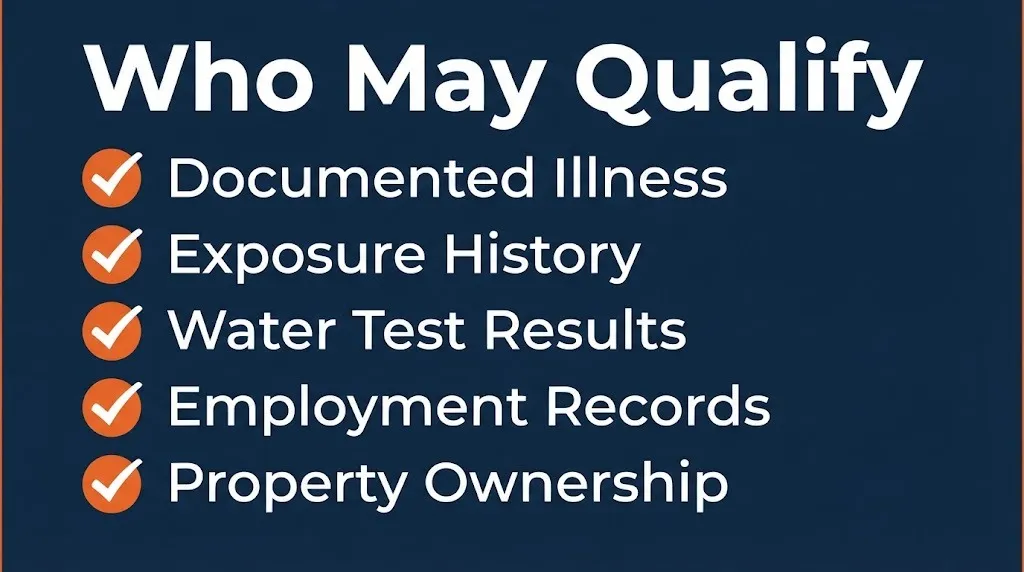
The proof you need for a PFAS claim is medical records, exposure history, water test results, and sometimes employment or military service records. The exact proof depends on the claim type.
For personal injury claims, the most important proof is a medical diagnosis. Without a diagnosed condition, you do not have a personal injury claim. A doctor must link your condition to PFAS exposure, and your lawyer must build causation evidence.
For property damage claims, proof includes well test results, property records, and evidence of contamination. For water system claims, proof includes testing data and treatment cost records.
Here is a general evidence list.
- Medical records with diagnosis
- Water test results showing PFAS levels
- Employment or military records showing exposure
- Property ownership records
- Treatment invoices for filtration systems
- Communication with water providers about contamination
Keep everything. Digital copies are fine. The more documentation you have, the stronger your claim.
Key Takeaway: PFAS claim value follows proof. A diagnosis plus exposure evidence is worth more than worry alone.
What are PFAS forever chemicals?
PFAS forever chemicals are a group of synthetic compounds that do not break down in the environment or the human body. They accumulate over time. They are linked to several health conditions including certain cancers, thyroid disease, immune system effects, and developmental issues.
The name “forever chemicals” comes from their persistence. They are used in firefighting foam, nonstick coatings, water-resistant fabrics, food packaging, and industrial processes. They have been found in drinking water, soil, wildlife, and human blood.
The litigation targets manufacturers who knew about the risks and did not warn the public. DuPont, 3M, Chemours, and others have faced claims over contamination near plants, military bases, and fire training sites.
What is the PFAS water contamination settlement?
The PFAS water contamination settlement is a set of agreements in which chemical manufacturers pay public water systems for treatment and monitoring costs. The largest is the 3M settlement worth up to $12.5 billion. DuPont, Chemours, and Corteva have a separate $1.185 billion settlement.
These settlements do not usually pay individual residents. They pay the water systems. The systems use the money to install filtration and test for PFAS.
If you drink water from a system that received settlement funds, you benefit indirectly through cleaner water. You do not get a direct check in most cases. That is the most misunderstood part of the PFAS litigation.
What is the PFAS firefighter foam lawsuit?
The PFAS firefighter foam lawsuit involves aqueous film-forming foam, or AFFF, used in firefighting and military training. Firefighters and military personnel exposed to AFFF have filed personal injury claims over cancers and other illnesses.
The AFFF litigation is a major part of the federal multidistrict litigation. Bellwether cases have produced large verdicts and settlements. Firefighters with documented PFAS-linked cancers are among the highest-value individual claimants.
If you are a firefighter or veteran with a PFAS-linked diagnosis, you may have a stronger claim than a typical resident. Your exposure history is documented through employment and service records.
What are the PFAS settlement amounts for water systems?
The PFAS settlement amounts for water systems are allocations based on system size, contamination level, and treatment costs. The 3M settlement provides funds through a formula. Not every system receives the same amount.
A small rural water district may receive a few hundred thousand dollars. A large metropolitan system may receive millions. The money is meant to reimburse past costs and fund future treatment, not to enrich the system.
Residents do not receive a per-person share. The system receives the allocation and spends it on infrastructure. That is the verified structure of the settlement.
What happens if I drank PFAS-contaminated water?
If you drank PFAS-contaminated water, you may be at increased risk for health effects. But drinking the water alone does not automatically qualify you for a settlement. You need a diagnosed condition and proof of exposure for a personal injury claim.
Here is what you can do.
- Ask your water system for test results.
- Talk to your doctor about PFAS blood testing and health monitoring.
- Document your water source and dates of exposure.
- Consult a PFAS attorney if you have a diagnosis.
- Watch for medical monitoring settlements that may apply to your community.
The medical monitoring route is often the most realistic for exposed residents without a current illness. Those settlements provide testing and monitoring, not large cash payments.
What is the PFAS medical monitoring settlement?
A PFAS medical monitoring settlement provides free or low-cost medical testing for people exposed to PFAS. It does not usually pay cash. Instead, it funds blood tests, doctor visits, and ongoing health screening.
The DuPont medical monitoring settlement in the West Virginia case is the best-known example. It covered thousands of residents and provided testing for PFOA-related health markers.
Medical monitoring is a preventive benefit, not a payout. If you are healthy but exposed, this is the most likely benefit available to you.
Are PFAS settlements taxable?
PFAS settlements may be taxable depending on the payment’s purpose. Personal injury compensation for physical injury or sickness is generally not taxable. Property damage payments are usually not taxable if they reimburse a loss. Punitive damages and interest are taxable.
The IRS rules are the same for PFAS settlements as for other litigation settlements. The origin of the claim controls the tax treatment.
If you receive a PFAS settlement, ask a tax professional about your specific payment. The administrator may issue a tax form depending on the payment amount and character.
Key Takeaway: PFAS settlement tax treatment depends on what the payment is for. Physical injury payments are usually excluded. Other payments may be taxable.
What is the PFAS lawsuit settlement update for personal injury cases?
The PFAS lawsuit settlement update for personal injury cases is that bellwether trials and settlements continue to shape the litigation. Large verdicts in individual cases have pushed defendants toward settlement in some categories. But no global personal injury settlement covers all claimants.
Personal injury cases move individually. Each plaintiff must prove exposure and causation. That makes the process slower than a class action but potentially more valuable per person.
If you have a serious illness and strong exposure evidence, your case may be worth pursuing now. If you wait, you may run into statute of limitations issues.
How long do PFAS lawsuits take?
PFAS lawsuits take years. Class actions and multidistrict litigation move slowly. Personal injury cases can take three to five years or longer from filing to resolution.
The 3M water system settlement took years from filing to approval. The DuPont litigation spans decades from the original PFOA cases to the current settlements. Bellwether trials are scheduled years in advance.
If you are hoping for a quick check, PFAS litigation is not that. It is a long process with uncertain outcomes.
What Happens Next
If you have a diagnosed PFAS-linked illness: Consult a PFAS attorney immediately. Your statute of limitations may be running.
If you drank contaminated water but are healthy: Ask your doctor about medical monitoring and watch for class actions in your area.
If your water system received settlement funds: The system will use the money for treatment. You may see water quality improvements over time.
If you own a contaminated well: Get a water test and property assessment now.
If you are just curious: The next milestone is continued bellwether outcomes in the AFFF litigation and state-level cases against manufacturers.
The single most important date is your own state’s statute of limitations deadline for personal injury claims. That date is personal to you, not published on any national calendar.