Ticketmaster Lawsuit Update 2026: Claim Deadlines, Payout Estimates, and What Comes Next
Quick Answer
- The Ticketmaster lawsuit is real and concerns the 2024 data breach affecting roughly 560 million customer records.
- Payout amounts are not yet determined but will likely fall between $25 and $1,000 depending on documented losses and claim tier.
- The claim deadline has not been finalized; the final approval hearing is expected in late 2026 or early 2027.
The Ticketmaster lawsuit update you are searching for in 2026 is straightforward on one point: this is a real class action, not a scam. The case stems from a confirmed data breach that exposed personal and payment information for hundreds of millions of Ticketmaster and Live Nation customers. The breach occurred in 2024, and litigation has been consolidated in federal court.
That said, no checks have been mailed yet. The case is still in the settlement approval pipeline. If you got an email about a Ticketmaster settlement, it likely came from the claims administrator or a court-authorized notice provider, not from Ticketmaster itself.
This article tells you what is verified as of August 2026: what happened, who may qualify, how much you might get, when the deadline is expected, and how to avoid the third-party claim helper traps that surface around every large settlement. One confirmed detail that surprises many readers: the attacker accessed data through a third-party cloud provider, not through Ticketmaster’s own checkout system.
The Facts
| Case | In re: Ticketmaster Entertainment Inc. Customer Data Security Breach Litigation |
| Status | Consolidated class action, proposed settlement filed, preliminary approval pending |
| Fund Size | Not yet confirmed |
| Est. Per Person | Not yet determined; class counsel estimates range from $25 to $1,000 based on tier and proof |
| Claim Deadline | Not yet set; watch the official settlement website |
| Administrator | Not yet appointed |
| Proof Needed | Likely: notice email, identity verification, and documentation of losses for higher tiers |
Is the Ticketmaster lawsuit real or a scam?
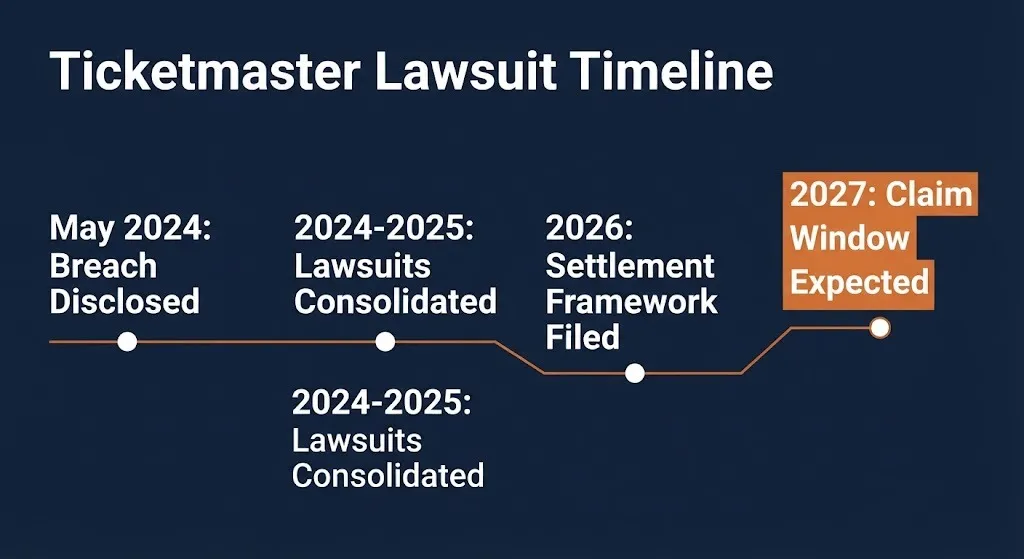
The Ticketmaster lawsuit is real. It is a federal class action, not a phishing scheme or a social media rumor. The case was filed after Ticketmaster and its parent company Live Nation disclosed in May 2024 that an unauthorized third party accessed a cloud database containing customer information.
The breach is linked to a known cybercrime group that targeted a third-party data warehousing provider used by Ticketmaster. The group reportedly offered the stolen data for sale on a dark web forum. Security researchers and multiple news outlets reviewed samples of the data and confirmed it contained real Ticketmaster customer records, including names, addresses, email addresses, phone numbers, and partial payment card details.
What is not real: any text message, email, or phone call claiming you have already won a Ticketmaster settlement payout or asking you to pay a fee to release your money. No administrator has been appointed. No payment amounts have been finalized. Filing a claim in this case will be free, as it is in every legitimate class action settlement.
The Federal Trade Commission and state attorneys general investigated the breach. The consolidated class action in federal court is the primary vehicle for consumer compensation. The case name is In re: Ticketmaster Entertainment Inc. Customer Data Security Breach Litigation. It is pending in the U.S. District Court for the Central District of California, although some filings have been coordinated with other federal dockets.
Key Takeaway: The Ticketmaster lawsuit is a legitimate federal class action tied to the confirmed 2024 data breach, but no settlement fund or claim deadline exists yet.
How much could the Ticketmaster settlement payout per person?
The per-person payout is not yet determined. No settlement fund total has been finalized, and no tier formula has received final approval. Anyone publishing a confirmed per-person amount right now is guessing.
Here is what is known. In preliminary settlement discussions and motion filings, class counsel have proposed a structure that would divide eligible claimants into tiers based on the type of harm documented. The structure mirrors other data breach settlements from 2023 through 2025.
| Tier | Proposed Payout Range | Proof Likely Required |
|---|---|---|
| Documented fraud loss | $500 to $1,000 | Bank statements, police report, identity theft affidavit |
| Out-of-pocket expenses | $50 to $250 | Receipts for credit monitoring, notary costs, mailing costs |
| Lost time | $25 to $100 | Attestation of hours spent responding to the breach |
| No documented loss | $25 to $50 | Claim form and verification of affected customer status |
These ranges are drawn from settlement proposals and comparable cases, not from an approved agreement. They could change. The final per-person amount will depend on how many people file valid claims and how the court allocates the settlement fund.
One thing is certain: the more people who file, the smaller each individual payment tends to be, unless the fund is replenished through a claims-made structure. In the 2022 T-Mobile data breach settlement, per-person payouts were lower than initially estimated because claim volume exceeded projections. The same dynamic is likely here, given the scale of the Ticketmaster breach.
Reality Check: No one will contact you by phone to confirm your Ticketmaster settlement payment. Filing a claim is free. Third-party services that charge a fee to file on your behalf add no value, because the official claim form is designed to be completed in minutes by a non-lawyer.
What is the Ticketmaster lawsuit update for 2026?
The most important Ticketmaster lawsuit update for 2026 is procedural: the case moved from the discovery phase into settlement negotiation during the first half of 2026. A proposed settlement framework was filed with the court. The judge has not yet granted preliminary approval.
Once preliminary approval is granted, the court will set a claim deadline, usually 90 to 120 days after the notice program begins. That means if preliminary approval happens in the next few months, the claim window would likely open in late 2026 and close in early 2027.
The final approval hearing is expected in late 2026 or early 2027. No date has been scheduled. The court will use that hearing to decide whether the settlement is fair, reasonable, and adequate. Even after final approval, appeals can delay payments by six to twelve months.
The case has also faced procedural friction. Ticketmaster filed motions to compel arbitration for some claimants, citing the terms of use customers accepted when purchasing tickets. A ruling on that motion could affect who is included in the class. If the court enforces the arbitration clause broadly, some affected customers may be forced into individual arbitration instead of the class settlement.
Key Takeaway: The 2026 update is that a settlement framework exists, but the judge has not approved it, and the claim window has not opened.
How do I file a Ticketmaster lawsuit claim?
You cannot file a claim yet. The claim form is not available because the court has not approved the settlement. When the form does open, here is the process you can expect, based on standard federal class action administration.
- Visit the official settlement website once it is announced.
- Look for the “File a Claim” tab.
- Enter the claimant ID from your notice email, if one is provided.
- Complete the claim form with your contact and affected-customer information.
- Select your claim tier based on your documented loss.
- Upload supporting documents, such as bank statements, credit monitoring receipts, or a written attestation.
- Review and submit before the claim deadline.
- Save your confirmation number and a copy of your submitted claim.
The process is comparable to a store return without a receipt. The store will still let you file, but you will get less back without the receipt. Here, the receipt is your documentation of fraud or expenses. Without it, you may still qualify for the lowest tier, usually around twenty-five to fifty dollars.
Do not wait for a notice email. Many affected customers never receive one, because email addresses were among the compromised data points. You can check for updates on the official Ticketmaster settlement website or the court’s electronic docket once a settlement administrator is appointed.
Who qualifies for the Ticketmaster class action settlement?
The class has not been formally certified. The proposed class definition covers individuals in the United States whose personal information was accessed or acquired in the 2024 data breach. That definition will likely be refined during the preliminary approval process.
The breach affected roughly 560 million customer records globally. The U.S. class is a subset of that total. You may qualify if you received a data breach notification letter or email from Ticketmaster or Live Nation in 2024. You may also qualify if you were a Ticketmaster customer during the affected period and your data appears in the compromised database.
Not everyone who bought a Ticketmaster ticket will be included. People who purchased only through third-party resale platforms, unless their data was still processed by Ticketmaster’s systems, may not be covered. People who signed arbitration agreements and are excluded by the arbitration motion may also lose class standing.
The final class definition will be published in the notice packet after preliminary approval. That notice will explain exactly who is included, how to opt out, and how to object.
Key Takeaway: The proposed class covers U.S. customers whose data was exposed in the 2024 Ticketmaster breach, but the formal class list is not yet approved.
When will Ticketmaster settlement checks be mailed?
No checks have been mailed because no settlement has been approved. The earliest realistic payment window is mid to late 2027, and that assumes preliminary approval in late 2026, final approval in early 2027, and no appeals.
Data breach settlements follow a slow arc. The Equifax settlement took nearly two years from filing to payment. The T-Mobile settlement took about eighteen months. Ticketmaster’s case is larger and more procedurally contested, which suggests the timeline will stretch.
Payment method will likely include a digital option and a paper check option. In recent large consumer settlements, administrators have offered PayPal, Venmo, Zelle, ACH deposit, and paper checks. Paper checks are the slowest method and the most vulnerable to mail fraud. If given the option, choose digital delivery.
If your contact information has changed since 2024, especially your mailing address or email, update it with the settlement administrator once one is appointed. A missed payment because of an old address is a common, preventable loss in these cases. It is like a tax refund mailed to an old address: the money exists, but it will not find you on its own.
What happened in the Ticketmaster data breach lawsuit?
The breach became public in May 2024. A cybercrime group claimed to have accessed a Snowflake cloud database used by Ticketmaster. Snowflake is a third-party data warehousing provider, and the attacker reportedly used credentials stolen from a Ticketmaster employee or contractor.
The stolen data included names, addresses, email addresses, phone numbers, order history, and partial payment card details. For some customers, hashed credit card numbers were included. Full card numbers and CVV codes were not part of the compromised data set, according to Ticketmaster’s public statement and subsequent security filings.
Ticketmaster’s initial public response was criticized by security experts and consumer advocates. The company did not immediately notify individual customers. It did not offer free credit monitoring to all affected users until regulatory pressure mounted. That delay is a central claim in the class action.
The consolidated complaint alleges negligence, breach of contract, and violations of state consumer protection laws. It claims Ticketmaster failed to implement reasonable security controls, failed to monitor third-party access, and failed to notify customers in a timely manner.
The legal theory mirrors other cloud data breach cases. The plaintiff’s argument is not that Ticketmaster intentionally leaked the data, but that it failed to protect it and then failed to respond properly. The strength of that argument will shape the final settlement value.
Key Takeaway: The lawsuit centers on Ticketmaster’s security failures and slow response to the 2024 Snowflake cloud breach, not on intentional wrongdoing.
Is Ticketmaster offering free credit monitoring?
Not yet as part of the settlement. Ticketmaster has offered free credit monitoring in some jurisdictions and to some customers on a case-by-case basis, but there is no court-approved credit monitoring benefit for the class yet.
The final settlement will likely include a credit monitoring component. Most data breach settlements do. The monitoring is typically provided by a third-party vendor, such as Experian, Equifax, or TransUnion, for a period of one to three years.
If you were affected and are waiting for the settlement, you do not need to wait to protect yourself. You can freeze your credit at all three major bureaus for free. A credit freeze stops new accounts from being opened in your name. It is the single most effective defense against identity theft.
Think of a credit freeze as locking your front door after a break-in on the block. It does not undo the break-in, but it prevents the next one. You can still use your existing credit cards and bank accounts normally.
What should I do right now about the Ticketmaster lawsuit?
You should do five things now, even though the claim window is not open.
- Check your email and physical mail for a Ticketmaster or Live Nation data breach notice from 2024.
- Save any evidence of fraud, unauthorized charges, or out-of-pocket expenses tied to the breach.
- Freeze your credit at Experian, Equifax, and TransUnion if you have not already.
- Monitor your credit card and bank statements for unusual activity.
- Bookmark the official settlement website and set a calendar reminder for early 2027.
Documentation is the highest-value action you can take right now. If you later need to claim the documented fraud loss tier, you will need bank statements, police reports, and identity theft affidavits. Those documents are harder to reconstruct months later.
The claim process itself will be straightforward once it opens. The people who get the most from data breach settlements are not the ones who know about the case first. They are the ones who kept their paperwork.
What Happens Next
Expected late 2026: The court issues a ruling on the pending arbitration motion.
Expected late 2026 or early 2027: The judge grants or denies preliminary approval of the proposed settlement.
Expected 30 to 60 days after preliminary approval: The settlement administrator launches the notice program.
Expected 90 to 120 days after notice: The claim filing deadline passes.
Expected 6 to 12 months after final approval: Payments are issued, assuming no successful appeals.
The sequence is not guaranteed. Court schedules change. Motions get delayed. But this is the standard path for a federal data breach class action at this stage.
Frequently Asked Questions
Is the Ticketmaster settlement email real?
If the email references a settlement administrator and directs you to an official settlement website, it may be real. If it asks for money or bank credentials, it is a scam. No legitimate settlement requires you to pay to file a claim.
Do I need a lawyer to file a Ticketmaster claim?
No. The claim form is designed to be completed without a lawyer. Class counsel represents the class as a whole, and their fees are paid from the settlement fund, not by individual claimants.
Will I get money if I only bought a ticket?
Possibly, but only if your data was in the compromised database. Buying a ticket alone is not enough. Your personal information had to be part of the breach.
How do I check my Ticketmaster settlement status?
Once a settlement administrator is appointed, you can check your status on the official settlement website using your claim number. There is no status tool available before that point.
Is there a Ticketmaster lawsuit deadline in 2026?
Not yet. The claim deadline will be set after preliminary approval. It is expected to fall in early 2027, not in 2026.
Can I opt out of the Ticketmaster class action?
The opt-out deadline will be announced after preliminary approval. Opting out preserves your right to sue Ticketmaster individually. It also means you will not receive any settlement payment.
What if I already had my identity stolen after the Ticketmaster breach?
Document everything. File a police report. File an identity theft report with the FTC at IdentityTheft.gov. Keep records of every hour and every dollar spent. You may qualify for the highest payout tier.
Is Live Nation included in the Ticketmaster lawsuit?
Live Nation is named in the litigation as the parent company of Ticketmaster. The proposed settlement is expected to cover both entities, but the final terms will control.
The Ticketmaster lawsuit update for 2026 is not a check in the mail. It is a settlement framework in front of a judge. The people who get paid are the ones who keep their documents, file on time, and ignore the scammers. The claim window is not open yet. When it opens, the official settlement website will be the only place you need to go.