Diego Pavia Lawsuit 2026: NCAA Eligibility Case, Court Ruling, and What It Means for College Athletes
Quick Answer
- The Diego Pavia lawsuit is real and challenges NCAA rules that counted junior college seasons against Division I eligibility.
- No monetary settlement exists; the case seeks declaratory and injunctive relief, not traditional damages.
- No claim deadline applies because this is not a class action, but the ruling could affect current and future junior college transfers.
The Diego Pavia lawsuit is real. It is a federal antitrust challenge to NCAA eligibility rules. Pavia, a quarterback who played two seasons at a junior college before transferring to Vanderbilt and later New Mexico State, sued the NCAA in 2024. He argued the NCAA’s rule counting junior college seasons against his Division I eligibility violated antitrust law.
The case is not a class action. It is an individual lawsuit seeking a court order, not a settlement fund. No one is filing claims. No checks are being mailed. The case matters because its outcome could change eligibility rules for thousands of junior college transfers.
This article explains what is verified: the legal claims, the court’s preliminary ruling, who is affected, and what comes next. One fact that surprises many people: the court granted Pavia a preliminary injunction, allowing him to play another season, but the underlying legal question remains unresolved on appeal.
The Facts
| Case | Diego Pavia v. NCAA |
| Status | Active federal antitrust litigation, preliminary injunction granted, appeal pending |
| Fund Size | Not applicable; no monetary damages sought |
| Est. Per Person | No monetary payout; case seeks eligibility rule changes |
| Claim Deadline | None; not a class action |
| Administrator | None |
| Proof Needed | Not applicable to consumers |
Is the Diego Pavia lawsuit real or a scam?
The Diego Pavia lawsuit is real. It was filed in the U.S. District Court for the Middle District of Tennessee. The case name is Diego Pavia v. National Collegiate Athletic Association. The docket is public. The claims are specific and documented.
Pavia alleged the NCAA’s junior college eligibility rule violated federal antitrust law. The rule counted his two seasons at New Mexico Military Institute, a junior college, against his Division I eligibility clock. That left him with less time to play at the Division I level than players who spent their entire careers at four-year schools.
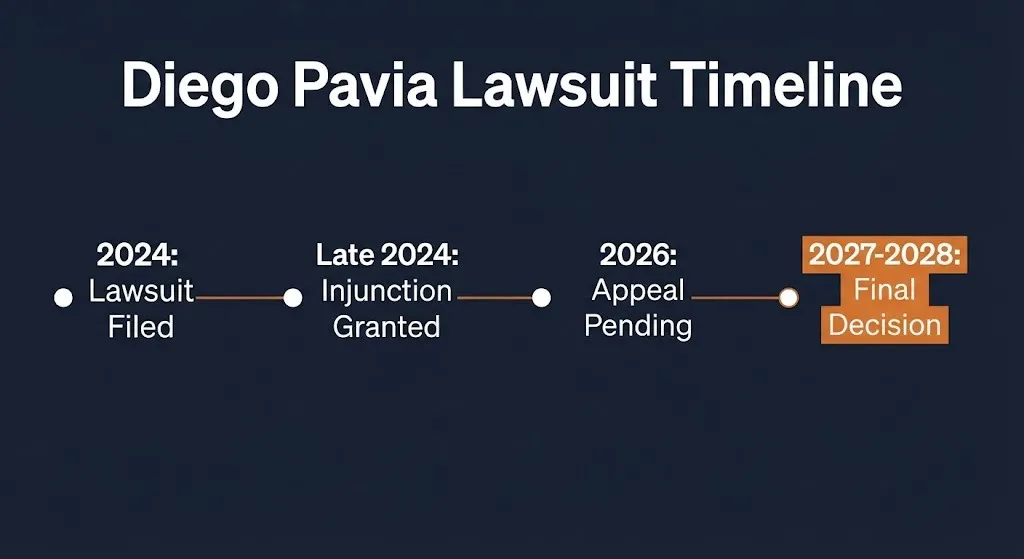
The court granted Pavia a preliminary injunction in late 2024. That ruling allowed him to play an additional season at Vanderbilt in 2025. The injunction does not end the case. The NCAA appealed. The underlying antitrust question is still being litigated.
What is a scam: any message or website claiming you can file a claim or receive money from the Pavia case. This is not a settlement case. No fund exists. No claim form exists. Anyone asking for your information or money related to this lawsuit is misleading you.
Key Takeaway: The Pavia lawsuit is a real antitrust case against the NCAA, but it is not a class action, has no settlement fund, and offers no monetary claims for the public.
What is the Diego Pavia lawsuit about?
The lawsuit challenges the NCAA’s rule that counts junior college seasons against a player’s Division I eligibility. Under NCAA rules, athletes have five years to play four seasons. For junior college transfers, the years spent at the junior college count against that clock.
Pavia played two seasons at New Mexico Military Institute. He then transferred to New Mexico State for two seasons and Vanderbilt for one. By the NCAA’s count, he had used four seasons of eligibility. He wanted one more year.
Pavia’s legal argument is that the rule is anticompetitive. He claims it restricts the market for college athletes by shortening their playing careers compared to athletes who began at four-year schools. The antitrust theory is that the NCAA’s eligibility rules unreasonably restrain competition in the labor market for college athletes.
The NCAA argued the rule is necessary to preserve competitive balance and academic integrity. The court rejected that argument at the preliminary injunction stage, finding Pavia was likely to succeed on the merits.
Key Takeaway: The case challenges whether the NCAA can count junior college seasons against Division I eligibility without violating antitrust law.
How much money could the Pavia lawsuit pay?
Nothing. The Pavia lawsuit does not seek monetary damages in the traditional sense. It seeks declaratory and injunctive relief, which means a court order declaring the rule illegal and preventing the NCAA from enforcing it.
The case is not a class action. There is no settlement fund. No athlete is receiving a check from this litigation. The value of the case is in its legal precedent, not in direct payments.
If Pavia ultimately wins, the practical effect would be rule changes. Junior college transfers could receive additional eligibility. That could affect thousands of athletes. But the change would come through NCAA rule amendments or further litigation, not through claim forms or settlement administrators.
The comparison is like a court ruling that changes a store’s return policy. The store does not send checks to every customer. It changes the policy going forward.
Reality Check: No one will contact you about a Pavia settlement payment. This case is about eligibility rules, not money. Third-party services claiming to register athletes for a Pavia payout are fraudulent.
Who does the Diego Pavia lawsuit affect?
The direct parties are Diego Pavia and the NCAA. But the ruling’s impact extends further. Junior college transfers in football, basketball, baseball, and other sports could benefit if the rule is struck down.
The preliminary injunction applied only to Pavia. But the legal reasoning could support similar claims by other athletes. If the final judgment invalidates the junior college eligibility rule, the NCAA would have to change its policy for everyone.
Here is who might be affected.
- Junior college athletes planning to transfer to Division I programs.
- Current Division I athletes who played at junior colleges and lost eligibility time.
- Coaches and programs that recruit junior college transfers.
- The NCAA, which would need to revise its eligibility rules.
The case does not affect high school recruits who go directly to Division I programs. It does not affect Division II or III eligibility rules. It is specific to the junior college transfer path.
Key Takeaway: The case directly affects Pavia but could change eligibility rules for all junior college transfers, not just quarterbacks or football players.
What is the current status of the Pavia lawsuit in 2026?
The case is active. The preliminary injunction remains in place as of August 2026, according to the public docket. Pavia played the 2025 season at Vanderbilt under that injunction. The NCAA’s appeal is pending before the U.S. Court of Appeals for the Sixth Circuit.
The appeal is the next major milestone. If the appellate court affirms the preliminary injunction, the case returns to the district court for a final decision on the merits. If the appellate court reverses, the injunction could be lifted while the case continues.
No trial date has been set. The case is still in the pretrial phase, with motions and discovery ongoing. A final resolution could take another one to two years.
The broader legal context matters too. The Pavia case is one of several antitrust challenges to NCAA rules. The outcome of those related cases could influence how the Sixth Circuit rules.
What did the court decide in the Pavia case?
The court decided Pavia was likely to succeed on his antitrust claim. The judge granted a preliminary injunction, which is a temporary order preventing the NCAA from enforcing the junior college eligibility rule against Pavia.
The court found the NCAA’s eligibility rules are subject to antitrust scrutiny. That was a significant ruling because the NCAA has historically argued its rules are exempt from antitrust law. The court applied the rule of reason, a legal standard that weighs the anticompetitive effects of a rule against its procompetitive justifications.
The court found Pavia showed a likelihood of success on the merits. It also found he would suffer irreparable harm without the injunction because his athletic career would end. The court was not persuaded by the NCAA’s arguments about competitive balance.
The ruling was preliminary, not final. It does not permanently invalidate the rule. But it signals the court’s view of the case.
Key Takeaway: The preliminary ruling favored Pavia and signaled that NCAA eligibility rules are subject to antitrust law, but the final outcome remains undecided.
What is the NCAA’s argument in the Pavia case?
The NCAA argues its junior college eligibility rule is necessary to preserve competitive balance and academic integrity. The organization claims the rule prevents schools from stacking rosters with older, more experienced junior college players.
The NCAA also argues its rules are exempt from antitrust scrutiny under the Supreme Court’s decision in NCAA v. Board of Regents and subsequent cases. The organization has historically maintained that amateurism rules are not commercial activity subject to antitrust law.
The court rejected that argument at the preliminary stage. The judge found the eligibility rules have commercial effects on the labor market for college athletes. That finding is consistent with the Supreme Court’s 2021 ruling in NCAA v. Alston, which held that NCAA rules limiting education-related benefits violated antitrust law.
The NCAA’s appeal will test whether the Alston reasoning extends to eligibility rules. That is the central legal question.
What does the Pavia case mean for college athletes?
If Pavia ultimately wins, the practical effect would be more eligibility for junior college transfers. Athletes who played two years at a junior college could still have four years of Division I eligibility, rather than losing those years against the clock.
That would be a significant change. It would make junior college a more attractive development path. It would also give athletes more control over their careers. A player who struggled to find a Division I opportunity out of high school could play two years in junior college without sacrificing future eligibility.
The change would not happen automatically. The NCAA could appeal a final loss. The organization could also revise its rules voluntarily to avoid further litigation. But the direction of the case points toward more athlete rights.
The case also reinforces the broader trend of antitrust law being applied to college sports. The NCAA has lost several high-profile antitrust cases in recent years. The Pavia case is part of that pattern.
Key Takeaway: A Pavia win would mean more eligibility for junior college transfers and another antitrust loss for the NCAA, but the change would come through rule revisions, not payments.
What is the difference between the Pavia case and a class action?
The Pavia case is an individual lawsuit. A class action bundles thousands of similar claims into one case. The Pavia case has one plaintiff, one defendant, and one legal question.
There is no class certification. No notice program. No claim form. No opt-out deadline. The distinction matters because people searching for a Pavia payout are misunderstanding the case.
The case could still have broad effects. A ruling in Pavia’s favor would likely prompt the NCAA to change its rules for everyone. But that change would come through policy, not through a settlement fund.
The comparison is like a Supreme Court decision on a consumer issue. The ruling changes the law for everyone, but no one receives a check.
What should college athletes do now about eligibility rules?
If you are a junior college athlete or a current Division I athlete who lost eligibility time due to junior college seasons, here is what you should do.
- Document your junior college and Division I seasons, including dates and eligibility decisions.
- Keep all communications from the NCAA, your school, and your conference about eligibility.
- Consult with your school’s compliance office about your current eligibility status.
- Watch for developments in the Pavia case and related NCAA antitrust litigation.
- Do not rely on the preliminary injunction as a guarantee of additional eligibility.
- If you believe you have been unfairly denied eligibility, seek legal advice from an attorney with sports law experience.
The preliminary injunction applies only to Pavia. Other athletes would need their own legal action or an NCAA rule change to benefit.
What Happens Next
2026: The Sixth Circuit appeal remains pending.
Late 2026 or 2027: The appellate court could rule on the preliminary injunction.
After appeal: The case returns to the district court for further proceedings.
2027 to 2028: A final judgment on the merits could issue.
If Pavia wins: The NCAA may revise the junior college eligibility rule.
These dates are estimates based on the current docket. They can change.
Frequently Asked Questions
Is the Diego Pavia lawsuit a class action?
No. It is an individual antitrust lawsuit against the NCAA. There is no class, no settlement fund, and no claim process.
Can I get money from the Pavia lawsuit?
No. The case seeks a court order changing eligibility rules, not monetary damages.
What did Diego Pavia sue the NCAA for?
He sued over a rule that counted his junior college seasons against his Division I eligibility, which he argued violated antitrust law.
Did Pavia win his case?
He won a preliminary injunction allowing him to play another season. The final outcome is still pending on appeal.
What is the NCAA’s junior college eligibility rule?
The rule counts seasons played at junior colleges against an athlete’s five-year clock to play four Division I seasons.
Who is affected by the Pavia ruling?
Junior college transfers in Division I sports could be affected if the rule is ultimately struck down.
Where is the Pavia case pending?
The case is in the U.S. District Court for the Middle District of Tennessee, with an appeal pending in the Sixth Circuit.
When will the Pavia case be resolved?
No final date is set. A resolution could take one to two more years through the appeal and trial process.
The Diego Pavia lawsuit is real, active, and consequential. It is not a settlement case. No money is being paid. No claims are being filed. The case is about whether the NCAA can count junior college seasons against Division I eligibility without violating antitrust law. The preliminary ruling favored Pavia. The appeal is pending. If Pavia ultimately wins, the practical effect would be more eligibility for junior college transfers across the country. That change would come through rule revisions, not through checks in the mail. For now, the case remains one of the most important antitrust challenges to NCAA rules in 2026.