PACT Act Compensation 2026: Claim Deadlines, Payout Amounts, and Who May Qualify
Quick Answer:
- The PACT Act is a real federal law, not a lawsuit, expanding VA disability benefits for toxic-exposed veterans.
- Monthly compensation depends on disability rating, marital status, and dependents, with 2026 rates ranging from $175 to over $4,000.
- No deadline exists for filing new claims, but backdated benefits to August 2022 required filing by August 9, 2023.
If you’re a veteran who served near burn pits, in contaminated water, or around toxic chemicals, you’ve probably heard about the PACT Act. You might be wondering if it’s real, how much you can get, and whether you’ve already missed your chance to file. The short answer: the law is real, the money is real, and most veterans can still file.
The PACT Act is not a lawsuit. It’s a federal law signed in August 2022 that created presumptive service connection for dozens of conditions linked to toxic exposure. That means if you served in certain locations during certain time periods and now have a listed condition, the VA assumes your service caused it.
This article explains what the PACT Act covers, who may qualify, how much compensation you might receive, and exactly how to file. One surprising verified detail: more than 1.7 million claims have been filed under the PACT Act since it became law, and the VA has granted over 1.1 million of them.
The Facts
| Case | PACT Act of 2022 (not a lawsuit, a federal law) |
|---|---|
| Status | Active, accepting new claims with no deadline |
| Fund Size | Federal appropriated funds, not a settlement |
| Est. Per Person | $175 to $4,000+ monthly, depending on rating and dependents |
| Claim Deadline | None for new claims |
| Administrator | U.S. Department of Veterans Affairs |
| Proof Needed | DD214, service records, medical diagnosis |
Is the PACT Act Real?
The PACT Act is real. It’s not a class action settlement or a private lawsuit. It’s a federal law that fundamentally changed how the VA handles toxic exposure claims.
President Biden signed the Sergeant First Class Heath Robinson Honoring our Promise to Address Comprehensive Toxics Act, better known as the PACT Act, on August 10, 2022. The law expanded VA health care and benefits for veterans exposed to burn pits, Agent Orange, and other toxic substances.
The law is named for Sergeant First Class Heath Robinson, an Ohio National Guard soldier who died of cancer after serving near burn pits in Iraq. His family advocated for years to get the law passed.
Unlike a class action settlement, the PACT Act doesn’t have a fixed fund that runs out. It’s funded through federal appropriations. That means the money doesn’t run dry like a settlement fund can. Claims are paid as long as Congress continues to fund the VA.
The law is permanent. It doesn’t expire. Veterans can file new claims at any time.
Is There a PACT Act Lawsuit?
There is no PACT Act lawsuit. The PACT Act is a federal law, not litigation. But that confusion is common, and it’s important to understand the difference.
Some veterans see headlines about “PACT Act compensation” and assume there’s a court case with a settlement fund. That’s wrong. The compensation comes directly from the VA through the disability benefits system, not from a lawsuit settlement.
There have been lawsuits related to the PACT Act, but they’re different things. Some lawsuits challenged the VA’s implementation of the law. Others involved individual claims that were denied and then appealed to the U.S. Court of Appeals for Veterans Claims.
Those lawsuits don’t change how most veterans file for benefits. The process is the same: file a claim with the VA, get a disability rating, and receive monthly compensation based on that rating.
If you see a website advertising a “PACT Act lawsuit settlement” or asking you to join a class action, it’s misleading. The real path to compensation is filing a VA claim, and that’s free.
Key Takeaway: The PACT Act is a federal law, not a lawsuit. Compensation comes from the VA disability system, not from any court settlement.
How Much Does the PACT Act Pay Per Month?
PACT Act compensation depends on your VA disability rating, which ranges from 0 to 100 percent in 10 percent increments. The higher your rating, the higher your monthly payment.
For 2026, VA disability compensation rates are set by federal law. A veteran with a 10 percent rating receives $175.51 per month. A veteran with a 100 percent rating receives $3,831.30 per month. Those amounts increase if you have a spouse, children, or dependent parents.
Here’s the 2026 monthly compensation table for selected ratings:
| Disability Rating | Veteran Alone | Veteran with Spouse |
|---|---|---|
| 10% | $175.51 | $175.51 |
| 30% | $537.24 | $600.24 |
| 50% | $1,102.04 | $1,198.04 |
| 70% | $1,759.19 | $1,889.19 |
| 90% | $2,297.96 | $2,461.96 |
| 100% | $3,831.30 | $4,044.30 |
These are base rates. Additional amounts apply for each dependent child, dependent parent, or a spouse receiving Aid and Attendance.
The rating you receive depends on the severity of your service-connected condition. A veteran with asthma caused by burn pit exposure might receive a 30 percent rating. A veteran with cancer caused by toxic exposure might receive a 100 percent rating, at least temporarily.
The VA determines your rating based on medical evidence. The PACT Act doesn’t change the rating schedule. It changes whether your condition is presumed to be service-connected.
Can You Get Retroactive PACT Act Payments?
Retroactive payments are possible, but the window for the most generous backdating has closed. This is the single most misunderstood part of the PACT Act.
The original law allowed veterans who filed by August 9, 2023, to receive benefits backdated to August 10, 2022, the date the law was signed. That meant up to one year of back payments for eligible veterans.
If you filed after August 9, 2023, your effective date is generally the date you filed the claim. You won’t receive back payments to August 2022. That’s a significant difference.
There’s an exception. If you filed an intent to file by August 9, 2023, and then completed your claim within one year, you preserved the earlier effective date. An intent to file is a simple form that tells the VA you plan to file.
The practical lesson: file as soon as possible. Every month you wait is a month of compensation you won’t receive. The VA generally doesn’t backdate claims except in specific circumstances.
This is like a warranty claim. If you wait too long to report the problem, you lose coverage for the period you waited. The difference is that the PACT Act still accepts new claims, but you won’t get paid for the months before you filed.
How Do You File a PACT Act Claim?
Filing a PACT Act claim is free. You don’t need a lawyer. You don’t need to pay anyone to help you. Here’s the process:
- Gather your DD214 or other proof of service.
- Identify the locations and dates you served.
- Get a current diagnosis for your condition.
- File an intent to form to lock in today’s date.
- Complete VA Form 21-526EZ online or by mail.
- Submit medical records that show your diagnosis.
- Attend a VA compensation and pension exam if requested.
- Wait for the VA rating decision.
You can file online through the VA website. You can also file by mail or in person at a VA regional office. The process is free.
Veterans service organizations like the VFW, American Legion, and Disabled American Veterans offer free help. They have trained service officers who can help you file correctly. You don’t need to pay a private company for this help.
The VA also offers free assistance through its own claims specialists. There’s no reason to pay for help filing a PACT Act claim. Any company charging a fee is selling something you can get for free.
What Conditions Does the PACT Act Cover?
The PACT Act created presumptive service connection for more than 20 new conditions. That means if you have one of these conditions and served in a covered location during a covered period, the VA assumes your service caused it.
The conditions fall into two main categories: burn pit and toxic exposure conditions, and Agent Orange conditions.
Burn pit and toxic exposure conditions include:
- Asthma diagnosed after service
- Chronic bronchitis
- Chronic obstructive pulmonary disease
- Chronic rhinitis
- Chronic sinusitis
- Constrictive bronchiolitis
- Emphysema
- Granulomatous disease
- Interstitial lung disease
- Pleuritis
- Pulmonary fibrosis
- Sarcoidosis
- Brain cancer
- Gastrointestinal cancer of any type
- Glioblastoma
- Head cancer of any type
- Kidney cancer
- Lymphoma of any type
- Melanoma
- Neck cancer of any type
- Pancreatic cancer
- Reproductive cancer of any type
- Respiratory cancer of any type
Agent Orange conditions include:
- Hypertension
- Monoclonal gammopathy of undetermined significance
The full list is longer. The VA published a complete list of presumptive conditions on its website. Check the official VA PACT Act page for the most current list.
Key Takeaway: The PACT Act covers more than 20 new conditions as presumptively service-connected. Check the VA list to see if yours is included.
Who Qualifies for the PACT Act?
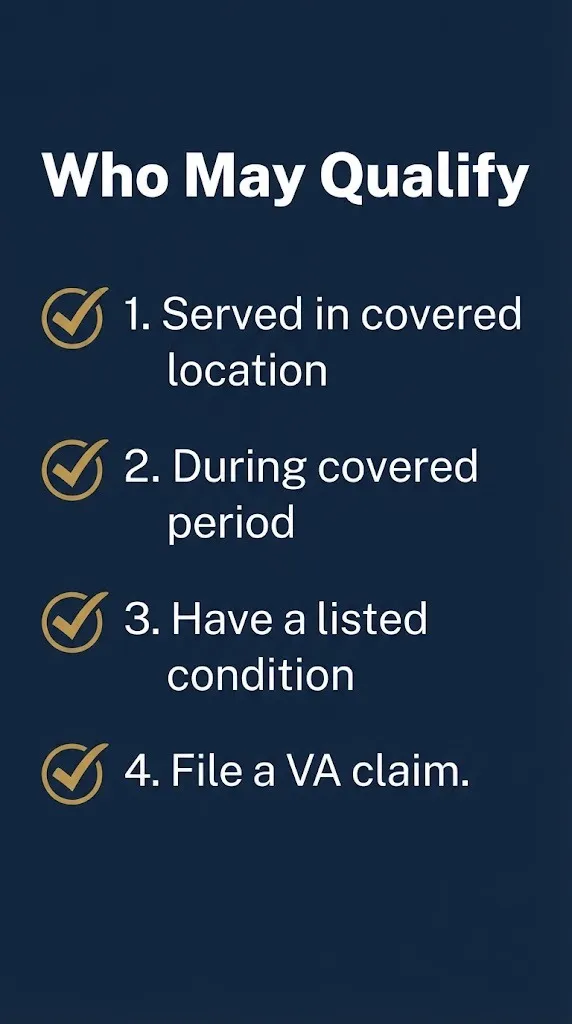
You may qualify if you served in specific locations during specific time periods and now have a listed condition. The PACT Act defines covered locations and periods precisely.
For burn pit and toxic exposure claims, covered locations include:
- Iraq from August 2, 1990, to present
- Afghanistan from September 19, 2001, to present
- Djibouti, Egypt, Jordan, Lebanon, Syria, and Yemen since 2001
- Uzbekistan since September 19, 2001
- The Philippines since September 19, 2001
- Somalia since August 2, 1990
- Bahrain, Kuwait, Oman, Qatar, Saudi Arabia, and the UAE since August 2, 1990
For Agent Orange claims, covered locations include:
- Vietnam from January 9, 1962, to May 7, 1975
- Thailand at any U.S. or Thai base from January 9, 1962, to June 30, 1976
- Laos from December 29, 1965, to September 30, 1969
- Cambodia at Mimot or Krek from April 16, 1969, to April 30, 1969
- Guam, American Samoa, or Johnston Atoll during specific periods
The exact locations and dates matter. Your DD214 shows where you were stationed. If it doesn’t match the covered locations, you may not qualify under the presumptive rules.
You can still file a claim even if your location isn’t on the list. The VA may grant it on a case-by-case basis with additional evidence.
When Is the PACT Act Deadline?
There is no deadline for filing a new PACT Act claim. The law is permanent and continues to accept claims.
The only deadline that mattered was August 9, 2023. Veterans who filed by that date could receive benefits backdated to August 10, 2022. That deadline has passed.
If you file today, your effective date is generally today’s date or the date you file an intent to file. You won’t receive back payments for the period before you filed.
This is a critical distinction. No deadline for filing doesn’t mean no advantage to filing soon. Every month you wait is a month of compensation you won’t receive.
Think of it like a retirement account. The earlier you contribute, the more it grows. The earlier you file a PACT Act claim, the earlier your effective date. The later you file, the more monthly payments you leave on the table.
What Does the PACT Act Cover for Veterans?
The PACT Act covers two main things: disability compensation and VA health care. Most of the attention goes to disability compensation, but the health care expansion is equally important.
For disability compensation, the law creates presumptive service connection for listed conditions. That means the VA assumes your condition is service-connected if you served in a covered location during a covered period.
For health care, the law expanded VA eligibility for veterans who served in covered locations. Veterans who served in Vietnam, Thailand, Laos, or Cambodia are now eligible for VA health care without having to prove service connection for a specific condition.
The law also expanded health care for post-9/11 veterans. Veterans who deployed to a combat zone are eligible for VA health care for five years after discharge, up from two years under the old rules.
The health care expansion matters because it gets veterans into the VA system. Once you’re in the system, you can get treatment for conditions that might later become service-connected.
Key Takeaway: The PACT Act covers both disability compensation and expanded VA health care. Both are free to apply for.
How Do You Check Your PACT Act Claim Status?
You can check your claim status online through the VA website. The VA’s claim status tool shows where your claim is in the process and what’s happening next.
Here’s how to check:
- Go to the VA website and log in to your account.
- Click on the claim status link.
- View your open claims and their current status.
- Check for any requests for additional information.
- Contact the VA at 1-800-827-1000 if you have questions.
The VA also sends letters by mail at key stages of the claims process. Those letters explain what’s happening and what you need to do next.
Claims processing times vary. The VA has received more than 1.7 million PACT Act claims since the law passed. That volume has slowed processing for everyone.
The average claim takes 125 to 150 days, but complex claims can take longer. The VA has hired thousands of new claims processors to handle the backlog. Processing times should improve, but there’s no guarantee.
How Long Does a PACT Act Claim Take?
Most PACT Act claims take between 125 and 150 days from filing to decision. Some take longer. Some take less.
The VA publishes average processing times on its website. Those numbers change monthly. Check the current numbers before you file so you have realistic expectations.
Several factors affect how long your claim takes:
- The complexity of your claim
- Whether the VA needs additional medical evidence
- Whether you need a compensation and pension exam
- How many claims the VA is processing at the time
- Whether your claim is fully developed or needs additional information
A fully developed claim moves faster. That means submitting all your evidence at once: service records, medical records, and a current diagnosis. The more complete your claim, the fewer delays.
You can check your status at any time. The VA’s online tool shows real-time updates. If your claim seems stuck, call the VA at 1-800-827-1000 and ask what’s holding it up.
Reality Check: Never Pay for PACT Act Help
Some companies charge veterans for help filing PACT Act claims. They promise faster processing or higher ratings. Here’s the reality: no one can guarantee a faster decision or a higher rating. The VA processes claims in the order received, and your rating depends on medical evidence, not on who files your paperwork. Veterans service organizations provide free, accredited help. The VA provides free help. If a company wants you to pay for PACT Act assistance, walk away. You’re paying for something you can get for free, and some companies take a percentage of your back pay.
What Is the PACT Act Update for 2026?
The PACT Act is fully implemented as of 2026. The VA continues to process claims, expand outreach, and add new presumptive conditions as scientific evidence emerges.
In 2026, the VA announced several updates:
- Additional presumptive conditions are under review based on new scientific studies
- Claims processing times have improved slightly from earlier years
- The VA has expanded its network of toxic exposure screening clinics
- Outreach efforts continue to reach veterans who haven’t filed yet
The law is permanent and evolving. The VA has authority to add new presumptive conditions without new legislation. That means the list of covered conditions will likely grow over time.
If you filed a claim in the past and were denied, you may be able to file again. The VA has instructed claims processors to re-review denied claims that might now qualify under the PACT Act. That’s especially true for claims denied before August 2022.
What If Your PACT Act Claim Was Denied?
If your PACT Act claim was denied, you have the right to appeal. The denial letter explains why the VA denied your claim and what you can do about it.
The appeals process has several levels:
- Higher-level review: A senior claims adjudicator reviews your existing file. No new evidence allowed.
- Supplemental claim: You submit new evidence that wasn’t in your original file.
- Board of Veterans’ Appeals: You appeal to the Board, which can hold a hearing and issue a decision.
- U.S. Court of Appeals for Veterans Claims: You appeal to the federal court.
The deadlines for appeals are strict. You generally have one year from the date of the denial letter to file an appeal. Missing the deadline can mean losing your right to appeal.
Don’t give up if your claim was denied. Many veterans win on appeal. The key is to submit additional evidence: a stronger medical opinion, a clearer nexus statement, or records that show your service location more clearly.
What Happens Next With the PACT Act?
The PACT Act is permanent law, but the implementation continues to evolve. Here’s the expected timeline:
- Ongoing: VA continues processing new and pending PACT Act claims
- 2026: VA expected to announce additional presumptive conditions
- 2026: VA continues toxic exposure screening expansion
- No deadline: New claims accepted indefinitely
- No deadline: Appeals accepted within one year of denial
The law doesn’t expire. The money doesn’t run out. The VA continues to hire staff and improve processing times.
The single most important action you can take is to file now if you haven’t already. The earlier you file, the earlier your effective date. Waiting costs you money.
Frequently Asked Questions
Is the PACT Act compensation real?
Yes, the PACT Act is a real federal law.
It provides VA disability compensation for toxic-exposed veterans.
More than 1.1 million claims have been granted since 2022.
How much is the PACT Act monthly payment?
Monthly payments range from $175.51 to $3,831.30 for veterans alone.
Higher amounts apply with dependents.
The exact amount depends on your disability rating.
Is there a PACT Act filing deadline?
No deadline exists for filing new claims.
The retroactive benefits window closed on August 9, 2023.
File now to lock in today’s effective date.
What conditions are covered under the PACT Act?
More than 20 conditions are presumptively service-connected.
They include asthma, chronic bronchitis, and many cancers.
Check the VA list for the complete current list.
Do I need a lawyer to file a PACT Act claim?
No lawyer is needed to file a PACT Act claim.
Veterans service organizations provide free accredited help.
Never pay a company for claim assistance.
Can I get retroactive PACT Act payments?
Retroactive payments to August 2022 required filing by August 9, 2023.
If you filed after that date, your effective date is generally your filing date.
There is no back payment for the period before you filed.
How do I check my PACT Act claim status?
Check your status online through the VA website.
Call the VA at 1-800-827-1000 for assistance.
The VA also sends letters by mail at key stages.
What locations are covered under the PACT Act?
Covered locations include Iraq, Afghanistan, and several other countries.
Vietnam, Thailand, Laos, and Cambodia are covered for Agent Orange.
Check your DD214 against the official VA list.
The PACT Act is one of the largest expansions of veteran benefits in American history. It’s permanent, it’s funded, and it’s accepting new claims every day. If you served in a covered location and now have a listed condition, you may qualify for monthly compensation that could change your financial life.
The single most important fact: there is no deadline to file, but every month you wait is a month of compensation you won’t receive. File now, not later.