Sweet Settlement Student Loans 2026: Full Update on Sweet v. Cardona
Quick Answer
- Sweet v. Cardona is a real, court-approved $6 billion settlement, case No. 3:19-cv-03674 in the Northern District of California.
- There’s no fixed per-person dollar amount. Eligible borrowers get full loan discharge, a refund of payments, and credit repair.
- The Department of Education missed its April 15, 2026 deadline, automatically triggering full relief for the non-Exhibit C post-class group.
If you’re searching for the Sweet settlement, here’s the direct answer: it’s a real, finalized class action settlement, and as of August 2026, the Department of Education has now missed two separate court-ordered deadlines to process borrower defense claims tied to it.
This affects hundreds of thousands of federal student loan borrowers who filed borrower defense applications between 2019 and November 2022, claiming their schools misled them. The most important recent number is $6 billion, the total relief figure cited when the settlement was reached in 2022.
This article breaks down exactly who qualifies, what happens when the Department misses a deadline, and where the case stands right now. One detail that surprises a lot of borrowers: missing a government deadline in this case actually works in their favor.
The Facts
| Category | Detail |
|---|---|
| Case | Sweet v. Cardona, now Sweet v. McMahon, formerly Sweet v. DeVos |
| Court | U.S. District Court for the Northern District of California |
| Case Number | 3:19-cv-03674 |
| Status | Post-approval enforcement phase, active as of August 2026 |
| Fund Size | $6 billion in relief, as characterized when the settlement was reached in June 2022 |
| Est. Per Person | Not a fixed figure. Full loan discharge, refund of payments made, and credit correction |
| Claim Window | Closed. Covers borrowers who applied by June 22, 2022, or November 15, 2022 for post-class status |
| Administrator | U.S. Department of Education, Federal Student Aid office |
| Proof Needed | None for existing applicants. Relief ties to already-submitted borrower defense applications |
Is the Sweet v. Cardona Settlement Real?
Yes, Sweet v. Cardona is a real, court-approved class action settlement, filed in the U.S. District Court for the Northern District of California under case number 3:19-cv-03674. Seven student borrowers, led by named plaintiff Theresa Sweet, filed the case on June 25, 2019.
The lawsuit accused the Department of Education of unlawfully delaying and denying borrower defense claims, which let students seek loan cancellation when their school defrauded or misled them. The parties reached a settlement on June 22, 2022, and the court granted final approval on November 16, 2022.
The case has since been recaptioned twice, first as Sweet v. Cardona under former Education Secretary Miguel Cardona, and now as Sweet v. McMahon under the current secretary. It remains the same underlying case and settlement.
Key Takeaway: This is a genuine, finalized federal court settlement, not a rumor or a scam, and it’s still actively enforced in 2026.
How Much Money Is in the Sweet Settlement?
The settlement was characterized as providing $6 billion in total relief when it was reached in June 2022. That figure reflects loan discharges, refunds, and credit corrections combined, not a single cash payout pool.
This isn’t a traditional settlement fund that gets divided among claimants. Instead, each eligible borrower’s individual federal student loans tied to a covered school get discharged entirely, along with a refund of amounts they already paid.
| Relief Component | What It Covers |
|---|---|
| Loan discharge | Full cancellation of the federal loan balance tied to the covered school |
| Refund | Return of payments the borrower already made on that loan |
| Credit correction | Removal or correction of the loan’s tradeline on credit reports |
How Much Will You Get From the Sweet v. Cardona Settlement?
Not a fixed dollar figure. Your specific relief depends entirely on your individual loan balance and how much you’ve already paid toward it.
If you qualify for Full Settlement Relief, you receive complete discharge of the federal loans tied to your borrower defense claim, a refund of every payment you made on those loans, and correction of your credit report. There’s no capped or shared pool that gets divided among borrowers.
This differs from most class action settlements you’ll see covered elsewhere, where a fixed fund gets split pro rata among claimants. Here, relief scales directly to what you personally borrowed and repaid.
Reality Check: No legitimate part of this settlement process ever requires you to pay a fee, and any company charging you money to “process” your Sweet settlement relief isn’t affiliated with the Department of Education or the court.
Do You Need to File a New Claim for the Sweet Settlement?
No, if you already submitted a borrower defense application by the relevant deadline, you don’t need to file anything new. The settlement’s claim window closed years ago.
You’re covered if you had a pending borrower defense application on June 22, 2022, or if you applied as a post-class applicant between June 23 and November 15, 2022. No new applications are being accepted under this specific settlement.
If you never filed a borrower defense application at all, this particular settlement doesn’t apply to you, though separate current borrower defense options may still exist through the Department of Education directly.
How Do You Check Your Sweet v. Cardona Settlement Status?
You check your status by searching your email for official notices from the Department, then contacting class counsel if you can’t locate a decision. Start with your inbox before assuming anything went wrong.
- Search every email inbox you’ve used for messages from [email protected].
- Look specifically for subject lines mentioning “Sweet v. Cardona Settlement” notices.
- Check spam and junk folders, since notices sometimes land there.
- If you find no notice and believe you’re covered, email [email protected] directly.
- Copy [email protected], the email for class counsel at the Project on Predatory Student Lending.
- Include your full name, any prior names or emails used, and your application number if available.
Key Takeaway: Missing notices are common enough that class counsel has set up a dedicated inbox specifically to track down borrowers who fell through the cracks.
What Do You Do if You Haven’t Received Your Sweet Settlement Relief?
If you were approved but haven’t received discharge, refund, or credit correction, you should email class counsel directly with specifics about what’s missing. Don’t assume the process is simply running late without checking.
Explain clearly which type of relief you’re missing, whether that’s the loan discharge itself, your refund, or the credit report correction. Include your borrower defense application number if you have it, along with any name or email variations you used when applying.
Some borrowers have reported issues with their loan servicer, including instances of loans reportedly remaining in forbearance status longer than expected. If your servicer hasn’t reflected your relief, raising it with class counsel is the most direct path to resolution.
What Is the April 15, 2026 Deadline in the Sweet v. Cardona Case?
April 15, 2026 was the court-ordered deadline for the Department of Education to decide non-Exhibit C post-class borrower defense applications. The Department missed it.
This deadline followed a series of failed extension requests. The court denied the Department’s first extension request on December 11, 2025. The Department then filed a second Rule 60(b) motion seeking more time on January 22, 2026.
The Ninth Circuit Court of Appeals denied the Department’s request for an emergency stay on March 25, 2026, finding the Department was unlikely to succeed on the merits of its appeal. With no further relief granted, the April 15, 2026 deadline stood, and the Department missed it.
What Happened When the Department of Education Missed the Settlement Deadline?
Missing the deadline automatically triggered Full Settlement Relief for the affected group of borrowers under the terms of the settlement agreement. This is a built-in enforcement mechanism, not a separate legal victory that had to be fought for again.
This isn’t the first time this has happened in this case. The Department previously missed its January 28, 2026 deadline for Exhibit C post-class applicants, automatically triggering full relief for roughly 170,000 borrowers in that group. Notices for that group went out March 30, 2026.
Legal advocates for the class have been direct about what this means. The Project on Predatory Student Lending stated the Department cannot stay a deadline that has already passed, once the Ninth Circuit denied the emergency stay request.
Key Takeaway: Under the settlement’s own terms, a missed government deadline doesn’t delay your relief, it automatically grants it in full.
What Is Full Settlement Relief Under the Sweet Settlement?
Full Settlement Relief means complete discharge of your covered federal loans, a refund of every payment you made on them, and removal or correction of the loan from your credit reports. It’s the maximum benefit available under the settlement.
Borrowers can receive Full Settlement Relief in two ways: either the Department reviews their borrower defense application on the merits and approves it, or the Department misses its court-ordered deadline to decide the case at all.
Both paths lead to the same outcome. Think of it like a warranty claim that gets automatically approved if the company doesn’t respond within its promised review window.
Who Qualifies as a Class Member in Sweet v. Cardona?
You’re a class member if you had a pending borrower defense application as of June 22, 2022, or if you received a form denial of your application between December 2019 and October 2020. That’s the settlement’s core class definition.
Borrowers who applied for borrower defense after June 22, 2022, but before November 16, 2022, fall into a separate but related group called post-class applicants, covered under the settlement’s expanded terms.
| Group | Application Window |
|---|---|
| Original class members | Pending application as of June 22, 2022 |
| Form denial group | Received denial between December 2019 and October 2020 |
| Post-class applicants | Applied between June 23 and November 15, 2022 |
What Are Exhibit C Schools in the Sweet Settlement?
Exhibit C schools are a specific list of 151 institutions the settlement identified as carrying a presumption of substantial misconduct toward borrowers. Attending one puts you on a faster relief track than other schools.
Original class members who attended an Exhibit C school and had a pending application received automatic Full Settlement Relief years ago, shortly after the settlement’s final approval in November 2022.
Post-class applicants tied to Exhibit C schools were placed on a stricter Department decision deadline. That deadline, January 28, 2026, was also missed by the Department, triggering automatic relief for that group as well.
What Is a Post-Class Applicant in the Sweet v. Cardona Case?
A post-class applicant is a borrower who submitted a borrower defense application between June 23 and November 15, 2022, after the settlement was reached but before it received final court approval. They’re covered under expanded settlement terms, separate from the original class.
Post-class applicants tied to non-Exhibit C schools faced the April 15, 2026 decision deadline, which the Department missed, triggering their automatic relief.
If you applied after November 15, 2022, you’re not covered under this settlement at all. Those claims fall outside the Sweet agreement and follow the Department’s standard borrower defense process instead.
Key Takeaway: Your exact application date and target school both determine which deadline and relief track applies to your specific claim.
Why Was Sweet v. Cardona Renamed Sweet v. McMahon?
The case name changes each time a new U.S. Secretary of Education takes office, since the sitting secretary is the named defendant in their official capacity. That’s a standard legal formality, not a sign the case restarted.
The lawsuit began as Sweet v. DeVos under Secretary Betsy DeVos, became Sweet v. Cardona under Secretary Miguel Cardona, and is now formally styled Sweet v. McMahon. The underlying case, settlement terms, and case number 3:19-cv-03674 remain unchanged throughout.
Most borrowers and news coverage still refer to it as the Sweet settlement or Sweet v. Cardona, since that’s the name attached to it when the actual settlement was reached in 2022.
What Happened in the Ninth Circuit Appeal of the Sweet Settlement?
The Ninth Circuit dismissed appeals filed by three original intervenors on November 5, 2024, and separately denied the Department’s emergency stay request on March 25, 2026. Both rulings kept the settlement’s enforcement deadlines intact.
The three intervenors, believed to be for-profit school entities affected by the settlement’s terms, had attempted to challenge parts of the agreement after it received final approval. Their appeals were dismissed.
More recently, when the Department sought an emergency stay of the April 15, 2026 processing deadline, the Ninth Circuit rejected that request too, finding the government unlikely to succeed on the underlying merits of its appeal.
What Happens Next in the Sweet v. Cardona Case?
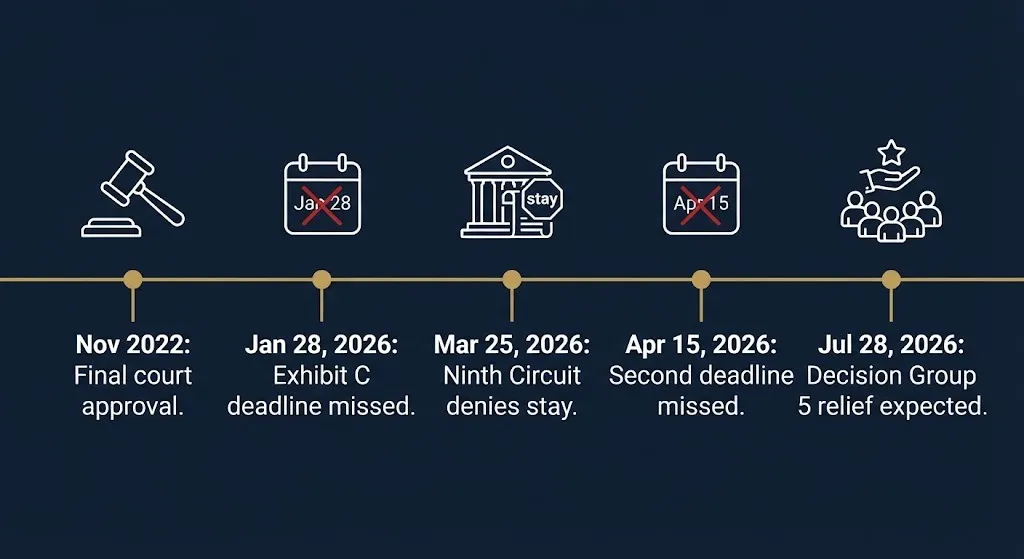
- November 16, 2022: Settlement receives final court approval.
- January 28, 2026: Department misses Exhibit C post-class deadline, triggering automatic relief for roughly 170,000 borrowers.
- March 25, 2026: Ninth Circuit denies the Department’s emergency stay request.
- April 15, 2026: Department misses the non-Exhibit C post-class deadline, triggering additional automatic relief.
- July 28, 2026: Expected deadline for Decision Group 5 approved applicants to receive Full Settlement Relief.
Frequently Asked Questions
Is the Sweet v. Cardona student loan settlement legit?
Yes, it’s a real, finalized federal court settlement with case number 3:19-cv-03674 in the Northern District of California.
It received final court approval on November 16, 2022, and remains actively enforced in 2026.
How much money will I get from the Sweet settlement?
There’s no fixed dollar amount. Eligible borrowers get full discharge of their covered loans, a refund of prior payments, and credit report correction.
The exact value depends entirely on your individual loan balance and payment history.
Do I need to apply for the Sweet settlement now?
No, the claim window closed years ago and covers only borrowers who already filed borrower defense applications by November 15, 2022.
If you never applied, this specific settlement doesn’t apply to you.
What happens if the Department of Education misses a Sweet settlement deadline?
Missing a court-ordered deadline automatically triggers Full Settlement Relief for the affected group of borrowers.
This has already happened twice in 2026, in January and again in April.
How do I know if I’m part of the Sweet v. Cardona class?
You’re likely covered if you had a pending borrower defense application on June 22, 2022, or applied between June 23 and November 15, 2022.
Check your email, including spam folders, for official notices from [email protected].
What is an Exhibit C school in this settlement?
It’s one of 151 schools the settlement identified as carrying a presumption of misconduct toward borrowers.
Borrowers tied to these schools generally received relief faster than those tied to other institutions.
Who do I contact if I haven’t received my Sweet settlement relief?
Email [email protected] directly, and copy [email protected], the class counsel at the Project on Predatory Student Lending.
Include your application number and any name or email variations you used when applying.
Is Sweet v. Cardona the same case as Sweet v. McMahon?
Yes, the name changes only because the sitting Secretary of Education is the named defendant.
The underlying case, settlement terms, and case number have not changed since the settlement was reached in 2022.
The number to remember here is April 15, 2026, the deadline the Department of Education already missed, triggering automatic relief for thousands of borrowers. Check your email for official settlement notices now.
If you believe you qualify but haven’t received relief, contact class counsel directly rather than waiting indefinitely for a decision that may already be overdue.