CarShield Lawsuit 2026: Payout Status, Class Action Update, and Who Already Got Paid
Quick Answer
- Yes, it’s real: the FTC sued NRRM, LLC (dba CarShield) and American Auto Shield, LLC, and won a $10 million judgment in July 2024.
- The FTC already mailed 168,179 refund checks worth $9.6 million in December 2025, no claim form required.
- A newer private class action is paused in arbitration as of May 2026, so no new settlement fund or payout amount exists for that case yet.
If you’re searching “carshield lawsuit,” you’ve probably either gotten a refund check, seen a headline, or wondered if you’re owed money. The short version: the Federal Trade Commission already sued CarShield, won, and already paid people back.
That first case is done. The FTC sent checks automatically to 168,179 people in December 2025, and recipients had to cash them within 90 days. A second, separate legal fight, a private class action filed in March 2025, is where things stand today, and it just got a lot slower.
This article covers what CarShield actually got accused of, who already got a check, what happened to the newer lawsuit, and what your options are if you missed the refund window entirely. One detail most coverage buries: the class action didn’t settle, it got sent to arbitration instead, which is a very different outcome for anyone hoping for a public payout.
The Facts
| Case | FTC v. NRRM, LLC (dba CarShield) and American Auto Shield, LLC, Case No. 4:24-cv-01055; separately, Lindsey-Evans v. NRRM, LLC, Case No. 4:25-cv-00363 |
| Status | FTC settlement finalized and paid (December 2025); private class action paused, sent to arbitration (May 2026) |
| Fund Size | $10 million FTC monetary judgment; $9.6 million already distributed as consumer refunds |
| Est. Per Person | FTC refunds averaged roughly $57 per person; private arbitration payouts not yet determined |
| Claim Deadline | No claim form was required for the FTC refund; checks mailed automatically in December 2025 and had to be cashed within 90 days |
| Administrator | Analytics, the FTC’s refund administrator for this case (1-855-298-8877) |
| Proof Needed | None for the original refund; the paused private case would require your CarShield or American Auto Shield contract and denied-claim records |
Is the CarShield Lawsuit Real, or Is This a Scam?
Yes, the CarShield lawsuit is a real federal case, filed and won by the Federal Trade Commission.
The FTC filed its complaint on July 31, 2024, in the U.S. District Court for the Eastern District of Missouri, against NRRM, LLC (doing business as CarShield) and its contract administrator, American Auto Shield, LLC. Both companies agreed to a stipulated order the same day, meaning they settled rather than going to trial.
The order includes a $10 million monetary judgment, a permanent injunction against deceptive advertising, and new rules requiring CarShield’s celebrity endorsers to be truthful about their own experience with the product.
Key Takeaway: This isn’t a rumor or a text-message scam, it’s a documented FTC enforcement action with a public court docket and a completed refund program.
How Much Is the CarShield Lawsuit Payout Per Person?
Most people who got an FTC refund received a modest amount, not a windfall, because the $9.6 million redress fund was split across 168,179 consumers.
Do the math and that averages out to roughly $57 per person, though individual amounts varied based on what each consumer paid CarShield and how the FTC’s distribution formula weighted their documented harm. This was never a case where everyone got an equal check.
Compare it to a store refunding a defective product you already used for months: you get money back, but not the full amount you originally paid in, because the refund reflects actual harm, not a full buyback.
Key Takeaway: The $57 average is a blended figure across all 168,179 recipients, your own check amount depended on your specific contract and claim history.
CarShield Class Action Lawsuit: What’s the Settlement Amount?
There is no confirmed settlement amount for the private CarShield class action, because that case has not settled.
Lindsey-Evans v. NRRM, LLC was filed in March 2025 in the same Missouri federal court, on behalf of consumers who say American Auto Shield and CarShield failed to honor vehicle service contracts. In May 2026, a federal judge granted CarShield’s motion to compel arbitration, pausing the case rather than letting it move toward a public trial or settlement.
Not yet determined. Because the case is now in individual arbitration rather than open litigation, there is no class-wide settlement fund, no payout tiers, and no timeline for resolution that a news outlet can verify. Arbitration outcomes are typically private and not publicly reported.
What Was in the CarShield Refund Checks?
The refund checks the FTC mailed in December 2025 were based on actual harm documented in CarShield’s own customer and complaint records, not a flat per-person rate.
FTC Refund Snapshot
| Detail | Verified Figure |
|---|---|
| Total redress distributed | $9.6 million |
| Consumers who received checks | 168,179 |
| Average amount per check | Approximately $57 |
| Time window covered | Contracts purchased September 2019 through September 2024 |
| Cash-by deadline | 90 days from the December 2025 mailing date |
If you received a check and didn’t cash it within that 90-day window, it has very likely expired. The FTC generally does not reissue expired refund checks, and there is no new claim window confirmed for this same program as of August 2026.
How to File a CarShield Lawsuit Claim or Join the Class Action
You cannot file a new claim in the original FTC case, since that refund program is closed and required no application. Here’s what you can actually do right now.
- Check whether you received a check in December 2025 and whether you cashed it in time.
- Call the FTC’s refund administrator, Analytics, at 1-855-298-8877 if you believe you qualified but never received a check.
- Gather your CarShield or American Auto Shield contract, billing statements, and any denied-claim paperwork.
- Contact a consumer protection attorney to ask whether your contract includes an arbitration clause.
- If your contract has an arbitration clause, ask an attorney about filing an individual arbitration demand.
- Watch official FTC and court sources for any future updates on the paused Lindsey-Evans case.
How to Check If You’re Eligible for a CarShield Refund
You were eligible for the original FTC refund only if you paid CarShield for a vehicle service contract between September 2019 and September 2024 and had a repair claim denied.
The FTC identified eligible consumers automatically from CarShield’s own records, so no claim form or application was ever required. If you fit that description and never received a check, that likely means your specific claim history didn’t match the FTC’s documented harm criteria, not that you were overlooked entirely.
Quick eligibility check:
- Did you have an active CarShield or American Auto Shield contract between September 2019 and September 2024?
- Did you file a repair claim under that contract that was denied?
- Did you receive a check in December 2025?
- If you answered yes to the first two but no to the third, contact the refund administrator directly.
Should You Pursue Arbitration or Wait for the Class Action?
Whether arbitration makes sense for you depends on the size of your individual claim and whether you’re willing to pursue it alone rather than as part of a group.
Arbitration replaces a public class action lawsuit with a private, individual proceeding. That generally means faster resolution than years of federal litigation, but it also means no public settlement fund, no media coverage of the outcome, and typically higher upfront cost relative to the amount in dispute for small claims.
Reality Check: No legitimate FTC refund program or law firm will ever call, text, or email you asking for payment, banking details, or a “processing fee” to release money you’re owed. The FTC identified CarShield refund recipients automatically and mailed checks directly. If someone contacts you claiming they can “unlock” a CarShield payout for a fee, that is not the FTC, and it is not Analytics, the real refund administrator.
CarShield Lawsuit Update 2026: What’s Changed This Year
The biggest 2026 development is that the private class action stalled, not that a new settlement emerged.
In May 2026, a federal judge in the Eastern District of Missouri granted CarShield’s motion to compel arbitration in the Lindsey-Evans case, effectively pausing the litigation track that could have led to a second, larger public settlement. Before that ruling, the case had been moving through discovery and pretrial motions since its March 2025 filing.
Meanwhile, the FTC’s original case remains closed on the enforcement side. The consent order signed in July 2024 still binds CarShield and American Auto Shield to stricter advertising and endorsement rules going forward, regardless of the arbitration outcome in the private case.
Key Takeaway: 2026 brought a setback for anyone hoping for a second public class settlement, not a new payout program.
Why Was the CarShield Class Action Sent to Arbitration?
The case was sent to arbitration because CarShield’s vehicle service contracts include an arbitration clause that the presiding judge found enforceable.
Arbitration clauses are common in service contracts and typically require disputes to go through a private arbitrator instead of a public court. When a judge grants a motion to compel arbitration, the court case is effectively paused or dismissed for the affected plaintiffs, and they must pursue their claims individually outside the public court system.
This is a significant setback for anyone who was hoping the class action would produce a second, larger settlement fund similar to the FTC’s. It does not affect the FTC case, which already concluded.
Is CarShield Still Being Sued in 2026?
Yes, CarShield still faces active legal exposure in 2026, but through arbitration rather than open class litigation.
The FTC’s consent order remains in force, meaning CarShield and American Auto Shield are legally bound to their new advertising and disclosure requirements indefinitely. Individual consumers can still pursue arbitration claims under their contracts, though those proceedings are private and don’t produce the kind of public settlement fund a class action would.
Key Takeaway: “Still being sued” in 2026 means individual arbitration claims and an enforceable consent order, not a new public lawsuit accepting claims.
What Did CarShield Do Wrong? Why Is CarShield Being Sued?
CarShield advertised that customers would “never pay for expensive car repairs again,” but the FTC found many repairs were not actually covered.
The FTC’s complaint alleged CarShield and American Auto Shield misrepresented what their vehicle service contracts covered, falsely claimed customers could use any repair facility of their choice, and misrepresented rental car benefits. Consumers paid up to $120 per month for contracts riddled with exclusions they weren’t told about upfront.
The complaint also alleged that CarShield’s celebrity endorsers, including well-known sports and entertainment figures, claimed to be satisfied CarShield customers when many had never actually used the service contracts themselves.
Who Qualified for the CarShield FTC Refund?
You qualified for the original FTC refund if you paid for a CarShield vehicle service contract between September 2019 and September 2024 and had a claim denied under that contract.
The FTC used CarShield’s own business records to identify these consumers automatically, which is why no application process ever existed for this particular refund round. This is different from most class action settlements, where you typically have to submit a claim form to get paid.
CarShield vs. American Auto Shield: Who’s Actually Responsible?
Both companies share legal responsibility, since CarShield markets the contracts and American Auto Shield designs and administers them.
NRRM, LLC (CarShield) is based in Missouri and handles marketing, advertising, and sales. American Auto Shield, LLC, based in Colorado, is described in court filings as the company that develops and administers the actual vehicle service contracts, meaning it decides what gets covered and what claims get denied. The FTC named both as defendants because the deceptive advertising and the denied-claims problem span both companies’ roles.
What Happens Next in the CarShield Case
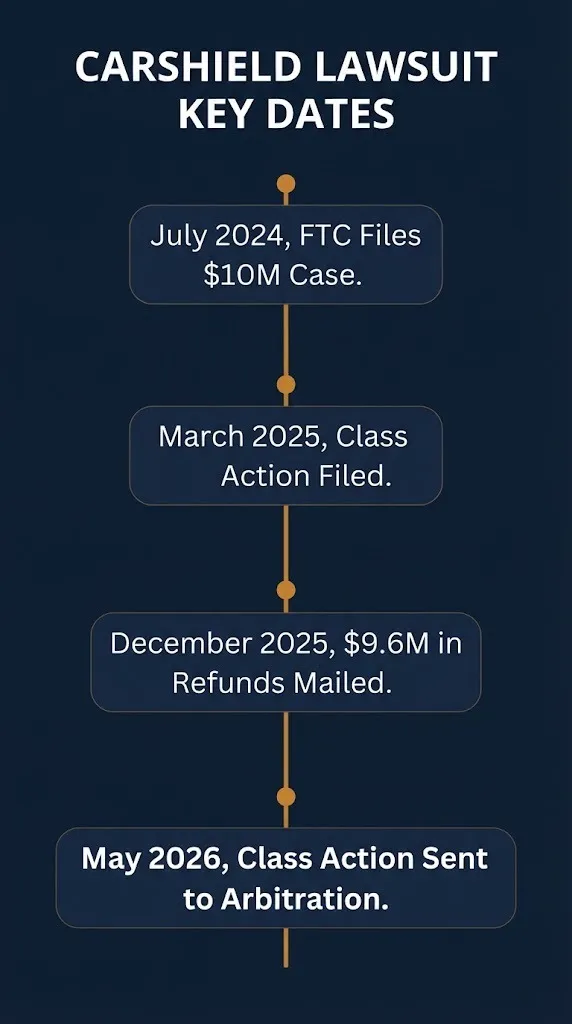
- Completed, December 2025: FTC mailed $9.6 million in refund checks to 168,179 consumers, no claim form required.
- Completed, roughly March 2026: 90-day window to cash FTC refund checks closed.
- May 2026 (confirmed): Federal judge sent the Lindsey-Evans private class action to arbitration, pausing that litigation track.
- Ongoing, no confirmed date: Individual arbitration claims can still proceed under CarShield’s contract terms.
- TBD: Whether any future FTC action or state attorney general case opens a new refund program; nothing confirmed as of August 2026.
Frequently Asked Questions
Is the CarShield lawsuit legitimate?
Yes, it’s a real FTC enforcement action that resulted in a $10 million judgment against NRRM, LLC (CarShield) and American Auto Shield.
The FTC already distributed $9.6 million in refunds to 168,179 consumers in December 2025.
How much was the average CarShield refund check?
The average FTC refund worked out to roughly $57 per person, based on $9.6 million split across 168,179 recipients.
Individual amounts varied depending on documented harm and contract history.
Can I still file a claim for the CarShield lawsuit?
No new claim form exists for the completed FTC refund program, since checks were mailed automatically without an application process.
The separate private class action is currently paused in arbitration, so there’s no active settlement claim process for that case either.
What happened to the CarShield class action lawsuit?
A federal judge sent the case, Lindsey-Evans v. NRRM, to arbitration in May 2026, pausing it rather than allowing a public trial or settlement.
This means individual consumers may need to pursue arbitration claims separately rather than as a group.
Do I need a lawyer to pursue a CarShield arbitration claim?
No, you’re not required to have one, but arbitration involves legal and procedural rules many consumers find easier to navigate with an attorney.
A consumer protection lawyer can review your contract’s arbitration clause and help you decide whether pursuing a claim makes financial sense.
Why did some CarShield customers not get a refund check?
The FTC only refunded consumers who paid for a contract between September 2019 and September 2024 and had a claim denied during that window.
If your situation falls outside those dates or circumstances, you likely didn’t match the program’s documented eligibility criteria.
Is CarShield still in business and selling contracts in 2026?
Yes, CarShield continues to operate and sell vehicle service contracts, now under the FTC’s consent order restricting its advertising claims.
The order requires the company to avoid deceptive marketing and ensure endorser testimonials are accurate going forward.
If you received a CarShield refund check in December 2025, check now whether you cashed it before the 90-day window closed. If you didn’t get a check but believe you qualified, call the FTC’s refund administrator, Analytics, directly rather than searching for a claim form online.
The single most important fact right now: the FTC’s payout program is closed, and the newer class action is paused in arbitration as of May 2026, so there is no active public claim process for new CarShield money today.