Workers Compensation CT 2026: Rates, New Laws, and How Settlements Actually Work
Quick Answer
- Connecticut workers’ compensation is a real, state-mandated no-fault insurance system run by the Workers’ Compensation Commission (WCC), not a lawsuit or settlement program.
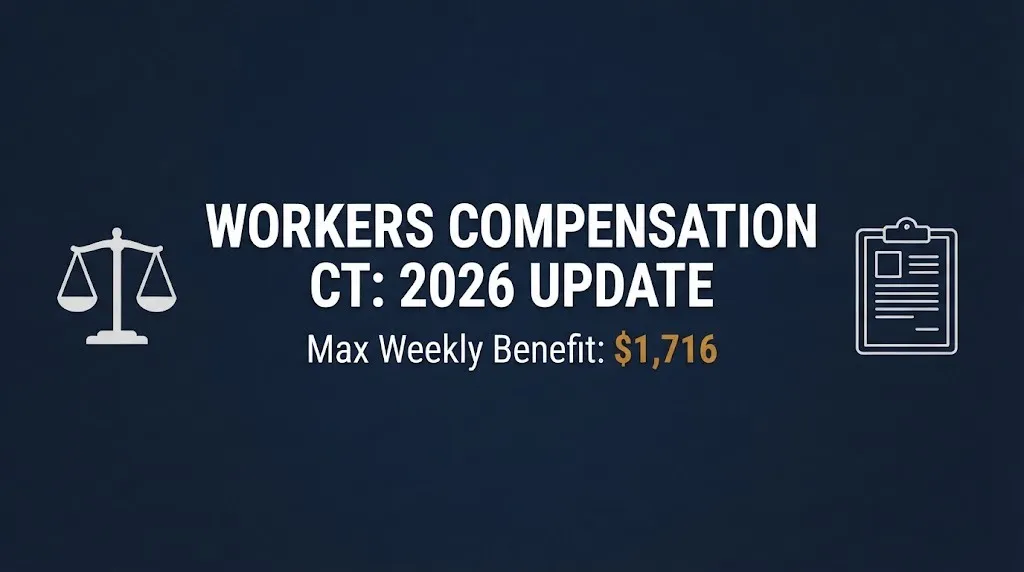
- Weekly wage-loss benefits are capped at $1,716.00 for injuries between October 1, 2025 and September 30, 2026, based on the state average weekly wage.
- You generally must file a workers’ compensation claim within one year of an accidental injury, or three years for an occupational disease.
If you’re searching “workers compensation ct,” you’re probably either an injured worker trying to understand your benefits, or a business owner tracking premium changes. Connecticut runs one of the oldest workers’ compensation systems in the country, dating back to 1913, and it changed twice in the past 18 months.
The headline number for workers matters most: the maximum weekly benefit for a claim tied to an injury in the current benefit year is $1,716.00. For employers, the headline number is different: state regulators approved another rate cut for 2026, the twelfth straight year of declines.
This article breaks down current 2026 benefit rates, two major legal changes reshaping Connecticut workers’ comp claims, how the filing and settlement process actually works, and what to do if your claim gets denied. One detail that surprises a lot of people: Connecticut workers can no longer collect certain extended benefits that a 2025 court ruling briefly allowed, because the legislature reversed it within two months.
The Facts
| Governing Law | Connecticut Workers’ Compensation Act, Chapter 568 of the Connecticut General Statutes (enacted 1913) |
| Status | Active statewide no-fault system; two major changes took effect in 2025 and 2026 |
| Fund Size | Not applicable, benefits are paid through employer-purchased insurance or approved self-insurance, not a shared settlement fund |
| Est. Per Person | Weekly benefits capped at $1,716.00 for injuries dated October 1, 2025 through September 30, 2026; lump-sum settlement amounts vary by case and are not published |
| Claim Deadline | One year from date of injury for accidental injuries; three years from first symptoms for occupational disease |
| Administrator | Connecticut Workers’ Compensation Commission (WCC) |
| Proof Needed | Form 30C claim form filed with your employer and the WCC, plus medical documentation of the injury |
Is Connecticut Workers Compensation Insurance Required for All Employers?
Yes, Connecticut law requires nearly every employer with at least one employee to carry workers’ compensation insurance or qualify as an approved self-insurer.
This is a no-fault system, meaning you can receive benefits regardless of who caused the accident, with limited exceptions like intentional self-injury or intoxication. In exchange, injured employees generally cannot sue their employer or coworkers for damages related to a workplace injury, since the workers’ comp system replaces that lawsuit path.
State agencies specifically cannot deny an employee the right to file a claim, and coverage applies to full-time, part-time, and in most cases temporary workers.
Key Takeaway: Workers’ compensation in Connecticut is not optional for employers and not something you have to prove fault to access, but it does replace your right to sue your employer directly.
How Much Does Workers Compensation Pay in Connecticut?
Your weekly wage-loss benefit is generally calculated as 75 percent of your after-tax average weekly wage, up to a state maximum that changes every year.
For injuries dated October 1, 2025 through September 30, 2026, the maximum weekly compensation rate is $1,716.00, based on a state average weekly wage of $1,715.03. Minimum rates also apply.
2025-2026 Benefit Year Rate Snapshot
| Benefit Type | Rate |
|---|---|
| Maximum weekly compensation | $1,716.00 |
| Minimum weekly rate, total disability | Lesser of $343.20 or 75% of average weekly wage |
| Minimum weekly rate, permanent partial | $50.00 |
| Death benefit burial allowance | $4,000, plus weekly benefits to dependents for up to 312 weeks |
These figures come from the WCC’s official benefit rate tables and adjust annually based on the state’s average weekly wage. Your specific benefit amount depends on your actual pre-injury wages, not just the statewide cap.
How Do CT Workers’ Compensation Settlements Work?
A Connecticut workers’ compensation settlement, formally called a Stipulation, is a lump-sum or structured payment that closes out your claim in exchange for giving up the right to future weekly benefits on that injury.
There is no published statewide average settlement amount, because every Stipulation depends on your specific injury, permanent impairment rating, remaining medical needs, and negotiation between your attorney and the insurance carrier. Any website claiming a fixed “average CT workers’ comp settlement” figure is estimating, not reporting a verified number.
Not yet determined: statewide average settlement value. This depends on injury severity, disputed causation, and how much future medical treatment is expected, none of which is centrally published by the WCC.
A Stipulation must be approved by a Workers’ Compensation Commissioner before it becomes final, similar to how a court has to approve a legal settlement before it’s binding.
Key Takeaway: Settlement amounts in Connecticut workers’ comp cases are individually negotiated and Commissioner-approved, there’s no fixed formula or public average to compare against.
Are Connecticut Workers Compensation Insurance Rates Going Up or Down in 2026?
Rates are going down for most Connecticut employers in 2026, marking the twelfth consecutive year of declines.
The Connecticut Insurance Department approved an average 3.8 percent decrease in voluntary market loss costs and a 0.4 percent decrease in assigned risk plan rates, effective January 1, 2026. The approval followed recommendations from the National Council on Compensation Insurance (NCCI), which analyzes workers’ comp rate data across more than 40 states.
Not every industry got a cut, though. Office and clerical classifications actually saw an increase: 1.3 percent in the voluntary market and 4.9 percent in the assigned risk plan.
Reality Check: Falling insurance rates for employers do not reduce the benefits an injured worker is legally entitled to. State law guarantees the same weekly benefit calculations and medical coverage regardless of what an employer pays in premiums, so a lower rate environment is not a signal that claims are being paid less generously.
How Do You File a Workers Compensation Claim in Connecticut?
You file a Connecticut workers’ compensation claim by submitting Form 30C to both your employer and the Workers’ Compensation Commission.
- Report your injury to your employer or supervisor as soon as possible.
- Get medical treatment and make sure the provider documents the injury as work-related.
- Complete Form 30C, the official WCC claim form.
- Send Form 30C to your employer and the appropriate WCC district office, typically by certified mail.
- Keep copies of all medical records, wage statements, and correspondence.
- Track your claim status and respond promptly to any WCC or insurer requests for documentation.
- Consult a workers’ compensation attorney if your claim is delayed, disputed, or denied.
What Is the Deadline to File a Workers Compensation Claim in CT?
You generally have one year from the date of an accidental injury to file a formal workers’ compensation claim in Connecticut.
For occupational diseases, meaning illnesses that develop gradually from workplace exposure, such as carpal tunnel syndrome or certain respiratory conditions, you have three years from the first manifestation of symptoms to file.
Deadline Checklist:
- Accidental injury (like a fall or lifting injury): 1 year from the date of injury.
- Occupational disease (like repetitive strain or exposure-related illness): 3 years from first symptoms.
- Death claims filed by dependents: separate rules apply, consult the WCC or an attorney directly.
Missing these deadlines can permanently bar your right to benefits, even if your claim would otherwise be valid, so don’t treat a one-year window as distant if you’re already dealing with a workplace injury.
How Do You Appeal a Denied Connecticut Workers Compensation Claim?
You appeal a denied Connecticut workers’ comp claim by requesting a formal hearing before a Workers’ Compensation Commissioner, and further appealing to the Compensation Review Board if needed.
The Compensation Review Board (CRB) is the WCC’s first level of appeal, made up of a three-Commissioner panel that reviews disputed rulings. Beyond the CRB, cases can be appealed further to the Connecticut Appellate Court and, in rare cases, the Connecticut Supreme Court, as happened with the Gardner decision discussed below.
Key Takeaway: A denial isn’t necessarily final, Connecticut has a structured, multi-level appeals process built into the workers’ comp system itself.
What Changed in Connecticut Workers Compensation Law in 2026?
The most significant 2026 change is Public Act 26-12, which expands wage replacement benefits for certain assaulted public-sector workers and takes effect October 1, 2026.
Governor Ned Lamont signed the law on May 11, 2026. It’s part of a broader workforce bill covering pay transparency, disability accommodation notices, and wage protections in construction, but its workers’ compensation provision is the most consequential for injured employees.
2026 Law Change Snapshot
| Detail | Verified Fact |
|---|---|
| Law name | Public Act 26-12 |
| Signed | May 11, 2026 |
| Effective date (workers’ comp provision) | October 1, 2026 |
| Who it affects | Teachers, health care providers, and related employees assaulted on the job |
| What it changes | Raises wage replacement from the standard 75% after-tax average weekly wage to 100% of average weekly earnings for qualifying assault-related incapacity |
What Was the Gardner Decision and How Did It Change CT Workers Comp?
The Gardner decision was a March 2025 Connecticut Supreme Court ruling that temporarily expanded how long injured workers could collect certain disability benefits, before the legislature reversed most of it two months later.
In Gardner v. Department of Mental Health and Addiction Services, decided March 18, 2025, the court ruled that administrative law judges had discretion to continue awarding temporary partial disability benefits for up to 520 weeks, even after a worker reached maximum medical improvement, instead of converting the claim to a permanent partial disability award.
Employers and insurers warned this would spike costs dramatically. State and business analysts projected a potential 235 percent jump in premiums, costing an estimated $320 million a year statewide.
Key Takeaway: Gardner briefly expanded benefit duration before lawmakers stepped in within two months to limit the fiscal impact.
What Does the 2025 Legislative Fix Mean for Your Claim?
House Bill 6863, signed into law as Public Act 25-12 on May 20, 2025, rolled back most of the Gardner expansion and made two other significant changes to injury benefits.
The law added a new subsection, §31-308a(c), which reduced eligibility for supplemental temporary partial disability benefits from 520 weeks down to 60 weeks for a claimant still unable to perform their usual work. Workers who actively participate in a vocational rehabilitation program can potentially receive an additional 60 weeks, for a maximum combined supplemental period of about 120 weeks.
Separately, the same law increased the permanent partial disability schedule for cervical spine (neck) injuries from 117 weeks to 208 weeks, a nearly 78 percent increase, for injuries occurring on or after July 1, 2025. This change applies specifically to the value assigned to certain scheduled injuries, not to every type of claim.
What Does Connecticut Workers Compensation Insurance Cover?
Connecticut workers’ compensation insurance covers medical treatment, a portion of lost wages, and death benefits for employees injured or killed in the course of their job.
Covered categories generally include:
- Medical care: treatment directly related to the work injury, with no out-of-pocket cost to the employee for authorized care.
- Temporary total disability: wage replacement while you’re completely unable to work.
- Temporary partial disability: wage replacement while you can work in a limited capacity, at reduced pay.
- Permanent partial disability: a scheduled payment based on lasting impairment to a specific body part.
- Death benefits: burial allowance and ongoing weekly payments to qualifying dependents.
Coverage applies regardless of fault, but it generally does not cover injuries caused by intoxication, horseplay unrelated to job duties, or intentional self-harm.
Who Administers Workers Compensation in Connecticut?
The Connecticut Workers’ Compensation Commission (WCC) administers the entire system, from claim filings to hearings to benefit rate publications.
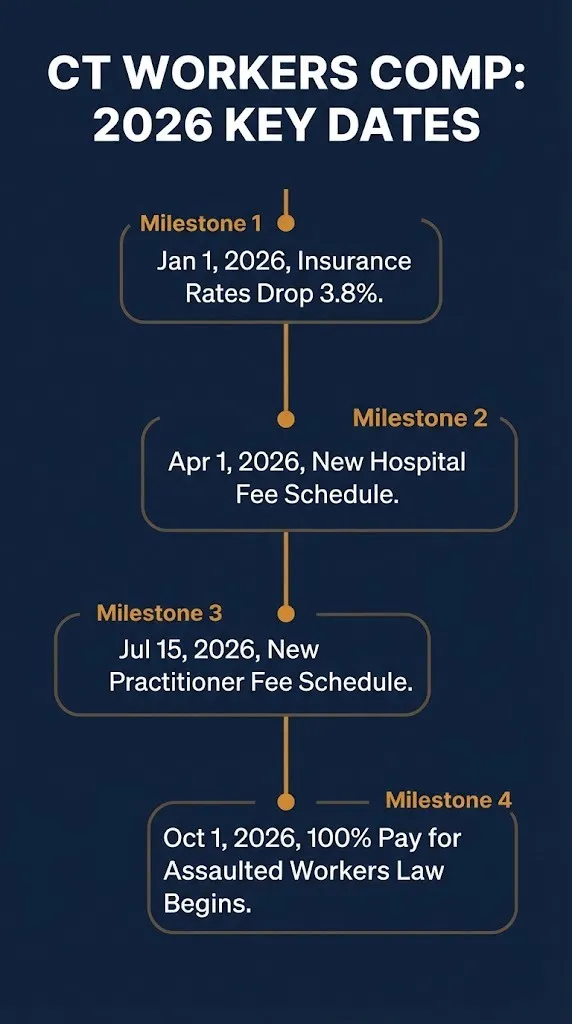
The WCC publishes annual benefit rate tables, fee schedules for medical providers, and guidance documents. Recent 2026 updates from the agency include a hospital and ambulatory surgical center fee schedule effective April 1, 2026, and a practitioner fee schedule effective July 15, 2026.
Injured workers or employers with general questions can reach WCC assistance at 1-800-223-WORK.
What Benefits Are Available Under Connecticut Workers Compensation?
Available benefits scale with the severity and permanence of your injury, from short-term wage replacement to lifetime awards for the most serious cases.
A worker with a minor injury might receive a few weeks of temporary total disability and medical coverage. A worker with a permanent impairment might receive a scheduled award based on the injured body part, calculated using the WCC’s official weeks tables, which now include the expanded 208-week cervical spine schedule discussed above. Death benefits extend to dependents for up to 312 weeks, plus a $4,000 burial allowance.
What Happens Next for CT Workers Compensation
- January 1, 2026 (confirmed): New workers’ compensation insurance rates took effect, averaging a 3.8% voluntary market decrease and 0.4% assigned risk decrease.
- April 1, 2026 (confirmed): Updated hospital and ambulatory surgical center fee schedule took effect.
- July 15, 2026 (confirmed): Updated practitioner fee schedule took effect.
- October 1, 2026 (confirmed): Public Act 26-12’s enhanced wage replacement for assaulted teachers and health care workers takes effect.
- Ongoing: WCC continues publishing annual benefit rate tables each fall for the following claim year, expected again around September 2026 for the October 2026 to September 2027 period.
Frequently Asked Questions
Is Connecticut workers compensation mandatory for employers?
Yes, nearly all Connecticut employers with at least one employee must carry workers’ compensation insurance or qualify as an approved self-insurer.
This is a no-fault requirement set under Chapter 568 of the Connecticut General Statutes.
How much does CT workers comp pay per week?
Your weekly benefit is generally 75 percent of your after-tax average weekly wage, capped at $1,716.00 for injuries dated October 1, 2025 through September 30, 2026.
The exact amount depends on your actual pre-injury earnings, not just the statewide maximum.
What is the average workers comp settlement in Connecticut?
There is no verified statewide average, since Stipulation settlements are individually negotiated based on injury severity, impairment rating, and future medical needs.
Any site quoting a specific average figure is estimating, not citing a published state number.
How long do I have to file a workers comp claim in CT?
You generally have one year from the date of an accidental injury, or three years from the first symptoms of an occupational disease.
Missing this window can permanently bar your right to benefits.
What changed with the Gardner decision?
Connecticut’s Supreme Court briefly expanded how long injured workers could collect temporary partial disability benefits after reaching maximum medical improvement.
The legislature reversed most of that expansion within two months through Public Act 25-12.
Are Connecticut workers comp insurance rates going up in 2026?
No, rates are decreasing overall, marking the twelfth straight year of average declines approved by the Connecticut Insurance Department.
One exception is the office and clerical classification, which saw a rate increase instead of a cut.
What does Public Act 26-12 do for injured workers?
It raises wage replacement to 100% of average weekly earnings for teachers, health care providers, and related employees who cannot work due to an on-the-job assault.
This is a higher rate than the standard 75% after-tax average weekly wage most other injured workers receive, and it takes effect October 1, 2026.
If you’ve been hurt on the job in Connecticut, your first move is filing Form 30C with your employer and the Workers’ Compensation Commission well before the one-year deadline. If you’re negotiating a Stipulation settlement, get your permanent impairment rating and future medical needs documented before agreeing to any lump-sum number.
The single most important date ahead is October 1, 2026, when Public Act 26-12’s expanded benefits for assaulted teachers and health care workers take effect statewide.