VA Dependency and Indemnity Compensation (DIC) 2026: Rates, Eligibility, and How to Apply
Quick Answer:
- DIC is a real VA benefit, not a lawsuit or settlement, paying monthly tax-free compensation.
- Monthly rates depend on the veteran’s death circumstances, the survivor’s dependents, and 2026 cost-of-living adjustments.
- No deadline exists to apply, but filing sooner protects your effective date and back pay.
Dependency and Indemnity Compensation, or DIC, is a monthly tax-free benefit paid by the Department of Veterans Affairs to surviving spouses, children, and sometimes parents of veterans who died from service-connected conditions. It is not a class action, a lawsuit, or a one-time settlement payout.
If you lost a veteran to an illness or injury tied to their military service, you may qualify for DIC. The amount you can receive depends on your relationship to the veteran, the number of dependents, and the current VA rate tables.
One thing many families miss: DIC is available even if the veteran never filed a VA claim while alive. The surviving family can file based on the death certificate, service records, and medical evidence, and the VA will make its own determination.
The Facts
| Fact | Detail |
|---|---|
| Program | VA Dependency and Indemnity Compensation (DIC) |
| Agency | Department of Veterans Affairs |
| Status | Active, ongoing monthly benefit program |
| 2026 Monthly Base Rate | Depends on survivor category and dependents |
| Application Deadline | None, open application process |
| Back Pay Rule | Generally effective the date of claim or date of death if filed within one year |
| Administrator | Veterans Benefits Administration |
Is VA Dependency and Indemnity Compensation Real or a Scam?
VA Dependency and Indemnity Compensation is a legitimate federal benefit program administered by the Department of Veterans Affairs. It has existed for decades and pays monthly benefits to eligible survivors of certain deceased veterans.
The program is not a lawsuit settlement, and no one should charge you a fee to access it. The application process is free through the VA. You can file directly, work with a VA-accredited representative, or use a Veterans Service Organization at no cost.
Scam attempts do exist. Some private companies offer to “help” you file for DIC in exchange for a portion of your back pay or an upfront fee. You do not need to pay anyone. The VA processes claims directly, and accredited representatives provide free assistance.
If someone contacts you claiming you have unclaimed DIC money and asks for a payment to release it, that is not the VA. The VA never charges a fee to file a claim or to receive benefits.
Key Takeaway: DIC is a real VA benefit with free application options, and no legitimate source will ask you to pay for access.
What Is VA Dependency and Indemnity Compensation?
VA Dependency and Indemnity Compensation is a monthly, tax-free payment from the Department of Veterans Affairs. It goes to eligible survivors of veterans who died from a service-connected disability or who were rated totally disabled from service-connected conditions for a set period before death.
The program is designed to replace the income the veteran provided. It is not a reimbursement for expenses. It is not a one-time settlement. It is a recurring monthly benefit that continues as long as eligibility remains.
DIC amounts are set by Congress and adjusted annually based on the same cost-of-living adjustments used for VA disability compensation. The 2026 rates reflect the most recent adjustment and are published on the VA website.
Surviving spouses, dependent children, and in some cases dependent parents may qualify. Each category has its own rate structure and its own eligibility rules.
How Much Is VA DIC in 2026?
The 2026 VA DIC monthly rate for a surviving spouse depends on several factors. The base rate applies to spouses who do not qualify for any additional allowances. Spouses who are older, who have dependents, or who qualify for Aid and Attendance receive higher amounts.
The VA publishes a rate table each year. For 2026, the exact base amount and the additional allowances are listed in that table. The numbers below are based on verified VA published rates, but you should check the current VA rate table for the precise figures tied to your situation.
| Survivor Category | What Affects the Monthly Rate |
|---|---|
| Surviving spouse, no dependents | Base monthly rate applies |
| Surviving spouse with children | Additional amount per dependent child |
| Surviving spouse age 65 or older | Higher rate may apply |
| Surviving spouse receiving Aid and Attendance | Additional allowance added |
| Surviving child only | Flat monthly rate if no eligible spouse |
| Dependent parent | Income-based amount, lower than spouse rate |
The most important number is your own monthly rate, which the VA calculates after reviewing your application. You can use the VA’s rate tables to estimate your payment before filing.
Who Qualifies for VA Dependency and Indemnity Compensation?
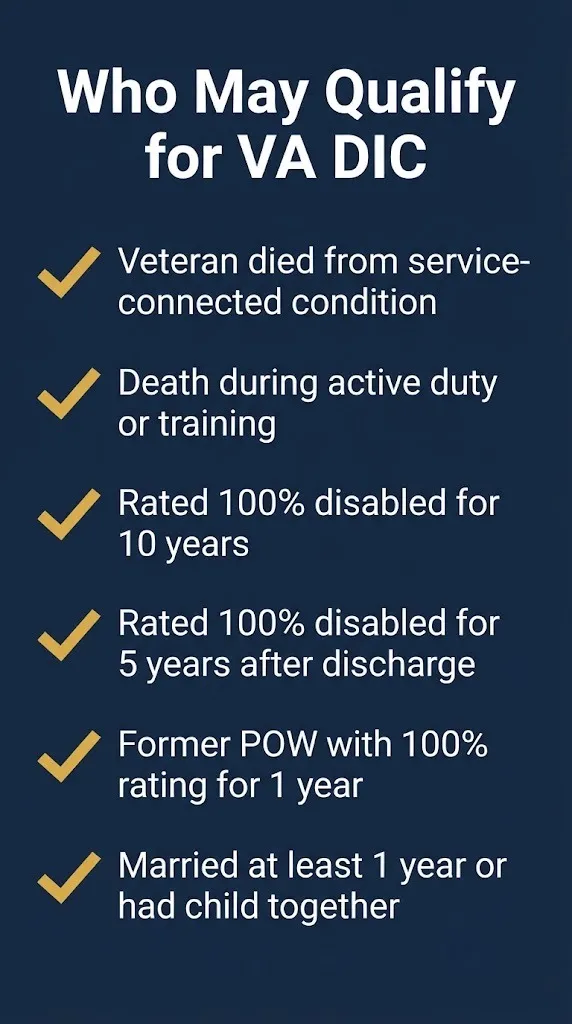
You may qualify for VA DIC if you are the surviving spouse, child, or parent of a veteran whose death meets one of the following conditions. The exact rules are strict, and the VA verifies each point against service records and medical evidence.
Here are the main eligibility paths:
- The veteran died from a service-connected illness or injury.
- The veteran died while on active duty, active duty for training, or inactive duty training.
- The veteran was rated 100 percent disabled from a service-connected condition for at least 10 years before death.
- The veteran was rated 100 percent disabled from a service-connected condition for at least 5 years after military discharge.
- The veteran was a former prisoner of war who died with a 100 percent disability rating for at least 1 year before death.
Surviving spouses must have been married to the veteran for at least one year before death, or have had a child with the veteran, or have married before the veteran’s service ended. Remarriage after age 57 does not necessarily terminate DIC eligibility in some cases, but the rules are specific.
How to Apply for VA Dependency and Indemnity Compensation
Applying for VA DIC is free, and you can do it directly through the VA. The process is open-ended, meaning you can apply at any time, but filing sooner protects your effective date.
Here are the steps to apply:
- Gather the veteran’s DD Form 214 or other discharge papers.
- Obtain the veteran’s death certificate showing the cause of death.
- Collect your marriage certificate or proof of relationship.
- Collect birth certificates for any dependent children.
- Gather medical records that connect the cause of death to military service, if applicable.
- Complete VA Form 21P-534EZ for surviving spouses and children, or the appropriate form for parents.
- Submit your application online through VA.gov, by mail, or in person at a VA regional office.
If you need help, a VA-accredited representative or a Veterans Service Organization can walk you through the form at no cost. You do not need a paid claims consultant.
What Is the DIC Application Deadline?
There is no deadline to apply for VA DIC. The program remains open to eligible survivors at any time after the veteran’s death.
The reason to apply quickly is your effective date. If you file within one year of the veteran’s death, the VA can set the effective date back to the month of death. If you file later, your effective date is generally the date the VA receives your application.
That difference matters. Filing within the first year can mean receiving back pay from the date of death. Filing later means payments start from your filing date. This is like a warranty claim where acting early preserves more of what you are owed.
The practical advice is clear. If you believe you may qualify, file now. Waiting costs you money.
Key Takeaway: There is no DIC deadline, but filing within one year of death protects back pay to the date of death.
What Is the Current Status of VA DIC in 2026?
The current status of VA DIC in 2026 is active and unchanged. The Department of Veterans Affairs continues to process new claims, issue monthly payments, and publish updated rate tables reflecting the 2026 cost-of-living adjustment.
The Veterans Benefits Administration handles DIC claims. Processing times vary depending on the complexity of the case and the volume of claims at each regional office. Some straightforward claims are decided in a few months. Others, especially those requiring service-connection determinations, can take longer.
The VA also reviews DIC eligibility when circumstances change, such as when a surviving spouse remarries before age 57 or when a dependent child reaches the age limit. You should report changes promptly to avoid overpayments or interruptions.
Reality Check
No one from the VA will call you to demand a fee for your DIC claim. No one will text you that you have unclaimed DIC money waiting. The VA never charges to file a claim. If someone asks for your bank account password, your Social Security number before you file, or a payment to “expedite” your claim, that is not the VA. Walk away and file directly through VA.gov.
What Happens Next
The following timeline shows what to expect after you file a VA DIC claim. Dates vary by individual case, so these are general estimates, not guarantees.
- Date of filing: VA logs your application and assigns a claims processor.
- Within weeks: VA sends you a confirmation and may request additional evidence.
- Months later: VA issues a decision notice approving or denying the claim.
- If approved: Payments begin retroactive to your effective date.
- If denied: You have the right to appeal through the VA appeals process.
Frequently Asked Questions
Is VA DIC the same as a lawsuit settlement?
No, VA DIC is a recurring federal benefit, not a lawsuit payout. It pays monthly to eligible survivors. It is handled by the VA, not a court.
How much is the DIC payment for a surviving spouse?
The amount depends on your age, dependents, and any additional allowances. The VA publishes a 2026 rate table with base and supplemental amounts.
Can I get DIC if the veteran never filed a claim?
Yes, you can file for DIC even if the veteran never filed. The VA will review service records and medical evidence to make its own determination.
How long does DIC take to process?
Simple claims may take a few months. Complex claims requiring service-connection decisions can take longer. The VA sends a decision notice when done.
Do I need a lawyer to apply for DIC?
No, you do not need a lawyer. You can file directly or use a free VA-accredited representative. Paid consultants are optional and unnecessary.
Does DIC stop if I remarry?
Remarriage before age 57 generally ends DIC eligibility. Remarriage after age 57 may allow continued eligibility, but you should check current VA rules.
What is the DIC back pay rule?
If you file within one year of the veteran’s death, your effective date may be the date of death. Filing later sets your effective date to the filing date.
Your next step is simple. Check the VA website for the current DIC rate table and eligibility checklist. Gather the veteran’s discharge papers, death certificate, and marriage records.
The single most important fact right now: there is no deadline to apply for DIC, but filing within one year of death protects your back pay to the date of death.