Radiation Exposure Compensation Act 2026: Claim Status, Payout Amounts, and Deadlines
Quick Answer
- The Radiation Exposure Compensation Act is a real federal program, not a scam, that pays eligible radiation victims.
- Payments range from $50,000 to $100,000 per person depending on the disease and exposure category.
- The program has no fixed deadline, but filing promptly after diagnosis strengthens your claim and avoids policy changes.
You or someone you know lived downwind of nuclear test sites. You worked in uranium mines. You were exposed to radiation and now you have cancer. You searched for the Radiation Exposure Compensation Act because you want to know if this program is real and whether you can get paid.
Here is the direct answer. The Radiation Exposure Compensation Act, known as RECA, is a real federal compensation program. It pays one-time lump sums to people who developed certain diseases after exposure to radiation from nuclear testing or uranium industry work.
This guide explains who qualifies, how much the program pays, how to file, and what is happening with RECA in 2026. One surprising verified fact: RECA has already paid out over $2 billion to more than 40,000 claimants since it began, making it one of the longest-running federal compensation programs in U.S. history.
The Facts
| Item | Detail |
|---|---|
| Program Name | Radiation Exposure Compensation Act (RECA) |
| Administering Agency | U.S. Department of Justice |
| Payment Amounts | $50,000, $75,000, or $100,000 per claimant |
| Qualifying Diseases | Specific cancers and non-cancer conditions |
| Filing Deadline | No fixed deadline as of August 2026 |
| Claim Processing Time | Typically 12 to 18 months |
| Total Paid Since Inception | Over $2 billion |
| Total Claims Paid | More than 40,000 |
Is the Radiation Exposure Compensation Act Real?
Yes, the Radiation Exposure Compensation Act is real. It is a federal law passed by Congress and signed into law in 1990. It is not a lawsuit settlement and not a private program.
The program is administered by the Civil Division of the U.S. Department of Justice. Claims are reviewed by federal officials, and payments are issued from the U.S. Treasury. The money is real, the process is documented, and tens of thousands of people have received payments.
RECA exists because the federal government acknowledged that certain groups of Americans were exposed to radiation from Cold War-era nuclear weapons testing and uranium mining. The program is not charity. It is statutory compensation for documented harm.
If you see websites claiming RECA is a new lawsuit or that you must pay to file, those sites are misleading. Filing a RECA claim is free, and the official process goes through the Department of Justice.
Who Qualifies for RECA Compensation?
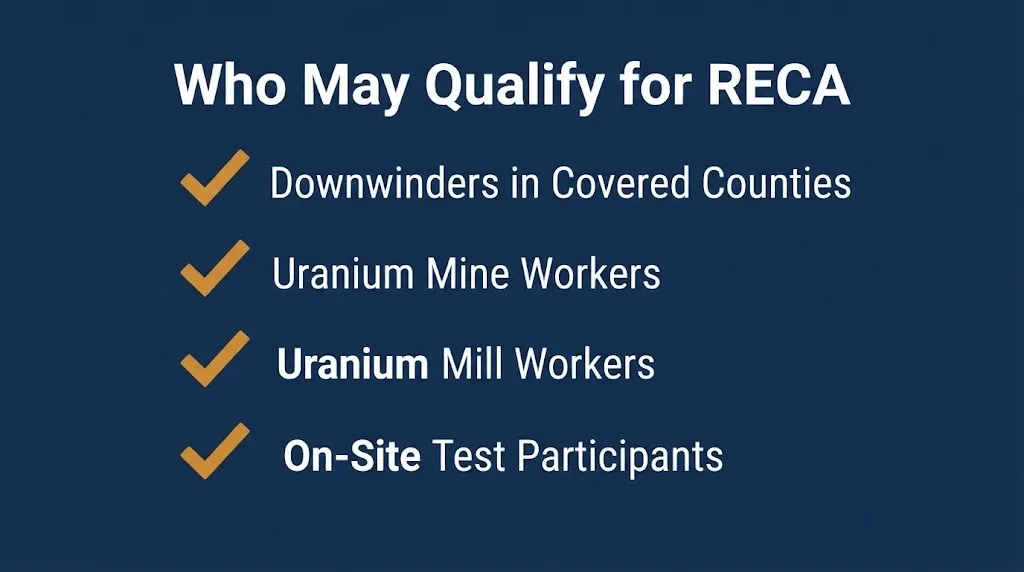
You may qualify for RECA compensation if you belong to one of the covered exposure categories and developed a qualifying disease. The categories are downwinders, uranium industry workers, and on-site participants at nuclear test sites.
Downwinders are people who lived in certain counties of Arizona, Nevada, and Utah during specified periods when atmospheric nuclear testing occurred. These counties are listed in the statute, and the exposure periods range from 1951 to 1962 depending on location.
Uranium industry workers include people who worked in uranium mines, mills, or as ore transporters between 1942 and 1971. They must have developed a qualifying disease after at least one year of employment.
On-site participants include military personnel and civilians who were present at atmospheric nuclear test sites and developed certain cancers.
What Diseases Qualify for RECA Compensation?
RECA covers specific diseases, not every illness a claimant may have. The qualifying diseases vary by exposure category.
For downwinders, the qualifying diseases include leukemia (other than chronic lymphocytic leukemia), multiple myeloma, lymphomas (other than Hodgkin’s disease), and primary cancers of the thyroid, breast, esophagus, stomach, pharynx, small intestine, pancreas, bile ducts, gall bladder, liver, colon, ovary, salivary gland, urinary bladder, brain, lung, and bone.
For uranium workers, the qualifying diseases include lung cancer, pulmonary fibrosis, fibrosis of the lung, cor pulmonale related to fibrosis of the lung, silicosis, and pneumoconiosis.
On-site participants have a list that includes leukemia, multiple myeloma, lymphomas, and primary cancers of the thyroid, breast, esophagus, stomach, pharynx, small intestine, pancreas, brain, lung, liver, colon, ovary, salivary gland, and urinary bladder.
Key Takeaway: Only the diseases listed in the statute qualify. A cancer diagnosis alone is not enough if the disease is not on the covered list.
How Much Does RECA Pay?
RECA pays one-time lump sums of $50,000, $75,000, or $100,000 depending on the exposure category and qualifying disease.
Here is the standard payment table:
| Claimant Category | Payment Amount |
|---|---|
| Downwinder with covered cancer | $50,000 |
| On-site participant with covered cancer | $75,000 |
| Uranium miner with covered disease | $100,000 |
| Uranium mill worker with covered disease | $100,000 |
| Ore transporter with covered disease | $100,000 |
These amounts are set by statute and have not changed since RECA was enacted. The payment is not taxable as income. It is a one-time payment, not ongoing benefits.
The amount is the same regardless of medical bills, lost wages, or the severity of the disease. This is not a lawsuit settlement with individualized damages. It is a statutory payment set by Congress.
How Do I File a RECA Claim?
You file a RECA claim by submitting a claim form and supporting documentation to the Department of Justice. The process is free and does not require a lawyer.
Here are the steps:
- Download the RECA claim form from the Department of Justice website.
- Complete the form with your personal information and exposure history.
- Gather medical records proving your qualifying disease.
- Gather documents proving your presence in a covered area or employment in the uranium industry.
- Submit the claim by mail to the RECA program office.
- Respond to any requests for additional information from the Department of Justice.
- Wait for the claim review and payment decision.
The process is document-heavy. The more evidence you provide, the smoother the review. Missing records are the most common reason for delay.
What Evidence Do I Need for a RECA Claim?
You need medical evidence and exposure evidence to file a RECA claim. Both are required, and neither is optional.
Medical evidence includes pathology reports, hospital records, biopsy results, and a doctor’s statement confirming the diagnosis. The diagnosis must match one of the qualifying diseases exactly.
Exposure evidence varies by category. For downwinders, you need proof of residence in a covered county during the covered period. This can include birth certificates, school records, tax records, property deeds, or affidavits from family members. For uranium workers, you need employment records, union records, or coworker affidavits.
The Department of Justice provides detailed guidance on what qualifies as acceptable evidence. The strongest claims include official government or medical records rather than personal affidavits alone.
Key Takeaway: RECA claims require both medical proof of a qualifying disease and proof of exposure in a covered area or occupation.
What Is the Coldwater Creek Lawsuit and How Does It Relate to RECA?
Coldwater Creek is a site in St. Louis County, Missouri, where radioactive waste from the Manhattan Project was improperly stored. The contamination spread through the creek and surrounding residential areas, exposing people who lived, played, or worked nearby.
A lawsuit against the companies responsible for the contamination was filed, but RECA does not currently cover Coldwater Creek residents. The existing RECA geographic categories are limited to downwinders in Arizona, Nevada, and Utah, and uranium workers nationwide.
In 2024 and 2025, Congress considered expanding RECA to include Coldwater Creek and other sites, including parts of Missouri, New Mexico, Idaho, Montana, Colorado, Tennessee, Kentucky, and Guam. The expansion passed the Senate in 2024 but did not become law.
As of August 2026, Coldwater Creek residents may have separate legal claims through private litigation, but they are not covered by RECA unless the law changes.
Are Coldwater Creek Residents Covered by RECA Now?
No, Coldwater Creek residents are not covered by RECA as of August 2026. The program’s geographic scope remains limited to the original downwinder counties and uranium industry workers.
The Coldwater Creek contamination is real and documented. The Environmental Protection Agency and the Agency for Toxic Substances and Disease Registry have studied the area. But the federal compensation program has not been expanded to include it.
Residents of Coldwater Creek may have other legal options. Private lawsuits against the corporations responsible for the waste, including Mallinckrodt and Cotter Corporation, have been filed. Some have settled. Those settlements are separate from RECA.
If you live near Coldwater Creek and have a radiation-related illness, you should consult an attorney about private litigation options. Filing a RECA claim will not help because the program does not cover that geographic area.
What Are Downwinders and Downwinder Compensation?
Downwinders are people who lived in specific counties downwind of the Nevada Test Site during atmospheric nuclear testing. They are eligible for RECA compensation if they developed a covered cancer.
The testing period ran primarily from 1951 to 1962. During that time, the federal government detonated over 100 atmospheric nuclear weapons at the Nevada Test Site. Radioactive fallout drifted across parts of Nevada, Utah, and Arizona.
The covered counties are listed in the RECA statute. They include:
- In Arizona: Apache, Coconino, Gila, Navajo, Yavapai, and part of Mohave County
- In Nevada: Eureka, Lander, Lincoln, Nye, White Pine, and part of Clark County
- In Utah: Beaver, Garfield, Iron, Kane, Millard, Piute, San Juan, Sevier, Washington, and Wayne
If you lived in one of these counties during the covered period and developed a qualifying cancer, you may be eligible for the $50,000 downwinder payment.
Key Takeaway: Downwinder compensation is a $50,000 payment for people who lived in specific counties and developed a covered cancer after exposure to nuclear test fallout.
Reality Check
No legitimate RECA claim requires an upfront fee. The Department of Justice does not charge to file. No private company can speed up your RECA payment for a fee. If someone calls or emails offering to “process” your RECA claim for money, that is a scam. The official process is free, and you can file directly with the Department of Justice.
What Is the Current Status of RECA in 2026?
RECA remains active in its original form as of August 2026. The program continues to accept and pay claims from eligible downwinders, uranium workers, and on-site participants.
The expansion effort, known as RECA Reauthorization, has stalled in Congress. The Senate passed an expansion bill in 2024 that would have added Coldwater Creek, parts of New Mexico, and other sites, and would have increased payment amounts. The House did not pass the bill before the end of the legislative session.
A new Congress began in 2025, and expansion advocates have reintroduced legislation. As of August 2026, no expansion bill has been signed into law. The original RECA program continues, but the expanded categories and higher payments are not in effect.
If you are watching for changes, the key legislation to monitor is the RECA Reauthorization Act. It has bipartisan support but has not crossed the finish line.
How Long Does a RECA Claim Take?
A RECA claim typically takes 12 to 18 months from submission to payment. The timeline depends on the completeness of your documentation and the workload of the Department of Justice review team.
Claims with complete medical records and strong exposure evidence process faster. Claims missing key documents are delayed while the Department requests additional information.
The Department of Justice publishes annual reports on RECA claim processing. Those reports show the number of claims received, approved, denied, and pending. The backlog has fluctuated over the years, but 12 to 18 months is a realistic expectation for a complete claim.
Can I File a RECA Claim for a Deceased Family Member?
Yes, you can file a RECA claim on behalf of a deceased family member if that person would have qualified. The claim becomes part of the deceased person’s estate.
The executor or administrator of the estate files the claim. If no formal estate exists, a surviving spouse, child, or other heir may file, but the Department of Justice may require documentation establishing your authority to act.
The qualifying disease must still be one of the covered diseases, and the exposure evidence must still establish that the deceased person belonged to a covered category.
The payment goes to the estate, not to the individual filer directly. How the money is distributed depends on the deceased person’s will or state intestacy laws.
What Happens Next
Here is the expected timeline for RECA-related developments in 2026 and beyond:
- Ongoing: The Department of Justice continues processing claims under the original RECA statute.
- Late 2026: Possible congressional action on RECA expansion legislation.
- If expansion passes: New geographic areas and higher payment amounts would phase in.
- If expansion fails: The original program continues unchanged.
- For claimants: Submit complete documentation now to avoid delays regardless of legislative changes.
Frequently Asked Questions
Is RECA a one-time payment or monthly benefits?
RECA is a one-time lump sum payment.
It is not ongoing monthly compensation.
The amount is $50,000, $75,000, or $100,000 depending on your category.
Do I need a lawyer to file a RECA claim?
No, you can file a RECA claim without a lawyer.
The process is free and the Department of Justice provides claim forms and instructions.
A lawyer may help if your claim is denied and you need to appeal.
Is RECA compensation taxable?
No, RECA payments are not taxable as income.
The payments are excluded from federal income tax.
They do not affect Social Security or Medicare benefits.
What if my county is not on the RECA list?
You are not eligible for RECA unless your county or occupation is covered.
The geographic list is specific and has not changed since 1990.
Contact your member of Congress about expansion if you believe your area should be added.
Can uranium workers get compensated for lung cancer?
Yes, uranium miners with lung cancer may qualify for the $100,000 payment.
The lung cancer must be primary lung cancer, not cancer that spread from another site.
Employment records proving at least one year of uranium mining are required.
What is the difference between RECA and the Coldwater Creek lawsuit?
RECA is a federal compensation program with set payments and eligibility rules.
The Coldwater Creek lawsuit is private litigation against corporations that contaminated the site.
Coldwater Creek is not currently covered by RECA.
Can I file a RECA claim if I already received a settlement?
It depends on the settlement and the disease.
If you received compensation for the same disease from another source, RECA may offset or deny the claim.
Disclose all prior compensation when you file.
File Your Claim Now and Do Not Wait for Expansion
The Radiation Exposure Compensation Act is real and paying claims. If you or a family member lived in a covered county or worked in the uranium industry and developed a qualifying disease, gather your records and file now.
Do not wait for Congress to expand the program. The original RECA remains active, and filing under the current rules protects your rights while the legislative process continues.
The single most important action: download the claim form from the Department of Justice and start assembling your medical and exposure records today.