What Does Compensation Mean? Full Legal Definition Guide (2026)
Quick Answer
- Compensation is money or benefits given to repay someone for a loss, injury, or service performed.
- The amount you could get depends entirely on the legal context (wages, injury damages, or benefit payouts) and is not a fixed figure.
- There is no single deadline for “compensation” as a term. Deadlines only exist inside specific claims, like a lawsuit or benefits program.
If you searched “compensation definition” because you saw the word in a settlement notice, a job offer, or a court filing, you want a straight answer, not a law school lecture. This article gives you that answer, then breaks down how the word changes meaning depending on where you found it.
Compensation, in its simplest legal sense, is a pecuniary remedy awarded to an individual who has sustained an injury in order to replace the loss caused by that injury. It also covers ordinary pay for work. Courts, employers, and insurance companies all use the word, but they don’t always mean the same thing.
This matters because the word shows up everywhere: your paycheck, a workers’ comp form, a class action notice, an eminent domain letter. One surprising detail: in Louisiana’s civil law system, “compensation” has a completely separate meaning tied to canceling out debts between two people, not injury payments at all.
The Facts
| Category | Detail |
|---|---|
| Term | Compensation |
| Field | Legal, employment, and consumer law |
| Core Meaning | Payment or benefit given to repay a loss, injury, or service |
| Common Legal Uses | Personal injury damages, workers’ compensation, employment pay, eminent domain payments |
| Fixed Amount | Not applicable, amount depends on the specific claim or job |
| Governing Law | Varies by state and by claim type (tort law, labor law, contract law) |
| Where to Verify a Specific Claim | The official settlement or claims administrator site for that case |
Not yet determined and “check the official settlement website” apply anytime someone asks how much compensation they personally could receive. This article defines the word. It does not estimate your payout, because that number only exists inside an actual claim, case, or job offer.
Compensation Meaning
Compensation means giving someone money, goods, or a benefit to make up for something they lost, were owed, or provided. It is one of the oldest concepts in law, tracing back to the basic idea that if you harm or owe someone, you owe them a way to be made whole.
The word carries two broad meanings that people mix up constantly:
- Pay for work or service. Wages, salary, bonuses, and benefits an employer gives an employee.
- Repayment for a loss. Money awarded after an injury, property damage, breach of contract, or government taking of land.
Both meanings share the same root idea: balancing something out. Compensation is the act of providing something, such as money, to someone as recompense for loss, injury, or suffering, according to Justia’s legal dictionary. The same source notes it can also describe a kind of payment given in return for a valuable item supplied or for a service offered.
Key Takeaway: Compensation always means “making someone whole,” whether that’s through a paycheck for work done or a payout for harm suffered.
What Does Compensation Mean
What does compensation mean in plain terms? It means something was taken, owed, or damaged, and a payment or benefit is meant to balance the scale. Cornell Law School’s Wex dictionary frames it through a real example: workers’ compensation laws protect employees who suffer harm on the job by providing fixed benefits or monetary awards in an attempt to avoid the need for litigation.
That example shows the practical side of the word. Instead of forcing an injured worker to sue their employer and prove fault in court, most states created a compensation system that pays a set benefit automatically once the injury is confirmed. The word “compensation” in that context signals a no-fault, faster path to payment.
In everyday consumer disputes, the word shows up differently. A store might offer you a gift card as compensation for a bad product. An airline might offer a travel voucher as compensation for a canceled flight. None of that requires a lawsuit. It’s simply a business choosing to make something up to you.
Define Compensation
To define compensation cleanly: it is a payment, benefit, or other remedy given to offset a loss, an injury, or work performed. Black’s Law Dictionary, one of the most cited legal references in U.S. courts, defines it even more directly.
According to the free legal dictionary drawing on Black’s Law framework, compensation is indemnification, payment of damages, making amends, that which is necessary to restore an injured party to their former position.
That phrase, “restore an injured party to their former position,” is the legal north star for how courts think about compensation in injury cases. The goal isn’t to punish anyone (that’s a separate legal category called punitive damages). The goal is to put the harmed person back where they would have been if the harm never happened, as closely as money can manage that.
Key Takeaway: Legally, compensation aims to restore, not punish. Punishment falls under a different category called punitive damages.
Definition of Compensation
The definition of compensation splits into several legal buckets depending on which field of law you’re in. Merriam-Webster’s Dictionary of Law lists four separate legal meanings, showing just how broad the word really is.
Per that source, compensation can mean: the act of compensating; in Louisiana civil law, the ending of mutual obligations between two people usually by operation of law; something that makes up for a loss such as payment received for a breach of contract; and payment to unemployed or injured workers or their dependents, including unemployment compensation and workers’ compensation.
Here’s a simple table breaking those four legal buckets down:
| Legal Bucket | What It Covers |
|---|---|
| General compensation | The basic act of making up for a loss |
| Louisiana civil law compensation | Canceling mutual debts between two parties |
| Breach-of-contract compensation | Payment covering a contract loss |
| Benefits compensation | Unemployment or workers’ comp payments to injured or jobless workers |
Most people searching this term care about the general and benefits categories. If you’re dealing with a specific claim, the definition that matters is the one written into that program’s rules, not the dictionary definition alone.
Meaning of Compensation
The meaning of compensation shifts once you move from dictionaries into actual statutes and regulations. Federal law, for example, defines compensation with extreme precision when it comes to specific benefit programs.
Under the Railroad Retirement Act regulations, compensation means any form of payment made to an individual for services rendered as an employee for an employer, services performed as an employee representative, and any separation or subsistence allowance paid under certain benefit provisions.
That level of detail exists because benefit programs need exact rules to decide who qualifies and for how much. A dictionary definition works fine for everyday conversation. It won’t tell you whether a specific bonus, allowance, or side payment counts toward your benefit calculation. For that, you need the actual statute or plan document governing your situation.
Think of it like a store return policy. “We accept returns” sounds simple until you read the fine print about receipts, time limits, and condition of the item. Compensation works the same way: simple concept, detailed rules underneath.
What Does the Word Compensation Mean
Breaking the word down to its roots helps explain why it covers so much ground. “Compensation” comes from the Latin “compensare,” meaning to weigh one thing against another, or to counterbalance.
That root explains why the word applies to both paychecks and injury payments. In both cases, something is being weighed against something else: your labor against your wage, or your loss against a payment meant to offset it.
The Cambridge Dictionary captures the modern everyday use well, defining it as money that is paid to someone in exchange for something that has been lost or damaged, or for work performed. It also notes the employment usage: the combination of money and other benefits that an employee receives for doing their job.
So when someone asks “what does the word compensation mean,” the honest answer is: it depends whether you’re asking about a paycheck, a lawsuit, or a government benefit program. Context decides which flavor of the definition applies.
Key Takeaway: The word’s Latin root, meaning “to counterbalance,” explains why it stretches across pay, benefits, and injury law alike.
Compensation Def
Short version, for anyone who wants the def without the history lesson: compensation is payment or benefit given to make up for a loss, harm, or service. That’s the working definition across nearly every legal context.
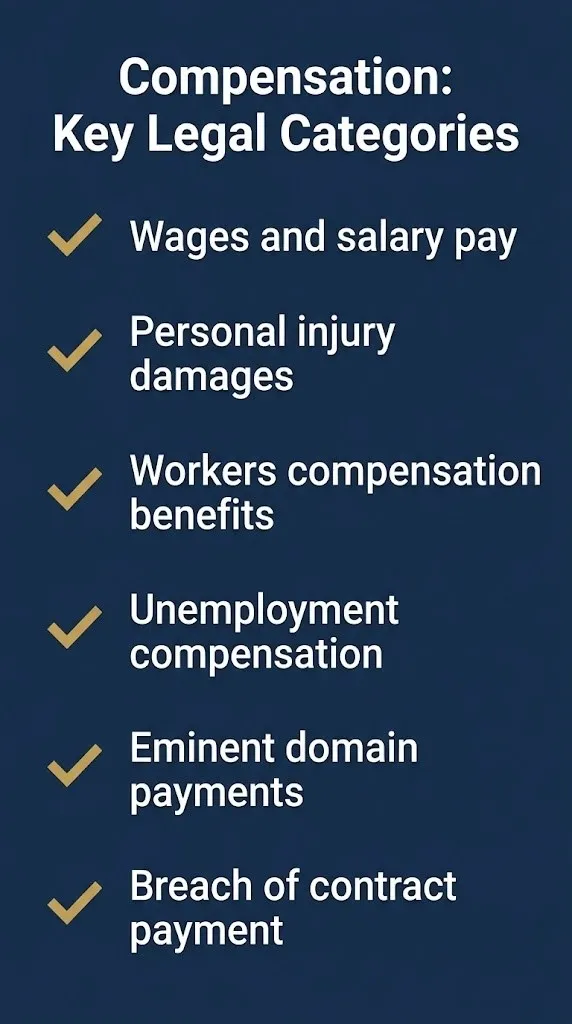
Here’s a quick-reference list of what typically counts as compensation in U.S. law:
- Wages, salary, bonuses, and commission for work performed
- Damages awarded in a personal injury lawsuit
- Workers’ compensation benefits after a job injury
- Unemployment compensation after a qualifying job loss
- Payment for property taken by the government (eminent domain)
- Settlement payments in a class action or consumer claim
USLegal’s reference material narrows the employment version further, noting that compensation in the employment context covers all rewards received by a worker for duty and services rendered related to a job, which may include hourly wages, salary, overtime, bonuses, stock options, health insurance, pension plans, and vacation or sick time.
That’s a much bigger list than most people expect. Compensation in a job offer isn’t just your salary number. It’s the whole package.
What Is the Definition of Compensation
If you’re asking what is the definition of compensation for a specific type of claim, here’s how the major categories break down in plain language.
Personal injury compensation covers medical bills, lost wages, pain and suffering, and property damage after an accident someone else caused. Workers’ compensation covers medical care and partial wage replacement after a workplace injury, regardless of fault. Unemployment compensation covers partial wage replacement after a qualifying job loss. Eminent domain compensation covers the value of land or property the government takes for public use.
A newer legal reference source frames the modern definition this way: compensation refers to something, typically money, given to an individual or entity in exchange for work or services performed, or to make up for a loss, injury, or damage experienced, aiming to restore balance or properly reward contributions.
Reality Check
No government agency or court sends unsolicited texts offering “compensation” for a claim you never filed. Filing a legitimate claim, whether workers’ comp, a class action, or unemployment benefits, is always free through the official channel. Anyone asking for a fee upfront to “release your compensation” is running a scam, not processing a claim.
Compensation Mean (In a Lawsuit Context)
When people search “compensation mean” alongside a specific lawsuit or settlement notice, they usually want to know what category of payment they’re being offered. Lawsuits typically split compensation into two types.
Economic compensation covers costs you can add up with receipts: medical bills, lost wages, repair costs, out-of-pocket expenses. Non-economic compensation covers harder-to-measure harm: pain and suffering, emotional distress, loss of enjoyment of life.
| Type | Covers | Proof Needed |
|---|---|---|
| Economic | Medical bills, lost wages, repairs | Receipts, pay stubs, invoices |
| Non-economic | Pain, suffering, emotional harm | Medical records, testimony |
| Punitive (rare) | Punishing extreme misconduct | Court finding of malice or gross negligence |
If you received a notice using the word “compensation” tied to a specific case number, that notice should spell out which category applies to you. If it doesn’t, that’s a red flag worth double-checking against the official case record.
Key Takeaway: Not all compensation is equal. Economic compensation needs paperwork; non-economic compensation relies on the severity of your circumstances.
Compensation Means (How Courts Apply It)
Compensation means different dollar outcomes depending on the theory of the case. In a breach of contract claim, compensation typically aims to give you the benefit you would have received if the contract had been honored.
In a negligence claim (a typical personal injury or auto accident case), compensation aims to cover your actual losses caused by someone else’s carelessness. In eminent domain, compensation must reflect fair market value of the property taken, a rule rooted directly in the U.S. Constitution’s requirement that Senators and Representatives, and by extension the broader constitutional compensation clause tradition, receive payment for service or property taken.
How Compensation Is Calculated in a Class Action Settlement
This is the version of the question most people land on this site to answer. Compensation in a class action or mass settlement is not calculated off a dictionary definition. It’s calculated off the settlement agreement itself.
Here’s the general process most settlements follow:
- A total settlement fund gets approved by the court.
- Legal fees and administrative costs get deducted first.
- The remaining fund is split among approved claims.
- Payout tiers may exist based on severity, proof submitted, or purchase amount.
- Checks or payments go out after the claims deadline and final approval hearing pass.
Because every settlement is different, there is no universal number for “how much is compensation.” Not yet determined is the honest answer unless you’re looking at one specific, named case with a published settlement fund and claim count.
What Happens Next
Expected [ongoing]: The word “compensation” continues to apply broadly across employment, injury, and benefits law with no single unifying dollar figure.
Expected [per individual claim]: If you are pursuing compensation through a specific lawsuit, workers’ comp claim, or settlement, that individual case follows its own timeline of filing, review, and payout.
Expected [2026 and beyond]: State and federal compensation-related laws, including workers’ comp and unemployment compensation rules, continue to see periodic updates, so check your state labor department or the relevant court record for the most current rule set.
Frequently Asked Questions
What does compensation mean in simple terms?
Compensation means payment or a benefit given to make up for a loss, an injury, or work performed.
It’s the legal way of saying “making something right” through money or benefits.
Is compensation the same as a settlement?
Not exactly. A settlement is an agreement to resolve a dispute, and compensation is often the payment that comes out of that settlement.
You can receive compensation without a settlement (like a paycheck), and a settlement can include forms of compensation beyond cash.
What’s the difference between compensation and damages?
Damages is the legal term for the money awarded by a court, while compensation is the broader concept of making someone whole.
Compensatory damages are simply damages calculated to match your actual losses.
Does compensation always mean money?
No. Compensation can include benefits like health insurance, stock options, vacation time, or in-kind goods, not just cash.
Employment compensation packages regularly include non-cash benefits.
What is workers’ compensation?
Workers’ compensation is a state-run benefit system that pays medical costs and partial wages to employees hurt on the job, without requiring a lawsuit.
It’s a no-fault system, meaning you generally don’t need to prove your employer was careless to receive benefits.
How much compensation can I expect from a lawsuit?
There is no fixed amount. It depends entirely on the type of claim, your proven losses, and the specific settlement or verdict in your case.
Check the official court record or settlement administrator site for any figures tied to your specific situation.
What does compensation mean on a job offer?
On a job offer, compensation usually means your total pay package, including salary, bonuses, and benefits, not just your base salary number.
Always ask for the full compensation breakdown before accepting an offer.
Can I get compensation without going to court?
Yes. Many compensation types, including workers’ comp, unemployment benefits, and negotiated settlements, don’t require a courtroom trial.
Litigation is one path to compensation, not the only one.