Camp Lejeune Compensation 2026: What You Can Actually Get, and When
Quick Answer
- Camp Lejeune compensation is real: the government has paid $723 million and offered $907 million through June 15, 2026, but under 1% of claims are resolved.
- Elective Option payouts run $100,000 to $550,000 per person, based on illness tier, exposure length, and wrongful death add-ons.
- A federal court ordered the DOJ and plaintiffs to reach a global settlement framework by October 30, 2026, the most important date on the calendar right now.
You served, lived, or worked at Camp Lejeune, and now you’re trying to figure out if the compensation talk is real. It is, but the numbers on most legal-marketing pages don’t match what the court record actually shows.
Roughly 407,000 people filed administrative claims with the Navy before the deadline closed. As of the June 15, 2026 joint status report, resolution sits well under 1%. The single date that matters most right now: October 30, 2026, the deadline a four-judge panel set for the government and plaintiffs’ leadership to hammer out a global settlement structure.
This article covers what compensation actually pays, how the VA benefit differs from the lawsuit track, and what happens next in the litigation. One detail most coverage skips: no jury has ever valued a Camp Lejeune claim, because no bellwether trial has happened yet, nearly four years after the law passed.
The Facts
| Case | In re: Camp Lejeune Water Litigation (MDL-2218), U.S. District Court, Eastern District of North Carolina |
| Status | Active. Elective Option paying select claims. No bellwether trial has occurred. Global settlement talks ordered by court |
| Fund Size | No fixed fund. Congressional Budget Office estimates total federal exposure up to $21 billion. $907 million offered, $723 million paid as of June 15, 2026 |
| Est. Per Person | Elective Option: $100,000 to $450,000 (up to $550,000 with 5+ years exposure plus wrongful death add-on) |
| Claim Deadline | Administrative filing closed August 10, 2024. No new CLJA claims accepted. Global settlement deadline: October 30, 2026 |
| Administrator | Department of the Navy (Elective Option) and DOJ Torts Branch (litigation). No independent settlement fund administrator yet |
| Proof Needed | 30+ days on base between August 1, 1953 and December 31, 1987, plus a qualifying diagnosis and supporting medical records |
Is Camp Lejeune Compensation Legit, or a Scam?
Camp Lejeune compensation is a real, government-run program, not a scam. It exists because Congress passed the Camp Lejeune Justice Act in 2022, part of the broader PACT Act.
The program has two separate tracks. One is the Department of the Navy’s Elective Option, a faster administrative payout. The other is a federal lawsuit filed in the Eastern District of North Carolina, the mandatory venue for every CLJA case.
Real red flags exist, though. Nobody legitimate texts you out of nowhere promising a settlement check. Filing a claim with the Navy or the VA costs nothing.
Here’s the part most sites gloss over: less than 2% of Elective Option claims with basic documentation have enough support to reach DOJ approval, according to litigation trackers monitoring the program in June 2026. That’s a documentation bottleneck, not proof your claim is weak.
Key Takeaway: Camp Lejeune compensation is a legitimate federal program, but the Elective Option’s own documentation screen is currently blocking most claims from moving forward.
How Much Is Camp Lejeune Compensation Worth in 2026?
Camp Lejeune compensation through the Elective Option ranges from $100,000 to $550,000, depending on your diagnosis tier and how long you were exposed.
The government sorts qualifying illnesses into two tiers. Tier 1 covers cancers most strongly linked to the contaminated water. Tier 2 covers other serious conditions.
Elective Option Payout Structure
| Tier | Conditions | Base Range |
|---|---|---|
| Tier 1 | Kidney cancer, liver cancer, bladder cancer, leukemia, non-Hodgkin’s lymphoma | $150,000 to $450,000 |
| Tier 2 | Multiple myeloma, Parkinson’s disease, kidney disease/end-stage renal disease, systemic sclerosis | $100,000 to $400,000 |
Exposure length raises the number within each tier. Cases involving a death from a qualifying illness add another $100,000 on top. The government has not published a fixed schedule for lawsuits that go to trial instead, because no trial verdict exists yet as of this writing.
Reality Check: No one can guarantee you a specific dollar figure before the Navy reviews your file, and anyone quoting you a firm number without seeing your records is guessing. Filing directly with the Navy or the VA is always free, and paid “claim processing” services outside your attorney’s normal fee are not required to get your claim moving.
VA Compensation for Camp Lejeune Water Contamination: How Much Does It Pay?
VA compensation for Camp Lejeune water contamination is a separate, ongoing monthly disability benefit, not a one-time settlement check. It pays if you have one of eight presumptive conditions tied to the water.
Those eight conditions are: adult leukemia, aplastic anemia and other myelodysplastic syndromes, bladder cancer, kidney cancer, liver cancer, multiple myeloma, non-Hodgkin’s lymphoma, and Parkinson’s disease.
Because these are “presumptive,” you don’t need to prove the water caused your illness. You only need to show you served, lived, or worked on base for 30 days between August 1, 1953 and December 31, 1987.
At a 100% disability rating, veterans without dependents currently receive $3,938.58 a month, tax-free, based on VA rates in effect through 2026. Benefits can be paid retroactively to August 10, 2022, the date the PACT Act was signed. Unlike the lawsuit track, there is no filing deadline for VA disability claims.
Key Takeaway: VA disability compensation and Camp Lejeune Justice Act lawsuit money are two different systems, and filing for one does not cancel your right to pursue the other.
Camp Lejeune Bladder Cancer Lawsuit: What Compensation Looks Like
A Camp Lejeune bladder cancer lawsuit falls under Tier 1 of the Elective Option, meaning it carries one of the program’s higher base payout ranges.
Bladder cancer is one of the five illnesses selected for the Track 1 bellwether cases now pending before Judge James Dever in the Eastern District of North Carolina. Those test cases are meant to set values for thousands of similar claims.
Elective Option offers for bladder cancer generally fall in the $150,000 to $450,000 range, before any exposure-length or wrongful death adjustments. If you decline that offer, your case moves into the federal lawsuit track instead, where no jury has yet valued any Camp Lejeune claim.
Think of it like a car insurance total-loss estimate you’re free to reject. Rejecting the number doesn’t end your claim, it just moves you to a different process with a different, unpredictable timeline.
Camp Lejeune Kidney Cancer Lawsuit: What Compensation Looks Like
A Camp Lejeune kidney cancer lawsuit also qualifies under Tier 1, the highest compensation category in the Elective Option.
Kidney cancer is included among the Track 1 bellwether illnesses, alongside bladder cancer, leukemia, non-Hodgkin’s lymphoma, and Parkinson’s disease. The Agency for Toxic Substances and Disease Registry has linked kidney cancer to the trichloroethylene (TCE) found in Camp Lejeune’s water supply.
Base Elective Option offers for kidney cancer sit in the same $150,000 to $450,000 range as other Tier 1 illnesses. Documentation matters heavily here: the Navy is applying strict screening, including a rule requiring diagnosis within 35 years of last exposure.
If you were exposed at age 20, for example, you’d generally need a kidney cancer diagnosis by around age 55 to meet that window under current Elective Option guidance.
Camp Lejeune Leukemia Lawsuit: What Compensation Looks Like
A Camp Lejeune leukemia lawsuit is one of the five illness categories chosen for the first bellwether trials in the Eastern District of North Carolina.
Leukemia sits in Tier 1, the higher-paying category, with base Elective Option offers between $150,000 and $450,000. Sample settlement disclosures from earlier in the program showed a leukemia claimant with one to five years of base exposure receiving an offer around $300,000, though individual results vary and aren’t guaranteed.
Because leukemia cases are part of the bellwether group, the outcome of those trials, whenever they finally happen, will likely shape how the government values every other pending leukemia claim in the docket of roughly 3,590 active lawsuits.
How to File for Camp Lejeune Compensation
New administrative claims are no longer accepted; the filing deadline closed August 10, 2024. If you already filed before that date, here’s how your case moves forward now.
- Confirm the Navy has your administrative claim on file and note your claim number.
- Gather proof of 30+ days on base between August 1953 and December 1987.
- Collect medical records confirming your qualifying diagnosis.
- Wait for or request Elective Option eligibility review from the Navy.
- If offered an Elective Option payout, respond within 60 days to accept or decline.
- If declined, offer expires, or your claim is denied, you may file suit in the Eastern District of North Carolina.
- You generally have 180 days after a denial or six-month non-response to file that lawsuit.
- Keep every letter and offer document; deadlines here are firm and rarely extended.
Key Takeaway: If you already filed before the August 2024 deadline, your case is still alive, but the 60-day and 180-day response windows on any letter you receive are not flexible.
How to File a VA Claim for Camp Lejeune Water Contamination
Filing a VA disability claim for Camp Lejeune water contamination is separate from the lawsuit and has no deadline, so filing sooner only helps your back pay.
- Confirm you served, lived, or worked on base for 30+ days between August 1953 and December 1987.
- Gather medical records showing a diagnosis of one of the eight presumptive conditions.
- Complete VA Form 21-526EZ, Application for Disability Compensation.
- Note “Camp Lejeune water contamination exposure, PACT Act presumptive” as your service connection basis.
- Submit online through VA.gov, by mail, or through a Veterans Service Officer.
- Attend any scheduled Compensation and Pension exam.
- Track your claim status and respond quickly to any VA requests for more evidence.
Filing an “Intent to File” first can lock in an earlier effective date, which matters because your effective date controls how far back your payments reach.
Camp Lejeune Lawsuit Symptoms: Which Conditions Qualify
Camp Lejeune lawsuit symptoms cover a specific list of diagnosed illnesses, not general symptoms like fatigue or headaches on their own.
The Elective Option recognizes eight core conditions across its two tiers: kidney cancer, liver cancer, bladder cancer, leukemia, non-Hodgkin’s lymphoma, multiple myeloma, Parkinson’s disease, and kidney disease.
A broader list applies to claims pursued through the lawsuit track outside the Elective Option, including:
- Pancreatic cancer
- Renal cell carcinoma
- Prostate cancer
- Testicular cancer
- Ovarian and thyroid cancer
- Soft tissue sarcoma
- Birth defects and impaired fetal development
If your diagnosis isn’t on the Elective Option list, you may still have a claim through the federal lawsuit, just not the faster administrative payout path.
Contaminated Water Camp Lejeune Lawsuit: Where the Case Stands Now
The contaminated water Camp Lejeune lawsuit is currently stuck in pretrial motion fights, with no bellwether trial date confirmed as of August 2026.
Roughly 3,590 lawsuits remain pending in the Eastern District of North Carolina, spread across four judges. Expert discovery on causation is largely finished. What’s left are dozens of motions over which expert testimony judges will allow.
A judge already struck a key government expert’s report earlier in 2026 after finding nearly 300 undisclosed revisions. Plaintiffs also lost an appeal challenging the court’s ruling that these cases will not go before a jury, which weakens their negotiating leverage heading into the fall.
Reality Check: Some marketing pages have circulated specific bellwether “verdict” dollar figures. No verified court record supports any bellwether settlement or verdict as of this writing. Treat any specific bellwether payout number you see online with real skepticism until it’s confirmed on the court docket.
Camp Lejeune Water Contamination Lawsuits: Settlement Fund and Deadline Update
Camp Lejeune water contamination lawsuits do not yet have a fixed settlement fund. The government pays claims individually through the Elective Option as they’re approved.
As of the June 15, 2026 joint status report, the Department of Justice had offered $907 million and paid $723 million, up from $794.7 million offered and $570.7 million paid roughly two months earlier.
Key Takeaway: Payments are accelerating, but the underlying bottleneck hasn’t budged. Fewer than 1% of the roughly 407,000 filed claims are resolved, and only about 12% of claimants qualify for the faster Elective Option track at all.
The four-judge panel’s October 30, 2026 deadline for a global settlement framework is the development to watch. If that framework materializes, it could finally give every pending claim a predictable payout range instead of the current case-by-case guessing.
When Will Camp Lejeune Settlement Checks Go Out?
If you accept an Elective Option offer, the Navy is expected to process payment within 60 days of receiving your signed paperwork.
For the broader lawsuit track, timing is far less predictable. No bellwether trial has occurred yet, and no global settlement framework has been finalized as of this writing.
Litigation trackers following the June 2026 status report note that even fast Elective Option claims can take 6 to 18 months from initial filing to final payment once documentation, review, and the 60-day acceptance window are all factored in. That’s assuming your claim clears the Navy’s documentation screen in the first place.
What Happened at Camp Lejeune? The Water Contamination Explained
Drinking water at Marine Corps Base Camp Lejeune was contaminated with industrial chemicals from 1953 through 1987, exposing anyone who lived or worked there for 34 years.
The contamination came from leaking underground fuel tanks, industrial waste disposal, and an off-base dry cleaner. Two on-base water treatment plants, Hadnot Point and Tarawa Terrace, were affected by chemicals including trichloroethylene (TCE), tetrachloroethylene (PCE), benzene, and vinyl chloride.
The most contaminated wells weren’t shut down until 1985, two years before the exposure period officially ends under the law. It took until 2022, and passage of the Camp Lejeune Justice Act as part of the PACT Act, for Congress to open a path to compensation. Before that, a 2016 case seeking damages for hundreds of former residents was dismissed under a North Carolina statute of repose.
Who Qualifies for Camp Lejeune Compensation?
You may qualify for Camp Lejeune compensation if you lived, worked, or were in utero on base for at least 30 days between August 1, 1953 and December 31, 1987.
This applies to veterans, family members, and civilian workers, not just active-duty service members. A dishonorable discharge generally disqualifies a veteran from Elective Option compensation, though VA disability rules differ.
You also need a qualifying diagnosis. That means one of the illnesses recognized under the Elective Option or, for the VA track, one of the eight presumptive conditions. Strength of your medical documentation, not just your diagnosis, often determines whether your claim actually clears the Navy’s review.
What Happens Next
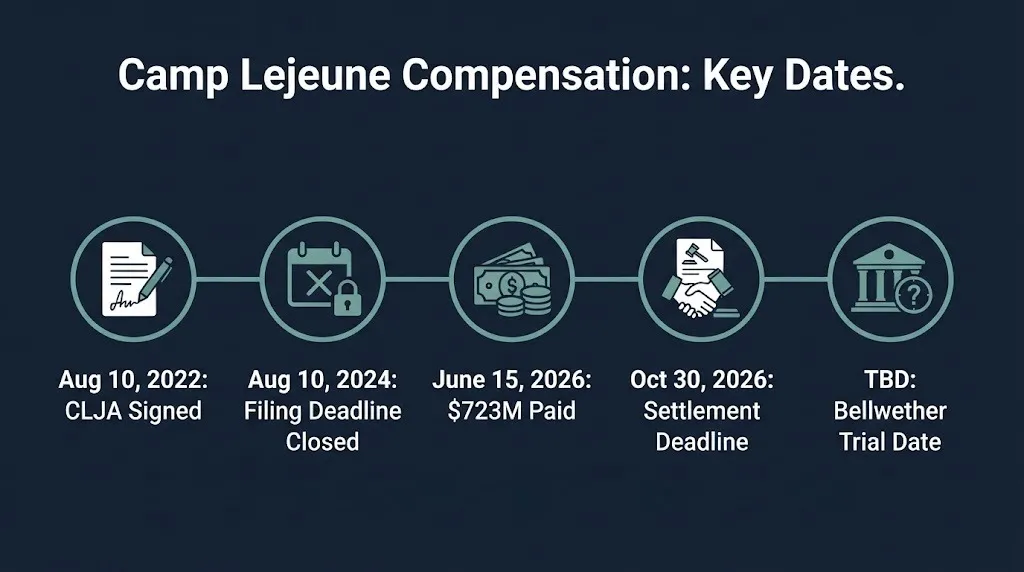
August 10, 2022: Camp Lejeune Justice Act signed into law as part of the PACT Act.
August 10, 2024: Administrative claim filing deadline closed; no new CLJA claims accepted since.
June 15, 2026: Joint status report confirms $907 million offered, $723 million paid.
October 30, 2026: Court-ordered deadline for DOJ and plaintiffs to reach a global settlement framework.
Expected late 2026: Bellwether trial dates remain unset; the government has said it wants Track 1 cases positioned for trial by year end.
Frequently Asked Questions
Is Camp Lejeune compensation real or a scam?
It’s a real, government-administered program created by the Camp Lejeune Justice Act.
Payments have been made through the Elective Option since 2023, though the process moves slowly.
No legitimate part of the program requires you to pay a fee just to file.
How much does a Camp Lejeune settlement pay?
Elective Option payouts range from $100,000 to $550,000, depending on illness tier, exposure length, and wrongful death status.
Lawsuit payouts for cases that go to trial have not yet been established, since no bellwether verdict exists.
Treat any specific “average settlement” figure online as an estimate, not a guarantee.
Can I get both VA disability and Camp Lejeune Justice Act compensation?
Yes, these are separate benefits under different laws.
VA disability pays a monthly, tax-free benefit for a service-connected presumptive condition.
CLJA compensation, through the Elective Option or a lawsuit, is a separate one-time payment.
What is the Camp Lejeune Elective Option?
It’s a faster, government-run settlement track for a defined list of qualifying illnesses.
Claimants have 60 days to accept or decline an offer once it’s extended.
Accepting it means giving up your right to pursue the same claim through a lawsuit.
Is there still time to file a Camp Lejeune claim?
The administrative claim filing deadline closed August 10, 2024, and no new CLJA claims are accepted.
There is no deadline for VA disability compensation claims tied to Camp Lejeune water exposure.
If you already filed a CLJA claim before the deadline, your case remains active.
When will Camp Lejeune bellwether trials happen?
No trial date has been confirmed as of this writing, despite the case being filed in 2023.
The government has stated a goal of positioning Track 1 cases for trial before the end of 2026.
Those verdicts, once they happen, are expected to shape payouts for thousands of other pending claims.
What conditions qualify for Camp Lejeune compensation?
The Elective Option covers eight core conditions, split into two payout tiers by severity and evidence strength.
A wider list of conditions, including several additional cancers, can still support a lawsuit outside that program.
Your treating physician’s documentation is often what determines whether a claim clears review.
How long does a Camp Lejeune claim take to pay out?
Elective Option payments are expected within 60 days of accepting a signed offer.
The broader process, from filing to final payment, has run 6 to 18 months for many claimants.
Lawsuit-track cases have no confirmed payout timeline yet, since litigation is still in pretrial motions.
If you have a pending Camp Lejeune claim, mark October 30, 2026 on your calendar, the court’s own deadline for a global settlement framework. Check the status of your specific claim through your attorney or the Navy’s Camp Lejeune Claims Unit rather than relying on secondhand payout figures.