Florida Workers’ Compensation Lawyer 2026: Fees, Deadlines, and How to Choose
Quick Answer:
- A Florida workers’ compensation lawyer is a licensed attorney who handles workplace injury claims under state law.
- Florida caps attorney fees in workers’ compensation cases, typically as a percentage of benefits secured.
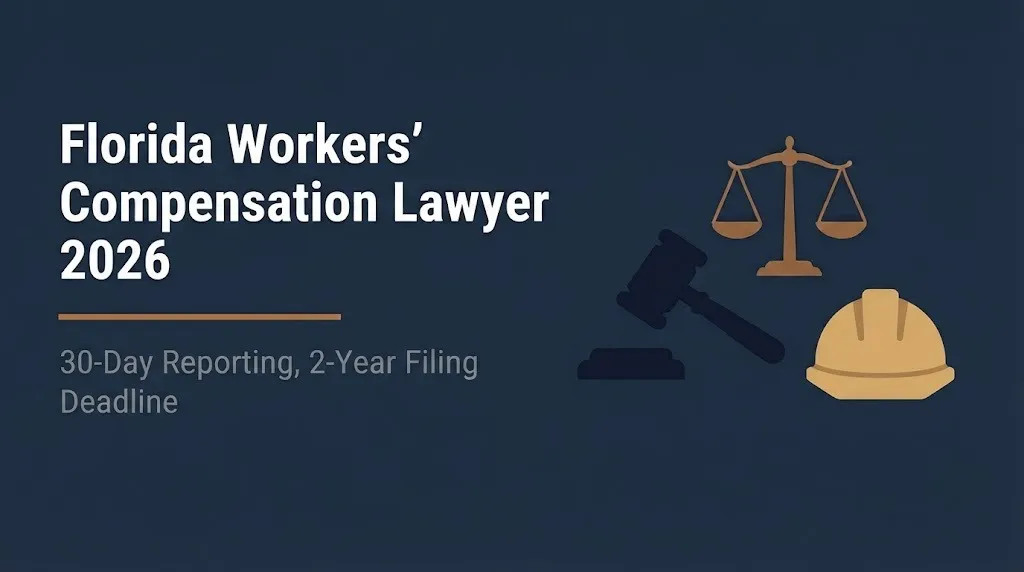
- Injured workers must report injuries within 30 days and file claims within two years in most cases.
If you got hurt on the job in Florida, you are probably wondering whether you need a lawyer and how much one costs. The answer is not one-size-fits-all. Florida workers’ compensation is a state-run system with its own rules, deadlines, and fee structures. A lawyer can help, but only if you understand what they do and what they charge.
The people searching this term include construction workers injured on job sites, nurses with lifting injuries, and office workers with repetitive stress claims. The single most important deadline is Florida’s two-year statute of limitations for filing a workers’ compensation claim, though the 30-day injury reporting rule matters just as much.
This article covers how Florida workers’ compensation lawyers work, what they cost, when you need one, and how to verify a lawyer’s license. One surprising detail: Florida law caps attorney fees in workers’ compensation cases, which means lawyers cannot charge whatever they want.
| The Facts | |
|---|---|
| Governing Law | Florida Workers’ Compensation Act, Chapter 440 |
| Reporting Deadline | 30 days from injury or discovery |
| Filing Deadline | 2 years from injury date |
| Attorney Fees | Statutory formula, percentage-based |
| Contingency Fee | Yes, capped by law |
| License Verification | The Florida Bar directory |
| Dispute Resolution | Office of Judges of Compensation Claims |
Is a Florida Workers’ Compensation Lawyer Legitimate?
Yes, a Florida workers’ compensation lawyer is a legitimate licensed professional. These attorneys specialize in the Florida Workers’ Compensation Act and represent injured workers in claims against employers and insurance carriers.
The legal framework is specific to Florida. Chapter 440 of the Florida Statutes governs workers’ compensation in the state. It sets the benefits, the deadlines, and the dispute resolution process. A lawyer who understands this statute can navigate the system faster than an injured worker acting alone.
The Florida Bar licenses all attorneys in the state. You can verify any lawyer’s license through the bar’s online directory. A legitimate workers’ compensation lawyer will have an active license and no disqualifying disciplinary history.
This is not a class action or a settlement program. It is individual representation. Your case is your own, and the outcome depends on your specific injury, medical records, and employer’s insurance coverage.
How Much Does a Florida Workers’ Compensation Lawyer Cost?
Florida workers’ compensation lawyers work on contingency. That means you pay nothing upfront. The lawyer receives a percentage of the benefits they secure for you. Florida law strictly limits these fees.
The fee formula applies to benefits obtained after the lawyer gets involved. The lawyer does not take a percentage of benefits you already received before hiring them. The fee is calculated on the new benefits secured through the lawyer’s efforts.
| Benefit Type | Typical Fee Range |
|---|---|
| Medical benefits | Percentage of value, statutory cap |
| Lost wage benefits | Percentage of benefits secured |
| Settlement lump sums | Percentage, capped by statute |
| Permanent impairment benefits | Percentage of amount obtained |
Florida judges must approve all attorney fees in workers’ compensation cases. The fee must be reasonable and within statutory limits. A lawyer cannot charge a fee without approval from a judge of compensation claims.
The cost should never be a barrier to hiring a lawyer. If a lawyer asks for money upfront, that is a red flag. Legitimate Florida workers’ compensation lawyers work on contingency.
When Should You Hire a Florida Workers’ Compensation Lawyer?
You should consider hiring a Florida workers’ compensation lawyer when your claim is denied, your benefits are delayed, or your employer disputes the injury. Simple claims with no dispute may not require a lawyer.
If the insurance carrier accepts your claim and pays benefits promptly, you can often handle the process yourself. But if the carrier denies the claim, stops paying, or offers a settlement that seems low, a lawyer adds value.
| Situation | Lawyer Needed |
|---|---|
| Claim accepted, benefits paid | Not usually |
| Claim denied | Yes |
| Benefits stopped prematurely | Yes |
| Employer disputes injury | Yes |
| Settlement offer received | Yes, review before signing |
| Permanent impairment rating disputed | Yes |
The settlement review is critical. Insurance carriers often offer settlements that seem generous but fail to account for future medical needs. A lawyer can evaluate whether the offer is fair.
What Are the Deadlines for a Florida Workers’ Compensation Claim?
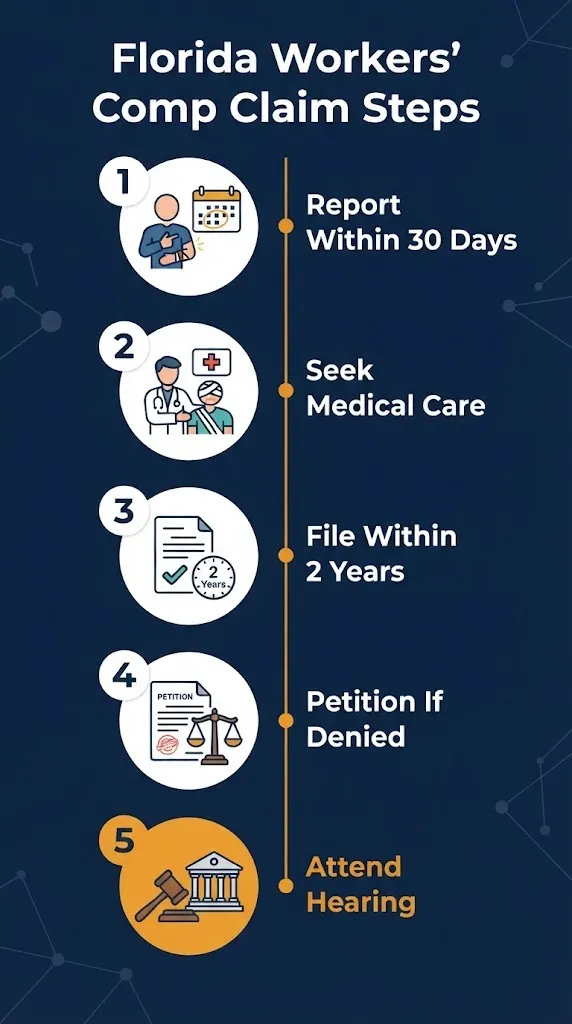
Florida imposes two critical deadlines for workers’ compensation claims. The first is the 30-day reporting requirement. You must notify your employer of the injury within 30 days of the accident or the discovery of the injury.
The second deadline is the two-year statute of limitations. You must file a claim with the Florida Division of Workers’ Compensation within two years of the injury date. Missing either deadline can bar your claim.
| Deadline | Time Limit |
|---|---|
| Report injury to employer | 30 days |
| File workers’ compensation claim | 2 years |
| Request hearing after denial | Varies, generally within 1 year |
| Appeal judge’s decision | 30 days from order |
The reporting deadline is shorter than most workers realize. If you wait 60 days to report an injury, the insurance carrier may argue the injury did not happen at work. Report immediately.
The filing deadline has exceptions for occupational diseases that develop over time. The clock may start on the date you knew the disease was work-related, not the date of first exposure.
How Do You Find a Florida Workers’ Compensation Lawyer?
Finding a Florida workers’ compensation lawyer starts with The Florida Bar directory. The directory lists every licensed attorney in the state and allows you to filter by practice area and location.
The next step is narrowing by experience. Look for a lawyer who handles workers’ compensation cases regularly, not a general practitioner who dabbles. Ask how many cases they have handled and what outcomes they achieved.
Here is a practical search process:
- Visit The Florida Bar lawyer directory.
- Filter by workers’ compensation practice area.
- Read client reviews and disciplinary records.
- Shortlist three to five lawyers.
- Schedule free consultations.
- Ask about their experience with your type of injury.
- Compare fee structures and communication styles.
- Verify the license independently before signing anything.
Referrals from coworkers or union representatives can be useful. But always verify the license yourself. A recommendation does not replace a bar directory check.
Key Takeaway: Florida workers’ compensation lawyers work on contingency with statutory fee caps, and the 30-day reporting rule is the most immediate deadline you face after an injury.
What Does a Florida Workers’ Compensation Lawyer Do?
A Florida workers’ compensation lawyer handles every aspect of your claim from filing through resolution. The lawyer gathers evidence, communicates with the insurance carrier, and represents you in hearings before a judge of compensation claims.
The specific tasks include filing the claim, obtaining medical records, negotiating with the carrier, requesting hearings when disputes arise, and representing you at mediation or trial. The lawyer also reviews settlement offers and advises whether to accept.
| Task | What the Lawyer Does |
|---|---|
| Case evaluation | Reviews medical and employment records |
| Claim filing | Prepares and files necessary forms |
| Negotiation | Communicates with the insurance adjuster |
| Litigation | Represents you at hearings |
| Settlement review | Advises on lump-sum offers |
| Appeals | Files appeals if a decision is unfavorable |
The lawyer’s value is highest when the case is contested. An unrepresented worker facing an experienced insurance defense lawyer is at a structural disadvantage. The workers’ compensation lawyer levels the playing field.
What Is the Florida Workers’ Compensation Dispute Process?
When a workers’ compensation dispute arises, the case goes to the Office of Judges of Compensation Claims. This is a specialized administrative court system, not the regular civil courts.
The process starts with a petition for benefits. The insurance carrier responds. If the dispute remains unresolved, the judge holds a hearing. The judge issues a decision, which either side can appeal to the First District Court of Appeal.
| Dispute Stage | What Happens |
|---|---|
| Petition filed | You request specific benefits |
| Carrier response | Carrier accepts or denies |
| Mediation | Attempt at informal resolution |
| Final hearing | Judge hears evidence and rules |
| Appeal | First District Court of Appeal reviews |
The process is faster than civil litigation. Most workers’ compensation hearings occur within months of the petition, not years. That speed is one advantage of the workers’ compensation system.
What Benefits Are Available Under Florida Workers’ Compensation?
Florida workers’ compensation provides several types of benefits. Medical benefits cover all reasonable and necessary treatment for the work injury. There is no dollar cap on medical care.
Lost wage benefits include temporary total disability, temporary partial disability, and permanent impairment benefits. The amounts are set by statute and based on your average weekly wage.
| Benefit Type | What It Covers |
|---|---|
| Medical care | Doctor visits, surgery, therapy, prescriptions |
| Temporary total disability | You cannot work at all |
| Temporary partial disability | You return to lighter duty at lower pay |
| Permanent impairment | You have a lasting impairment rating |
| Death benefits | Paid to dependents of deceased workers |
The wage replacement benefits are capped at a percentage of the statewide average weekly wage. Florida recalculates the maximum rate annually.
Reality Check: No Lawyer Can Guarantee a Workers’ Compensation Outcome
Reality Check: Any lawyer who guarantees a specific workers’ compensation settlement is lying. Florida law sets benefit amounts by formula, not negotiation. A lawyer can advocate for you and challenge denials, but the outcome depends on your medical evidence and the statutory framework. No ethical lawyer promises a result.
How Does Florida Workers’ Compensation Differ From Other States?
Florida workers’ compensation is generally less generous than some other states. The wage replacement rates are lower, and the duration of temporary benefits is shorter. This makes the stakes of a denied claim higher.
Florida also has a unique attorney fee structure. The state has repeatedly changed the fee law, and the current rules cap fees tightly. Some lawyers decline workers’ compensation cases because the fees are too low to justify the work.
| State Comparison | Florida | Other States |
|---|---|---|
| Temporary wage rate | Lower percentage | Often higher |
| Fee cap | Strict statutory cap | Varies |
| Dispute forum | Specialized judges | Varies |
| Filing deadline | 2 years | 1 to 3 years |
The practical effect is that injured workers in Florida need to act quickly and document thoroughly. The system does not reward delay.
What Should You Do Immediately After a Florida Workplace Injury?
The steps you take immediately after a Florida workplace injury affect your claim more than anything a lawyer can do later. The first step is medical care. The second is reporting.
Here are the verified steps:
- Seek medical attention immediately, even for minor injuries.
- Report the injury to your supervisor in writing.
- Get the name of the employer’s workers’ compensation insurance carrier.
- Follow all medical treatment recommendations.
- Keep a journal of symptoms, missed workdays, and medical appointments.
- Save all medical bills and correspondence.
- Contact a workers’ compensation lawyer if the claim is denied.
The written report is critical. A verbal report to a coworker does not satisfy the 30-day requirement. Text or email your supervisor so there is a record.
Key Takeaway: Florida’s two-year filing deadline and 30-day reporting rule are strict, and the dispute process moves through specialized judges, not the regular civil courts.
What Happens If Your Florida Workers’ Compensation Claim Is Denied?
A denial is not the end of the road. Florida gives you the right to challenge the denial through the Office of Judges of Compensation Claims. The process starts with a petition for benefits.
The petition lists the specific benefits you are seeking. The insurance carrier must respond. If the carrier maintains the denial, the case proceeds to mediation and then to a hearing.
| Post-Denial Step | Action |
|---|---|
| File petition for benefits | Request the denied benefits |
| Carrier response | Carrier must answer |
| Mediation | Attempt resolution |
| Final hearing | Judge rules on benefits |
You can file the petition yourself, but a lawyer increases your chances. The rules of procedure and evidence apply, and the carrier will have a lawyer. You should too.
What Is the Average Florida Workers’ Compensation Settlement?
There is no reliable average settlement for Florida workers’ compensation cases. Settlements vary by injury severity, the worker’s average weekly wage, and the permanence of the impairment.
Minor injuries with full recovery may settle for a few thousand dollars. Catastrophic injuries with permanent impairment can settle for six figures or more. The range is too wide for an average to be meaningful.
| Injury Severity | Typical Settlement Range |
|---|---|
| Minor sprains, full recovery | $5,000 to $20,000 |
| Surgery with residual impairment | $30,000 to $75,000 |
| Permanent partial disability | $75,000 to $150,000 |
| Permanent total disability | $150,000 or more |
These ranges are illustrative, not guarantees. Florida’s statutory benefit formula controls the value of any settlement. A lawyer can calculate the value of your claim based on your specific facts.
What Happens Next If You Need a Florida Workers’ Compensation Lawyer
| Expected Timing | Milestone |
|---|---|
| Immediately | Report injury and seek medical care |
| This week | Contact a workers’ compensation lawyer |
| Within days | Lawyer evaluates your claim |
| If denied | File petition for benefits |
| Within months | Mediation and possible hearing |
| Resolution | Settlement or judge’s decision |
The timeline moves faster than civil litigation but slower than most workers expect. Simple claims resolve in weeks. Contested claims can take six months or more.
The most important action is the first one. Report the injury. Get treatment. Call a lawyer. The longer you wait, the harder the claim becomes.
Frequently Asked Questions
How much does a Florida workers’ compensation lawyer charge?
Florida lawyers work on contingency with statutory fee caps.
You pay nothing upfront.
The fee is a percentage of benefits the lawyer secures for you.
Do I need a lawyer for a Florida workers’ compensation claim?
You do not need a lawyer for an accepted, undisputed claim.
You should hire a lawyer if the claim is denied.
You should have a lawyer review any settlement offer.
What is the deadline to report a workplace injury in Florida?
You must report the injury within 30 days.
The clock starts on the injury or discovery date.
Report in writing to preserve proof.
How long do I have to file a Florida workers’ compensation claim?
You have two years from the injury date.
Occupational diseases may have a different start date.
Do not wait until the last minute.
Can I be fired for filing a Florida workers’ compensation claim?
Florida law prohibits retaliation for filing a claim.
If you are fired, you may have a separate retaliation claim.
Document any change in treatment after reporting.
What if my employer does not have workers’ compensation insurance?
Florida requires most employers to carry coverage.
If uninsured, you may still receive benefits through a state fund.
The employer faces penalties and potential personal liability.
How do I check if a Florida workers’ compensation lawyer is licensed?
Use The Florida Bar online directory.
The lookup is free and shows disciplinary history.
Verify the license before signing anything.
What is a Florida workers’ compensation settlement?
A settlement is a lump-sum payment resolving your claim.
The judge must approve most settlements.
Once approved, the settlement is final.
Florida workers’ compensation is a state-specific system with strict deadlines and capped attorney fees. The 30-day reporting rule is the first hurdle. The two-year filing deadline is the second. A lawyer can help you clear both and fight for the benefits you deserve. August 25, 2026 is the date this information was verified. The date that matters most to you is the day you report your injury, and that should be today.