Automobile Accident Litigation 2026: Process, Deadlines, and Settlement Realities
Quick Answer:
- Automobile accident litigation is a civil lawsuit filed after a car crash to recover damages from the at-fault party.
- Settlement amounts vary widely, from a few thousand dollars to seven figures for catastrophic injuries.
- The filing deadline is your state’s statute of limitations, typically one to three years from the accident date.
If you were hurt in a car crash and the insurance company is not paying fairly, automobile accident litigation may be your path to recovery. This is not a class action or a mass settlement. It is an individual lawsuit against the driver, owner, or company responsible for the crash. The process is real, and it produces real settlements, but it takes time and evidence.
The people searching this term include crash victims with mounting medical bills, families who lost a loved one, and drivers facing lawsuits from the other side. The single most important deadline is your state’s statute of limitations, which sets the window for filing your lawsuit.
This article covers how automobile accident litigation works, what your case may be worth, how long it takes, and how to find the right lawyer. One surprising detail: most car accident lawsuits never reach trial. The overwhelming majority settle before a jury ever hears the case.
| The Facts | |
|---|---|
| Claim Type | Individual personal injury lawsuit |
| Legal Standard | Negligence, fault-based in most states |
| Statute of Limitations | 1 to 3 years, varies by state |
| Settlement Range | $5,000 to $1,000,000+ |
| Insurance Source | At-fault driver’s liability policy |
| Trial Rate | Under 5% of filed cases |
| Deadline | Your state’s filing deadline |
Is Automobile Accident Litigation Legitimate?
Yes, automobile accident litigation is a legitimate legal process. It is the formal mechanism for resolving disputes over who pays for crash injuries. The process is governed by state personal injury law, court rules, and insurance regulations.
When you file an automobile accident lawsuit, you are asking a court to determine fault and award damages. The defendant is usually the at-fault driver, but it can also be a trucking company, a government entity responsible for road maintenance, or a vehicle manufacturer.
The system is not a settlement program. You do not file a claim form and wait for a check. You build a case, negotiate with the insurance company, and if negotiation fails, go to trial. The process is adversarial, and the insurance company has lawyers.
Most cases settle. The trial rate for personal injury cases is consistently under 5%. The rest resolve through negotiation, mediation, or pre-trial settlement.
How Much Is an Automobile Accident Lawsuit Worth?
The value of an automobile accident lawsuit depends on the severity of the injury, the insurance coverage available, and the strength of the liability evidence. Minor injuries with full recovery may settle for a few thousand dollars. Catastrophic injuries can produce seven-figure settlements.
The settlement calculation starts with your economic damages. Those include medical bills, lost wages, and future medical costs. Non-economic damages, like pain and suffering, are added on top.
| Injury Severity | Typical Settlement Range |
|---|---|
| Minor soft tissue, full recovery | $5,000 to $25,000 |
| Fractures, surgery required | $30,000 to $100,000 |
| Permanent impairment | $100,000 to $500,000 |
| Catastrophic injury | $500,000 to $1,000,000+ |
| Wrongful death | $250,000 to $1,000,000+ |
These ranges are not guarantees. The actual value of your case depends on your specific facts. Insurance policy limits often cap the recovery. If the at-fault driver has a $50,000 policy, that may be the practical ceiling unless you have underinsured motorist coverage.
Who Can File an Automobile Accident Lawsuit?
You may file an automobile accident lawsuit if you were injured in a crash caused by someone else’s negligence. The right to sue depends on proving fault, not just being in an accident.
Passengers, drivers, pedestrians, and cyclists can all file. The key requirement is that someone else’s carelessness caused your injuries. If you were partially at fault, your recovery may be reduced under comparative negligence rules.
| Potential Plaintiff | Typical Situation |
|---|---|
| Driver hit by another car | Other driver ran a red light |
| Passenger in either vehicle | Injured through no fault of their own |
| Pedestrian struck | Driver failed to yield |
| Cyclist hit | Driver opened door into bike lane |
| Family of deceased | Wrongful death claim |
The defendant is usually the at-fault driver. But other parties may share liability. A trucking company may be liable for its driver’s negligence. A bar may be liable for serving an intoxicated driver under dram shop laws. A vehicle manufacturer may be liable for a defect that caused the crash.
What Should You Do After a Car Accident?
What you do in the hours and days after a car accident can make or break your litigation. The first priority is medical care. The second is documentation. The third is legal consultation before talking to the insurance company.
Here are the verified steps to take:
- Seek medical attention immediately, even if you feel fine.
- Call the police and obtain a copy of the accident report.
- Take photos of the scene, vehicle damage, and injuries.
- Gather witness names and contact information.
- Do not admit fault or apologize in a way that implies fault.
- Report the accident to your insurance company.
- Consult a personal injury lawyer before giving a recorded statement.
The insurance company’s adjuster may call quickly with a friendly tone and a quick settlement offer. That offer is usually far below the case’s value. You are not required to accept it. You are not required to give a recorded statement without legal advice.
What Is the Deadline to File an Automobile Accident Lawsuit?
The deadline to file an automobile accident lawsuit is your state’s statute of limitations. Most states give you one to three years from the accident date. Some states allow longer for wrongful death or cases involving minors.
The clock starts on the date of the accident in most cases. For injuries that are not discovered immediately, the discovery rule may extend the deadline. But do not count on that exception.
| State Category | Typical Filing Window |
|---|---|
| One-year states | 1 year from accident date |
| Two-year states | 2 years from accident date |
| Three-year states | 3 years from accident date |
| Wrongful death | Often 1 to 3 years from death |
| Minor victims | Clock may pause until age 18 |
Missing the deadline means losing the right to sue. Courts do not extend the deadline because you were busy, unsure, or negotiating with the insurance company. The only safe approach is to consult a lawyer well before the deadline.
Key Takeaway: Automobile accident litigation is an individual lawsuit, not a class action, and the statute of limitations in your state is the strict deadline that controls whether you can file at all.
How Does Fault Affect an Automobile Accident Lawsuit?
Fault is the central question in most automobile accident lawsuits. You must prove the other driver was negligent. Negligence means the driver failed to act with reasonable care and that failure caused your injuries.
Evidence of fault includes police reports, witness statements, traffic camera footage, and accident reconstruction. The strength of that evidence determines whether the insurance company takes your claim seriously or forces you to trial.
| Evidence Type | What It Shows |
|---|---|
| Police report | Officer’s assessment of fault |
| Witness statements | Independent observations |
| Traffic camera footage | Visual record of the crash |
| Accident reconstruction | Expert analysis of causation |
| Cell phone records | Distracted driving evidence |
Comparative negligence rules apply in most states. If you were 20% at fault, your recovery is reduced by 20%. Some states bar recovery entirely if you are more than 50% at fault. The specific rule in your state matters.
How Long Does Automobile Accident Litigation Take?
Automobile accident litigation takes six months to three years in most cases. Simple cases with clear liability and modest injuries settle in months. Complex cases with disputed fault or severe injuries can take years.
The timeline depends on whether the case settles or goes to trial. Settlement negotiations can begin immediately after you finish medical treatment. If the case files and proceeds through discovery, the timeline stretches.
| Litigation Stage | Typical Duration |
|---|---|
| Medical treatment | 1 to 6 months |
| Settlement negotiation | 1 to 3 months |
| Lawsuit filing | Within statute of limitations |
| Discovery | 6 to 12 months |
| Trial | 1 to 2 weeks |
| Appeal, if any | 6 to 18 months |
The pace frustrates many plaintiffs. But rushing a settlement before you know the full extent of your injuries often leaves money on the table. A lawyer can advise when the time is right.
What Is the Difference Between a Car Accident Claim and a Lawsuit?
A car accident claim is an insurance claim. You file it with the at-fault driver’s insurance company. The claim seeks compensation for your injuries and damage. Most cases resolve at the claim stage without a lawsuit.
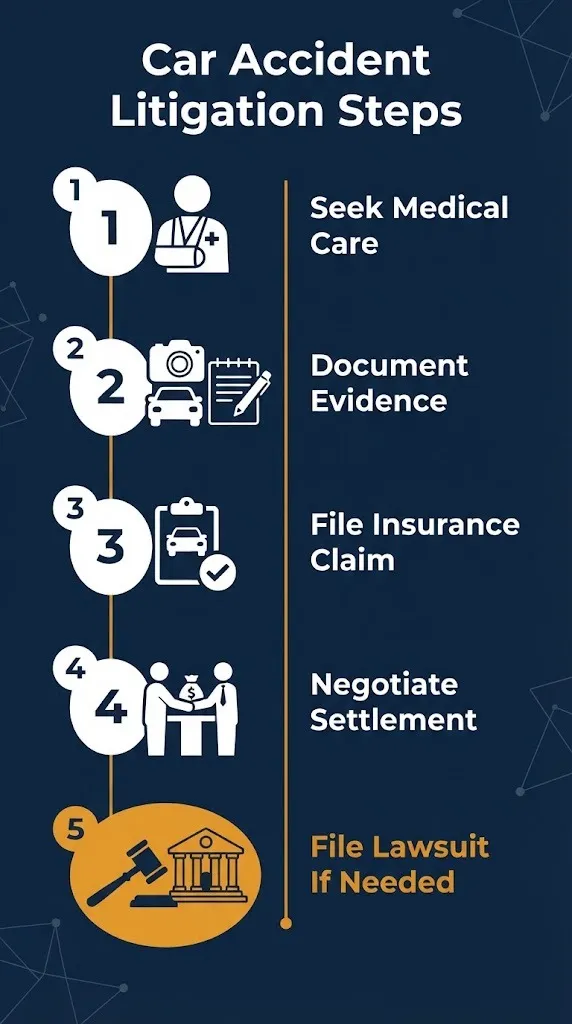
A lawsuit is a formal court filing. You file it when the insurance claim fails, the settlement offer is inadequate, or the deadline is approaching. The lawsuit is the stick that forces serious negotiation.
| Process Step | What Happens |
|---|---|
| Insurance claim | You notify the at-fault insurer |
| Investigation | Insurer evaluates liability and damages |
| Settlement offer | Insurer makes an offer |
| Lawsuit filing | You file a complaint in court |
| Discovery | Both sides exchange evidence |
| Trial or settlement | Case resolves |
Many lawyers wait to file the lawsuit until after the insurance company has shown it will not settle fairly. The filing itself often changes the negotiation dynamics because the insurance company now faces litigation costs.
Key Takeaway: Most car accident cases settle before trial, but the credible threat of a lawsuit is what drives fair settlement offers from insurance companies.
How Do Insurance Policy Limits Affect Litigation?
Insurance policy limits set the practical ceiling for most automobile accident recoveries. The at-fault driver’s liability policy has a limit, often $25,000 to $250,000 depending on the policy. If your damages exceed the limit, the excess may be unrecoverable unless other coverage exists.
Your own underinsured motorist coverage can fill the gap. If the at-fault driver has a $50,000 policy and you have $100,000 in underinsured motorist coverage, you may recover up to $150,000 total.
| Coverage Source | What It Pays |
|---|---|
| At-fault driver’s policy | Up to policy limit |
| Your underinsured motorist coverage | Excess above at-fault limit |
| Your health insurance | Medical bills |
| Your collision coverage | Vehicle damage |
| Umbrella policy | Additional coverage if defendant has one |
The insurance investigation is not just about fault. It is about finding every available coverage source. A lawyer can identify coverage you did not know existed.
Reality Check: The First Settlement Offer Is Usually Low
Reality Check: Insurance companies are businesses. Their adjusters are trained to minimize payouts. The first offer in an automobile accident case is often far below the claim’s true value. You do not have to accept it. You do not have to negotiate alone. A lawyer can evaluate the offer against your actual damages and the available insurance. The insurance company has lawyers. So should you.
What Damages Can You Recover in Automobile Accident Litigation?
You can recover economic and non-economic damages in automobile accident litigation. Economic damages are the measurable losses: medical bills, lost wages, property damage, and future care costs.
Non-economic damages are the intangible losses: pain and suffering, emotional distress, loss of enjoyment of life, and loss of consortium for a spouse. These damages are harder to quantify but often represent the largest portion of a settlement.
| Damage Type | What It Covers |
|---|---|
| Medical bills | Past and future treatment |
| Lost wages | Time off work |
| Property damage | Vehicle repair or replacement |
| Pain and suffering | Physical and emotional distress |
| Loss of consortium | Spouse’s loss |
| Punitive damages | Rare, for egregious conduct |
Punitive damages are rare in car accident cases. They require proof of egregious misconduct, like drunk driving or intentional harm. Most cases do not qualify.
What Happens If the At-Fault Driver Has No Insurance?
If the at-fault driver has no insurance, your recovery options narrow. You may rely on your own uninsured motorist coverage. That coverage is optional in some states and mandatory in others.
Uninsured motorist coverage pays for your injuries when the at-fault driver has no insurance or flees the scene. The coverage limits are set by your own policy, often matching your liability limits.
| Coverage Scenario | Recovery Source |
|---|---|
| At-fault driver insured | Their liability policy |
| At-fault driver uninsured | Your uninsured motorist coverage |
| Hit and run | Your uninsured motorist coverage |
| At-fault driver underinsured | Your underinsured motorist coverage |
| No coverage available | Personal assets of at-fault driver, often limited |
If no insurance exists and the at-fault driver has no assets, a lawsuit may produce a judgment you cannot collect. Your lawyer should assess collectability before you invest in litigation.
Key Takeaway: Insurance policy limits and available coverage often determine the practical value of an automobile accident case, not just the severity of the injury.
What Happens Next in Automobile Accident Litigation
| Expected Timing | Milestone |
|---|---|
| Immediately | Medical care and accident documentation |
| Within days | Insurance claim filed |
| Within weeks | Lawyer evaluates liability and damages |
| Within months | Settlement negotiation |
| If no settlement | Lawsuit filed |
| 6 to 18 months | Discovery and possible trial |
The timeline is predictable. The outcome is not. The most important variable is the quality of your evidence and the skill of your lawyer.
The best action is to start early. Preserve evidence. See a doctor. Consult a lawyer. The statute of limitations is running from the day of the crash.
Frequently Asked Questions
Is it worth suing after a car accident?
It may be worth suing if your injuries required medical care.
Settlement values often exceed $10,000 for moderate injuries.
A lawyer can evaluate your specific case.
How much does a car accident lawyer cost?
Most car accident lawyers work on contingency.
You pay nothing upfront.
The lawyer takes 33% to 40% of the settlement.
How long do I have to file a car accident lawsuit?
The deadline depends on your state’s statute of limitations.
Most states give one to three years.
Consult a lawyer immediately to protect your rights.
What if the other driver blames me?
Comparative negligence rules may reduce your recovery.
Your lawyer can challenge the fault determination.
Evidence like photos and witness statements helps.
Can I sue for a car accident that was my fault?
You may still have a claim if the other driver was partly at fault.
Your recovery is reduced by your percentage of fault.
Some states bar recovery if you are over 50% at fault.
How do insurance companies value car accident claims?
Insurers consider medical bills, lost wages, and liability.
They often discount pain and suffering.
Their first offer is usually low.
What is a fair settlement for a car accident?
A fair settlement covers your economic and non-economic damages.
The amount depends on injury severity and insurance limits.
A lawyer can calculate a reasonable range for your case.
Will my car accident case go to trial?
Most cases settle before trial.
The trial rate is under 5% for personal injury cases.
The credible threat of trial drives better settlements.
Automobile accident litigation is the formal process for recovering what a crash cost you. It is not fast, and it is not easy. But it is the system that holds negligent drivers accountable and forces insurance companies to pay fair value. August 25, 2026 is the date this information was verified. The date that matters most to you is your state’s statute of limitations, and that clock started on the day of your accident.