Georgia Workers’ Compensation Laws in 2026: Benefits, Deadlines and Your Rights
Quick Answer
- Georgia requires employers with 3 or more employees to carry workers’ compensation coverage.
- Injured workers can receive up to $800 per week, or two-thirds of their average weekly wage, whichever is lower.
- You generally have 1 year from the date of your accident to file a formal claim with the state board.
If you got hurt on the job in Georgia, state law entitles you to medical treatment and partial wage replacement, administered through the Georgia State Board of Workers’ Compensation. The system pays out regardless of who caused the accident, but it comes with strict rules on doctors, deadlines, and how much you can actually collect.
This affects nearly every employee in the state, since coverage is mandatory for businesses with three or more workers. The number that matters most is the one-year statute of limitations, since missing it can end your right to benefits entirely.
This article breaks down what Georgia law actually says about benefit amounts, filing deadlines, and your rights if a claim gets denied. One detail catches a lot of workers off guard: you don’t automatically get to pick your own doctor.
The Facts
| Case | Georgia Workers’ Compensation Act, O.C.G.A. Title 34, Chapter 9 |
| Status | Current law; $800/week cap in effect since July 1, 2023, no confirmed change for 2026 |
| Fund Size | Not applicable, benefits are paid through private or self-insured employer coverage, not a shared settlement pool |
| Est. Per Person | Two-thirds of average weekly wage, between $50 and $800 per week depending on benefit type |
| Claim Deadline | 1 year from the date of the accident to file Form WC-14 |
| Administrator | Georgia State Board of Workers’ Compensation (SBWC) |
| Proof Needed | Employer’s Form WC-1, your Form WC-14, and supporting medical documentation |
Is Workers’ Compensation Mandatory for Georgia Employers?
Yes, Georgia law requires most employers with three or more employees to carry workers’ compensation insurance.
This threshold is higher than in many other states, which often require coverage starting at just one employee. Full-time, part-time, and seasonal workers generally count toward that headcount.

Certain categories are exempt from mandatory coverage even at larger companies. These typically include sole proprietors, business partners, independent contractors, casual laborers, and some agricultural or domestic workers.
- Employer threshold: 3 or more employees
- Applies to: most private employers operating in Georgia
- Commonly exempt: sole proprietors, partners, independent contractors, casual labor
Key detail: if your employer has fewer than three employees, they may legally have no coverage requirement at all, which changes your options after an injury.
Do All Georgia Employees Qualify for Workers’ Comp Coverage?
Most employees of covered Georgia businesses qualify, but several worker categories fall outside the system entirely.
Coverage generally extends to full-time, part-time, and seasonal employees performing work for a covered employer. Independent contractors are typically excluded, since they are not legal employees under the statute.
Georgia law also carves out narrower exemptions for certain agricultural workers, domestic servants, and railroad employees, depending on the specifics of the job. If your employment status is unclear, that classification alone can determine whether you have any claim at all.
Key Takeaway: Coverage in Georgia hinges on two gatekeeping questions, whether your employer meets the three-employee threshold and whether you count as a covered employee rather than an excluded worker type.
How Much Does Workers’ Compensation Pay in Georgia?
Georgia workers’ comp pays two-thirds of your average weekly wage, subject to state-set maximum and minimum limits.
The exact amount depends on which benefit category applies to your situation. Total disability, partial disability, and death benefits each carry their own caps under the law.
| Benefit Type | Rate | Weekly Cap | Duration |
|---|---|---|---|
| Temporary Total Disability (TTD) | 2/3 of AWW | $800 max, $50 min | Up to 400 weeks |
| Temporary Partial Disability (TPD) | 2/3 of wage difference | $533 max | Up to 350 weeks |
| Death benefits (dependents) | 2/3 of AWW | $800 max | Ongoing, spouse cap $320,000 |
These figures apply to accidents occurring on or after July 1, 2023, the date the current caps took effect. Injuries from earlier periods are governed by lower caps in place at the time.
What Is the Maximum Weekly Workers’ Comp Benefit in Georgia?
The current maximum weekly workers’ compensation benefit in Georgia is $800 for temporary total disability, a rate that has applied since July 1, 2023.
This confirmed figure comes directly from the Georgia State Board of Workers’ Compensation’s own published guidance. Some other websites circulating in 2026 claim the cap has already jumped to $850 or $875, but neither figure is confirmed by the Board as of this writing.
Georgia’s benefit caps have increased gradually over time through periodic legislative action, not automatic annual adjustment.
- 2016 to 2019 accidents: $575/week max
- 2019 to 2022 accidents: $675/week max
- 2022 to 2023 accidents: $725/week max
- July 1, 2023 to present: $800/week max
Reality Check: Several sites ranking for Georgia workers’ comp searches in 2026 cite unverified numbers like $850 or $875 per week, often paired with vague “industry projection” language. Treat any benefit figure you can’t trace back to the State Board of Workers’ Compensation or an actual statute as unconfirmed, not as your real payout.
How Is Your Average Weekly Wage Calculated in Georgia?
Your average weekly wage (AWW) is calculated using your actual earnings from the 13 weeks before your injury, under a method set by state law.
Georgia applies three methods in order of preference under O.C.G.A. Section 34-9-260. The state uses the first one that fits your situation.
- Your actual gross earnings over the 13 weeks before the injury, averaged.
- If you hadn’t worked long enough, a similar coworker’s wages in the same job.
- If neither method fits, your contracted hourly rate multiplied by scheduled hours.
A higher AWW means a higher weekly check, up to the state maximum. Getting this number right matters, since even a small miscalculation compounds across hundreds of weeks of benefits.
How Do You File a Workers’ Compensation Claim in Georgia?
You file a Georgia workers’ compensation claim by submitting Form WC-14, called a Notice of Claim, to the State Board of Workers’ Compensation.
Reporting your injury to your employer is not the same as filing a formal claim with the state. Many workers assume one step covers both, and that mistake can cost valuable time against your deadline.
- Report the injury to your employer immediately after it happens.
- Seek treatment from a physician on your employer’s posted panel.
- Confirm your employer files Form WC-1, the employer’s first report of injury.
- Download Form WC-14 from the SBWC website if your claim is denied or delayed.
- Complete the form with accurate details about the injury and treatment.
- File the completed form with the State Board of Workers’ Compensation.
- Send copies to your employer and their insurance carrier.
- Keep records of medical visits, missed work, and communications.
Your first benefit check should be mailed within 21 days of your first missed day of work, according to the Board’s own FAQ guidance.
How Do You Choose a Doctor Under Georgia Workers’ Comp Law?
Georgia law generally requires injured workers to choose a treating physician from their employer’s posted panel of physicians.
Employers must post a list of at least six physicians or clinics in a visible, common area of the workplace. That panel must include one orthopedic physician and no more than two industrial clinics.
If you’re unhappy with your first choice, Georgia law allows one change to another doctor already on the list without needing employer permission. Any further change generally requires agreement from your employer or the insurer.
- Panel must list at least 6 physicians or professional groups
- Must include 1 orthopedic physician
- No more than 2 industrial clinics allowed on the list
- One free doctor change is allowed without employer sign-off
Key Takeaway: Georgia’s panel-of-physicians rule means your choice of doctor is more restricted than in many states, and going outside the posted panel can leave you responsible for the bill.
What Can You Do if Your Georgia Workers’ Comp Claim Is Denied?
If your Georgia workers’ compensation claim is denied, you can request a hearing before an administrative law judge through the State Board of Workers’ Compensation.
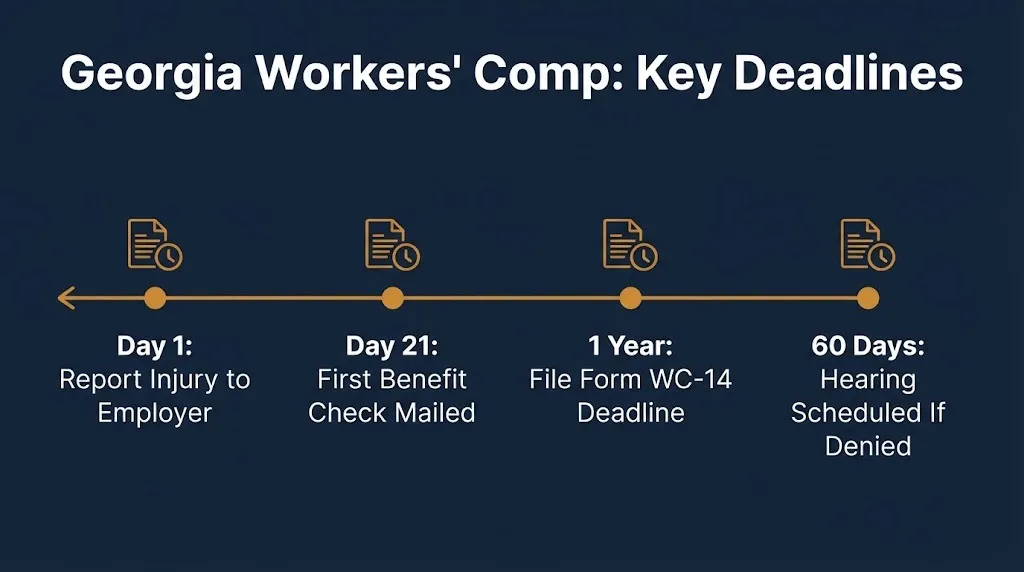
A hearing functions similarly to a trial, where a judge reviews the facts and evidence from both sides before deciding what benefits, if any, you’re owed. According to Board guidance, hearings are generally scheduled within 60 days of the Board receiving your Form WC-14.
Think of a denial like a warranty claim a store first tries to reject. You don’t automatically lose, but you have to formally push back through the right process before the clock runs out.
- Confirm your Form WC-14 was properly filed with the SBWC.
- Gather all medical records and wage documentation.
- Request a hearing before an administrative law judge.
- Attend the hearing and present your evidence.
- Review the judge’s written decision once issued.
- Consider an appeal to the Board’s Appellate Division if you disagree.
Did Georgia Increase the Workers’ Comp Benefit Cap for 2026?
No, there is no Board-confirmed increase to Georgia’s workers’ compensation benefit caps specifically for 2026.
The most recent confirmed increase took effect July 1, 2023, raising the TTD maximum to $800 per week and the TPD maximum to $533 per week. That change came through Georgia House Bill 480, signed during the 2023 legislative session.
Multiple lower-quality sites are circulating unverified figures like $850 or $875 for 2026, often attached to vague phrases like “projected” or “expected.” None of that appears on the official SBWC website or in confirmed legislative action as of this writing.
Key Takeaway: Until the Georgia legislature passes and the Board confirms a new rate, the enforceable maximum weekly benefit remains $800, and any higher number you see should be treated as unverified.
What Are the Latest Changes to Georgia Workers’ Compensation Law in 2026?
As of this writing, no major statutory overhaul to Georgia’s workers’ compensation law has been confirmed for 2026 through official Board channels.
Some legal-marketing sites describe sweeping 2026 changes, including new digital filing mandates or a shortened panel-posting window. These claims are not confirmed on the SBWC’s own site, and this article marks them as unconfirmed rather than reporting them as settled law.
What is confirmed is that the underlying framework, the panel-of-physicians system, the 400-week TTD duration cap, and the one-year statute of limitations, remains active and unchanged this year.
- Confirmed: $800/week TTD cap, in place since July 1, 2023
- Confirmed: 1-year statute of limitations to file Form WC-14
- Unconfirmed: reported 2026 rate hikes to $850 or $875 per week
- Unconfirmed: reported mandatory digital-only filing changes
What Injuries and Conditions Are Covered Under Georgia Workers’ Comp?
Georgia workers’ compensation generally covers injuries and illnesses that arise out of and in the course of your employment.
Covered categories typically include sudden workplace accidents, repetitive trauma injuries, occupational diseases, and the aggravation of pre-existing conditions caused by work duties. Coverage applies regardless of who was at fault for the accident, since Georgia runs a no-fault system.
Certain situations are generally excluded from coverage. These typically include injuries caused by willful misconduct, intoxication, or a worker’s failure to use provided safety equipment.
- Covered: sudden accidents, repetitive trauma, occupational disease
- Covered: aggravation of a prior condition due to work activity
- Typically excluded: willful misconduct, intoxication, safety-equipment refusal
Who Is Exempt From Georgia Workers’ Compensation Coverage?
Certain worker categories are exempt from mandatory Georgia workers’ compensation coverage even when their employer meets the three-employee threshold.
Independent contractors are the largest exempt category, since they are not legally classified as employees. Sole proprietors and business partners can also generally opt out of covering themselves, even while covering their employees.
Other commonly cited exemptions include casual laborers, certain agricultural workers, and domestic servants, though specifics can vary by job classification.
Key Takeaway: Exemptions in Georgia are based on your legal work classification, not your job title, so a worker labeled a “contractor” who is actually functioning as an employee may still have grounds to pursue a claim.
Can You Be Fired for Filing a Workers’ Comp Claim in Georgia?
No, Georgia law prohibits employers from firing or retaliating against workers for filing a legitimate workers’ compensation claim.
If retaliation happens anyway, affected workers generally have legal options, which can include reinstatement or back pay through separate legal action outside the workers’ comp system itself.
This protection covers the act of filing and pursuing a valid claim, not poor job performance or unrelated misconduct that may still be grounds for termination.
What Is the Statute of Limitations for Workers’ Comp Claims in Georgia?
You generally have one year from the date of your accident to file a formal workers’ compensation claim in Georgia.
According to the State Board of Workers’ Compensation’s own FAQ page, filing Form WC-14 within that window protects your rights to benefits. Missing it can bar your claim entirely, similar to how a missed tax filing deadline can forfeit a refund you were otherwise owed.
Additional deadline triggers can extend or affect this window depending on your situation.
- 1 year from the date of the accident
- 1 year from the date of your last authorized medical treatment
- 2 years from the date of your last income benefit payment, whichever is latest
- 5-year automatic dismissal if no hearing is held and no benefits were paid
Key Takeaway: Georgia’s one-year clock is unforgiving, and workers who wait to see if their employer “handles it” often lose that window before realizing a formal claim was ever necessary.
What Happens at a Georgia Workers’ Compensation Hearing?
A Georgia workers’ compensation hearing works like a trial, where an administrative law judge reviews evidence from both sides and issues a binding decision.
Hearings are generally scheduled within 60 days of the Board receiving your Form WC-14, based on the Board’s own published guidance. Both you and the employer’s insurer can present medical records, wage documentation, and testimony.
If you disagree with the judge’s ruling, Georgia law allows further appeal to the Board’s Appellate Division, and beyond that, into the state court system.
- Judge reviews your Form WC-14 and case file.
- Both sides submit medical and wage evidence.
- Testimony is heard from involved parties.
- Judge issues a written decision.
- Either side may appeal to the Appellate Division.
What Happens Next
- Ongoing in 2026: The $800 per week TTD cap set July 1, 2023, remains the confirmed, enforceable maximum.
- Expected, no set date: Any future benefit cap increase would require new legislative action and Board confirmation.
- If injured now: The one-year filing clock starts immediately from your date of accident.
- If denied: A hearing request generally moves to a scheduled date within about 60 days.
- Ongoing: Watch the SBWC’s official Benefits Information page directly for any rate changes, rather than secondhand blog claims.
Frequently Asked Questions
What is the maximum workers’ comp payout in Georgia?
The maximum weekly benefit is $800 for temporary total disability, in effect since July 1, 2023.
Some claims of higher 2026 rates are not confirmed by the State Board of Workers’ Compensation.
How long do I have to file a workers’ comp claim in Georgia?
You generally have one year from the date of your accident to file Form WC-14.
Additional deadlines can apply based on your last treatment date or last benefit payment.
Does my employer have to carry workers’ comp insurance in Georgia?
Yes, if your employer has three or more employees, coverage is generally mandatory under state law.
Smaller employers may be exempt from the requirement entirely.
Can I pick any doctor for a workers’ comp injury in Georgia?
No, you generally must choose from your employer’s posted panel of at least six physicians.
You are allowed one free change to another doctor already on that list.
How many weeks can I receive workers’ comp benefits in Georgia?
Temporary total disability benefits can generally continue for up to 400 weeks.
Catastrophic injuries may qualify for benefits without that weekly cap.
Can I be fired for filing a workers’ comp claim?
No, Georgia law prohibits retaliation against employees for filing a legitimate claim.
Workers who experience retaliation generally have separate legal remedies available.
What happens if my workers’ comp claim is denied?
You can request a hearing before an administrative law judge through the State Board.
Hearings are typically scheduled within 60 days of the Board receiving your claim form.
Did the Georgia workers’ comp weekly cap increase in 2026?
No confirmed increase has been published by the State Board of Workers’ Compensation for 2026.
The current enforceable maximum remains $800 per week for total disability.
The Bottom Line
If you were hurt on the job in Georgia, the one-year statute of limitations is the deadline that matters most, and it starts running from your accident date whether or not your employer has filed anything.
Check the State Board of Workers’ Compensation’s official site directly for current forms and rates, and keep copies of every medical record and wage document tied to your claim.