Class Action Lawsuit in 2026: How to File, Check Status, and Claim Your Share
Quick Answer
- A class action lawsuit groups people with similar claims against one defendant into a single case.
- Payouts vary widely by case, often $10 to $500 per person after attorneys’ fees.
- The most important date is the claim deadline specific to each case, not a universal date.
Class action lawsuits let one or a few people sue on behalf of a much larger group. If you got a notice in the mail or an email about a settlement, you might be wondering whether it is real and whether it is worth your time. The short answer: many are real, some are not, and the value depends entirely on the specific case.
The most important number in any class action notice is the claim deadline. Miss it, and you get nothing. File before it, and you may get a check months later, after the court gives final approval.
This guide covers how class actions actually work, how to file a claim, how to spot fakes, how much money to expect, and the current status of major 2026 cases like the Temu class action settlement. One verified detail most people miss: filing a claim is always free, and anyone charging you a fee to “help” is taking money you could keep yourself.
The Facts
| Item | Detail |
|---|---|
| Case | Varies by specific lawsuit |
| Status | Multiple active settlements in 2026 |
| Fund Size | Case-specific, some exceed $100 million |
| Est. Per Person | Often $5 to $500 after fees |
| Claim Deadline | Case-specific, check official notice |
| Administrator | Court-appointed, varies per case |
| Proof Needed | Usually minimal, sometimes receipts |
Is a Class Action Lawsuit Legit?
Yes, class action lawsuits are a legitimate legal process governed by Federal Rule of Civil Procedure 23 in federal courts and similar rules in state courts. They are not a new phenomenon. They have existed for decades and have returned billions of dollars to consumers, employees, and patients.
A class action becomes legitimate once a judge certifies the class. That means the court has reviewed the claims and agreed that enough people share a common legal injury to justify one combined case. Before certification, a lawsuit is just a proposal, not a guaranteed payout.
Scam attempts do exist. Some people receive text messages or emails that look like settlement notices but are actually phishing attempts. Real settlement notices never ask for your bank password, your Social Security number upfront, or a payment to receive your money. You should always cross-check a notice against the official court docket or the settlement website listed in the notice.
Key Takeaway: Class actions are real legal tools, but each case lives or dies by its own court record, and you should verify any notice before sharing personal information.
How Does a Class Action Lawsuit Work?
A class action works by consolidating thousands or millions of individual claims into one lawsuit. One person, called the lead plaintiff or class representative, stands in for everyone else. The court must find that the group is large enough, the legal issues are common, and the lead plaintiff will fairly represent the class.
The process moves in stages. First, a complaint is filed. Second, the plaintiff asks for class certification. Third, if certified, the case proceeds to discovery or settlement talks. Fourth, if a settlement is reached, the court must approve it. Fifth, class members receive notice and the chance to file a claim, object, or opt out.
Think of it like a group project in school, but with binding legal consequences. One person does the heavy lifting. Everyone else gets a share, but only if they sign their name on the right form.
The entire timeline can take two to five years. Some cases settle within a year. Others drag on for a decade. In 2026, courts are still working through cases filed as far back as 2018.
How Do I Know If I Qualify for a Class Action Settlement?
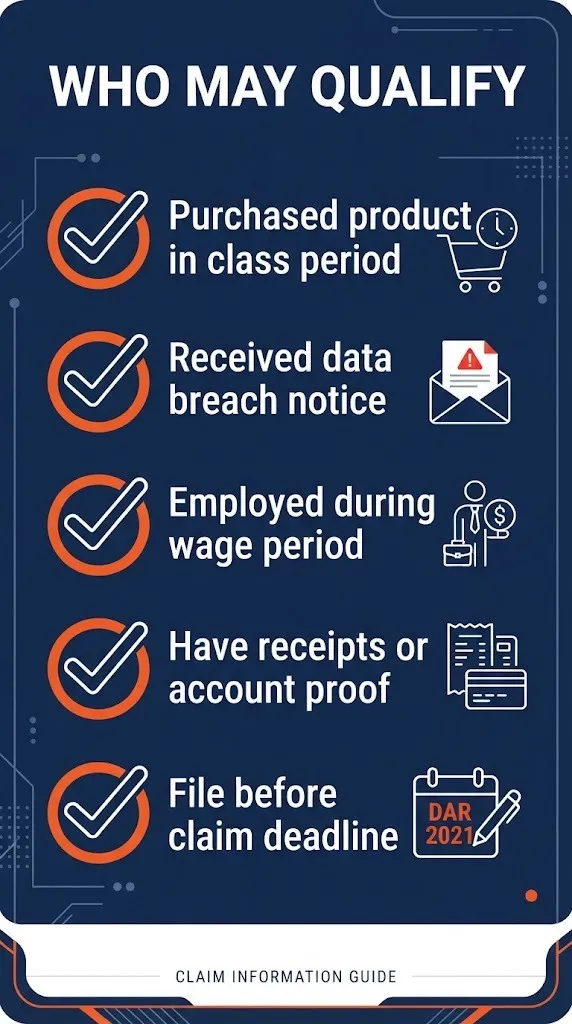
Eligibility depends on the class definition in the settlement agreement or court order. The class definition describes who is covered, usually by purchase dates, product type, employment dates, or specific harm.
You may qualify if you fall inside the class period and the class definition. The class period is the window of time during which the alleged harm occurred. For example, a data breach case might cover anyone whose information was exposed between January 2022 and March 2024.
Receiving a notice is a strong sign you may qualify, but it is not a guarantee. Notices sometimes go out broadly. Conversely, you might qualify even if you never received a notice, especially if you moved or the administrator could not find your address.
- Check the class definition carefully
- Confirm your purchase or employment dates fall within the class period
- Look for proof requirements such as receipts or account records
- File online or by mail before the deadline
- Keep a copy of your confirmation number
How to File a Class Action Lawsuit
Filing a class action lawsuit as a named plaintiff requires an attorney. You do not file a class action on your own in small claims court. You first need a lawyer who practices class action litigation to evaluate your claim and agree to represent you.
Here are the steps if you want to start a class action lawsuit:
- Gather all evidence of the harm, including receipts, emails, account statements, and communications.
- Contact a class action attorney who handles your type of case, such as consumer fraud, wage theft, or product defect.
- The attorney investigates whether similar cases already exist and whether a class is viable.
- The attorney files a complaint in federal or state court.
- The attorney moves for class certification, which the court grants or denies.
- If certified, the case proceeds toward trial or settlement.
- If settled, the court approves the settlement and notice goes to the class.
Starting a class action is different from filing a claim in an existing class action. Most readers want the second thing: filing a claim. That process is simple, online, and takes minutes.
Key Takeaway: Starting a class action requires a lawyer and a certified class. Filing a claim in an existing settlement requires a form and a deadline.
How to File a Class Action Lawsuit Claim in 2026
Filing a claim in an existing class action settlement is free and usually takes less than ten minutes. You do not need a lawyer. You do not need to pay anyone.
The claim form is available on the official settlement website. You can find that website in the notice you received, or by searching the case name plus the word “settlement” on a search engine. Never use a third-party site that asks for payment.
Here is the standard claim process in 2026:
- Visit the official settlement website listed in the notice.
- Enter your unique Claim ID or Class Member ID if one was included.
- Confirm your eligibility by answering questions about purchase dates or employment.
- Provide proof if requested, such as a receipt, invoice, or account number.
- Choose your payment method: check, prepaid card, Venmo, PayPal, or direct deposit.
- Review your information for accuracy.
- Submit the claim and save your confirmation number.
Claims are almost never accepted by phone. Some older settlements allowed phone claims, but in 2026 the overwhelming majority are online-only with a mail-in paper option for those who cannot use the internet.
Is the Temu Class Action Lawsuit Real?
Yes, Temu has faced multiple class action lawsuits in the United States. The most notable cases involve allegations of data privacy violations, tracking user activity without proper consent, and misleading discount advertising. Some of these cases have reached settlement, while others remain in litigation.
The Temu class action lawsuit sign up form appears on official settlement websites only. If you see a sign up form on social media or through a text message, verify the URL before entering any information. The form itself should never ask for a payment.
One Temu settlement in 2025 resolved claims that the app collected more data than its privacy policy disclosed. The settlement website allowed users to submit claims for a small cash payment. That case has closed. New Temu lawsuits filed in 2026 are still in early stages.
If you are looking for a current Temu class action lawsuit sign up form in 2026, check the official court docket for the Northern District of Illinois or the Central District of California, where many Temu cases are filed. No nationwide Temu settlement is currently open for claims as of August 2026.
How Much Money Can You Get from a Class Action Lawsuit?
Class action payouts are usually modest. Most class members receive between $10 and $500. Some receive more, especially in wage and hour cases or cases with clear documented damages. Some receive less than $5, especially in massive consumer cases with millions of claimants.
The per-person amount depends on the size of the settlement fund, the number of valid claims filed, and the tier structure. Attorneys’ fees typically consume 25 to 35 percent of the fund. The lead plaintiff may receive an extra service award, usually $5,000 to $25,000.
| Settlement Type | Typical Per-Person Payout |
|---|---|
| Data breach | $25 to $500 |
| Consumer product false advertising | $10 to $75 |
| Wage and hour (unpaid overtime) | $500 to $5,000+ |
| TCPA robocalls | $50 to $300 |
| Antitrust price fixing | $5 to $50 |
If fewer people file claims, each person gets more. If more people file, each gets less. That is why the final amount is never known until after the claim deadline passes and the administrator counts the valid claims.
Reality Check
No legitimate class action settlement ever requires you to pay money upfront. Any message demanding a “processing fee” or “release fee” to get your settlement payment is a scam. The claims administrator pays you, never the other way around.
What Is the Average Class Action Lawsuit Payout per Person?
The average per-person payout across all class action settlements in the United States is roughly $32 to $78, but that figure is misleading. A small number of large payouts in employment and antitrust cases pull the average up. The median, which is the middle value, is much lower, often under $20.
Data breach settlements often pay the least because proving actual harm is hard. Product defect cases can pay more if you have receipts. Wage and hour cases tend to pay the most per person because damages are calculable from timesheets.
In 2026, many consumer settlements use a tiered structure. You might receive a base payment for filing a claim with no proof, and a higher payment if you submit receipts or other documentation. The base payment might be $10, and the documented payment might be $75 or $150.
The honest answer: most people get enough for a meal, not a mortgage payment. The value of a class action is often the deterrent effect on the company, not the check in your mailbox.
Key Takeaway: Payouts are modest for most people, with documented damages producing the highest individual awards.
How Long Does a Class Action Lawsuit Take?
Most class actions take two to four years from filing to final payout. The timeline breaks down like this:
| Stage | Typical Duration |
|---|---|
| Filing to class certification | 1 to 2 years |
| Certification to settlement or trial | 1 to 2 years |
| Preliminary approval to final approval | 3 to 9 months |
| Claim deadline to first payout | 3 to 12 months |
| Appeals, if any | 6 months to 2 years |
A case filed in 2022 might pay out in 2026. A case filed in 2024 might not pay until 2028. If a defendant appeals the certification decision, everything stops.
Your claim status is usually available on the settlement website. Most administrators provide a claim status lookup tool. You can enter your Claim ID and see whether your claim was received, validated, or flagged for deficiency.
What Is the Deadline to File a Claim in 2026?
There is no single deadline for all class action lawsuits. Each settlement sets its own claim deadline, usually 60 to 120 days after the notice date. Some deadlines are as short as 30 days. A few are as long as six months.
The deadline appears in bold on the first page of the official notice and on the settlement website. It is always a specific date, never a vague “soon” or “coming up.”
If you miss the deadline, you almost always lose your right to claim. Courts rarely extend deadlines except for demonstrated hardship. Set a calendar reminder the day you receive a notice. Do not wait.
Temu Class Action Lawsuit Sign Up Form: What to Know in 2026
The Temu class action lawsuit sign up form only exists when a settlement receives preliminary approval. Before that stage, there is no form. You cannot sign up for a class action in advance. You can only wait for the court to approve a settlement and open the claims period.
Temu has faced legal scrutiny over its data practices, shipping fees advertised as free, and counterfeit product claims. Some cases have been consolidated into multidistrict litigation, which is a process that groups similar federal lawsuits before one judge for efficiency.
As of August 2026, no active Temu settlement is accepting claims on a nationwide basis. Several proposed settlements are pending. Check the official settlement website or the court docket for the case number listed in the notice you received.
If a friend sends you a Temu sign up form link, check the domain name carefully. The official site will have a simple, predictable URL, often ending in .com and containing the case name. A scam site might use a similar URL with extra characters or a different domain extension.
How Do I Check My Class Action Claim Status?
You check your class action claim status on the official settlement website. Most sites have a claim status portal where you enter your Claim ID and zip code. You can also call the toll-free number for the claims administrator.
Status updates typically show one of these labels: Received, Under Review, Deficient, Approved, or Paid. A Deficient status means you need to submit additional documentation. An Approved status means the administrator accepted your claim, but payment still depends on final approval and distribution.
If you lost your Claim ID, you can usually request a resend through the website by providing your name and the email or mailing address you used. It is not a reason to panic.
Keep your confirmation email. It is the fastest way to prove you filed if something goes wrong. Think of it like keeping a store return receipt: without it, you can still make your case, but it takes longer.
Key Takeaway: The claim status tool and your confirmation number are your proof of filing and your best way to track payment.
How Do Class Action Lawyers Get Paid?
Class action lawyers work on contingency. They pay the litigation costs upfront and get reimbursed only if the case wins or settles. Their fee comes out of the settlement fund, not from your pocket.
The court must approve the fee. Judges often scrutinize requests that exceed 30 percent of the fund in consumer cases. In large securities cases, fees are sometimes lower, around 15 to 25 percent. In small consumer cases, fees of 33 percent are common.
The lead plaintiff may also request a service award for their time and risk. Courts have become more skeptical of large service awards. In 2025 and 2026, several appellate decisions reduced or rejected service awards that seemed disproportionate to the work performed.
What Happens If I Do Nothing in a Class Action?
If you do nothing, you stay in the class. You give up your right to sue separately, but you receive whatever the class receives, if anything. In most cases, doing nothing means you get no payment because you did not file a claim.
For settlements with automatic payments, you might receive a check without filing. These are less common. Most settlements require a claim form, especially consumer cases with large classes.
If you want to keep your right to sue the company individually, you must opt out before the opt-out deadline. That deadline is usually the same as or earlier than the claim deadline. Opting out means you get nothing from the settlement, but you preserve your own claims.
What Happens Next: Timeline for Pending 2026 Class Actions
- September 2026: Several consumer settlement claim deadlines close.
- October 2026: Final approval hearings scheduled for multiple data breach settlements.
- November 2026: Administrators begin validating claims for cases with September deadlines.
- Early 2027: First distribution of settlement funds for cases approved in late 2026.
- Mid 2027: Appeals may delay payments in contested settlements.
Frequently Asked Questions
Is a class action lawsuit worth joining?
Yes, if the claim form is short and the deadline is manageable, filing a claim is almost always worth the five minutes it takes. The downside is minimal, and even a $20 check is something you would not have otherwise.
Do I need a lawyer to file a class action claim?
No, you do not need a lawyer to file a claim in an existing settlement. The claims process is designed for individuals to complete on their own. Hiring a lawyer for a claim is unnecessary and usually costs more than the payout.
What proof do I need for a class action claim?
It depends on the settlement. Some require receipts or account statements. Others allow a simple sworn declaration. The claim form tells you exactly what is required, and you should not submit more than what is asked.
Can I join a class action lawsuit after the deadline?
No, if the claim deadline has passed, you almost always lose your right to file. Courts rarely reopen deadlines. The only exception is if you never received notice and can show the administrator failed to reach you despite reasonable efforts.
Will I get taxed on a class action settlement?
Possibly, but most small consumer settlements are considered a return of your own money, not income, and are not taxable. Larger awards, especially in employment cases, may be taxable. The settlement agreement usually addresses tax treatment, and you should ask a tax professional if the amount is significant.
How do I know if a settlement notice is real?
Check the case name and court in the notice against the court’s public docket, which is free to access online. Real notices include a court name, case number, and claims administrator contact. Fake notices are vague, demand payment, or ask for sensitive data like your full Social Security number.
Can I file a claim for a deceased relative?
Yes, in many cases the estate or heirs can file a claim for a deceased class member. The claim form usually includes a section for this. You may need to provide proof of death and your authority to act for the estate.
Closing
Class action settlements are real, free to join, and worth the minutes they take to file a claim. The single most important date is the claim deadline printed on your notice. Check the official settlement website, confirm your eligibility, and file before the deadline.
For cases like Temu in 2026, keep an eye on the court docket and the official settlement administrator. No text message, no email, and no third party should ever charge you for something you can do yourself in minutes.