New Rules for PTSD VA Compensation in 2026: Ratings, Claims, and What Veterans Should Know
Quick Answer
- PTSD VA compensation is a real disability benefit for veterans with service-connected post-traumatic stress disorder.
- Monthly payments range from about $171 to over $3,700 depending on disability rating and dependents.
- There is no deadline to file a PTSD claim, but earlier filing locks in an effective date for back pay.
The VA pays monthly compensation to veterans with PTSD connected to their military service. If you saw headlines about new rules, you may wonder if the rating system changed or if you qualify now. The core process remains stable in 2026, but some changes affect how claims are evaluated.
The amount you receive depends on your disability rating, which ranges from 0 to 100 percent in 10 percent increments. A 100 percent rating pays significantly more than a 10 percent rating.
This guide explains the current PTSD rating criteria, how claims are evaluated, how much you may receive, and what to do if your claim was denied. One fact that surprises many veterans: you do not need a combat medal to qualify for PTSD compensation.
The Facts
| Item | Detail |
|---|---|
| Case | VA disability compensation, not a lawsuit |
| Status | Active, accepting claims |
| Fund Size | Federal appropriations, no fixed cap |
| Est. Per Person | $171 to $3,737 per month based on rating |
| Claim Deadline | None, but effective date matters |
| Administrator | U.S. Department of Veterans Affairs |
| Proof Needed | Service records, medical evidence, nexus opinion |
Is PTSD VA Compensation Legitimate?
Yes, PTSD VA compensation is legitimate. It is a federal benefit authorized by law and administered by the Department of Veterans Affairs. Millions of veterans receive monthly payments for service-connected PTSD.
The program is not a settlement. It is not a class action. It is an ongoing entitlement. If you meet the criteria, you may qualify for monthly tax-free payments.
The legal basis is Title 38 of the Code of Federal Regulations. PTSD is a recognized disability. The VA rates it using the General Rating Formula for Mental Disorders.
No one should charge you to apply for VA compensation. Accredited veterans service organizations and VA-accredited attorneys can help, but you can file on your own for free.
Key Takeaway: PTSD compensation is a real federal benefit, not a lawsuit or a one-time payout.
What Are the New PTSD VA Rating Rules in 2026?
The PTSD VA rating rules in 2026 follow the criteria in 38 CFR Part 4, specifically the General Rating Formula for Mental Disorders. The VA has not enacted a new rating schedule for PTSD this year, but the agency regularly updates its adjudication manual.
The rating formula evaluates symptoms and their impact on social and occupational functioning. Ratings range from 0 to 100 percent. A 0 percent rating recognizes service connection but pays no monthly compensation. A 100 percent rating means total occupational and social impairment.
The key symptoms the VA considers include anxiety, depression, panic attacks, sleep impairment, memory loss, and difficulty adapting to stressful circumstances. The more severe and frequent the symptoms, the higher the rating.
Some veterans expect a specific rating because they have a PTSD diagnosis. The diagnosis is not enough. The VA also looks at how the condition affects daily life.
How Much Does VA Pay for PTSD in 2026?
VA monthly PTSD compensation in 2026 ranges from $171.23 for a 10 percent rating with no dependents to $3,737.85 for a 100 percent rating with no dependents. Additional amounts apply for dependents.
These figures are the standard VA disability compensation rates for 2026. They apply to all service-connected disabilities, not just PTSD. The rate increases each year with a cost-of-living adjustment.
Here is the 2026 monthly compensation table for a veteran with no dependents:
| Disability Rating | Monthly Payment |
|---|---|
| 10 percent | $171.23 |
| 30 percent | $524.31 |
| 50 percent | $1,041.82 |
| 70 percent | $1,716.28 |
| 100 percent | $3,737.85 |
Veterans with a spouse, children, or dependent parents receive higher amounts. A 100 percent rated veteran with a spouse and one child may receive over $4,200 per month.
How Does the VA Rate PTSD?
The VA rates PTSD using the General Rating Formula for Mental Disorders. A VA psychiatrist or psychologist evaluates your symptoms. The evaluator assigns a level of impairment based on the frequency, severity, and duration of symptoms.
A 10 percent rating means mild symptoms that are controlled by medication or cause only minor social or occupational impairment. A 70 percent rating means severe symptoms that cause deficiencies in most areas, such as work, school, family relations, and mood.
A 100 percent rating means total occupational and social impairment. The veteran cannot work due to PTSD symptoms. This is the highest rating and the hardest to obtain.
The VA also considers a veteran’s entire history. If your symptoms wax and wane, the VA may assign an average rating. If your condition worsens over time, you can file for an increased rating.
How Do I File a PTSD VA Claim in 2026?
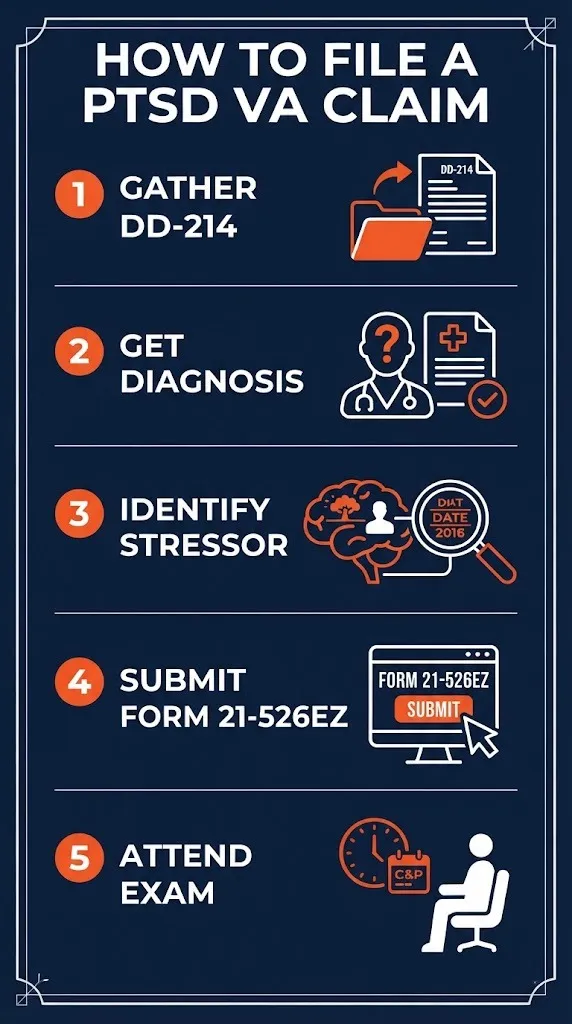
You file a PTSD VA claim by submitting VA Form 21-526EZ, the Application for Disability Compensation. You can file online through the VA website, by mail, or with help from a veterans service organization.
The claim requires evidence. The VA needs your service records, a current diagnosis of PTSD, and a medical opinion linking the PTSD to your service. That link is called a nexus.
Here are the steps to file:
- Gather your DD-214 and any service treatment records.
- Obtain a current PTSD diagnosis from a qualified mental health professional.
- Identify the stressful event in service that caused the PTSD.
- Provide a medical opinion connecting the event to the diagnosis.
- Submit VA Form 21-526EZ with all supporting evidence.
- Attend a VA compensation and pension exam if requested.
- Wait for a rating decision, then appeal if necessary.
The claim process can take months. Some claims are decided in under 120 days. Complex cases take longer.
What Evidence Do I Need for a PTSD VA Claim?
You need three types of evidence for a PTSD VA claim: a current diagnosis, an in-service stressor, and a medical nexus linking the stressor to the diagnosis.
The current diagnosis must come from a qualified mental health professional. A diagnosis from a licensed psychologist, psychiatrist, or clinical social worker qualifies. A note from a primary care doctor may not be enough.
The in-service stressor is the event that caused the PTSD. It could be combat, a training accident, military sexual trauma, or another traumatic event. The VA verifies stressors through service records, unit histories, or your own credible statement.
The nexus is a medical opinion stating that your PTSD is at least as likely as not caused by the in-service stressor. A VA examiner may provide this opinion during a compensation and pension exam.
Can I Get PTSD Compensation Without a Combat Medal?
Yes, you can get PTSD compensation without a combat medal. Combat experience is one way to establish a stressor, but it is not the only way.
The VA recognizes many types of stressors. Military sexual trauma is a common stressor. Training accidents, natural disasters during service, and witnessing death or serious injury also qualify. Fear of hostile military or terrorist activity can also support a PTSD claim.
If you do not have a combat medal, you will need to provide more detail about the stressor. The VA will look for corroborating evidence. That could include service records, news reports of the event, or statements from fellow service members.
Your own credible statement about the event matters. The VA cannot dismiss your claim just because you do not have a medal.
What If My PTSD VA Claim Was Denied?
If your PTSD VA claim was denied, you have the right to appeal. The denial letter explains why the VA denied the claim and what evidence you need to strengthen it.
The VA’s appeals process changed in recent years. You now have three options: a higher-level review, a supplemental claim, or an appeal to the Board of Veterans’ Appeals. Each option has different rules and timelines.
A higher-level review asks a senior VA employee to look at the same evidence again. A supplemental claim lets you add new evidence. A Board appeal sends the case to a judge.
You have one year from the denial date to appeal. If you miss the deadline, you may need to file a new claim.
Key Takeaway: A denial is not the end. The VA’s appeals process gives you multiple ways to fight a wrong decision.
How Long Does a PTSD VA Claim Take?
A PTSD VA claim takes an average of 120 to 180 days in 2026, but the time varies. Simple claims with clear evidence may be decided faster. Complex claims with missing evidence take longer.
The VA publishes average processing times. The numbers change monthly. A claim that requires a compensation and pension exam adds weeks. A claim that needs stressor verification adds more time.
The effective date matters more than the processing time. Your effective date is usually the date the VA received your claim. If you win, you get back pay to that date. Filing later means losing months of back pay.
File as soon as you have your diagnosis and basic evidence. Do not wait until you have a perfect file. The VA can request additional evidence after you file.
What Is the PTSD VA Rating Increase Process?
You file for a PTSD VA rating increase by submitting a new claim on VA Form 21-526EZ. You are asking the VA to re-evaluate your condition because it worsened.
The rating increase process is similar to the initial claim. You provide evidence that your symptoms are more severe. That evidence could include new treatment records, a letter from your therapist, or a statement about worsening symptoms.
The VA may schedule a new compensation and pension exam. The examiner will assess your current level of impairment. If the examiner finds more severe symptoms, the VA increases your rating.
Do not assume the VA will notice your condition worsened. The VA does not automatically re-evaluate every veteran. You must file the increase request yourself.
Reality Check
No one from the VA will call you to ask for money to process your PTSD claim. Filing a VA disability claim is always free. You do not need to pay a claims consultant or a third-party service to get your benefits. Accredited veterans service organizations and VA-accredited attorneys work on contingency, and many help for free.
What Are the New 2026 VA Dependency and Indemnity Compensation Rules?
Dependency and Indemnity Compensation, or DIC, is a separate VA benefit for surviving spouses and dependents of veterans who died from service-connected conditions. The rules for DIC are not the same as PTSD disability compensation.
DIC eligibility expanded in recent years. Surviving spouses of veterans who died from a service-connected disability may qualify, even if the veteran was not rated at 100 percent at the time of death.
The 2026 DIC base rate for a surviving spouse is approximately $1,612 per month, with additional amounts for children and for spouses who need aid and attendance. These figures are separate from PTSD compensation rates.
If you lost a veteran to PTSD-related causes, you may have a DIC claim. That process is different from a PTSD disability claim.
What Are the VA PTSD Presumptive Conditions in 2026?
The VA has presumptive rules for certain conditions, but PTSD is not a presumptive condition. Presumptive conditions are those the VA assumes are service-connected based on service location or timing.
PTSD requires proof of a stressor. The VA does not presume PTSD from service alone. That is different from conditions like certain cancers linked to burn pit exposure or Agent Orange.
A proposed rule or legislative change could alter PTSD stressor rules in the future, but no such change is law in 2026. Veterans should not rely on presumptive status for PTSD. The current rules require evidence of a stressor.
What Happens Next: PTSD VA Compensation in 2026 and Beyond
- September 2026: VA continues processing PTSD claims under the current rating schedule.
- October 2026: Annual cost-of-living adjustment announced for 2027 rates.
- November 2026: Veterans with pending appeals may see decisions from the Board of Veterans’ Appeals.
- December 2026: Effective date reminders for claims filed in 2026 preserve back pay.
- January 2027: New compensation rates take effect for all disability ratings.
Frequently Asked Questions
Is there a new PTSD VA rating schedule in 2026?
No new rating schedule has been enacted. The VA still uses the General Rating Formula for Mental Disorders.
How much is a 70 percent PTSD rating?
A 70 percent PTSD rating pays $1,716.28 per month for a veteran with no dependents in 2026.
Can I get PTSD compensation without a combat deployment?
Yes, any in-service stressor that caused PTSD can qualify, including training accidents or military sexual trauma.
How do I prove my PTSD stressor?
Provide service records, news reports, unit histories, or your own credible statement about the event.
What is the deadline to file a PTSD claim?
There is no deadline, but filing later means losing back pay to your effective date.
Can I work with a 100 percent PTSD rating?
A 100 percent rating means total occupational impairment. You generally cannot work with that rating.
What if my PTSD claim is stuck in appeals?
You can contact the VA or your representative for a status update. The Board of Veterans’ Appeals publishes its docket.
Is VA disability compensation taxable?
No, VA disability compensation is tax-free at the federal and state level.
Closing
PTSD VA compensation is a real, ongoing benefit. The rules did not change dramatically in 2026, but the money is real and the process is manageable if you have the right evidence.
The most important step is to file now if you have a PTSD diagnosis and a service connection. Every month you wait is a month of back pay you may never recover.