GLP-1 Lawsuit 2026: MDL Status, Case Counts, No Settlement Yet
Quick Answer
- Real litigation: two federal MDLs are active against Novo Nordisk and Eli Lilly over GLP-1 drug injuries.
- Payout: not yet determined, no settlement fund exists and no bellwether trial has been held.
- Deadline: no fixed federal filing deadline exists, but state statutes of limitations vary and don’t wait for the MDL.
If you’re searching “GLP-1 lawsuit,” here’s the direct answer: it’s a real, large, and still unsettled federal mass tort, not a case with checks going out yet.
This affects anyone who took Ozempic, Wegovy, Mounjaro, or a related drug and later developed a serious gastrointestinal condition or sudden vision loss. As of early August 2026, roughly 3,928 cases are pending in the gastrointestinal injury MDL, and about 200 in the separate vision loss MDL.
This article breaks down both tracks by case number, judge, and confirmed court activity, and corrects the record on where the litigation actually stands. One detail that surprises many readers: these two injury types are handled in two completely separate federal court proceedings, even though the same judge oversees both.
The Facts
| Case | MDL 3094 (In Re: GLP-1 RAs Products Liability Litigation, gastrointestinal injuries) and MDL 3163 (GLP-1 RAs NAION Products Liability Litigation, vision loss) |
| Status | Both active, in pretrial proceedings, no settlement reached |
| Fund Size | Not yet confirmed, no settlement exists in either MDL |
| Est. Per Person | Not yet determined |
| Claim Deadline | No federal MDL deadline confirmed, state statutes of limitations vary |
| Administrator | Not yet appointed, no settlement fund exists |
| Proof Needed | Gastric emptying study documentation required for gastroparesis claims in MDL 3094 |
Is the GLP-1 lawsuit real?
Yes. Two separate federal multidistrict litigations against GLP-1 drug makers are active in the U.S. District Court for the Eastern District of Pennsylvania.
MDL 3094, formally In Re: Glucagon-Like Peptide-1 (GLP-1) Receptor Agonists Products Liability Litigation, Case No. 24md3094, covers gastrointestinal injuries like gastroparesis, ileus, and gallbladder disease. MDL 3163 covers a separate injury, NAION, a condition causing sudden vision loss.
Both proceedings are overseen by U.S. District Judge Karen Spencer Marston. You can verify both case numbers directly through the Eastern District of Pennsylvania’s public MDL pages.
Key verified facts:
- MDL 3094: Case No. 24md3094, gastrointestinal injuries
- MDL 3163: Case No. 25md3163, NAION vision loss
- Both before Judge Karen S. Marston, E.D. Pennsylvania
- Defendants: Novo Nordisk and Eli Lilly
Is there a GLP-1 lawsuit settlement in 2026?
No. As of August 2026, no settlement exists in either the gastrointestinal injury MDL or the vision loss MDL.
This is worth stating plainly, since some sites describe the litigation as entering a “critical phase” in ways that can sound closer to settlement than the court record actually shows. Independent review of public court orders found no global settlement or scheduled bellwether trial as of mid-June 2026.
Here’s what would need to happen first, and where each step currently stands:
| Step | MDL 3094 Status | MDL 3163 Status |
|---|---|---|
| Leadership counsel appointed | Yes | Yes, February 2026 |
| Expert/Daubert briefing | Ongoing through 2026 | Early stages |
| Bellwether trial selected | Not yet | Not yet |
| Settlement negotiated | Not started | Not started |
| Settlement fund approved | Does not exist | Does not exist |
Key Takeaway: No GLP-1 lawsuit settlement exists in 2026, and any specific payout figure you see quoted is not sourced from either MDL’s court record.
How much money could you get from the GLP-1 lawsuit?
Not yet determined. No court, jury, or settlement administrator has set a payout figure in either GLP-1 MDL.
That’s a factual answer, not a dodge. Mass tort litigation like this typically needs bellwether trial verdicts before real settlement values emerge, and neither MDL has reached that stage.
| MDL | Fund Status |
|---|---|
| MDL 3094 (gastrointestinal) | No fund, summary judgment briefing ongoing |
| MDL 3163 (NAION vision loss) | No fund, early leadership and discovery phase |
What typically happens before real numbers exist:
- Bellwether cases get selected as representative trials.
- Those trials produce jury verdicts or negotiated resolutions.
- Verdict outcomes shape broader settlement negotiations.
- If a global settlement forms, a claims administrator sets payout tiers.
Do you qualify for the GLP-1 gastroparesis lawsuit?
You may qualify if you took a GLP-1 drug like Ozempic, Wegovy, Mounjaro, or Zepbound and were later diagnosed with gastroparesis, ileus, bowel obstruction, or gallbladder disease.
A key 2025 ruling in MDL 3094 changed what counts as sufficient proof. Judge Marston ruled that gastroparesis claims must be supported by documentation from a gastric emptying study, not just reported symptoms.
Drugs commonly named across GLP-1 injury claims:
- Ozempic and Wegovy (semaglutide, Novo Nordisk)
- Rybelsus (oral semaglutide, Novo Nordisk)
- Saxenda and Victoza (liraglutide, Novo Nordisk)
- Mounjaro and Zepbound (tirzepatide, Eli Lilly)
- Trulicity (dulaglutide, Eli Lilly)
According to case tracking, roughly 75% of complaints in MDL 3094 allege gastroparesis, about 18% allege ileus, and about 8% allege gallbladder injury.
Do you qualify for the GLP-1 vision loss (NAION) lawsuit?
You may qualify if you took a GLP-1 drug and were diagnosed with NAION, a condition causing sudden and often permanent vision loss in one or both eyes.
MDL 3163 is a separate court proceeding from the gastrointestinal MDL, created by the Judicial Panel on Multidistrict Litigation on December 15, 2025. It initially consolidated 21 actions plus nine related cases.
Reality Check: No legitimate settlement process starts with an unsolicited text or call promising a guaranteed GLP-1 payout, because no settlement exists in either MDL yet. Joining a mass tort through an attorney is normal, and initial case review is typically free, so there’s no reason to pay an upfront fee to “register” a claim.
The NAION docket has grown quickly. Case counts rose from 86 in May 2026 to roughly 200 by early August 2026, according to court tracking sources.
How to file a GLP-1 lawsuit claim
There’s no simple public claim form yet, since no settlement has been reached in either MDL. Filing currently means starting an individual case that would typically join the existing federal proceeding.
- Confirm which GLP-1 drug you took, and for how long.
- Gather medical records documenting your diagnosis.
- For gastroparesis claims, obtain gastric emptying study results if available.
- For vision loss claims, gather ophthalmology records confirming NAION.
- Consult an attorney experienced in mass tort or MDL litigation.
- Confirm your state’s statute of limitations before waiting further.
- Ask whether your case would join MDL 3094, MDL 3163, or a state court proceeding.
- Avoid paying any third party simply to “file early” or “reserve a spot.”
What proof do you need for a GLP-1 injury claim
You generally need documented proof of GLP-1 drug use and a qualifying diagnosis, and gastroparesis claims specifically require objective testing.
Since August 2025, Judge Marston’s ruling in MDL 3094 requires plaintiffs alleging gastroparesis to support that diagnosis with a properly performed gastric emptying study. Subjective symptom reports alone no longer meet the court’s standard.
Documentation likely to matter:
- Pharmacy or prescription records showing GLP-1 drug use
- A gastric emptying study for gastroparesis claims
- Ophthalmology records confirming a NAION diagnosis, for vision loss claims
- Hospital or treatment records tied to the alleged injury
Key Takeaway: Since August 2025, gastroparesis claims in MDL 3094 require gastric emptying study documentation, not just reported symptoms, so gathering that testing matters early.
What is the latest GLP-1 lawsuit update in 2026?
The latest confirmed update is that MDL 3094 had roughly 3,928 pending cases and MDL 3163 had roughly 200 pending cases as of early August 2026.
Case counts in both MDLs have grown steadily throughout 2026. MDL 3094 rose from about 3,546 cases in April to 3,636 in May, 3,763 in June, and roughly 3,928 by early August. MDL 3163 rose from 86 cases in May to about 110 by the June JPML report, then to roughly 200 by early August.
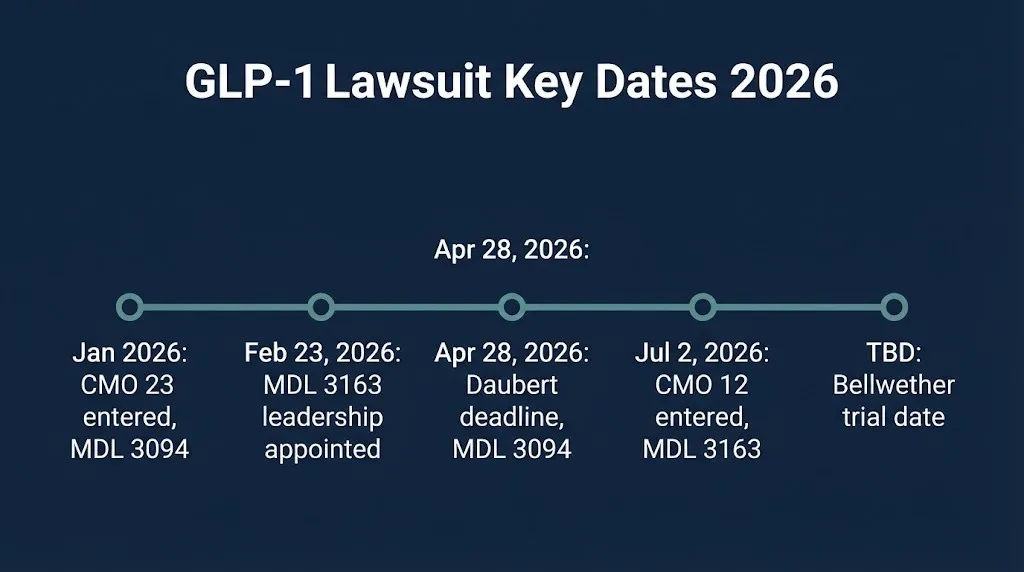
Confirmed 2026 timeline of major events:
- January 2026: CMO 23 entered in MDL 3094, driving toward expert and Daubert briefing
- February 23, 2026: Leadership appointment order issued in MDL 3163
- April 28, 2026: Daubert motions deadline in MDL 3094
- June 23, 2026: Status conference held in MDL 3094
- July 2, 2026: Case Management Order No. 12 entered in MDL 3163
When will GLP-1 lawsuit bellwether trials happen?
No bellwether trial date has been confirmed in either MDL as of August 2026.
Bellwether trials are a small number of representative cases tried first, helping both sides gauge how juries might respond across the larger docket. Industry trackers following the litigation expect bellwether selection around mid-2026, with first trials possibly happening in late 2026, though neither is confirmed by the court yet.
Think of the current stage like a home renovation that just cleared inspection: the project can move forward, but the final bill still isn’t written. Some trackers following the litigation expect any broad settlement is unlikely before late 2027, though that remains an estimate, not a court-set date.
Key Takeaway: Both GLP-1 MDLs remain in pretrial proceedings as of August 2026, with no bellwether trial date, settlement talks, or payout structure confirmed by the court.
What is MDL 3094 and MDL 3163?
MDL 3094 and MDL 3163 are two separate federal court structures consolidating GLP-1 injury lawsuits before the same judge for coordinated pretrial proceedings.
MDL 3094 was originally centralized in February 2024, initially assigned to Judge Gene E.K. Pratter before transferring to Judge Marston. It handles gastrointestinal injury claims exclusively.
MDL 3163 was created later, on December 15, 2025, specifically because the Judicial Panel on Multidistrict Litigation found NAION represents a distinct injury warranting its own coordinated proceeding, separate from the gastrointestinal cases.
What an MDL is, and isn’t:
- It consolidates similar federal lawsuits before one judge for pretrial efficiency.
- It is not a class action, each case keeps its own individual identity.
- Shared legal and scientific questions get resolved once for the whole group.
- Individual case outcomes can still vary once trials begin.
Why are patients suing over Ozempic, Wegovy, and Mounjaro?
Patients allege that Novo Nordisk and Eli Lilly failed to adequately warn about severe injuries linked to how these drugs work in the body.
GLP-1 receptor agonists intentionally slow gastric emptying as part of how they reduce appetite. Plaintiffs allege that in some patients, this effect becomes severe, persistent, and in certain cases irreversible even after stopping the medication.
Failure-to-warn claims form the core legal theory across both MDLs, arguing that patients and doctors weren’t given clear enough information about the risk of gastroparesis, bowel obstruction, gallbladder disease, or NAION before starting treatment.
What injuries are included in the GLP-1 lawsuit?
The GLP-1 lawsuit covers two distinct categories of alleged injury, gastrointestinal conditions and a specific eye condition called NAION.
Gastrointestinal claims in MDL 3094 primarily involve gastroparesis, described by case trackers as roughly 75% of complaints, along with ileus and gallbladder disease. NAION claims in MDL 3163 involve sudden, often permanent vision loss tied to optic nerve damage.
Injuries named across both MDLs:
- Gastroparesis (stomach paralysis)
- Ileus (intestinal blockage)
- Gallbladder disease requiring treatment
- Non-arteritic anterior ischemic optic neuropathy (NAION)
Who are the defendants in the GLP-1 lawsuit?
The two primary defendants are Novo Nordisk, maker of Ozempic, Wegovy, Rybelsus, Saxenda, and Victoza, and Eli Lilly, maker of Mounjaro, Zepbound, and Trulicity.
Both companies face failure-to-warn allegations across the two MDLs. Both are large, well-resourced pharmaceutical companies, and public reporting on the litigation notes they are expected to defend the cases aggressively rather than settle quickly.
What does the science say about GLP-1 drugs and these injuries?
The scientific link between GLP-1 drugs and severe gastrointestinal injury or NAION remains an active area of study, with no final court ruling establishing causation.
Delayed gastric emptying is a known, intended mechanism of these drugs, and plaintiffs argue that in some patients this becomes pathological rather than temporary. Studies cited in litigation tracking describe endoscopy, gastric emptying studies, and imaging as objective ways to document these gastrointestinal injuries.
For NAION, MDL 3163 has scheduled a Science Day, a standard mass tort procedure where medical experts present educational, non-adversarial information to the court about how GLP-1 drugs might interact with ocular blood flow and optic nerve health.
What happens next
April 28, 2026: Daubert motions deadline passed in MDL 3094.
July 2, 2026: Case Management Order No. 12 entered in MDL 3163, addressing cross-cutting issues.
Expected mid to late 2026: Bellwether case selection anticipated in both MDLs, not yet confirmed by the court.
Expected late 2026: Possible first bellwether trials, timing not yet set.
Expected no earlier than late 2027: Any broad settlement framework, based on how comparable mass torts typically progress, not a confirmed court date.
Frequently Asked Questions
Is the GLP-1 lawsuit legit?
Yes, it refers to two real, active federal multidistrict litigations.
MDL 3094 and MDL 3163 are both centralized in the Eastern District of Pennsylvania.
Case numbers and orders are publicly verifiable through the court’s official MDL pages.
How much is the GLP-1 lawsuit settlement worth?
No settlement exists yet, so no confirmed payout figure exists in either MDL.
Any specific dollar amount cited elsewhere is not sourced from a court filing.
Real numbers would only emerge after bellwether trials or a negotiated settlement.
What is the deadline to file a GLP-1 lawsuit?
There’s no single confirmed federal MDL filing deadline.
Deadlines depend on your state’s statute of limitations for product liability claims.
Speak with an attorney promptly, since waiting can affect your legal options.
Do I need a gastric emptying study to file a gastroparesis claim?
Court rules in MDL 3094 currently require this documentation for gastroparesis claims.
A 2025 ruling found that reported symptoms alone are not sufficient proof.
Other GI injuries, like bowel obstruction, may have different documentation standards.
Is the vision loss lawsuit part of the same case as the gastroparesis lawsuit?
No, they’re two separate MDLs, though the same judge oversees both.
MDL 3094 covers gastrointestinal injuries, MDL 3163 covers NAION vision loss.
Each has its own case number and its own pretrial schedule.
Who is being sued in the GLP-1 lawsuit?
Novo Nordisk and Eli Lilly are the primary named defendants.
Novo Nordisk makes Ozempic, Wegovy, Rybelsus, Saxenda, and Victoza.
Eli Lilly makes Mounjaro, Zepbound, and Trulicity.
When will GLP-1 lawsuit trials start?
No bellwether trial date has been confirmed by the court as of August 2026.
Industry trackers following the litigation expect possible trials in late 2026.
That timing remains an estimate, not a court-scheduled date.
If you or a family member took a GLP-1 drug and developed a serious gastrointestinal condition or sudden vision loss, gather your medical records now, including gastric emptying studies if applicable. Confirm your state’s statute of limitations before assuming the MDL timeline covers you.
The number worth remembering: as of early August 2026, roughly 3,928 gastrointestinal injury cases and 200 vision loss cases are pending, and neither MDL has reached a settlement.