Valve Lawsuit 2026: Class Action Facts, Trial Status, and What You Could Get
Quick Answer
- The Valve lawsuit is real, verified in federal court records as In re Valve Antitrust Litigation, No. 2:21-cv-00563-JNW in Seattle.
- No settlement fund exists yet; plaintiffs’ economists estimate developer damages over $3.1 billion, rising to about $9.3 billion if trebled under antitrust law.
- There’s no claim deadline yet because there’s no settlement; a certified developer class covers roughly 32,000 studios who paid Valve commissions since January 28, 2017.
If you’re searching “valve lawsuit,” here’s the direct answer: it’s a real, ongoing federal antitrust case against Valve Corporation, the company behind Steam, and it just cleared a major legal hurdle in March 2026.
This affects two separate groups differently. A certified class of roughly 32,000 game developers and publishers is already locked in, while everyday Steam shoppers fall under a separate consumer track that hasn’t been finalized the same way. The single most important fact right now: Judge Jamal N. Whitehead denied Valve’s motion for summary judgment in late March 2026, meaning the case is headed toward an actual jury.
This article breaks down what’s confirmed in court filings versus what’s still speculation, including a separate UK case worth roughly £656 million that most coverage buries. One surprising detail: Valve is also accused of refusing to pay $20 million in arbitration fees it agreed to when it tried to force consumer claims out of court.
The Facts
| Category | Detail |
|---|---|
| Case | In re Valve Antitrust Litigation, No. 2:21-cv-00563-JNW (consolidated from Wolfire Games, LLC v. Valve Corporation) |
| Court | U.S. District Court for the Western District of Washington, Seattle |
| Judge | Jamal N. Whitehead |
| Status | Summary judgment denied March 2026; heading to jury trial; no trial date set |
| Fund Size | Not yet confirmed, no settlement reached |
| Est. Per Person | Not yet determined |
| Claim Deadline | Not yet confirmed, no settlement claims process exists |
| Administrator | Not yet appointed |
| Proof Needed | Not applicable yet, since no claims process is open |
Is the Valve Lawsuit Real?
Yes, the Valve lawsuit is a real, federal antitrust case, verified in U.S. District Court records under case number 2:21-cv-00563-JNW. It’s not a rumor or a marketing claim.
The case traces back to April 2021, when indie developer Wolfire Games, along with named plaintiffs William Herbert and Daniel Escobar, filed the original complaint. That first version was dismissed on procedural grounds in late 2021, then refiled in 2022 and later consolidated with a similar suit from Dark Catt Studios.
There’s also a completely separate case in the United Kingdom, filed at the Competition Appeal Tribunal in London, covering a different group of consumers under different rules.
Key Takeaway: Two distinct legal actions exist against Valve right now, a certified U.S. federal case and a separate UK collective proceeding, and they don’t share a payout structure.
How Much Money Could You Get From the Valve Lawsuit?
No confirmed payout exists yet because Valve hasn’t settled and no jury has ruled. Any specific dollar figure per person you’ve seen online is a projection, not a court-approved number.
What is confirmed: plaintiffs’ economists have calculated a developer-side overcharge estimate tied to the case.
| Damages Category | Estimated Amount | Basis |
|---|---|---|
| Developer class overcharge estimate | More than $3.1 billion | Plaintiffs’ economic analysis |
| Developer damages if trebled | About $9.3 billion | Standard treble damages under U.S. antitrust law |
| Consumer class total | Not yet publicly disclosed | No consolidated figure released |
| UK collective claim | £656 million (about $897.7 million) | Provisional estimate filed with the UK tribunal |
Not yet determined. Individual per-person payouts, for both the developer class and any eventual consumer recovery, depend on a jury verdict or settlement that hasn’t happened. Plaintiffs have also stated their primary goal is a court injunction against Valve’s pricing rules, not just a damages check.
Valve Lawsuit Damages: Developer Class vs. Consumer Class
The Valve case runs on two separate tracks, and they’re not treated identically under the litigation. Understanding which one applies to you matters.
- Developer class: Certified November 25, 2024, covering an estimated 32,000 developers and publishers who paid Valve commissions since January 28, 2017. This class is automatically included without opting in individually.
- Consumer class: A parallel track involving Steam shoppers, still working through certification and, separately, an arbitration dispute over how those claims get resolved.
One example cited in litigation reporting involves a named plaintiff who spent $3,048.54 total on Steam over his lifetime, with the alleged overcharge estimated at roughly 54 percent of that spending. That’s an illustrative example from case filings, not a promise of what any individual consumer would recover.
Key Takeaway: If you’re a developer who sold a game on Steam since January 28, 2017, you’re likely already part of the certified class without doing anything; consumers are in a separate, less finalized track.
Do You Need to Do Anything to Join the Valve Lawsuit?
If you’re a developer or publisher covered by the certified class, you generally don’t need to opt in, since the class was certified to automatically include qualifying studios. Consumers fall under a different process that isn’t finalized yet.
The certified developer class covers those who paid Valve commissions on Steam sales from January 28, 2017 onward. Because this is a certified class action rather than an opt-in process, affected developers are typically included unless they choose to exclude themselves once formal notice is issued.
For consumers, no settlement claims process exists yet, so there’s currently nothing to file. Watch for official notice from the court or a settlement administrator, which would only appear after a resolution.
How to Check if You’re Part of the Valve Developer Class
Determining whether your studio qualifies for the certified developer class means checking your Steam commission payment history against the certified date range. Here’s how to approach it.
- Confirm you sold a game or paid commissions to Valve through Steam on or after January 28, 2017.
- Check whether your business falls under either the Wolfire-led complaint or the consolidated Dark Catt Studios matter.
- Watch for formal class notice, which is typically mailed or emailed once a settlement or verdict triggers a claims process.
- Consult the docket for case number 2:21-cv-00563-JNW directly if you want primary source confirmation.
- Do not pay any third party claiming to “register” you for the class; no such process exists yet.
- Retain your own Steam commission and sales records in case documentation is later required.
Reality Check: No legitimate Valve lawsuit process currently requires payment, personal banking details, or a “registration fee” from anyone, developer or consumer. Since no settlement exists, anything asking for money to join this case is not a verified part of the litigation.
What About the UK Valve Claim? Do You Need to Register?
The UK collective proceeding against Valve, certified in January 2026, covers up to 14 million UK consumers automatically, without requiring individual registration at this stage. This is separate from the U.S. federal case entirely.
Consumer advocate Vicki Shotbolt filed the claim in June 2024 before the Competition Appeal Tribunal, London’s dedicated antitrust court. The tribunal certified the case to proceed in January 2026, but no trial date had been set as of mid-2026.
The claim covers UK consumers who purchased games or in-game content through Steam since 2018, alleging Steam’s 30 percent commission combined with its pricing rules led to inflated consumer prices.
Valve Lawsuit Update 2026: What Happened in March?
In late March 2026, a federal judge in Seattle denied Valve’s motion for summary judgment, which was the company’s last major off-ramp to avoid a jury trial. This is the single most important procedural development in the case this year.
Judge Whitehead’s ruling doesn’t decide that Valve broke the law. It concluded that plaintiffs presented enough disputed evidence for a reasonable jury to potentially find Valve liable, meaning the case must go before a jury rather than getting dismissed.
That distinction matters for anyone tracking this case. A denied summary judgment motion is not a verdict, a settlement, or an admission of guilt. It’s a procedural finding that the dispute is real enough to require a trial.
When Is the Valve Antitrust Trial?
No confirmed trial date exists yet for the federal case, though legal observers following the litigation expect one to land sometime within the 2026 to 2027 window. That timeline is an informed projection, not a scheduled date.
The consolidated case has moved through years of procedural steps to reach this point, including a widely reported deposition of Valve co-founder Gabe Newell in November 2023, where he was questioned about internal company communications relevant to the pricing rules at issue.
Key Takeaway: No trial date has been formally set for either the U.S. federal case or the parallel UK tribunal case, despite both having cleared major certification hurdles in 2026.
Valve’s Arbitration Fight: Why Is Valve Accused of Blocking Consumers?
Valve is accused of refusing to pay roughly $20 million in arbitration fees after previously winning a court order compelling individual consumer claims into arbitration. This is a separate procedural fight tangled into the broader consumer track.
Valve had initially sought to force individual consumers into arbitration rather than a class action, arguing its terms of service required it. A court granted that request. But according to a sanctions motion filed by a consumer plaintiff, Valve then allegedly refused to pay the arbitration fees it owed once large numbers of consumers actually pursued individual arbitration claims.
That alleged nonpayment was described in court filings as a “bad faith” move that flouted the court’s own order compelling arbitration in the first place. This dispute remains part of the consumer track’s unresolved procedural tangle.
What Is the Valve Lawsuit About?
The Valve lawsuit alleges that the company used Steam’s dominant position in PC game distribution to enforce a 30 percent commission and pricing rules that limited competition. Steam is estimated to control roughly 74 to 75 percent of the PC digital game distribution market.
At the center of the case is Valve’s price parity policy, sometimes called a most-favored-nation clause. Plaintiffs allege this rule prevented developers from offering lower prices on competing storefronts, like the Epic Games Store, even when those competitors charged lower commission rates.
Plaintiffs argue this created a closed system: developers who wanted access to Steam’s massive user base had to accept Valve’s terms, and consumers paid prices that reflected reduced competition across the entire PC gaming market. Valve has defended the policy as a way to maintain consistent pricing and consumer trust across platforms.
Think of it like a landlord who owns every apartment building in a city and also runs the only rental listing website. Even if a cheaper unit exists elsewhere, the landlord’s rules stop anyone from actually advertising that lower price.
Who Is Wolfire Games and How Did This Case Start?
Wolfire Games is the independent studio that filed the original complaint against Valve in April 2021, alongside named plaintiffs William Herbert and Daniel Escobar. Their case became the foundation for the entire consolidated litigation.
Wolfire argued that Steam’s 30 percent commission, combined with its pricing parity requirement, made it structurally impossible for developers to compete fairly or offer discounted pricing elsewhere. After the first complaint was dismissed on procedural grounds in late 2021, Wolfire refiled in 2022.
The case was later consolidated with a similar action brought by Dark Catt Studios, combining developer plaintiffs into what’s now formally known as In re Valve Antitrust Litigation.
What Is Steam’s 30 Percent Commission and Price Parity Rule?
Steam’s standard commission is a 30 percent cut of most game sales made through its platform, and its price parity rule requires developers to keep prices consistent across competing storefronts. These two policies together form the core legal target of the lawsuit.
Critics argue this combination stifles competition by preventing developers from offering meaningful discounts on rival platforms, even when those platforms charge lower fees. Valve has publicly defended the arrangement as necessary to maintain a level playing field and preserve consumer trust in consistent pricing regardless of where someone shops.
If the court eventually rules against Valve on this point, developers could gain more pricing flexibility, potentially reshaping how PC games are priced and distributed across competing stores.
Who Are the Named Plaintiffs and Law Firms in the Valve Case?
The consumer class is being led by law firms Cohen Milstein and Hagens Berman, both with established track records in antitrust litigation against major tech platforms. The developer class has been represented by attorneys including David Rosen and the firm Quinn Emanuel.
Named plaintiffs across the consolidated case include Wolfire Games, Dark Catt Studios Holdings, William Herbert, Daniel Escobar, and several additional individuals and studios listed in the consolidated docket. Quinn Emanuel, representing the certified developer class, has publicly described it as one of the largest developer classes ever certified against a single platform holder.
Is Valve Expected to Settle?
There’s no confirmed indication Valve plans to settle, and legal observers following the case note Valve has historically been reluctant to settle disputes of this kind. That said, the March 2026 summary judgment denial removed one of Valve’s main options for avoiding trial altogether.
Settlement talks in major antitrust cases often intensify once a defendant loses its last procedural off-ramp before facing a jury, which is roughly where this case now stands. As of this writing, neither side has publicly signaled active settlement negotiations.
Key Takeaway: No settlement has been reached or publicly discussed, and the case is proceeding toward a jury trial that could happen anytime within the 2026 to 2027 window based on current court timelines.
What Happens Next
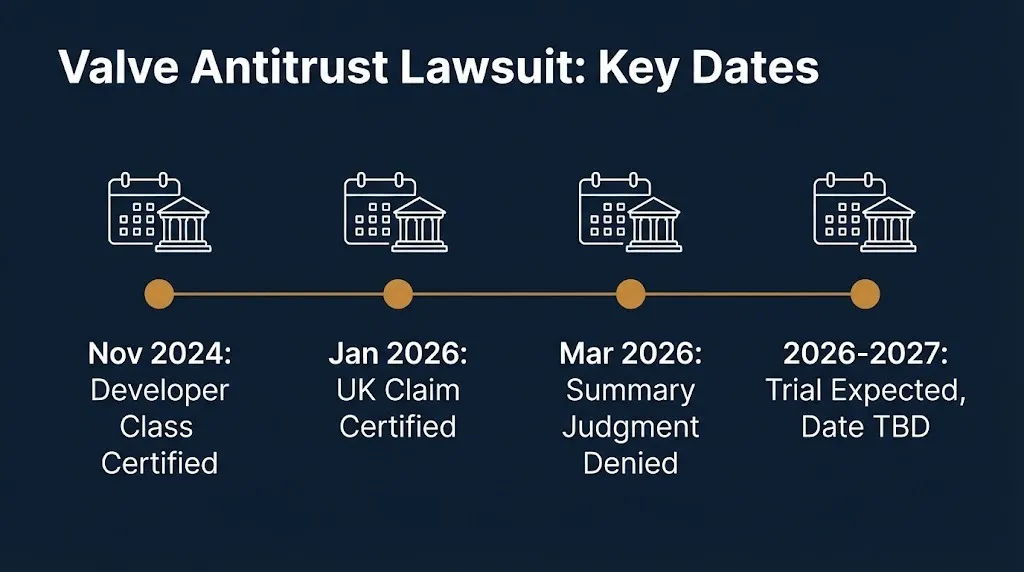
November 25, 2024 (completed): Judge Whitehead certified the developer class covering roughly 32,000 studios.
January 2026 (completed): The UK Competition Appeal Tribunal certified the parallel consumer case led by Vicki Shotbolt.
Late March 2026 (completed): Judge Whitehead denied Valve’s motion for summary judgment in the federal case, clearing the path to trial.
Expected 2026 to 2027: A federal jury trial date is anticipated but not yet formally scheduled, according to legal observers tracking the docket.
Expected, timing unconfirmed: A UK tribunal trial date for the separate £656 million collective claim has not yet been set.
Frequently Asked Questions
Is the Valve lawsuit a real class action?
Yes, it’s a real, court-verified federal antitrust case, In re Valve Antitrust Litigation, No. 2:21-cv-00563-JNW.
A separate certified collective proceeding also exists in the United Kingdom.
Both remain in active litigation with no settlement reached.
How much will I get from the Valve lawsuit?
No confirmed per-person payout exists because no settlement or jury verdict has occurred yet.
Plaintiffs estimate developer damages exceeding $3.1 billion, rising to about $9.3 billion if trebled.
Any specific personal dollar amount you’ve seen elsewhere is speculation, not a court-approved figure.
Do I need to file a claim to join the Valve lawsuit?
Developers who paid Valve commissions since January 28, 2017 are generally included in the certified class automatically.
Consumers currently have no claims process to file, since no settlement exists yet.
Watch for official court or administrator notice before responding to any claim request.
When is the Valve trial date?
No confirmed trial date exists yet for either the U.S. federal case or the UK tribunal case.
Legal observers expect the federal trial within the 2026 to 2027 window.
Check the official case docket for the most current scheduling information.
What did Valve get accused of doing with arbitration fees?
Valve is accused of refusing to pay roughly $20 million in arbitration fees owed after compelling individual consumer arbitration.
A consumer plaintiff filed a sanctions motion describing this as a “bad faith” move.
This dispute remains part of the unresolved consumer litigation track.
Is this the same as the UK Valve lawsuit?
No, the UK case is a separate collective proceeding before the Competition Appeal Tribunal in London.
It covers up to 14 million UK consumers and seeks a provisional £656 million in damages.
The U.S. federal case and the UK case operate independently with separate courts and timelines.
Will Valve have to change its 30 percent commission?
That outcome isn’t determined yet, since the case hasn’t reached trial or settlement.
Plaintiffs’ stated primary goal is a court injunction against Valve’s pricing rules, not just damages.
Any change to Steam’s commission structure would depend on the eventual verdict or settlement terms.
Check the official federal docket under case number 2:21-cv-00563-JNW for the most current filings, and don’t respond to any message asking for payment to join this case. As of August 31, 2026, no trial date, settlement, or confirmed payout exists for either the U.S. or UK Valve litigation.