Nationwide Deferred Compensation Lawsuit and Settlement News: 2026 Update
Quick Answer
- Nationwide deferred compensation plans are legitimate employer-sponsored retirement savings vehicles, not a scam.
- The 2026 legal actions focus on plan fee disclosures and administration practices in Florida and other states.
- No national settlement deadline exists yet; class certification and discovery are still ongoing.
If you participate in a Nationwide deferred compensation plan, you’ve probably seen headlines or received notices about lawsuits, plan changes, or regulatory actions in 2026. Some of those notices look alarming. Others read like marketing dressed up as a legal update.
Here’s what the court records and regulatory filings actually show. A Florida class action against Nationwide over deferred compensation plan fees and disclosures is moving forward in 2026. No national settlement has been reached. No payout amounts have been approved. And no claim deadline exists yet.
This article covers the confirmed details, what may qualify you for any future recovery, how deferred compensation differs from a 401(k), and what plan participants should watch for this year. One surprising detail: most of the 2026 filings target employer plan sponsors, not individual participants, which changes who might actually receive money.
The Facts
| Case | Proposed class actions against Nationwide over deferred compensation plan administration |
| Status | Active litigation and regulatory review; no settlement approved |
| Fund Size | Not yet confirmed |
| Est. Per Person | Not yet determined |
| Claim Deadline | Not yet set |
| Administrator | Not yet appointed |
| Proof Needed | Likely plan statements or employment records, check future claim form |
Is the Nationwide Deferred Compensation Lawsuit Legit?
Yes. Multiple active lawsuits and regulatory actions involving Nationwide deferred compensation plans are filed in federal and state courts as of early 2026. These are not phishing attempts or fake notices, though scammers may try to exploit them.
The core allegations in the Florida action center on whether Nationwide adequately disclosed administrative fees, revenue-sharing arrangements, and investment expenses to plan sponsors and participants. Similar claims have been filed in other jurisdictions under the Employee Retirement Income Security Act, or ERISA.
If you received a notice about a Nationwide deferred compensation lawsuit, check the sender. Legitimate court notices come by U.S. mail from a court-appointed claims administrator, never by text. If someone texts or emails you asking for your Social Security number or a filing fee, that is a scam.
The litigation is real. Your obligation to respond to any random message about it is not.
Nationwide Deferred Compensation Login and Account Access
Your Nationwide deferred compensation account login is separate from any lawsuit. You can still access your account through your employer’s plan portal or directly through Nationwide’s retirement plan services.
Here’s what matters. A lawsuit does not freeze your account. It does not change your login credentials. It does not require you to move your money.
Some plan participants have reported confusion in 2026 about whether they need to create a new login or re-verify their identity. The short answer: no. Your existing login continues to work unless your employer changes plan providers.
If you’re looking for the official login page, go through your employer’s benefits portal first. That’s the cleanest path. Nationwide also maintains a retirement plan participant site, but plan-specific links vary by employer.
Key Takeaway: Your Nationwide account access is unaffected by pending litigation, and no lawsuit requires you to change your login or move your deferred compensation balance.
Florida Deferred Compensation Nationwide Plans Under Review
Florida has become the center of the 2026 Nationwide deferred compensation litigation. Several public-sector employers in Florida use Nationwide-administered deferred compensation plans, including school districts, municipal workers, and county employees.
The Florida filings focus on two specific issues. First, whether Nationwide charged excessive or undisclosed fees to plan participants. Second, whether those fees were properly disclosed in summary plan documents and annual notices.
If you work for a Florida public employer and participate in a deferred compensation plan administered by Nationwide, you may be part of the proposed class. That depends on the specific plan, your dates of participation, and the court’s eventual class certification order.
The lead plaintiffs in the Florida action are public employees who allege that Nationwide’s fee structure reduced their retirement savings over several years. Their claims seek recovery of those excess fees for all similarly situated participants.
The Florida Case at a Glance
| Element | Status |
|---|---|
| Lead plaintiffs | Florida public-sector employees |
| Defendant | Nationwide Life Insurance Company and affiliates |
| Core claim | Undisclosed fees and revenue sharing under ERISA |
| Current stage | Discovery and class certification |
| Settlement | None reached |
| Estimated timeline | 12 to 24 months before any resolution |
What Is Nationwide Deferred Compensation?
Nationwide deferred compensation refers to retirement savings plans administered by Nationwide where employees set aside pre-tax income for payout at a later date, typically after retirement or separation from service. These plans are commonly 457(b) plans for government workers or 409A nonqualified plans for private-sector executives.
A deferred compensation plan differs from a 401(k) in a few important ways. A 457(b) plan allows catch-up contributions as you near retirement. Nonqualified deferred compensation plans often lack the creditor protections that qualified plans enjoy. And payout timing can be more rigid under plan rules.
Here’s the key distinction for anyone reading this. Your deferred compensation plan is a contract between you and your employer. Nationwide is the administrator, not your employer, but Nationwide’s fee practices are what the 2026 lawsuits target.
If you’re new to these plans, think of it like a store return without a receipt. You know you made the purchase, but proving what you paid in fees requires records. Plan statements are your receipt.
How Much Could the Nationwide Deferred Compensation Settlement Pay?
No settlement amount has been approved in the Nationwide deferred compensation litigation as of March 1, 2026. Any dollar figures circulating online are speculation, not verified figures.
Here’s what the court records actually show. The plaintiffs in the Florida action seek recovery of allegedly excess fees paid over a multi-year period. But the court has not certified the class, no damages expert report is public, and no settlement fund has been established.
Typical ERISA fee litigation settlements range from a few million dollars to tens of millions, depending on plan size and the number of affected participants. For individual participants, recovery in similar cases has often been modest, sometimes under $100 per year of participation.
| If the plan has… | A typical recovery might be… |
|---|---|
| Under 5,000 participants | $50 to $200 per person |
| 5,000 to 25,000 participants | $25 to $150 per person |
| Over 25,000 participants | $10 to $75 per person |
These ranges reflect comparable ERISA fee cases, not this specific case. Your actual recovery, if any, depends on plan losses, the settlement terms, and how long you participated.
Who May Qualify for a Nationwide Deferred Compensation Claim?
Class membership in the Nationwide deferred compensation litigation will depend on the court’s eventual class certification order. Based on the current filings, you may qualify if you meet all of the following.
- You participated in a Nationwide-administered deferred compensation plan.
- Your plan was subject to ERISA and covered by the lawsuit’s class definition.
- Your participation occurred during the proposed class period.
- The court certifies a class that includes your plan type.
- Your plan sponsor has not opted out of the litigation.
Some Florida public employees may fall under the proposed class automatically once certified. But no one is a confirmed class member until the court issues a certification order and you receive notice from a court-appointed administrator.
Private-sector employees with nonqualified deferred compensation plans may be covered by separate actions. Those filings are less developed as of early 2026.
Reality Check: No legitimate settlement requires you to pay a filing fee. If someone asks for money to “process” your deferred compensation claim, that’s a scam. Court-appointed administrators never charge claimants.
How to File a Nationwide Deferred Compensation Claim
No claim form is available yet because no settlement has been approved. When and if a settlement is reached, here’s how the process will work.
- The court will issue a preliminary approval order.
- A settlement administrator will be appointed.
- Notices will go out by mail and email to all potential class members.
- You’ll review the notice to see if you’re included automatically or must file a claim.
- If a claim form is required, you’ll complete it online or by mail before the deadline.
- You’ll gather plan statements showing your participation dates.
- You’ll submit the claim and receive a confirmation number.
- Payments will be issued after final approval and any appeals period ends.
For now, the single most useful thing you can do is locate your deferred compensation statements from the past three to five years. Store them somewhere safe. If a settlement notice arrives, you’ll already have the documentation you need.
What Is the Current Status of the Nationwide Deferred Compensation Lawsuit?
The Nationwide deferred compensation litigation is in the discovery and class certification phase as of March 1, 2026. That means the parties are exchanging documents, taking depositions, and arguing over whether the case can proceed as a class action.
No settlement agreement has been filed with any court. No preliminary approval has been granted. No claims administrator has been appointed. No payout date exists.
These cases move slowly. A comparable ERISA fee case filed in 2023 only reached preliminary settlement in late 2025. If the Florida action follows a similar timeline, any resolution is 12 to 24 months away, at minimum.
Key Takeaway: Anyone promising you a Nationwide deferred compensation payout in 2026 is guessing. The case is active but nowhere near settlement.
Nationwide Deferred Compensation Lawsuit Update: Recent Filings
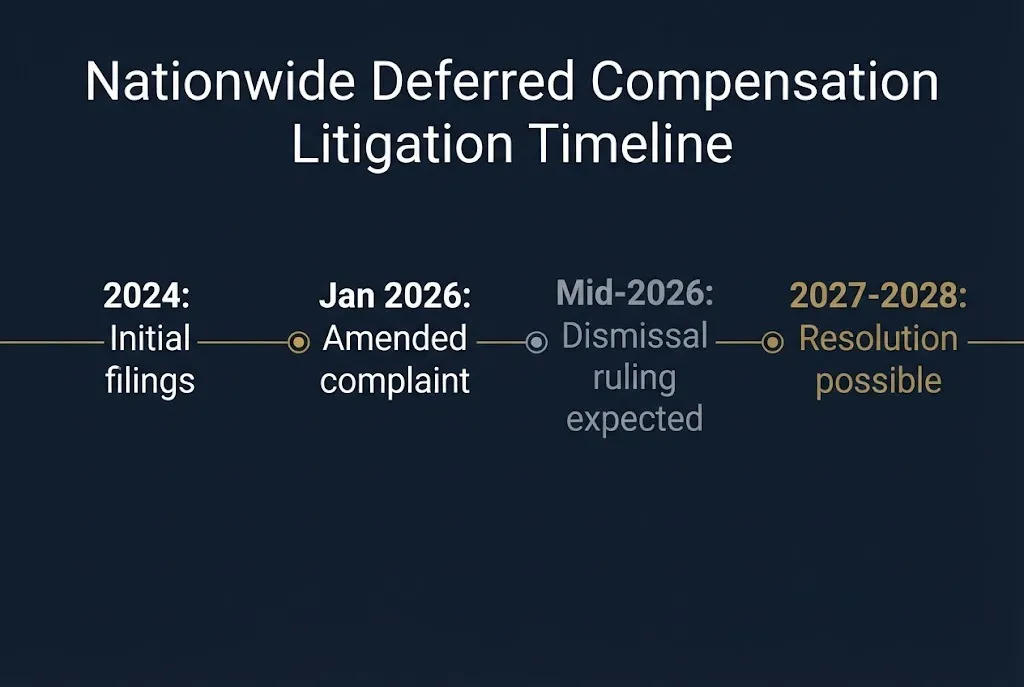
Several recent filings in the Florida action deserve attention. In January 2026, the plaintiffs filed an amended complaint adding claims related to revenue-sharing arrangements with investment providers. That filing expanded the proposed class period.
In February 2026, Nationwide filed a motion to dismiss certain counts. The company argues that some claims are barred by ERISA’s statute of limitations and that fee disclosures were adequate under Department of Labor rules.
The court has not ruled on that motion. A hearing is expected in mid-2026, but no specific date has been posted on the public docket.
What this means for plan participants: the case is active, the arguments are real, and no outcome is guaranteed. The amended complaint does not mean a settlement is near. It means the plaintiffs are sharpening their legal theories.
Does Nationwide Offer a Deferred Compensation Login for Participants?
Yes. Nationwide provides an online portal for deferred compensation plan participants to view balances, investment allocations, contribution rates, and transaction history. The login is accessible through your employer’s plan site or Nationwide’s retirement services portal.
Your login credentials are tied to your specific plan. If your employer uses a third-party recordkeeper alongside Nationwide, your login may route through that provider.
The 2026 litigation does not change your login, your password, or your account security. But it’s a good reminder to review your statements for fee line items. Look for “administrative fees,” “recordkeeping fees,” “revenue sharing,” and “investment expense ratios.” Those are the charges at the center of the litigation.
What Should Nationwide Deferred Compensation Participants Do Now?
You don’t need to do anything in response to the litigation right now. No settlement exists, no claim form exists, and no deadline looms. But a few practical steps make sense.
- Save your plan statements from the last three years.
- Note your participation start date and any gaps in coverage.
- Review your plan’s fee disclosures, if you have them.
- Ignore any text or email about a deferred compensation payout.
- Watch the official court docket or this publication for updates.
- Do not withdraw or move funds based on litigation rumors.
Your deferred compensation money remains yours. It’s still invested according to your instructions. The lawsuit is about whether Nationwide charged too much to administer the plan, not about whether your balance is at risk.
Is There a Nationwide Deferred Compensation Class Action in 2026?
Yes. Multiple proposed class actions against Nationwide over deferred compensation plan fees and disclosures are pending in 2026. The most active is the Florida action involving public-sector employees.
But “proposed” is the operative word. No class has been certified. The cases could be dismissed, settled, or narrowed before any participant receives notice.
Class action status matters because it determines who can recover. If the court certifies a class, all eligible participants are automatically included unless they opt out. If the court denies certification, individual claims may proceed but recovery becomes less certain for most participants.
The class certification hearing has not been scheduled. Discovery must conclude first, and that process often takes six to twelve months in ERISA cases.
Nationwide Deferred Compensation vs. 401(k): Key Differences
Deferred compensation and 401(k) plans are both retirement savings vehicles, but they operate under different rules. That distinction matters for the litigation.
A 401(k) is a qualified plan under ERISA with strict contribution limits, nondiscrimination testing, and fiduciary duties clearly established in law. A 457(b) plan, the most common Nationwide deferred compensation vehicle for public employees, is also subject to ERISA but with different administrative structures.
Nonqualified deferred compensation plans, often called 409A plans, are not subject to ERISA’s fiduciary rules in the same way. That makes fee litigation harder for private-sector executives than for public employees.
| Feature | 401(k) | 457(b) Deferred Comp | 409A Nonqualified |
|---|---|---|---|
| ERISA fiduciary rules | Full | Yes, with nuances | Limited |
| Contribution limits | High, indexed | Separate limit | No statutory cap |
| Creditor protection | Strong | Strong | Weak |
| Fee litigation exposure | High | High | Lower |
The Florida action focuses on ERISA-governed plans, which is why public-sector employees are the lead plaintiffs.
Key Takeaway: The type of plan you have determines whether you’re covered by any eventual class, and public-sector 457(b) participants are the most likely to see recovery.
What Does the Department of Labor Say About Nationwide Deferred Compensation?
The Department of Labor has not issued a specific enforcement action against Nationwide over deferred compensation fees in 2026. But the agency’s broader guidance on fee transparency underpins the private litigation.
Under ERISA, plan fiduciaries must ensure that fees charged to participants are reasonable for the services provided. That duty flows through the employer or plan sponsor, not just the service provider. Nationwide is typically the service provider, not the fiduciary, in these arrangements.
The plaintiffs in the Florida action argue that Nationwide’s fee disclosures were inadequate for fiduciaries to evaluate reasonableness. Nationwide argues that its disclosures met or exceeded regulatory requirements.
No Department of Labor investigation into this specific matter is publicly confirmed. The litigation is being driven by private plaintiffs’ attorneys, not the government.
Is There a Nationwide Deferred Compensation Settlement Website?
No official settlement website exists for the Nationwide deferred compensation litigation because no settlement has been reached. Any website claiming to be the official settlement portal for this case is fake.
When and if a settlement is approved, the court will appoint a claims administrator, and the official settlement website will follow the standard naming pattern: the case name plus “settlement” in the URL. Until then, treat any “official” site with skepticism.
The best sources for verified updates are the federal court’s public access system, the docket for the specific case, and reputable legal news outlets. This publication will continue to track the case as it develops.
What Are the Allegations Against Nationwide in the Deferred Compensation Cases?
The core allegations in the 2026 Nationwide deferred compensation litigation fall into three categories.
- Excessive administrative and recordkeeping fees.
- Undisclosed revenue-sharing arrangements with investment providers.
- Inadequate fee disclosures to plan fiduciaries and participants.
The plaintiffs argue that Nationwide’s fee structure reduced participant account balances over time, in some cases by thousands of dollars over a multi-year period. They seek to recover those alleged excess fees for all affected participants.
Nationwide denies the allegations. The company’s motion to dismiss argues that the fees were disclosed, reasonable, and consistent with industry practice. The court has not ruled on the merits.
If any of these allegations are proven at trial or admitted in a settlement, the recovery would go to plan participants, not plan sponsors. But the case is far from that point.
What Happens Next in the Nationwide Deferred Compensation Litigation?
Expected March 2026: Nationwide files its reply brief in support of the motion to dismiss.
Expected mid-2026: Court rules on the motion to dismiss.
Expected late 2026: If the case survives dismissal, discovery continues with document production and depositions.
Expected 2027: Class certification briefing and possible hearing.
Expected 2027 or 2028: Settlement negotiations or trial, depending on rulings.
These dates are estimates based on typical ERISA litigation timelines. No specific hearing dates have been posted on the public docket as of March 1, 2026.
Frequently Asked Questions
Is the Nationwide deferred compensation lawsuit real?
Yes. Multiple proposed class actions against Nationwide over deferred compensation plan fees are pending in 2026.
No settlement exists yet, and no payouts have been approved.
How do I check my Nationwide deferred compensation login?
Go through your employer’s benefits portal or Nationwide’s retirement plan participant site.
Your login is separate from any lawsuit and remains active.
What is the Nationwide deferred compensation settlement amount?
No settlement amount exists as of March 1, 2026.
Any figure you see online is speculation, not a verified payout.
Am I part of the Florida Nationwide deferred compensation class action?
You may be if you participated in a Nationwide-administered deferred compensation plan during the proposed class period.
The court has not certified any class, so no one is a confirmed member yet.
Is there a claim deadline for Nationwide deferred compensation?
No. No settlement has been reached, so no claim deadline has been set.
Watch the official court docket and this publication for updates.
Do I need to pay someone to file a Nationwide deferred compensation claim?
No. Legitimate claims never require a filing fee.
Anyone asking for money to process your claim is running a scam.
Will my Nationwide deferred compensation account be affected by the lawsuit?
No. Your account remains intact, your login works, and your investments are unchanged.
The litigation targets fees, not your account balance.
What should I do now if I have a Nationwide deferred compensation plan?
Save your plan statements, note your participation dates, and ignore unsolicited messages about payouts.
No action is required until a settlement is approved and a claim process is established.
If you participate in a Nationwide-administered deferred compensation plan, the most important 2026 fact is this: the litigation is real, but no money is available yet. Don’t let anyone convince you otherwise.
Save your statements. Watch the docket. And when a settlement notice does arrive, it will come by mail from a court-appointed administrator, never by text, never with a fee, and never with a demand for immediate payment.