Paragard IUD Lawsuit and Settlement News: 2026 Update
Quick Answer
- The Paragard IUD lawsuit is real, consolidated in a federal multidistrict litigation in Georgia.
- No global settlement amount has been verified; individual settlements remain confidential.
- No claim deadline exists yet, but statutes of limitations may bar older claims.
You had a Paragard IUD. It broke during removal. Or you’ve seen ads about Paragard lawsuits and wondered if you qualify for compensation.
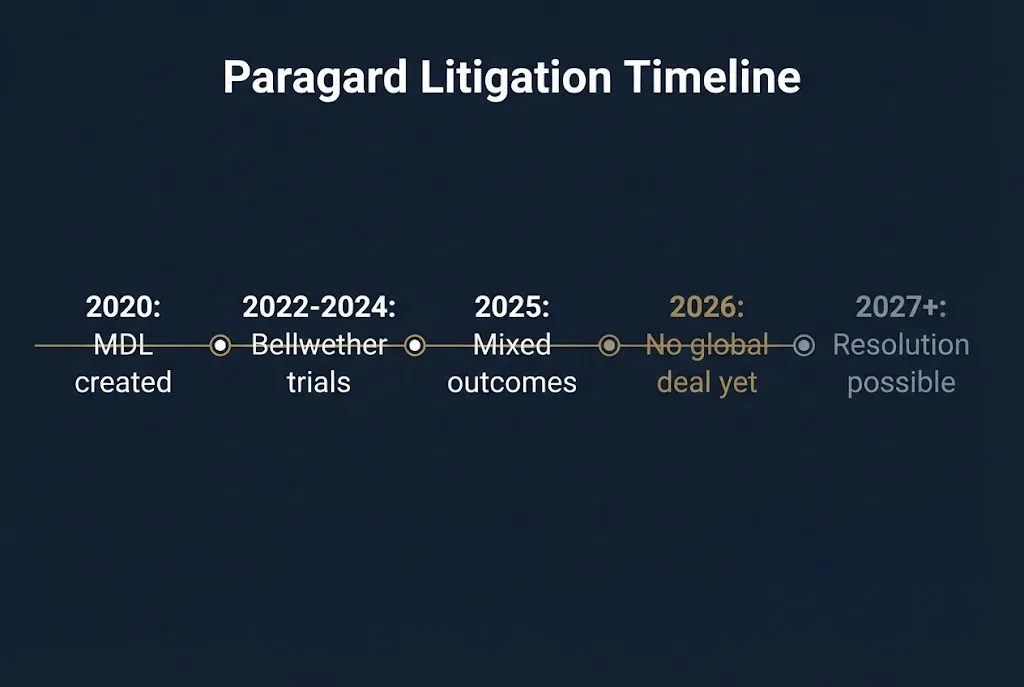
Here’s what the court records actually show. The Paragard litigation is consolidated in a multidistrict litigation, or MDL, in the Northern District of Georgia. The cases allege that the Paragard IUD’s design causes the device to break during removal, leaving fragments that require surgery. Bellwether trials have occurred with mixed results.
This article covers the verified status, what settlement amounts might look like based on trial outcomes, how bellwether verdicts are shaping the litigation, and what to do if you experienced a Paragard breakage. One surprising detail: the litigation has been active since 2020, and the bellwether outcomes have been less favorable to plaintiffs than many law firm ads suggest.
The Facts
| Case | In re: Paragard IUD Products Liability Litigation |
| Status | Active MDL; bellwether trials completed; no global settlement |
| Fund Size | Not established |
| Est. Per Person | Not yet determined |
| Claim Deadline | None set |
| Administrator | Not appointed |
| Proof Needed | Medical records, device removal records, fragment documentation |
Is the Paragard IUD Lawsuit Real?
Yes. The Paragard IUD litigation is a real, court-supervised multidistrict litigation involving thousands of plaintiffs who claim the device broke during removal, causing injuries requiring surgery. The cases are consolidated in the Northern District of Georgia.
The MDL was created in 2020 to handle common discovery and pretrial proceedings. It’s not a class action. Each plaintiff has their own case with their own medical history and injury facts.

The core allegation is that Paragard’s design makes the device prone to breakage during removal, particularly the arms of the T-shaped device. When breakage occurs, fragments can remain in the uterus, requiring hysteroscopy or hysterectomy to remove.
The litigation is real. The settlement amounts are not yet real because no global settlement exists.
What Is the Latest Update on the Paragard Lawsuit?
The latest verified update on the Paragard litigation is that multiple bellwether trials have been completed with mixed outcomes. Some trials have ended in defense verdicts, while others have resulted in plaintiff verdicts or settlements.
The bellwether trial process is designed to test how juries respond to the evidence. The outcomes of these trials influence settlement negotiations for the thousands of remaining cases.
The mixed results are significant. In mass tort litigation, strong plaintiff verdicts typically push defendants toward settlement. Defense verdicts do the opposite. The Paragard litigation has seen both, which complicates settlement negotiations.
As of early 2026, no global settlement has been announced, and the litigation continues through additional bellwether trials and case management.
Key Takeaway: The Paragard bellwether trials have produced mixed results, which means settlement dynamics are less favorable to plaintiffs than in some other medical device litigations.
What Are the Paragard Lawsuit Settlement Amounts?
No Paragard lawsuit settlement amounts have been verified as of March 1, 2026. No global settlement exists, and the court has not published any payout figures.
Individual settlements have occurred in some cases, but those amounts are confidential. The public record does not include a settlement grid or tier structure.
Any website or ad claiming specific Paragard settlement amounts is speculating. The litigation has not reached the global settlement stage, and the bellwether outcomes have not created a clear settlement benchmark.
When settlement amounts do emerge, they will be published in court filings or announced through a court-appointed claims administrator. Until then, treat all dollar figures as unverified.
What Injuries Are Claimed in the Paragard Lawsuits?
The Paragard lawsuits center on injuries caused by device breakage during removal. The most commonly cited injuries include uterine perforation, retained device fragments, and the need for surgical removal.
When the Paragard device breaks, the plastic arms can separate from the copper wire. Those fragments can embed in the uterine wall or migrate to other areas. Removing them often requires hysteroscopy, a surgical procedure to visualize and remove the fragments.
In severe cases, the breakage leads to hysterectomy, the surgical removal of the uterus. That outcome is devastating for women who wanted to preserve fertility.
The severity of the claimed injury matters for any future settlement value. Cases involving hysterectomy would likely be valued higher than cases where fragments were removed without lasting complications.
Who May Qualify for a Paragard Claim?
You may qualify for a Paragard claim if you had the device implanted and it broke during removal, leaving fragments that required medical intervention. The specific qualifying criteria are still being defined through the litigation.
Based on the current filings, potential claimants include women who experienced any of the following.
- Paragard device breakage during removal.
- Retained device fragments confirmed by imaging.
- Surgery to remove retained fragments.
- Uterine perforation caused by the device or fragments.
- Hysterectomy following Paragard complications.
The key is documented medical evidence. Your records should show the device was implanted, that it broke during removal, and that you required treatment for the breakage.
How Do I File a Paragard Lawsuit?
Filing a Paragard lawsuit requires hiring an attorney, gathering medical records, and potentially joining the MDL. Here are the steps.
- Confirm you had a Paragard IUD implanted.
- Gather medical records documenting the removal and any breakage.
- Obtain records of any surgery to remove retained fragments.
- Contact an attorney who handles medical device litigation.
- Provide your medical records and device history.
- Sign a retainer agreement if the attorney accepts your case.
- File your claim or join the MDL before your state’s statute of limitations expires.
- Participate in discovery and any future settlement process as directed.
There is no fee to file a claim with an attorney. Medical device attorneys work on contingency.
Reality Check: No one from a court or claims administrator will call you first about Paragard settlement money. Legitimate claims start with you contacting an attorney, never with unsolicited messages offering payouts.
What Is the Statute of Limitations for Paragard Claims?
The statute of limitations for Paragard claims varies by state, typically ranging from one to three years from the date you knew or should have known about the breakage. The clock usually starts when the device broke during removal and you learned about the fragments.
This timing matters. If your Paragard broke in 2021 and you had surgery that same year, your filing window may have closed in 2023 or 2024 depending on your state.
Some states apply a discovery rule that extends the deadline. Others are stricter. Don’t assume you have unlimited time. Contact an attorney promptly if you think you have a claim.
The Paragard litigation has been active since 2020, and many potential plaintiffs have already filed. But women who experienced breakage more recently may still have time.
What Do the Bellwether Outcomes Mean for Settlements?
The bellwether outcomes in the Paragard litigation have been mixed, which has a direct impact on settlement dynamics. Bellwether trials are test cases that show both sides how juries respond to the evidence.
When plaintiffs win bellwether trials, defendants face pressure to settle remaining cases at higher values. When defendants win, plaintiffs face pressure to accept lower settlements or risk losing at trial.
The Paragard litigation has seen both outcomes. Some juries have found for the plaintiffs, awarding damages for injuries caused by device breakage. Other juries have found for the defense, concluding that the plaintiffs failed to prove the device was defective.
This mixed record means settlement negotiations are more complex than in litigations where one side consistently wins. Neither side has a clear advantage, which often leads to more trials and slower resolution.
Key Takeaway: The mixed bellwether outcomes mean Paragard settlement amounts are harder to predict, and the litigation may take longer to resolve than other medical device MDLs.
What Is the Difference Between Paragard and Other IUD Lawsuits?
Paragard is a copper IUD, not a hormonal IUD. The litigation focuses on device breakage during removal, not on hormonal side effects. That distinction matters.
Other IUD litigations, such as those involving Mirena, have focused on different alleged injuries, including uterine perforation during insertion and hormonal side effects. The Paragard litigation is specifically about the device’s tendency to break during removal.
The design difference is central to the legal claims. Paragard’s T-shaped frame has plastic arms that plaintiffs allege are prone to fracture. The copper wire wrapped around the device is also at issue in some cases.
If you had a different IUD, the Paragard litigation does not apply to you. Your claim would fall under a different product liability framework.
What Happens Next in the Paragard Litigation?
Expected 2026: Additional bellwether trials may be scheduled or completed.
Expected late 2026: The court may issue rulings on pending motions or schedule further trials.
Expected 2027: If bellwether outcomes remain mixed, the court may encourage settlement conferences.
Expected 2028: Resolution of remaining cases through settlement or remand for individual trials.
Expected beyond 2028: Final resolution of the MDL.
These dates are estimates based on typical MDL timelines. No specific trial dates have been confirmed as of March 1, 2026.
Frequently Asked Questions
Is the Paragard lawsuit real?
Yes. The Paragard litigation is a real MDL in the Northern District of Georgia.
Thousands of cases are consolidated there.
What are the Paragard settlement amounts?
No settlement amounts have been verified.
No global settlement exists, and individual settlements are confidential.
Can I still file a Paragard claim in 2026?
Yes, if your device broke recently and you meet the statute of limitations.
Contact an attorney promptly to check your filing window.
What injuries qualify for a Paragard claim?
Device breakage during removal, retained fragments, and surgical removal are the main claims.
Documentation of the breakage and treatment is essential.
Do I need a lawyer for a Paragard lawsuit?
Yes. Medical device litigation requires experienced attorneys.
Attorneys work on contingency, so there’s no upfront fee.
What is the Paragard MDL?
It’s a multidistrict litigation consolidating thousands of individual Paragard cases.
The MDL is pending in the Northern District of Georgia.
Why are the bellwether outcomes mixed?
Juries have reached different conclusions about whether the device is defective.
That mixed record complicates settlement negotiations.
Is Paragard still on the market?
Yes. Paragard remains FDA-approved and available.
The litigation does not remove the device from the market.
If you had a Paragard IUD that broke during removal, the most important step is to check your state’s statute of limitations. That deadline, not the MDL’s timeline, determines whether you still have a claim.
Gather your medical records and device removal documentation. Then contact an attorney who handles medical device litigation. The litigation is real. The settlement amounts are not yet real. And no legitimate payout will find you on its own.