Compensation Package Examples and Plan Templates: 2026 Guide
Quick Answer
- A compensation package is the total pay and benefits an employer offers, not just salary.
- Components include base pay, bonuses, health insurance, retirement, and paid time off.
- No legal deadline applies, but reviewing your package before signing is essential.
You received a job offer. The salary number looks good. But the offer letter says “compensation package,” and you’re not sure what that includes or whether you’re leaving money on the table.
Here’s what matters. A compensation package is the full value of what an employer pays you, not just your base salary. It includes bonuses, health insurance, retirement contributions, paid time off, and sometimes equity or other benefits. The salary is only one piece.
This article covers what compensation packages include, how to evaluate them, what a compensation plan template looks like, and how to negotiate the total value. One surprising fact: many employees accept offers based on salary alone and miss thousands in benefits value they could have negotiated.
The Facts
| Case | Not a lawsuit; standard employment compensation structure |
| Status | Standard practice across U.S. employers |
| Fund Size | Not applicable |
| Est. Per Person | Varies by role, industry, and location |
| Claim Deadline | Not applicable |
| Administrator | Not applicable |
| Proof Needed | Offer letter, benefits summary, pay stubs |
What Is a Compensation Package?
A compensation package is the total value of everything an employer pays you for your work. It includes base salary, bonuses, benefits, and other financial and non-financial rewards.
The base salary is the fixed amount you’re paid each pay period. Bonuses are variable payments tied to performance, company results, or other metrics. Benefits include health insurance, retirement contributions, paid time off, and sometimes equity compensation like stock options or restricted stock units.
The total compensation package value often exceeds the base salary by 20 to 40 percent. A job paying $80,000 in salary with strong benefits may have a total package value of $100,000 or more.
Understanding the full package matters because two jobs with the same salary can have very different real values.
What Are the Components of a Compensation Package?
A compensation package has several standard components. The exact mix varies by employer, industry, and job level.
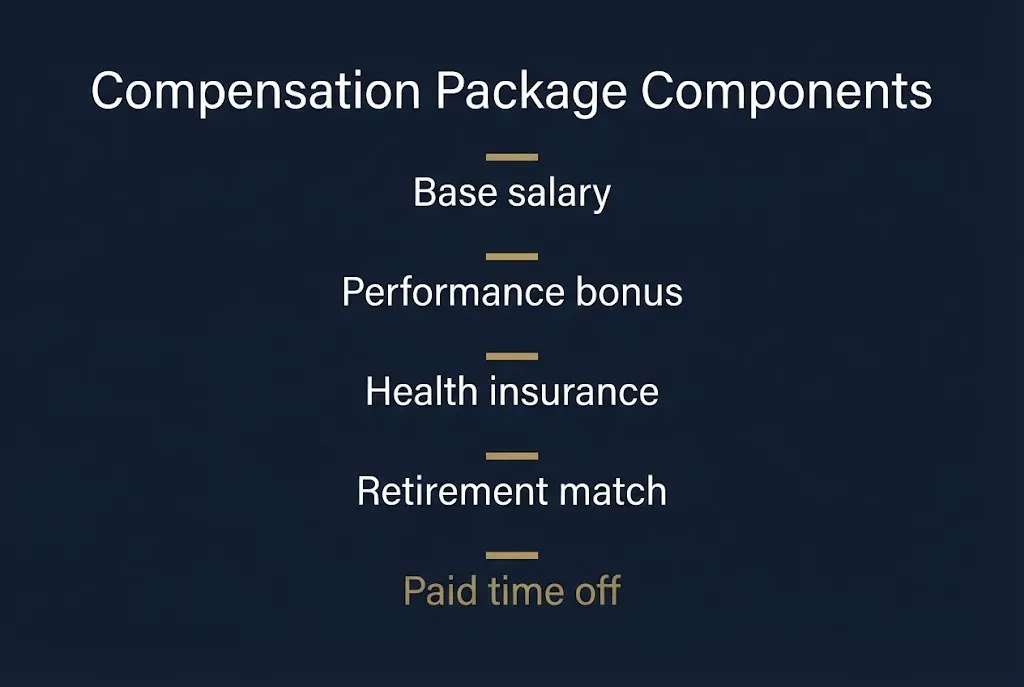
- Base salary: the fixed annual or hourly pay.
- Performance bonus: variable pay tied to individual or company results.
- Health insurance: medical, dental, and vision coverage.
- Retirement benefits: 401(k) match, pension, or profit sharing.
- Paid time off: vacation, sick leave, and holidays.
- Equity compensation: stock options, restricted stock units, or employee stock purchase plans.
- Other benefits: life insurance, disability coverage, tuition reimbursement, wellness stipends.
Each component has a dollar value. Health insurance alone can be worth $5,000 to $15,000 per year depending on the plan and employer contribution.
Key Takeaway: Your salary is only one part of your compensation package, and the benefits portion can be worth tens of thousands per year.
What Is an Example of a Compensation Plan?
An example of a compensation plan shows how all the components fit together for a specific role. Here’s a sample for a mid-level marketing manager in 2026.
| Component | Value |
|---|---|
| Base salary | $85,000 |
| Performance bonus (up to 15%) | $12,750 |
| 401(k) match (4%) | $3,400 |
| Health insurance (employer share) | $8,500 |
| Paid time off (20 days) | $6,538 |
| Total package value | $116,188 |
This example shows how benefits and bonus add over $31,000 to the base salary. The total package value is 37 percent higher than the salary alone.
Your actual package will differ based on your role, industry, and employer. But the structure is consistent: salary plus variable pay plus benefits equals total compensation.
What Is an Employee Compensation Plan Template?
An employee compensation plan template is a structured document that outlines how an employer pays and rewards employees. It’s used by HR departments and managers to create consistent offers.
A standard template includes these sections.
- Job title and classification.
- Base salary range for the role.
- Bonus or incentive plan structure.
- Benefits summary with employer contributions.
- Equity or long-term incentive details, if applicable.
- Paid time off policy.
- Performance review and salary adjustment schedule.
Templates vary by company size and industry. A startup might emphasize equity. A government agency might emphasize pension and job security. A sales organization might emphasize commission structure.
The template is the framework. Your offer letter applies it to your specific situation.
How Do You Evaluate a Compensation Package?
Evaluating a compensation package requires looking beyond the salary number. Here’s a step-by-step approach.
- Calculate the base salary value.
- Estimate the realistic bonus, not the maximum.
- Value the health insurance by comparing plan costs.
- Calculate the 401(k) match as free money.
- Convert paid time off to a dollar value.
- Estimate equity value if stock options or RSUs are included.
- Compare the total to your current package and market rates.
The comparison should be total to total, not salary to salary. A $10,000 salary increase that comes with a $15,000 loss in benefits is a pay cut.
What Is the Difference Between Salary and Compensation Package?
Salary is the fixed amount you’re paid. Compensation package is the total value of everything you receive. They are different numbers.
A salary of $70,000 is just the base pay. A compensation package of $95,000 includes that salary plus bonus, benefits, retirement match, and paid time off value.
The confusion between the two is common. Employers sometimes emphasize salary because it’s the largest single line item. But the full package is what you actually receive.
When comparing offers, always compare total package value. The higher salary may not be the better deal.
Key Takeaway: Salary and compensation package are not the same thing, and comparing only salaries can lead you to accept the worse offer.
How Do You Negotiate a Compensation Package?
Negotiating a compensation package starts with knowing your market value and the full package you need. Here’s how.
- Research salary and benefits benchmarks for your role and location.
- Identify which components matter most to you.
- Wait for the employer to make the first offer when possible.
- Counter with a specific total package request, not just a salary number.
- Negotiate benefits if salary is capped.
- Get everything in writing before accepting.
Benefits are often negotiable even when salary is not. If the salary is fixed, ask for a signing bonus, additional paid time off, or a higher retirement match.
The worst mistake is accepting an offer without negotiating. Most employers expect a counter and leave room for it.
What Are Common Mistakes When Reviewing a Compensation Package?
Several mistakes cost employees money when reviewing compensation packages.
- Focusing only on salary and ignoring benefits value.
- Assuming the maximum bonus is guaranteed.
- Not comparing health insurance plan costs.
- Ignoring the 401(k) match as free money.
- Not valuing paid time off in dollar terms.
- Accepting the first offer without negotiating.
- Not getting the full package details in writing.
Each mistake leaves value unclaimed. A careful review of the full package before signing protects your financial interests.
What Is a Total Compensation Statement?
A total compensation statement is a document that shows the full value of your compensation package, including salary, benefits, and other rewards. Many employers provide these annually.
The statement itemizes each component and assigns a dollar value. It shows your base salary, bonus, employer benefit contributions, retirement match, and the estimated value of paid time off.
Reviewing your total compensation statement is the clearest way to understand what your employer actually spends on you. The number is often 20 to 40 percent higher than your salary.
If your employer doesn’t provide one, you can calculate your own using your pay stubs, benefits summary, and retirement plan documents.
Reality Check: No legitimate employer will ask for your Social Security number or bank details by text message to “process your compensation package.” Real offer letters and benefits documents come in writing through official channels.
What Is Equity Compensation?
Equity compensation is a form of pay that gives you an ownership stake in the company. It’s common in startups and publicly traded companies, especially for higher-level roles.
The main types are stock options, restricted stock units, and employee stock purchase plans. Stock options give you the right to buy shares at a set price. Restricted stock units convert to shares over time. Employee stock purchase plans let you buy shares at a discount.
Equity value is not guaranteed. It depends on the company’s stock price, which can rise or fall. But equity can be the most valuable part of a compensation package if the company grows.
If your offer includes equity, ask about the vesting schedule, the current valuation, and what the shares could be worth in different scenarios.
How Do You Build a Compensation Plan for Your Team?
If you’re an employer or manager building a compensation plan, the process starts with market data and internal equity.
- Benchmark salaries for each role using industry data.
- Define bonus structures tied to measurable results.
- Select benefits that match your industry and budget.
- Create salary bands to ensure internal fairness.
- Document the plan in a written template.
- Review and adjust annually based on market changes.
A good compensation plan attracts talent and retains employees. A bad one does the opposite. The key is consistency and transparency.
Frequently Asked Questions
What is included in a compensation package?
Base salary, bonuses, health insurance, retirement benefits, paid time off, and sometimes equity.
The total value often exceeds salary by 20 to 40 percent.
How do I calculate my total compensation?
Add salary, bonus, employer benefit contributions, retirement match, and paid time off value.
Your total compensation statement, if provided, shows this calculation.
Is a compensation package negotiable?
Yes. Both salary and benefits are often negotiable.
If salary is capped, negotiate benefits like paid time off or a signing bonus.
What is a good compensation package?
A good package matches or exceeds market rates for your role and location.
It also includes strong benefits that meet your needs.
How often should I review my compensation package?
Review it annually, ideally before performance reviews.
Also review when you receive a job offer or a promotion.
What is a signing bonus?
A signing bonus is a one-time payment for accepting an offer.
It’s often negotiable even when salary is not.
What is the difference between exempt and non-exempt compensation?
Exempt employees are paid a salary and not eligible for overtime.
Non-exempt employees are paid hourly and earn overtime for hours over 40 per week.
Can I negotiate benefits after accepting an offer?
It’s harder after accepting. Negotiate before signing.
Get the full package in writing before you commit.
If you’re reviewing a compensation package in 2026, the most important step is to look beyond the salary number. Calculate the total value of bonuses, benefits, retirement match, and paid time off.
Then compare that total to your current package and market benchmarks. The package is the real offer, not the salary line. And the best time to negotiate is before you sign.