Trump Administration SNAP Lawsuit 2026: Food Assistance Cuts, Court Challenges, and What Recipients Should Know
Quick Answer
- SNAP is the federal food assistance program formerly known as food stamps, serving millions of households.
- Trump administration rule changes have faced multiple lawsuits from states and advocacy groups.
- No SNAP class action settlement or recipient payout fund exists as of March 2026.
The Supplemental Nutrition Assistance Program, or SNAP, is the largest federal food assistance program in the United States. It feeds tens of millions of people every month.
During the Trump administration, several rule changes tried to restrict who could receive SNAP benefits. Those changes triggered lawsuits from states, cities, and advocacy groups.
As of March 2026, no SNAP lawsuit has produced a settlement fund for recipients. The cases are about policy, not about paying individual claimants.
This article explains what the SNAP lawsuits are about, who filed them, what courts have ruled, and what it means for people who rely on food assistance.
The Facts
| Item | Details |
|---|---|
| Program | Supplemental Nutrition Assistance Program |
| Agency | U.S. Department of Agriculture |
| Legal Issue | Eligibility rule changes |
| Main Challengers | States, cities, advocacy groups |
| 2026 Settlement | Not yet confirmed |
| Recipient Payout Fund | None exists |
What Is the Trump Administration SNAP Lawsuit About?
The Trump administration SNAP lawsuits challenge rule changes that would have removed or reduced benefits for certain groups.
The biggest fight was over the “able-bodied adults without dependents” rule, often called the ABAWD rule. That rule limits benefits for adults aged 18 to 49 who do not have children and do not meet work requirements.
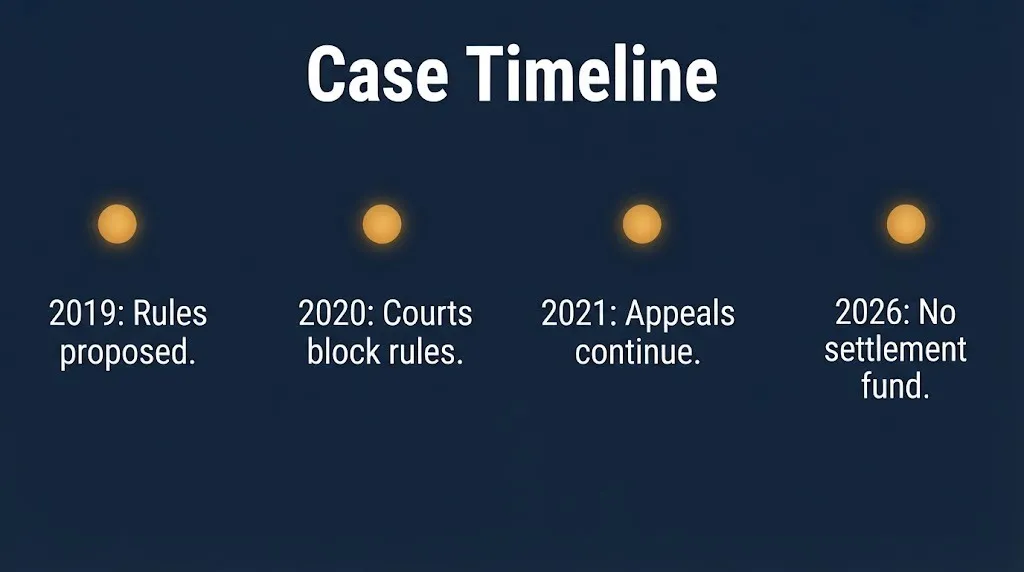
The Trump administration tried to tighten that rule in 2019. The change would have removed benefits from an estimated 688,000 people, according to USDA projections at the time.
Here are the main rule changes that faced lawsuits:
| Rule | What It Would Do | Estimated Impact |
|---|---|---|
| ABAWD work requirement | Tighten work rules for childless adults | 688,000 people |
| Broad-based categorical eligibility | Limit income eligibility for some households | 3.1 million people |
| State flexibility changes | Reduce state waiver options | Varies by state |
Who Filed Lawsuits Against the SNAP Rule Changes?
States, cities, and advocacy groups filed lawsuits challenging the SNAP rule changes.
The plaintiffs argued that the rules violated federal law, exceeded agency authority, or would cause irreparable harm to recipients.
Here are the main categories of plaintiffs:
| Plaintiff Type | Examples |
|---|---|
| States | California, New York, Pennsylvania |
| Cities | New York City, Washington D.C. |
| Advocacy groups | Food Research and Action Center |
| Legal aid organizations | National Health Law Program |
The lawsuits were filed in federal district courts across the country. Some were consolidated, while others proceeded separately.
What Did the Courts Rule on the SNAP Lawsuits?
Federal courts issued several rulings on the SNAP rule changes, with mixed outcomes at different stages.
The ABAWD rule was blocked by a federal judge in Washington D.C. in 2020. The judge found the rule violated the Administrative Procedure Act.
The broad-based categorical eligibility rule was also challenged. A federal judge in Pennsylvania blocked that rule in 2020 as well.
Here is the status of the major rulings:
| Rule | Court Ruling | Status as of 2026 |
|---|---|---|
| ABAWD work requirement | Blocked in 2020 | Remains blocked pending any appeal |
| Categorical eligibility | Blocked in 2020 | Remains blocked pending any appeal |
| State flexibility | Mixed rulings | Case-specific outcomes |
Key Takeaway: The courts largely blocked the Trump administration SNAP rule changes. But the legal battles continued through appeals and into the Biden and Trump administrations that followed.
Is There a SNAP Settlement for Recipients in 2026?
No. No SNAP settlement fund for recipients has been confirmed as of March 2026.
The SNAP lawsuits are not class actions seeking damages for individual recipients. They are challenges to agency rules, asking courts to block or uphold policy changes.
When a court blocks a rule, recipients keep their benefits. That is the remedy, not a cash payment.
Here is why no settlement exists:
| Reason | Explanation |
|---|---|
| Not a class action | These are administrative law cases |
| No damages sought | Plaintiffs asked for injunctions, not money |
| Remedy is policy change | Keeping benefits is the win |
| No claims administrator | No fund to distribute |
Reality Check: No legitimate SNAP lawsuit asks recipients to pay a fee to file a claim or receive benefits. If someone demands money to process your SNAP benefits, report it to your state agency.
What Is SNAP and Who Qualifies?
SNAP provides monthly food assistance to low-income households. Benefits are loaded onto an Electronic Benefit Transfer card, which works like a debit card at grocery stores.
Eligibility is based on household income, assets, and work requirements in some cases. The rules vary slightly by state.
Here are the basic eligibility standards:
| Requirement | General Standard |
|---|---|
| Income | At or below 130 percent of poverty |
| Net income | At or below 100 percent of poverty |
| Assets | Varies by state |
| Work requirement | Applies to some childless adults |
The exact numbers update annually. For 2026, the federal poverty guidelines set the baseline.
How Do Work Requirements Affect SNAP Benefits?
Work requirements apply to able-bodied adults without dependents, often called ABAWDs.
Under federal law, ABAWDs must work or participate in a work program for at least 80 hours per month to keep benefits beyond three months in a three-year period.
States can request waivers in areas with high unemployment. The Trump administration tried to limit those waivers, which was one of the main lawsuit issues.
Here is how the work requirement works:
| Group | Work Requirement |
|---|---|
| Adults 18-49, no children | Yes, 80 hours per month |
| Adults 50 and older | Generally exempt |
| Adults with children | Exempt in most cases |
| Disabled adults | Exempt |
What Is Broad-Based Categorical Eligibility?
Broad-based categorical eligibility lets states provide SNAP benefits to households with slightly higher incomes if they already qualify for other assistance programs.
The Trump administration tried to restrict this option, which would have removed benefits from an estimated 3.1 million people.
The rule was blocked in federal court. The case remains one of the most consequential SNAP legal battles of the past decade.
Here is what the rule would have changed:
| Item | Before Rule | Under Proposed Rule |
|---|---|---|
| Income limit | State could set higher | Federal limit only |
| Asset test | Could be waived | Would apply |
| Eligibility | Broader | Narrower |
What Should SNAP Recipients Do in 2026?
SNAP recipients should keep their benefits current and watch for official notices from their state agency.
No SNAP lawsuit settlement requires recipients to file a claim. Benefits continue through the normal state-administered process.
Here is what to do:
- Keep your contact information current with your state SNAP agency.
- Respond to any recertification requests on time.
- Report changes in income or household size as required.
- Watch for official notices from USDA or your state, not social media.
- Never pay anyone for help with SNAP benefits. Help is free.
What Happens Next
Expected 2026: SNAP policy debates continue in Congress, with work requirements a recurring point of negotiation.
Ongoing: Any remaining appeals from the Trump administration rule cases move through the federal courts.
Your move: Stay current with your state SNAP agency. No settlement claim process exists.
If a new rule is proposed: It would appear in the Federal Register before taking effect.
The Trump administration SNAP lawsuits were about who gets food assistance, not about paying money to individuals.
The courts blocked the biggest rule changes, and recipients kept their benefits. That was the win.
No settlement fund exists for SNAP recipients in 2026. Anyone claiming otherwise is running a scam.