Insurance Settlement in 2026: How Long Settlement Money Actually Takes and What Delays It
Quick Answer
- Most straightforward insurance settlements pay within 30 to 60 days after you sign the release.
- Class action and mass tort settlements take far longer, often six months to two years after final approval.
- The biggest delay is usually not the insurer but missing documentation, liens, or court approval requirements.
If you searched “insurance settlement,” “how long does it take to get settlement money,” or “how long does a settlement check take,” you probably have a pending claim and want to know when the money will arrive. This article gives you the verified timelines for different settlement types, what actually delays payment, and how to check your status.
Insurance settlements are not one process. A car accident claim with clear liability resolves differently from a workers compensation settlement, which differs from a class action payout. The timelines vary, but the mechanics are predictable.
The surprising verified detail: the single most common cause of delayed settlement checks is a missing or incorrectly completed release form, not insurer foot-dragging. The second most common is a medical or government lien that must be resolved before the check can issue.
The Facts
| Fact | Detail |
|---|---|
| Standard insurance claim | 30 to 60 days after signed release |
| Workers compensation settlement | 30 to 90 days after Industrial Commission approval |
| Class action settlement | 6 to 24 months after final approval |
| Personal injury lawsuit settlement | 30 to 60 days after release, plus lien resolution |
| Primary delay causes | Missing paperwork, liens, court approval, appeals |
| Payment methods | Check, direct deposit, or prepaid card |
How Long Does It Take to Get Insurance Settlement Money?
Most standard insurance settlements pay within 30 to 60 days after you sign the release and return it. That is the normal window, not a guarantee.
The timeline starts when the insurer receives your signed release. From there, the insurer processes the release, confirms no liens or subrogation claims exist, and issues payment. Each step can add days.
Some insurers pay faster. Direct deposit accelerates the process compared to a paper check. But no insurer can pay before the release is signed, and none will pay while a lien remains unresolved.
If your settlement involves a minor, a court must approve it. That requirement adds weeks or months, depending on the court’s calendar.
Key Takeaway: The standard window is 30 to 60 days after the signed release. Liens and court approval extend it.
How Long Does It Take to Receive a Settlement Check by Mail?
A settlement check mailed by an insurer or claims administrator typically arrives within 7 to 14 business days after the check is issued. The exact time depends on the mail service, the distance, and the processing date.
Electronic payment is faster. Direct deposit usually lands within 2 to 5 business days after the payment is initiated. Some administrators offer prepaid cards or Zelle-style transfers.
The check issue date is not the same as the mailing date. An insurer may issue a check on a Friday and mail it on Tuesday. That gap confuses many recipients.
If you have not received a check within three weeks of the issue date, contact the insurer or administrator. Checks do occasionally get lost, and a stop-payment and reissue process adds another week or two.
Key Takeaway: Paper checks take 7 to 14 business days after mailing. Direct deposit is faster. Lost checks add time.
How Long Does a Settlement Check Take to Clear?
A settlement check typically clears within 1 to 5 business days after you deposit it, depending on your bank’s hold policy and the check amount.
Large checks often trigger extended holds. Banks may hold amounts over a certain threshold for up to 7 business days to verify funds. That is a banking regulation issue, not a settlement problem.
Some banks place a partial hold, releasing a portion of the funds immediately and the rest later. Ask your bank about its hold policy before you deposit a large settlement check.
Depositing at the issuing bank or using mobile deposit with a bank that offers instant availability can speed access to funds.
Key Takeaway: Expect 1 to 5 business days for clearing, but large checks may face extended holds from your bank.
What Actually Delays an Insurance Settlement?
Delays fall into predictable categories. The first is paperwork. A missing signature, an incorrectly dated release, or a wrong address stalls the process.
The second is liens. Hospitals, Medicare, Medicaid, and child support agencies may place liens on settlement proceeds. The insurer will not release funds until those liens are resolved or negotiated.
The third is court approval. Settlements involving minors, wrongful death, or class actions require judicial sign-off. Courts move on their own calendars.
The fourth is disputes. If the insurer contests liability, damages, or policy limits, the settlement cannot finalize until the dispute resolves.
The fifth is volume. Large claims administrators handling thousands of checks process payments in batches. Your check may wait behind hundreds of others.
Key Takeaway: Paperwork, liens, court approval, disputes, and processing volume are the five delay categories. Most are avoidable or manageable.
Reality Check: No one legitimate will ask you to pay money to release your settlement check. If someone calls claiming your check is held pending a fee, that is a scam. Settlement money is never released faster for a payment.
How Long Do Class Action Settlements Take to Pay?
Class action settlements are the slowest payout category. The timeline from final approval to payment typically runs six months to two years, sometimes longer.
The process has required stages. After final approval, there is an appeal window. Objectors may appeal, which freezes the entire fund. If no appeal is filed, the administrator validates claims, resolves deficiencies, and calculates individual awards.
Claim validation alone can take months in a large class. The administrator must verify eligibility, apply the settlement formula, and handle disputes.
After validation, the administrator processes payments. Checks or digital payments go out in batches. The final payments may not arrive for months after the first batch.
Key Takeaway: Class action payouts take six months to two years after final approval. Appeals extend that further.
How Long Do Workers Compensation Settlements Take to Pay?
Workers compensation settlements in most states pay within 30 to 90 days after the settlement is approved by the state agency or commission.
The process has specific stages. You and the insurer negotiate a settlement. The agreement is submitted to the state workers compensation agency for approval. The agency reviews it for fairness and compliance.
Once approved, the insurer has a set period, often 14 to 30 days, to issue payment. Some states allow electronic payment, which speeds the process.
If the settlement involves a lump sum and future medical care, the approval process may be more detailed. That adds time.
Key Takeaway: Workers compensation settlements pay within 30 to 90 days after agency approval, depending on state rules.
How Long Do Personal Injury Lawsuit Settlements Take to Pay?
Personal injury lawsuit settlements follow a similar pattern to insurance settlements. After you sign the release, payment typically arrives within 30 to 60 days, subject to lien resolution.
The release is the key document. It ends your claim in exchange for the agreed amount. Until it is signed and returned, nothing moves.
After the release, your lawyer resolves outstanding liens. Medical providers, health insurers, and government programs may claim a portion of your settlement. Those negotiations can take weeks or months.
Once liens are resolved, the attorney deducts fees and costs, and you receive the remainder. The check goes to your lawyer’s trust account first, then to you.
Key Takeaway: Personal injury settlements pay within 30 to 60 days after the release, plus lien resolution time.
What Is a Settlement Release and Why Does It Matter?
A settlement release is the legal document that ends your claim in exchange for payment. It is the single most important document in the settlement process.
The release states that you agree to accept the settlement amount as full compensation and that you will not pursue further claims against the paying party. It may include confidentiality, non-disparagement, or other terms.
You should read the release before signing. Once signed, it is binding. There is no cooling-off period in most cases.
If the release has an error, payment stops. Missing signatures, wrong dates, or incorrect case numbers all cause delays. Review it carefully before returning it.
Key Takeaway: The release is the trigger for payment. Errors in the release delay your check.
How Do Liens Affect Settlement Payout Time?
Liens are claims against your settlement by third parties who paid for your medical care or other costs. They must be resolved before payment is released.
A hospital that treated you may file a lien for unpaid bills. Medicare or Medicaid may claim reimbursement. Child support agencies can intercept settlements for overdue support.
Your lawyer negotiates these liens. Some can be reduced. Others must be paid in full. That negotiation takes time.
The insurer or administrator will not issue payment while unresolved liens exist. The risk of paying the wrong party is too high.
Key Takeaway: Liens must be resolved before payment. Negotiation time varies by lien type and amount.
How Do I Check the Status of My Settlement Payment?
Checking your settlement payment status is straightforward. Start with your lawyer, if you have one. Your lawyer communicates with the insurer or administrator and can give you the most accurate update.
If you do not have a lawyer, contact the claims adjuster or settlement administrator directly. Have your claim number ready.
Ask specific questions. Has the release been processed? Have all liens been resolved? When was the check issued? What payment method was used?
Do not call every day. The process moves in stages, and frequent calls do not speed it up. A weekly check is reasonable.
Key Takeaway: Your lawyer or the claims administrator is the source for payment status. Ask specific questions about the stage.
What Are the Most Common Settlement Scams?
Scammers target people waiting for settlement money. The most common scam is a call or email claiming your check is held pending a fee.
No legitimate settlement requires a fee to release funds. Not one.
Another scam involves fake checks. Someone sends a check for more than the expected amount and asks you to return the difference. The check bounces, and you lose the money you sent.
A third scam involves fake settlement notices. They look official but direct you to a fake website that harvests your personal information.
If you are unsure, contact the real administrator using a number you find independently, not one in the message.
Key Takeaway: Never pay to release a settlement check. Verify any notice through official channels before responding.
What Happens Next After I Sign the Settlement Release?
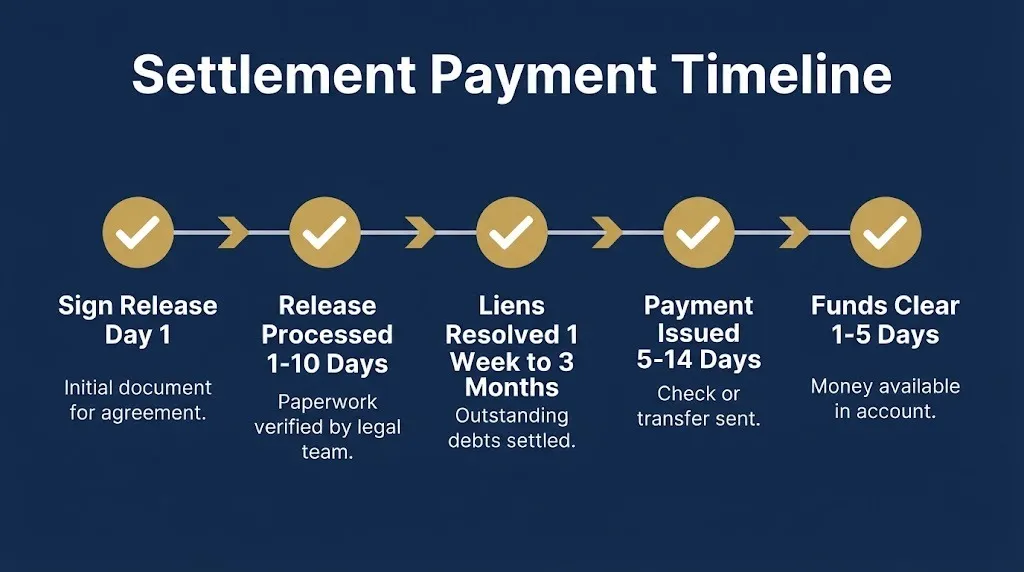
After you sign the release, the process moves through predictable stages. Here is the timeline.
| Stage | Typical Timing |
|---|---|
| Release processed by insurer | 1 to 10 business days |
| Lien resolution | 1 week to 3 months |
| Payment issued | After liens resolved, 5 to 14 days |
| Check mailed or direct deposit initiated | Same day as issuance |
| Funds clear in your account | 1 to 5 business days after deposit |
Each stage depends on the one before it. A delay at any point pushes everything later.
The best thing you can do is complete paperwork accurately, respond quickly to requests, and keep your contact information current.
Frequently Asked Questions
How long does it take to get settlement money after signing a release?
Most payments arrive within 30 to 60 days after the signed release, subject to lien resolution.
Why is my settlement check taking so long?
The most common reasons are missing paperwork, unresolved liens, court approval requirements, or processing volume.
Can I speed up my settlement payment?
You can complete paperwork accurately, respond quickly to requests, and choose direct deposit. You cannot skip required stages.
Do I have to pay taxes on my settlement?
It depends on the settlement type. Personal injury settlements are often tax-free. Lost wages and punitive damages are taxable.
What is a lien on a settlement?
A lien is a claim by a third party, such as a hospital or government agency, for payment from your settlement proceeds.
How do I check my settlement payment status?
Contact your lawyer or the claims administrator and ask about the specific stage of your payment.
Can a settlement check be lost?
Yes. If a check is lost, the issuer can stop payment and reissue it, adding one to two weeks.
Is direct deposit faster than a paper check?
Yes. Direct deposit typically arrives within 2 to 5 business days, compared to 7 to 14 business days for a paper check.
The single most important thing you can do to speed your settlement payment is to complete the release accurately and respond quickly to every request. Most delays come from avoidable paperwork errors and unresolved liens, not from insurer stalling.
If your payment is delayed, do not panic and do not pay anyone who promises to speed it up. Contact your lawyer or the administrator, ask what stage the payment is in, and address any missing items. The money moves when the process completes, not before.