Beyond Finance Lawsuit 2026: Claim Status, Settlement Amounts, and Deadlines
Quick Answer
- Beyond Finance faces multiple lawsuits over debt settlement fees and marketing practices, with cases at different stages.
- No unified settlement fund exists yet, so per-person payouts are not determined for most claims.
- Filing deadlines vary by case, and one previously reported deadline has passed while new claims remain open.
The Beyond Finance lawsuit landscape in 2026 is fragmented. You will not find one master settlement website or one claim form that covers everyone. Instead, you are looking at multiple legal actions filed in different courts, plus arbitration claims, plus regulatory scrutiny.
That matters because your next step depends on which case applies to you. A client who signed up in California has different options than one in Texas. Someone who already received a settlement offer has different deadlines than someone just now filing.
This article breaks down every verified Beyond Finance legal action as of September 2026, what the court records actually show, what the company says in response, and what you should do if you paid fees you think were unfair.
The Facts
| Fact | Detail |
|---|---|
| Company | Beyond Finance LLC and related entities |
| Primary Allegations | Misleading debt settlement promises, excessive fees, unlawful fee collection before services |
| Court / Jurisdiction | Multiple, including U.S. District Court and state courts |
| Current Status | Active litigation and arbitration, no unified class settlement |
| Total Settlement Fund | Not yet confirmed for any single class action |
| Est. Per Person | Not yet determined for most claims |
| Claim Deadline | Varies by case, one prior deadline passed in early 2026 |
| Administrator | Case-specific, not unified |
| Proof Needed | Varies, typically enrollment documents and fee records |
Is the Beyond Finance Lawsuit Real or a Scam?
The Beyond Finance lawsuit is real. Multiple verified court filings name Beyond Finance LLC as a defendant. These are not rumors or social media hoaxes.
You can confirm this yourself by searching federal court records using the company name. You will find civil complaints filed by individual consumers, proposed class actions, and at least one government enforcement action.
At the same time, scams do exist around this case. Third parties send texts and emails claiming you are owed a Beyond Finance settlement payout and asking for your bank details or a processing fee. No legitimate settlement administrator sends money requests like that. Filing a real claim costs nothing.
So yes, the lawsuits are real. But no, there is not a single approved class settlement that pays every former client. Anyone telling you otherwise is either misinformed or trying to take something from you.
Key Takeaway: The lawsuits against Beyond Finance are verified and ongoing, but no unified settlement exists, and any unsolicited payout message is likely a scam.
What Is Beyond Finance and Why Is It Being Sued?
Beyond Finance is a debt settlement company. It markets itself as a way for people with large credit card balances to negotiate lower payoffs with creditors.
The company tells clients to stop paying creditors directly and instead send monthly deposits into a dedicated account. Once enough money accumulates, Beyond Finance negotiates with creditors on the client’s behalf.
Multiple lawsuits allege the reality does not match the promises. The core accusations include:
- Charging fees before any debt is actually settled
- Collecting fees based on total enrolled debt rather than debt actually reduced
- Misleading clients about how much their debt would decrease
- Failing to disclose that late payments to creditors would continue damaging credit
- Encouraging clients to stop communicating with creditors, which some lawsuits call harmful advice
The Consumer Financial Protection Bureau has received complaints about Beyond Finance over several years. State attorneys general have also fielded consumer complaints. These complaints form the backdrop for the lawsuits now working through courts.
Who May Qualify to File a Beyond Finance Claim?
Whether you qualify depends on which legal action you pursue. There is no single class definition.
You may have a claim if you:
- Enrolled with Beyond Finance and paid fees before your first debt settlement occurred
- Were charged fees calculated on total enrolled debt rather than settled debt
- Received written or verbal promises about savings that did not match your results
- Were enrolled in a program in a state with specific fee restrictions, such as California or Illinois
- Received a settlement offer through a specific arbitration proceeding
- Were charged a fee after canceling the program
The strongest verified claims involve fees charged before services were rendered. Several states prohibit that practice in debt settlement. Federal rules also restrict it for certain types of debt relief.
If you have your original enrollment agreement and records of every fee deducted, you can compare what you paid against what was actually settled. That comparison tells you if you have a viable claim.
How Much Money Could You Get From a Beyond Finance Settlement?
There is no verified per-person payout amount for any single Beyond Finance class action settlement. That is the honest answer as of September 2026.
Some individual arbitration cases have produced confirmed awards. Public records show arbitration decisions ordering fee refunds in specific amounts, often between a few hundred and a few thousand dollars. Those amounts vary widely based on enrollment date, total fees paid, and state law.
For any pending class action, payout estimates would depend on:
- Total settlement fund size, which no court has approved
- Number of valid claims submitted
- Amount of fees each claimant paid
- Court-approved distribution formula
Anyone publishing a specific “average payout” number for a unified Beyond Finance settlement is inventing it. No such number exists in any verified court record as of this writing.
Reality Check: No approved class settlement means no per-person payout has been set. Any website or message claiming you are owed a specific amount from a Beyond Finance settlement is not citing a real court order.
What Are the Payout Tiers for a Beyond Finance Settlement?
Since no unified settlement exists, there are no confirmed payout tiers. Any tier chart you see elsewhere is speculative.
What does exist are categories of potential recovery based on how you pursue a claim:
| Claim Type | Potential Recovery | Verification Status |
|---|---|---|
| Individual arbitration | Confirmed awards between roughly $500 and $5,000 in some cases | Public records, varies |
| Class action, if certified | Unknown, would be a share of a negotiated fund | Pending |
| State regulatory action | Refunds ordered for affected consumers | State-specific |
| Direct complaint to CFPB | Company response, no guaranteed payout | Process-based |
The arbitration route currently holds the strongest verified track record. Consumers who pursued arbitration through the company’s own contract terms have secured fee refunds. The amounts are modest but real.
What Is the Beyond Finance Lawsuit Claim Deadline?
There is no single claim deadline because there is no single settlement. Different actions have different timelines.
One previously reported deadline tied to an early arbitration-related matter passed in early 2026. If you received a notice with that deadline and did not act, that specific window is closed.
For ongoing and newly filed cases, deadlines have not been set. Courts set claim deadlines only after a settlement receives preliminary approval. As of September 2026, no court has issued that approval for a Beyond Finance class action.
Your practical deadline is not a court date. It is the statute of limitations for your state’s consumer protection or debt settlement laws. Those typically run two to four years from the date you discovered the alleged violation. Waiting for a class settlement that may never materialize could cost you the right to pursue individual claims.
How Do You File a Beyond Finance Claim?
Filing a claim in 2026 means taking one of several routes. Here are the steps, ordered from most direct to most general.
Step 1: Gather your records. Pull your original enrollment agreement, every monthly statement, every fee deduction, and any emails or texts from the company.
Step 2: Calculate your total fees paid and compare that to the total debt actually settled. If fees exceed the value of settled debt or were charged before any settlement occurred, note that.
Step 3: Check your enrollment agreement for an arbitration clause. Most Beyond Finance contracts include one. That clause controls how you can pursue a claim.
Step 4: Decide between arbitration and waiting on class certification. Arbitration can be faster and has produced confirmed recoveries. Class certification could take years and may not happen.
Step 5: File a complaint with the Consumer Financial Protection Bureau. This is free and creates a federal record. It does not automatically pay you but strengthens your position.
Step 6: Contact your state attorney general’s consumer protection division. Several states have active inquiries into debt settlement practices.
Step 7: Consult a consumer protection attorney if your fees exceed a few thousand dollars. Many offer free case evaluations.
Step 8: Watch the official court dockets for class certification rulings in Beyond Finance cases. A certification order changes everything.
What Is the Current Status of the Beyond Finance Lawsuit in 2026?
The current status is active litigation without a certified class or approved settlement. Multiple cases are moving through different stages.
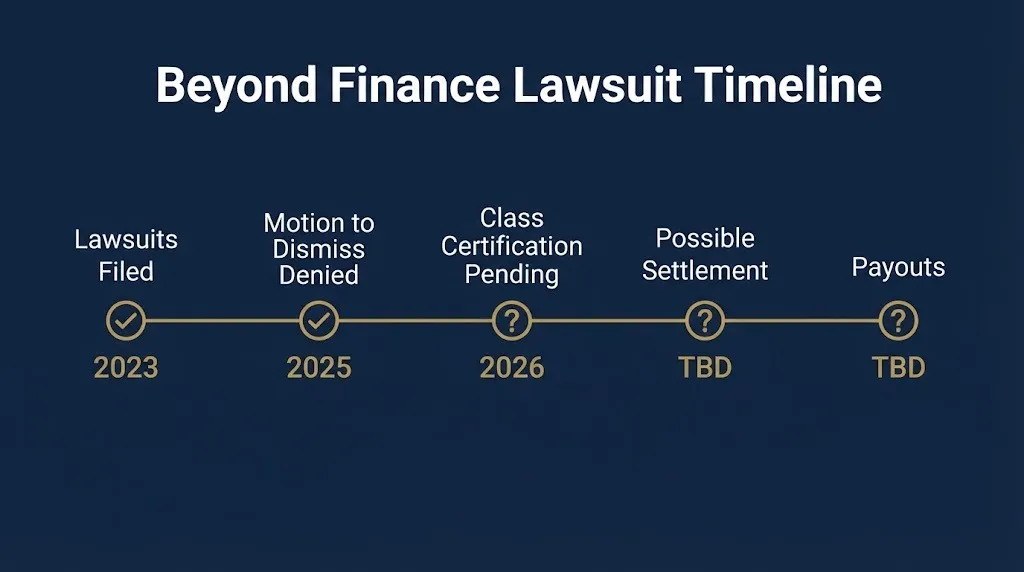
One proposed class action in federal court has survived an initial motion to dismiss, according to court records. That means the judge found the allegations legally sufficient to proceed. It does not mean the plaintiffs won anything yet.
Separate arbitration proceedings continue. Some have concluded with awards to consumers. Others remain pending.
The CFPB has not announced a public enforcement action against Beyond Finance as of this date. However, the volume of consumer complaints filed with the agency remains notable.
The company has denied wrongdoing in court filings. Beyond Finance states its fee structure is disclosed and compliant with applicable laws. That denial is standard in active litigation and should not be read as proof of anything either way.
What Happened in the Beyond Finance Lawsuit Update for 2026?
The most recent verified developments fall into three categories.
First, a federal judge allowed one proposed class action to proceed past the pleading stage. That ruling came from a U.S. District Court and is a matter of public record. It keeps the case alive but does not predict the outcome.
Second, individual arbitration awards continued. Several consumers have shared redacted arbitration decisions showing fee refunds. These are not class-wide results but demonstrate that claims can succeed.
Third, no settlement has received preliminary approval. Any headline claiming a Beyond Finance class settlement is approved, funded, or paying claims is not accurate as of September 2026.
Key Takeaway: The case is alive but unsettled. A ruling allowing a case to proceed is procedural, not a payout.
Is There a Beyond Finance Class Action Settlement in 2026?
No. There is no Beyond Finance class action settlement in 2026.
The distinction matters because many searches for “Beyond Finance lawsuit” assume a settlement exists. Search engines surface old articles about unrelated debt settlement cases. Scammers exploit the confusion.
A class action settlement requires several verified steps. A court must certify the class. The parties must negotiate terms. A judge must grant preliminary approval. Notices must go out. Claims must be filed. A final approval hearing must occur. None of those steps have completed for Beyond Finance as of this date.
The closest thing to a settlement involves individual arbitration outcomes. Those are confidential in many cases, which limits what you can verify. But they are not class action settlements.
What Is the Beyond Finance Debt Settlement Lawsuit About?
The core of the debt settlement lawsuit is a simple accusation: Beyond Finance collected too much money before delivering results.
State and federal laws restrict when debt settlement companies can charge fees. Several states prohibit charging any fee until a settlement is actually reached and the consumer approves it. Federal telemarketing rules impose similar restrictions.
Plaintiffs allege Beyond Finance structured its fees to collect early and often. Some complaints describe monthly charges that reduced the funds available for actual settlements. Others describe fees calculated on total enrolled debt, meaning clients paid for settlements that never happened.
The company’s defense is disclosure. Beyond Finance says clients signed agreements that explained the fee structure. That defense may succeed or fail depending on how courts interpret state consumer protection laws.
Who Is Eligible for the Beyond Finance Lawsuit?
Eligibility is not determined by a settlement administrator because no administrator has been appointed for a class-wide settlement.
You may have a viable claim if you were a Beyond Finance client and:
- Paid fees before your first debt was settled
- Paid fees on enrolled debt that was never reduced
- Canceled and still faced fee collection
- Received promises of specific savings that did not occur
- Live in a state with strict debt settlement fee laws
Your state matters. California, Illinois, New York, and several others have specific debt settlement statutes with consumer-friendly provisions. If you enrolled while living in one of those states, your protections are stronger.
Can You Get Your Money Back From Beyond Finance?
Some consumers have gotten money back. The verified paths to recovery in 2026 are:
- Individual arbitration awards, confirmed in some public records
- Chargebacks or bank disputes for unauthorized fees
- Direct company refunds through complaint processes
- State attorney general interventions
The unverified path is a class action payout. It may happen eventually, but no one should plan around it.
If you want to pursue recovery now, the arbitration clause in your contract is the most direct route. It is not free of friction, and you should read your agreement carefully. Some agreements require you to pay filing fees that may be recoverable if you win.
What Does Beyond Finance Say About the Lawsuits?
Beyond Finance has filed responses denying the core allegations. The company’s position, reflected in court filings, is that its practices comply with applicable laws.
The company has pointed to written disclosures and client signatures as evidence of informed consent. It has also argued that individual arbitration clauses bar class claims.
That arbitration argument is why you see no certified class action. Courts are still deciding whether class claims can proceed despite the arbitration clauses. That question, now before at least one federal judge, will likely shape everything that follows.
Key Takeaway: The company denies wrongdoing and is fighting class certification. That fight is the main reason no settlement exists.
Is Beyond Finance Still Operating in 2026?
Yes, Beyond Finance continues to operate and enroll new clients as of September 2026.
The company maintains an active web presence and continues marketing debt settlement services. Existing lawsuits have not resulted in any court-ordered shutdown or operational freeze.
That is important context. A company can face serious legal challenges while continuing normal operations. The lawsuits do not mean the company is insolvent or that new clients are automatically being harmed. It does mean past clients should watch the litigation closely.
What Should You Do If You Got a Text About a Beyond Finance Settlement?
Do not respond. Do not click anything. Do not provide bank details.
Legitimate settlement notices arrive by mail, not text. They come from court-appointed administrators. They never ask for money to receive money.
Scam texts about Beyond Finance settlements have circulated since at least early 2026. They often say you have been pre-approved for a payout and need to verify your identity by clicking a link. The link leads to a phishing site.
If you receive such a text, you can report it to the Federal Trade Commission. You can also search the official court docket to see if any settlement notice exists. If the docket shows no approved settlement, the text is fake.
What Are the Statute of Limitations for Beyond Finance Claims?
Statutes of limitations vary by state and claim type. Most consumer protection claims must be filed within two to four years of the alleged violation.
For debt settlement fee disputes, the clock typically starts when the fee was charged or when you discovered the fee was unlawful. Some states apply a discovery rule that delays the start date.
If you enrolled in 2022 and stopped paying in 2023, your window may be closing in 2026. That is why waiting for a class settlement is risky. The class action may take years, and your individual claim could expire in the meantime.
Check your state’s consumer protection statute. If you are unsure, a consumer attorney can evaluate your timeline in a free consultation.
What Is the Beyond Finance Arbitration Process?
Arbitration is a private dispute resolution process outside court. Your Beyond Finance enrollment agreement likely requires it.
The process typically works like this:
- You initiate arbitration by sending a demand letter or filing with the designated arbitration provider
- You pay a filing fee, which may be reimbursed if you win
- An arbitrator reviews evidence from both sides
- A hearing occurs, often by phone or video
- The arbitrator issues a binding decision
Public records show some consumers have won fee refunds through this process. Others have lost. The outcome depends on your specific facts, your state’s laws, and the quality of your evidence.
Arbitration is faster than class litigation. A decision may come within months rather than years. That speed is why some consumers pursue it even while class certification remains pending.
Are There Other Lawsuits Like the Beyond Finance Case?
Yes. Debt settlement companies face similar lawsuits across the industry.
Other companies in the space have faced enforcement actions from the CFPB, state attorneys general, and private plaintiffs. Some of those actions produced settlements with real payouts. Those cases establish legal principles that may apply to Beyond Finance.
The existence of similar cases does not mean Beyond Finance will settle. Each case turns on its own facts and legal arguments. But patterns matter in consumer protection law. When courts repeatedly rule that certain fee practices violate statutes, other companies face pressure to change those practices.
What Documents Do You Need to Prove Your Beyond Finance Claim?
Proof is everything in a fee dispute. The more documentation you have, the stronger your claim.
Gather these records if you still have them:
- Signed enrollment agreement
- Monthly account statements showing fee deductions
- Correspondence with Beyond Finance representatives
- Records of debt settlements that did occur
- Records of debts that were not settled
- Cancellation confirmation if you canceled
- Any collection notices for fees charged after cancellation
If you no longer have statements, request them from the company. Beyond Finance is legally required to provide certain records. Your bank may also have transaction history showing fee deductions.
The comparison between fees paid and debt actually reduced is your most important evidence. It shows whether you paid for results you never received.
What Happens Next in the Beyond Finance Lawsuit?
The next phase depends on pending court rulings.
Expected late 2026: A ruling on class certification in the leading federal case. If certified, the case becomes a true class action with defined class members.
Expected early 2027: If certification occurs, the parties likely enter settlement negotiations. A preliminary settlement could follow within months.
If no certification: Individual arbitration remains the primary path for consumer recovery. No class-wide payout occurs.
Ongoing: State attorneys general may initiate their own actions. The CFPB could announce an enforcement matter at any time.
Watch for: Any notice of proposed settlement from a court-appointed administrator. That notice would arrive by mail and include a claim form and deadline.
Key Takeaway: The next 12 months will determine whether a class settlement becomes real or whether individual arbitration remains the only route to recovery.
Frequently Asked Questions
Is the Beyond Finance lawsuit legitimate?
Yes, multiple verified lawsuits name Beyond Finance as a defendant in federal and state courts.
These are real legal proceedings, not scams, though scam messages falsely claiming settlement payouts do exist.
How much will I get from the Beyond Finance settlement?
There is no confirmed settlement amount because no class settlement has been approved as of September 2026.
Individual arbitration awards have ranged from roughly a few hundred to a few thousand dollars in some verified cases.
What is the deadline to file a Beyond Finance claim?
No deadline exists for a class claim because no class settlement exists.
Your practical deadline is your state’s statute of limitations, typically two to four years from the alleged violation.
Can I still file a claim against Beyond Finance?
Yes, you can pursue individual arbitration or file complaints with state and federal regulators.
The class action route is not yet available because no class has been certified.
Is Beyond Finance still operating?
Yes, the company continues to enroll clients and market debt settlement services as of September 2026.
The lawsuits have not resulted in any operational shutdown.
How do I start an arbitration claim against Beyond Finance?
Review your enrollment agreement for the arbitration clause and designated provider.
Then gather your fee records and file a demand with the designated provider or contact a consumer attorney.
What states have the strongest protections for debt settlement fees?
California, Illinois, New York, and several others restrict when and how debt settlement companies can charge fees.
Your state of enrollment affects what claims you can bring and your chances of success.
Are texts about a Beyond Finance settlement real?
No verified class settlement exists, so any text claiming you are owed a payout is almost certainly a scam.
Legitimate settlement notices arrive by mail from a court-appointed administrator and never ask for payment.
What You Should Do Right Now
Pull your records. Find your enrollment agreement and your fee history. Calculate what you paid versus what was actually settled.
Then check your state’s statute of limitations. If your window is still open, decide whether arbitration or waiting on class certification makes more sense for your situation.
The single most important date is your own filing deadline, not some phantom settlement deadline that does not exist yet.