Workers Compensation Law Firm Augusta 2026: How to Choose, What to Pay, and What to Expect
Quick Answer
- Augusta workers compensation attorneys charge a contingency fee capped at 25 percent of your settlement by Georgia law.
- Most offer free consultations, and you owe nothing unless they recover money for you.
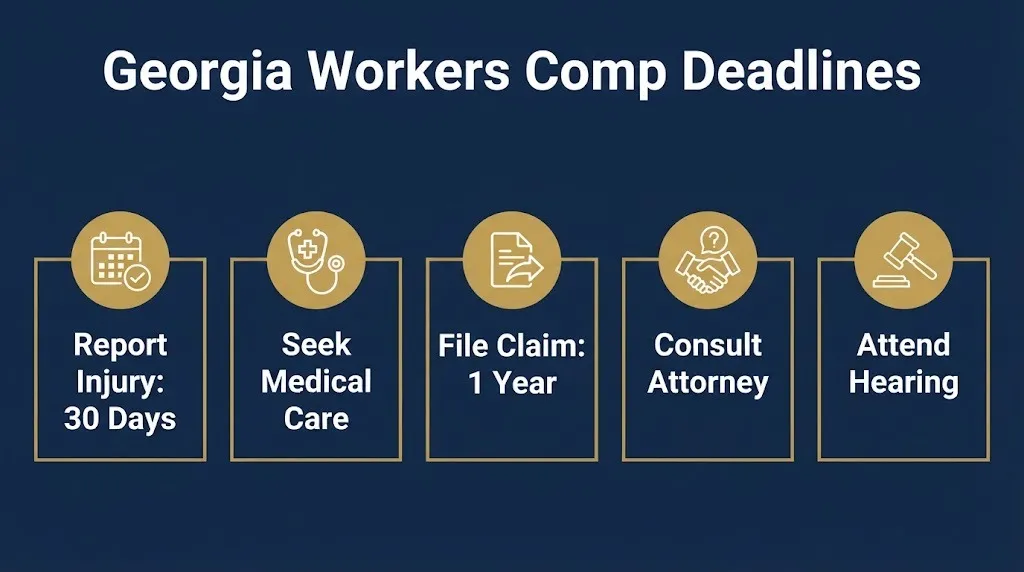
- The deadline to report a workplace injury in Georgia is 30 days, and the deadline to file a claim is one year.
Workers compensation in Augusta is not a class action. There is no settlement fund. There is no claim form shared by thousands of people. This is individual legal representation for individual workplace injuries.
That changes the questions that matter. Instead of asking “is this settlement real,” you are asking “which law firm will actually fight for me, and what will it cost.” The answer depends on Georgia’s workers compensation system, not on marketing promises.
This article breaks down how Augusta workers compensation law firms operate in 2026, what the law allows them to charge, and how to spot the difference between a real advocate and a settlement mill.
The Facts
| Fact | Detail |
|---|---|
| Governing Body | Georgia State Board of Workers’ Compensation |
| Attorney Fee Cap | 25 percent of settlement |
| Report Injury Deadline | 30 days from incident |
| File Claim Deadline | 1 year from incident |
| Consultation Cost | Free at most Augusta firms |
| Average Settlement | Varies widely by injury type and wage loss |
Is a Workers Compensation Law Firm in Augusta Worth Hiring?
A workers compensation attorney in Augusta is worth hiring if your injury is serious, your claim is denied, or your employer’s insurer is pushing back.
Georgia’s workers compensation system is designed for unrepresented workers to navigate, but the reality is different. Insurers have attorneys. They know the rules. They know how to minimize payouts. You are at a disadvantage without representation.

The data supports this. Workers with attorneys tend to recover more, even after the attorney fee, than workers who settle alone. That is not a guarantee. It is a pattern.
If your injury is minor, your claim is accepted, and your medical bills are being paid, you may not need an attorney. If any of those things is false, a consultation costs nothing and gives you a clearer picture.
How Much Does a Workers Comp Attorney in Augusta Cost?
The fee is capped at 25 percent of your settlement by Georgia law. That cap is set by the State Board of Workers’ Compensation, not by the attorney.
You do not pay that fee upfront. It comes out of your settlement or award. If your attorney recovers nothing, you owe nothing for the fee.
Some firms also charge for expenses. Those include medical record fees, expert witness costs, and filing fees. Ask whether those come out of your settlement separately from the 25 percent. The answer is usually yes, but the timing matters.
The contingency fee structure means your attorney has a financial incentive to maximize your settlement. It also means a small case might not interest a busy firm. That is not greed. It is math.
Key Takeaway: Augusta workers compensation attorneys work on contingency, capped at 25 percent, with no upfront fee and no recovery meaning no fee.
What Is the Deadline to File a Workers Comp Claim in Augusta?
The deadline to report your injury to your employer is 30 days from the date of the incident.
The deadline to file a formal claim with the State Board of Workers’ Compensation is one year from the date of the incident.
These deadlines are strict. Miss the 30-day notice and you can still file, but your employer may raise the late notice as a defense. Miss the one-year filing deadline and your claim is barred except in rare circumstances.
The comparison is simple. Filing a workers comp claim late is like returning a store item after the return window closes. The policy exists, but the window is closed, and you are relying on someone making an exception.
How Do Augusta Workers Compensation Settlements Work?
A workers compensation settlement in Georgia is a final resolution of your claim. You give up future benefits in exchange for a lump sum or a structured payment.
Not every claim settles. Some go to a hearing before an administrative law judge. Others are resolved through ongoing weekly benefits rather than a lump sum.
Settlement amounts depend on several verified factors:
- Your average weekly wage before the injury
- The severity and permanence of your injury
- Your ability to return to work
- Whether your injury is catastrophic under Georgia law
- The cost of future medical care
- The strength of your medical evidence
There is no average settlement number that applies to your case. A back strain resolves for less than a spinal cord injury. A denied claim that later wins resolves differently than an accepted claim settled early.
What Is a Catastrophic Injury in Georgia Workers Comp?
Georgia law defines catastrophic injuries separately from other workplace injuries. The designation changes what benefits you can receive.
A catastrophic injury is one that involves:
- Amputation
- Severe paralysis
- Severe brain injury
- Severe burns
- Blindness
- Any injury that prevents you from performing your prior work and any other work available in substantial numbers
Catastrophic injury claims can provide lifetime medical benefits and longer wage replacement. Non-catastrophic claims are capped at 400 weeks of benefits in most cases.
The distinction is contested often. Insurers push for non-catastrophic designation. Attorneys fight for catastrophic status. The difference in value is significant.
Key Takeaway: The catastrophic injury designation in Georgia changes the value of a workers comp claim dramatically, making attorney involvement more important for serious injuries.
How Do You Choose a Workers Comp Attorney in Augusta?
Choosing the right attorney is more important than choosing the biggest firm.
Step 1: Verify the attorney is licensed in Georgia and in good standing with the State Bar.
Step 2: Check whether the attorney focuses on workers compensation, not just personal injury generally.
Step 3: Read reviews that mention specific case outcomes, not just “nice staff” or “quick call back.”
Step 4: Ask how many workers comp cases the attorney handles each year.
Step 5: Ask what percentage of the practice is workers compensation versus other case types.
Step 6: Ask who will handle your case day to day, the partner or an associate or a paralegal.
Step 7: Ask for a realistic assessment of your case, not a guarantee.
Step 8: Get the fee and expense agreement in writing before signing.
What Questions Should You Ask an Augusta Workers Comp Firm?
The right questions reveal whether a firm is a fit.
- How long have you practiced workers compensation in Georgia?
- Have you handled cases like mine before?
- What is your honest assessment of my claim’s value?
- What are the weaknesses in my case?
- Who will I communicate with regularly?
- How long do you expect my case to take?
- What expenses will come out of my settlement?
- Have you gone to hearing before the State Board recently?
A confident attorney answers these directly. A settlement mill avoids them. You want someone who tells you the truth, even when the truth is that your case is not worth much.
What Is the Difference Between a Workers Comp Firm and a Settlement Mill?
A settlement mill is a high-volume practice that settles cases quickly for less than they are worth.
The model works like this. The firm takes hundreds of cases. It invests minimal time in each. It accepts the first reasonable offer from the insurer. It moves on to the next case. The client gets a check, but not the check the case deserved.
A dedicated workers compensation firm investigates. It gathers medical evidence. It prepares for hearing. It pushes back on lowball offers. It takes cases to the judge when necessary.
The difference is not always visible in advertising. Both types of firms say they fight for you. The difference shows in how they handle your case specifically.
What Does the Georgia State Board of Workers’ Compensation Do?
The State Board of Workers’ Compensation is the state agency that oversees workers comp in Georgia. It is not a court, but it functions like one for workplace injury claims.
The Board provides forms, processes claims, schedules hearings, and resolves disputes. It also approves attorney fees and settlements.
Your claim is filed with the Board. Your hearings happen before an administrative law judge assigned by the Board. Your settlement, if you reach one, goes through Board approval.
The Board is a resource for workers. Its website has forms, deadlines, and information about your rights. You do not need an attorney to use the Board’s resources, though an attorney helps when disputes arise.
Key Takeaway: The Georgia State Board of Workers’ Compensation sets the rules, deadlines, and fee caps that every Augusta workers comp firm must follow.
What Are the Most Common Workers Comp Injuries in Augusta?
Augusta’s economy shapes its workers comp claims. The city has a significant healthcare sector, manufacturing, and logistics presence.
Common claims include:
- Back injuries from lifting and patient handling
- Repetitive motion injuries in manufacturing
- Slip and fall injuries in warehouses and hospitals
- Machinery accidents in industrial settings
- Motor vehicle accidents for delivery and service workers
- Chemical exposure in certain facilities
Each injury type has a typical value range. Each also has common insurer defenses. An attorney who knows the Augusta employer landscape knows what those defenses look like.
Can You File a Workers Comp Claim Without an Attorney in Augusta?
Yes, you can file without an attorney. The State Board provides forms and instructions.
The process works for straightforward claims. You report the injury. Your employer files the first report of injury. The insurer accepts the claim. Your medical bills get paid. You receive weekly benefits while you recover. You return to work.
The process breaks down when the insurer denies the claim, disputes the medical treatment, or offers a low settlement. At that point, you are negotiating against professionals without one on your side.
The question is not whether you can file alone. It is whether you should. For a minor, accepted claim, filing alone works. For a denied or disputed claim, you probably need help.
Reality Check: No attorney can guarantee a settlement amount. Anyone who promises a specific dollar figure before seeing your medical records is selling you something, not representing you.
What Is the Average Workers Comp Settlement in Augusta?
There is no verified average settlement for Augusta specifically. Settlement amounts are not published by the State Board in a way that allows a reliable average.
What exists are ranges based on injury type and wage loss. A minor strain might settle for a few thousand dollars. A catastrophic injury might settle for hundreds of thousands or be paid as lifetime benefits.
Your settlement depends on your facts, not on an average. Your wages, your injury, your doctor’s opinions, your ability to return to work. Those are the variables.
Attorneys who quote an average are doing marketing, not analysis. A real evaluation requires your specific medical records and wage history.
What Happens If Your Augusta Workers Comp Claim Is Denied?
A denial is not the end. It is a step in the process.
You have the right to request a hearing before an administrative law judge. The hearing is your chance to present evidence and argue your case. You can do this with or without an attorney.
Denials happen for several reasons. The insurer may argue the injury did not happen at work. It may argue the injury is not as severe as claimed. It may argue you missed a deadline.
Each denial reason has a response. Medical records can show the injury. Witness statements can show the work connection. Payroll records can show wage loss. An attorney helps you assemble the response.
What Is the Timeline for a Workers Comp Case in Augusta?
The timeline varies by case complexity and whether disputes arise.
First 30 days: Report the injury to your employer.
First year: File your claim with the State Board if the insurer disputes it.
Months 1 to 6: Medical treatment and wage benefits if the claim is accepted.
Months 3 to 12: Settlement negotiations if your condition stabilizes.
Months 6 to 18: Hearing if the case cannot settle.
Months 12 to 24: Resolution through settlement or judge’s decision.
This is a general pattern. Your case may move faster or slower. Catastrophic claims take longer because the medical picture evolves over time.
Key Takeaway: A workers comp case in Augusta typically takes months, not weeks, and serious injuries take longer because medical stability takes time.
What Are the Red Flags When Hiring a Workers Comp Firm?
Some firms are better at marketing than at lawyering.
Watch for these red flags:
- Promising a specific settlement amount before reviewing records
- Pushing you to settle quickly without explaining your options
- Never taking cases to hearing
- Assigning your case to a different person than you met
- Charging upfront fees for a workers comp case
- Avoiding questions about case weaknesses
- Having no recent experience before the State Board
- Communicating only by email or through assistants
A real advocate is honest about uncertainty, responsive to your questions, and willing to go to hearing when the insurer will not be fair.
What Should You Bring to a Workers Comp Consultation?
Your consultation is more productive if you bring the right materials.
Bring any accident report you completed. Bring your medical records if you have them. Bring the contact information for witnesses. Bring your pay stubs showing your average weekly wage. Bring any correspondence from the insurer or your employer.
The more information you bring, the better the attorney can evaluate your case. A consultation without records is still useful, but the attorney can only speak in generalities.
What Happens Next in Georgia Workers Comp Law?
The legal landscape shifts slowly but steadily.
Current trend: Increased use of telemedicine for workers comp evaluations, which creates disputes over the quality of medical opinions.
Current trend: More claims involving repetitive motion and occupational disease, not just acute accidents.
Expected 2027: Possible legislative changes to benefit rates or fee caps, though nothing is pending that would alter the basic structure.
Watch for: State Board rule changes that affect hearing procedures or settlement approval.
Key Takeaway: The fundamentals of Georgia workers comp are stable, but procedural changes and medical review practices continue to evolve.
Frequently Asked Questions
How much does a workers comp attorney cost in Augusta?
The fee is capped at 25 percent of your settlement by Georgia law.
You pay nothing upfront, and you owe no fee if there is no recovery.
What is the deadline to report a work injury in Georgia?
You must report the injury to your employer within 30 days.
The formal claim deadline is one year from the date of injury.
Can I file workers comp without an attorney?
Yes, you can file without an attorney using State Board forms.
But disputes and denials are easier to handle with representation.
What is a catastrophic injury in Georgia workers comp?
A catastrophic injury includes amputation, severe paralysis, severe burns, or blindness.
Catastrophic designation provides longer benefits and medical coverage.
How long does a workers comp case take in Augusta?
Most cases resolve within 12 to 24 months.
Serious injuries take longer because medical stability takes time.
What happens if my workers comp claim is denied?
You can request a hearing before an administrative law judge.
A denial is a step in the process, not the final word.
What is the average workers comp settlement in Georgia?
No verified average exists because settlements are not published that way.
Your settlement depends on your wages, injury, and medical evidence.
Do I have to go to court for workers comp?
Workers comp hearings happen before an administrative law judge, not a jury.
Many cases settle without a hearing.
What You Should Do Right Now
If you are injured, report it to your employer immediately. Do not wait. The 30-day clock starts now, and missing it weakens your claim.
Then gather your records and call an Augusta workers compensation attorney for a free consultation. You have nothing to lose from the conversation and possibly a lot to gain.
The single most important deadline is 30 days to report the injury. Miss it and you are fighting from behind.