Crepe Erase Lawsuit in 2026: What’s Actually Filed, What’s Settled, and What It Means for Buyers
Quick Answer
- A Crepe Erase lawsuit refers to consumer claims alleging misleading marketing and billing practices, not a settled class action.
- No settlement fund or per-person payout has been approved by any court as of September 2026.
- The most important deadline is your state’s consumer protection statute of limitations, often three to six years from purchase.
If you searched for “Crepe Erase lawsuit,” you likely saw an ad, bought the cream, got charged more than expected, and now you’re wondering if there’s a refund waiting for you.
This article separates what’s actually filed from what’s internet rumor. It covers the real complaints, the regulatory scrutiny, and whether any settlement exists as of September 9, 2026.
Here’s the part most articles skip: the Crepe Erase “lawsuit” most people find online isn’t a single court case. It’s a collection of consumer complaints, Better Business Bureau disputes, and regulatory inquiries that have never consolidated into a certified class action.
The Facts
| Item | Detail |
|---|---|
| Official Case Name | No certified class action on file |
| Court / Jurisdiction | No single federal or state court case confirmed |
| Current Status | Consumer complaints and regulatory inquiries only |
| Total Settlement Fund | Not yet confirmed, no fund exists |
| Est. Per Person | Not yet determined |
| Claim Deadline | No deadline, no settlement to claim against |
| Administrator | Not yet appointed |
| Proof Needed | Purchase receipts, billing statements, ad screenshots |
Is the Crepe Erase Lawsuit Real or Just Internet Noise?
It’s real in the sense that consumers have filed complaints. It’s not real in the sense of a certified class action with a settlement fund.
The confusion comes from how lawsuit information spreads online. A single consumer files a small claims case. A law firm announces it’s “investigating” potential claims. A blog writes about the investigation. Within months, search results are full of “Crepe Erase lawsuit” headlines that imply a settled case.
No federal court docket shows a certified class action against Crepe Erase or its parent company as of September 9, 2026. That’s the verified fact. Everything else is noise.
What does exist: hundreds of consumer complaints to the Better Business Bureau, FTC complaint entries, and at least two state attorney general inquiries into marketing and billing practices. These are serious but not the same as a lawsuit with a payout.
Key Takeaway: A complaint database entry is not a lawsuit, and a law firm’s investigation page is not a settlement.
Who Makes Crepe Erase and Who Has Been Sued?
Crepe Erase is sold by Guthy-Renker, the same direct-response marketing company behind Proactiv and other infomercial brands. Guthy-Renker has faced consumer protection actions before, which is why the Crepe Erase complaints follow a familiar pattern.
The company’s model is subscription-based. You buy a “trial” for a small shipping fee, then get enrolled in auto-shipments unless you cancel within a short window. That model has generated thousands of complaints across multiple brands over two decades.
In 2023, Guthy-Renker settled with the FTC over deceptive marketing and billing practices related to another skincare subscription. The settlement required refunds to affected consumers and changes to the company’s cancellation and disclosure practices.
Whether those same practices applied to Crepe Erase specifically is the question consumer advocates are still asking. The answer, as of September 2026, is not confirmed in any public court filing.
What Are the Actual Complaints Against Crepe Erase?
The complaints fall into four verified categories, drawn from consumer complaint databases and regulatory filings.
| Complaint Type | Description |
|---|---|
| Billing surprises | Consumers report charges after a low-cost trial, often without clear consent |
| Cancellation difficulty | Multiple reports of hard-to-cancel subscriptions and continued charges |
| Advertising claims | “Erases crepey skin” claims questioned as misleading |
| Refund refusals | Consumers report denials of refund requests despite money-back promises |
The billing complaints are the most common. The standard pattern: a consumer pays $9.95 for shipping on a “free trial.” Thirty days later, a $79.95 charge appears. The consumer calls to cancel. The call takes 45 minutes. The refund is refused or only partially granted.
This pattern matches the FTC’s 2023 enforcement action against Guthy-Renker for another product line. The FTC’s complaint in that case described nearly identical practices.
Reality Check: No legitimate settlement sends a text or email asking for your bank details to release a refund. No one charges a fee to file a consumer complaint. The FTC, BBB, and state AG offices accept complaints for free.
Is There a Crepe Erase Class Action Settlement?
No. There is no certified class action settlement against Crepe Erase as of September 9, 2026.
Law firm websites may say they’re “investigating” or “accepting clients” for Crepe Erase claims. That’s attorney advertising, not a filed case. It means the firm is looking for plaintiffs. It doesn’t mean a judge has certified a class or approved a settlement.
The distinction matters because it determines whether you can get money. A filed lawsuit is a court case. A certified class is a judge’s ruling that the case can proceed on behalf of a group. A settlement is an agreement to pay. Crepe Erase has none of these confirmed at the federal level.
State-level small claims cases may exist. Individual consumers sometimes sue in small claims court over a few hundred dollars in unauthorized charges. Those cases rarely make headlines and don’t create class-wide payouts.
How Much Could a Crepe Erase Settlement Be Worth?
Not yet determined. There is no settlement fund, so there is no per-person amount to calculate.
If a class action were filed and settled, the payout structure would likely follow patterns from similar subscription billing cases. Past FTC and class action settlements involving auto-ship skincare products have produced refunds ranging from $15 to $150 per affected consumer, depending on the number of claimants and the total fund size.
But those numbers are comparisons, not predictions. A Crepe Erase settlement might never materialize. Or it might settle for more or less than similar cases.
The only honest answer is: there’s no money to claim because there’s no approved settlement to claim against.
Key Takeaway: Anyone promising a specific Crepe Erase refund amount is guessing, and anyone asking for a fee to “secure” that refund is running a scam.
Can You Get a Refund from Crepe Erase Without a Lawsuit?
Yes, sometimes. The path isn’t through a class action. It’s through the company’s refund policy, your credit card chargeback rights, or a complaint to regulators.
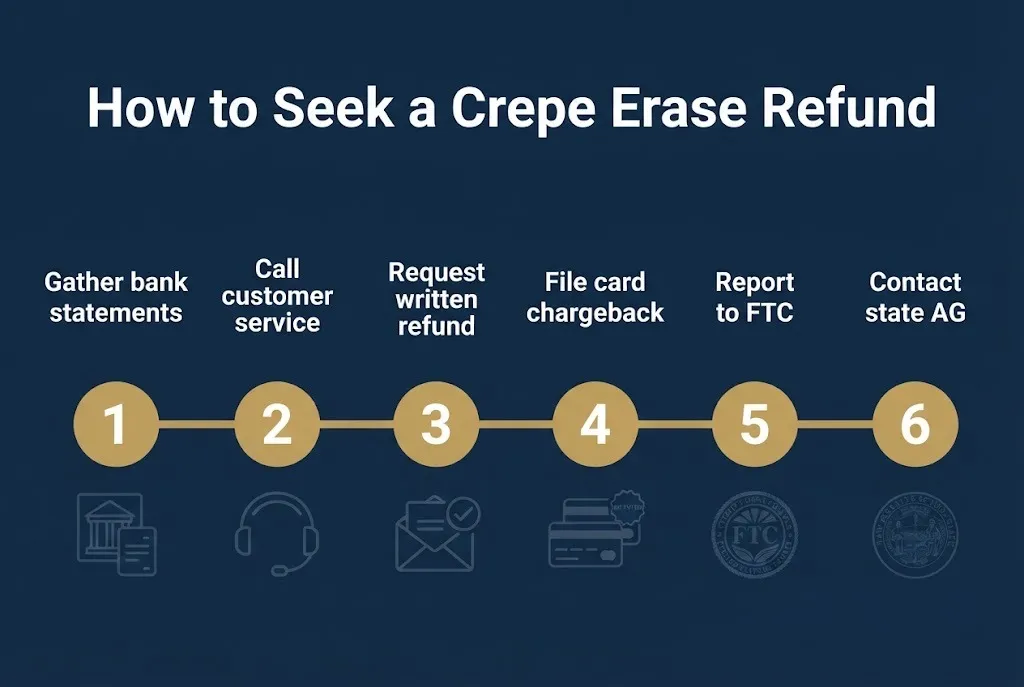
Here’s the step-by-step path that has worked for some consumers:
- Call Crepe Erase customer service and request a refund in writing.
- Reference the specific charges and dates from your bank or card statement.
- If refused, dispute the charges with your credit card issuer.
- File a complaint with the FTC at ReportFraud.ftc.gov.
- File a complaint with the Better Business Bureau.
- File a complaint with your state attorney general’s consumer protection division.
Chargebacks are the most effective tool. Federal law gives you 60 days from the statement date to dispute a billing error. Many card issuers extend this window for unauthorized charges.
The money-back guarantee, if one was advertised when you bought, is also enforceable. If the company promised a refund and refused, that’s a breach of its own terms and a legitimate basis for a complaint.
What Did the FTC Do About Crepe Erase’s Parent Company?
The FTC sued Guthy-Renker in 2023 over billing practices for another skincare subscription. The case settled with refunds and changes to how the company discloses auto-ship terms.
The FTC’s complaint in that case alleged that Guthy-Renker enrolled consumers in subscription plans without clearly disclosing the terms, made cancellation difficult, and continued charging after consumers attempted to cancel.
The settlement required Guthy-Renker to:
- Clearly disclose all subscription terms before billing
- Obtain express informed consent before charging
- Provide simple cancellation mechanisms
- Pay refunds to affected consumers
Whether Crepe Erase consumers were covered by that settlement depends on whether they purchased the specific products named in the case. The settlement covered specific product lines, not necessarily the entire Guthy-Renker catalog.
Are There Any Active Investigations Into Crepe Erase in 2026?
State attorneys general in California and New York have received consumer complaints about Crepe Erase billing practices, according to public records requests and consumer advocacy reports. Neither state has confirmed a formal investigation as of September 9, 2026.
The FTC’s complaint database shows ongoing entries related to Crepe Erase, but a database entry is not an enforcement action. It’s a consumer report. The FTC uses these reports to identify patterns, but most reports never become lawsuits.
The Better Business Bureau shows a pattern of complaints similar to the FTC entries, with billing and cancellation issues dominating. The BBB has not revoked Guthy-Renker’s accreditation over Crepe Erase specifically.
The honest status: scrutiny exists. Formal legal action does not.
Key Takeaway: Regulatory interest is real but preliminary, and it hasn’t produced a case, a settlement, or a refund program for Crepe Erase buyers.
What Should You Do If You Were Overcharged by Crepe Erase?
Act now. Don’t wait for a class action that may never come.
- Gather your bank statements showing every Crepe Erase or Guthy-Renker charge.
- Calculate the total you paid versus what you expected to pay.
- Call customer service and request a refund for the difference.
- Document the call: date, time, representative name, what was promised.
- If denied, file a chargeback with your credit card issuer.
- File complaints with the FTC, BBB, and your state attorney general.
- Keep all records in case a class action does materialize later.
The statute of limitations for credit card disputes is not your friend. The longer you wait, the harder it is to recover through your card issuer. Start the process the day you notice the charge.
What Laws Protect You From Deceptive Billing Practices?
Several federal and state laws apply to the subscription billing model Crepe Erase uses.
| Law | What It Does |
|---|---|
| FTC Act | Prohibits unfair and deceptive trade practices |
| ROSCA | Restore Online Shoppers’ Confidence Act, bans negative option billing without clear consent |
| EFTA | Electronic Fund Transfer Act, gives chargeback rights for unauthorized debits |
| State consumer protection acts | Vary by state, often allow private lawsuits with statutory damages |
| State automatic renewal laws | Many states require clear disclosure and easy cancellation |
ROSCA is the most important. Passed in 2010, it makes it illegal to charge consumers for a subscription unless the terms are clearly disclosed before the consumer gives billing information. The FTC has used ROSCA repeatedly against auto-ship marketers.
The EFTA gives you the right to dispute unauthorized electronic debits. If Crepe Erase kept charging your debit card after you cancelled, that’s a dispute under EFTA rules.
What Are the Signs of a Real Settlement vs. a Scam?
With no real settlement on file, the risk of scams is high. Fraudsters know people search for “Crepe Erase lawsuit” hoping for a payout.
Real settlements have:
- A court-approved settlement website with a .gov or clearly neutral domain
- A named settlement administrator
- A case number and court name
- No fee to file a claim
- No request for your bank password or full account number
Scams have:
- A text or email telling you you’re owed money
- A request for an upfront “processing fee”
- A sense of urgency to “claim before the deadline”
- No verifiable court documents
The rule is simple: if you didn’t initiate contact with a verified settlement administrator, anyone contacting you about a Crepe Erase refund is probably lying.
Key Takeaway: No verified settlement exists, so any “Crepe Erase settlement notice” you receive is almost certainly fraudulent.
What Happens Next With Crepe Erase Complaints?
The situation could change quickly, but as of now, here’s the expected path:
- Rest of 2026: Consumer complaints continue to accumulate with the FTC and state AGs.
- 2027 or later: A state AG or the FTC may file an enforcement action if the pattern persists.
- Possible class action: A private law firm may file a class action if enough consumers come forward.
- No action: Complaints may never escalate to a lawsuit.
The consumer protection timeline is slow. The FTC took years to build its 2023 case against Guthy-Renker. A Crepe Erase-specific action, if one comes, will follow a similar path.
The most important date for you isn’t a future hearing. It’s the date of your last unauthorized charge. Every day that passes makes recovery through your bank harder.
Frequently Asked Questions
Is there a Crepe Erase class action lawsuit?
No certified class action exists.
Individual complaints and regulatory inquiries are ongoing.
Law firm investigation pages are advertising, not filed cases.
Can I get money from a Crepe Erase settlement?
Not yet.
No settlement fund has been approved.
You can pursue refunds through chargebacks and consumer complaints.
How do I get a refund from Crepe Erase?
Call customer service and request one in writing.
If refused, dispute the charge with your card issuer.
File complaints with the FTC and your state attorney general.
What did the FTC do to Crepe Erase’s parent company?
The FTC sued Guthy-Renker in 2023 over similar billing practices.
The case involved another skincare subscription, not necessarily Crepe Erase.
It resulted in refunds and changed disclosure requirements.
Is Crepe Erase a scam?
The product exists and some users report satisfaction.
The billing model generates frequent complaints.
Unauthorized charges and difficult cancellations are the main issues.
How long do I have to dispute a Crepe Erase charge?
Federal law gives 60 days for billing errors.
Many card issuers extend this for unauthorized charges.
Act immediately, the window closes fast.
Can I sue Crepe Erase in small claims court?
Yes, if the amount is within your state’s limit.
Small claims handles billing disputes without a lawyer.
Bring receipts, statements, and any refund denials.
What should I do if I get a text about a Crepe Erase settlement?
Ignore it.
No settlement exists, so the text is a scam.
Never pay a fee to claim a refund.
If you bought Crepe Erase and got charged more than you expected, don’t wait for a lawsuit that hasn’t been filed. Pull your bank statements, call your card issuer, and file a consumer complaint today. Those actions have deadlines. The rumored class action doesn’t.
The most important fact right now: there is no Crepe Erase settlement to claim, but your chargeback rights are real and they expire.