Gerber Lawsuit in 2026: The Baby Food Heavy Metals Litigation Explained
Quick Answer
- The Gerber lawsuit centers on claims that baby food contained lead, arsenic, cadmium, and mercury at unsafe levels.
- No settlement fund or per-child payout has been approved, so no claim deadline exists yet.
- The most important deadline is your state’s statute of limitations for product liability, often two to three years.
If you searched for “Gerber lawsuit,” you’re likely a parent who fed your child Gerber baby food and just heard about heavy metals in those little jars and pouches. You want to know if your child was harmed, if there’s money to claim, and what to do now.
This article gives you the verified status of the litigation as of September 9, 2026. It explains what’s been filed, what science backs the claims, and whether any settlement exists.
Here’s the part most articles skip: there are actually multiple Gerber lawsuits, not one. Some target heavy metals. Others target false advertising. A few target specific product lines. They’re not the same case.
The Facts
| Item | Detail |
|---|---|
| Official Case Name | In re: Baby Food Products Liability Litigation |
| Court / Jurisdiction | U.S. District Court, multidistrict litigation |
| Current Status | Active litigation, no global settlement |
| Total Settlement Fund | Not yet confirmed, none approved |
| Est. Per Person | Not yet determined |
| Claim Deadline | No deadline, no settlement to claim against |
| Administrator | Not yet appointed |
| Proof Needed | Purchase records, medical records, product labels |
Is the Gerber Baby Food Lawsuit Legitimate?
Yes, the litigation is real and active in federal court. It’s not a rumor or a social media hoax.
The cases were consolidated into multidistrict litigation, which is a federal procedure that groups similar lawsuits from across the country before one judge for pretrial proceedings. That consolidation happened to handle the thousands of claims filed against Gerber and other baby food manufacturers.
A February 2021 congressional report put the issue on the national map. The House Subcommittee on Economic and Consumer Policy released findings showing that several baby food brands, including Gerber products, contained measurable levels of heavy metals.
The report didn’t prove specific harm to any individual child. That’s the legal gap the lawsuits are trying to bridge. Proving a product contained a substance is one thing. Proving that substance caused a specific child’s developmental delay or health condition is much harder.
Key Takeaway: The litigation is genuine, but existence of heavy metals doesn’t automatically equal a winning lawsuit for every exposed child.
What Is the Gerber Heavy Metals Lawsuit About?
The core claim is that Gerber and other manufacturers sold baby food containing lead, arsenic, cadmium, and mercury at levels that could harm developing brains and bodies.
Heavy metals occur naturally in soil and water. Rice absorbs arsenic particularly well. Root vegetables like sweet potatoes absorb lead and cadmium. The question isn’t whether trace amounts exist, it’s whether the levels in commercial baby food were high enough to cause harm and whether companies knew and failed to act.
The February 2021 congressional report found that some Gerber products contained lead at levels higher than what the FDA allows in bottled water. That’s a common comparison but not a perfect one, since the FDA has different standards for different products.
The FDA has since launched its Closer to Zero initiative, aimed at reducing heavy metals in baby food over time. The agency has issued draft guidance for lead in baby food, with final rules still pending as of September 2026.
What Products Are Named in the Gerber Lawsuit?
Multiple Gerber product lines appear in the litigation, based on the congressional report and subsequent filings.
| Product Category | Heavy Metals Identified |
|---|---|
| Rice cereals | Arsenic primarily, some lead |
| Sweet potato products | Lead and cadmium |
| Carrot products | Lead and cadmium |
| Fruit purees | Lower levels but still detectable |
| Teething biscuits | Lead and cadmium in some samples |
Rice-based products are the biggest concern because rice plants absorb arsenic from soil and water more efficiently than other crops. Gerber’s rice cereal was a staple first food for millions of American babies for decades.
The congressional report tested products from multiple brands and found heavy metals across the board, not just in Gerber products. That fact complicates the litigation. If every brand had similar levels, the “defect” argument becomes harder.
What Does the Science Say About Heavy Metals in Baby Food?
The science is clear that heavy metals are harmful at high enough doses. The legal fight is about whether the levels found in baby food were high enough to cause measurable harm.
Lead exposure in early childhood is linked to reduced IQ, attention problems, and behavioral issues. Arsenic is a known carcinogen and can affect brain development. Cadmium damages kidneys and can affect bone development. Mercury affects the nervous system.
But proving causation in a specific child is difficult. Many factors influence a child’s development, including genetics, environment, nutrition, and other exposures. Isolating baby food as the cause of a specific developmental delay requires expert testimony and detailed medical records.
The defense argument is straightforward: the levels in baby food were within the range found in other foods, and the amounts consumed by any individual child were too small to cause documented harm.
Key Takeaway: The gap between “heavy metals are dangerous” and “Gerber baby food caused this child’s specific injury” is the central legal battle.
Is There a Gerber Settlement in 2026?
No global settlement has been reached. No settlement fund exists. No per-child payout has been calculated.
Some individual cases may have settled privately, but those amounts aren’t public. In multidistrict litigation, early settlements sometimes happen for individual plaintiffs while the broader litigation continues. If such settlements have occurred in the Gerber cases, the terms remain confidential.
The litigation is still in pretrial proceedings, with bellwether trials used to test how juries respond to the evidence. Those trials haven’t happened yet as of September 9, 2026, or are in early stages.
Once bellwether trials produce verdicts, settlement talks typically accelerate. That’s how multidistrict litigation works. The first trials establish a value range, and both sides adjust their positions accordingly.
Reality Check: No legitimate settlement sends a text asking for your bank details. No one charges a fee to “register” for a lawsuit that has no settlement. If you get a message about a Gerber settlement payout, it’s a scam.
How Much Could a Gerber Settlement Be Worth?
Not yet determined. No settlement exists, so no payout range is verified.
To understand what a future settlement might look like, consumer lawyers look at comparable product liability cases. Past settlements involving childhood lead exposure from paint or water have ranged from a few thousand dollars for property damage claims to hundreds of thousands for documented injuries.
But those comparisons are imperfect. Baby food heavy metals cases involve lower exposure levels and harder causation questions than lead paint cases.
If a global settlement eventually emerges, payouts would likely be tiered. Children with documented developmental issues and medical records showing elevated blood lead levels might qualify for more. Children with no documented harm might qualify for a small refund or nothing at all.
These are educated guesses, not verified facts. The honest answer is that no one knows what a settlement might look like because the litigation hasn’t reached that stage.
Who Qualifies for a Gerber Lawsuit Claim?
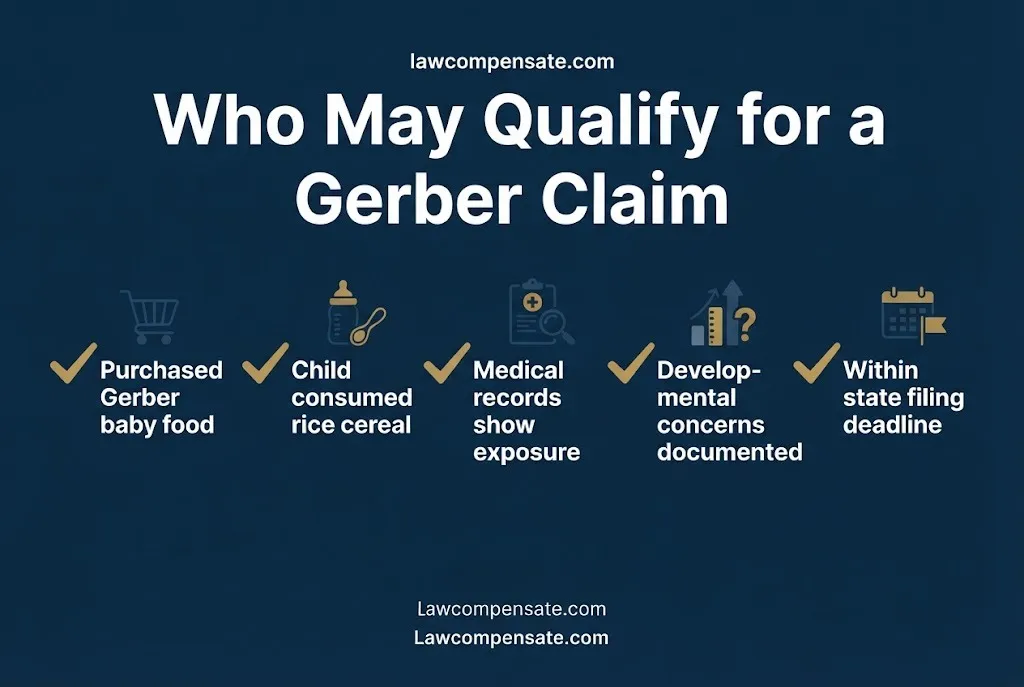
No qualification criteria exist yet because no settlement has been approved. When and if a settlement emerges, eligibility would likely depend on:
- Purchase records showing you bought specific Gerber products
- The child’s age at the time of consumption
- Medical records documenting heavy metal exposure
- Proof of developmental or health conditions linked to exposure
- The state where you purchased the products
Without a settlement, these are predictions based on how similar cases have been structured, not verified requirements.
The best thing you can do now is keep records. Save receipts if you still have them. Keep medical records. Document which products your child consumed and when. If a settlement emerges, that documentation will matter.
Can You Still File a Gerber Lawsuit?
Yes, if your state’s statute of limitations hasn’t expired. The deadline depends on where you live and when the injury was discovered.
Most states allow product liability claims within two to three years of discovering the injury. The discovery rule matters here because many parents didn’t learn about heavy metals in baby food until the 2021 congressional report.
Some states have longer windows. A few have shorter ones. If you’re considering filing, the time to talk to an attorney is now. The longer you wait, the harder it is to find a firm still accepting cases.
The law firms that advertised heavily for baby food cases in 2021 and 2022 have largely filled their dockets. New clients may face higher scrutiny and tougher intake standards.
What Is the Statute of Limitations for a Gerber Lawsuit?
It varies by state and by the specific legal theory. Most states set the limit at two to three years for personal injury claims.
The clock usually starts when you knew or should have known about the potential harm. The 2021 congressional report is the key date for many families. If you first learned about heavy metals in baby food from that report, your clock may have started in February 2021.
But this is a legal question that requires state-specific analysis. Some states have statutes of repose that bar claims after a certain number of years regardless of discovery. Others have more generous discovery rules.
The only safe advice: if you think you have a claim, talk to a product liability attorney this week. The deadline may be closer than you think.
Key Takeaway: Your filing deadline is personal to your state and your facts, and it may have already passed.
What Is the Difference Between the Gerber Lawsuit and the FDA Recall?
There’s a common confusion between the lawsuit and FDA recalls. They’re not the same thing.
The FDA has not issued a recall of Gerber baby food for heavy metals. The agency has issued draft guidance for reducing heavy metals, but no product was pulled from shelves specifically because of the litigation.
Recalls happen when a product poses an immediate safety risk. The FDA’s position is that heavy metals in baby food are a long-term exposure concern, not an acute danger requiring immediate recall.
The congressional report and the FDA’s Closer to Zero initiative are regulatory actions. The lawsuit is a private legal action by parents seeking compensation. They’re related but separate.
What Has Gerber Said About the Lawsuit?
Gerber has denied that its products are unsafe. The company points to its own testing and quality control measures.
Gerber’s public statements emphasize that heavy metals are naturally occurring and present in many foods, including homemade baby food and organic products. The company says it has reduced heavy metal levels in its products and supports the FDA’s Closer to Zero framework.
The company has not admitted liability in any filing. Its legal position is that the levels in its products were within legal limits and did not cause harm to any specific child.
That position hasn’t changed as of September 9, 2026. The litigation is adversarial, and Gerber is fighting the claims.
What Should Parents Do Now?
If you fed your child Gerber baby food and you’re concerned, here’s what you can do:
- Ask your pediatrician about heavy metal testing if your child shows developmental concerns.
- Keep all medical records, including well-child visits and any developmental screenings.
- Save purchase records, product labels, and any baby food containers you still have.
- Document which products your child consumed and the approximate time period.
- Track your child’s developmental milestones against standard timelines.
- If you believe your child has been harmed, consult a product liability attorney.
- Monitor the litigation through the official court docket.
The most important step is talking to your pediatrician, not a lawyer. Medical concerns come first. Legal action comes later, if at all.
What Happens Next in the Gerber Litigation?
The multidistrict litigation will follow the standard path for mass tort cases.
- Late 2026: Bellwether trial preparations continue, with expert witness challenges expected.
- 2027: First bellwether trials likely begin, depending on court scheduling.
- After first trials: Settlement talks intensify if plaintiffs win or if defense sees risk.
- No guaranteed outcome: The litigation could drag on for years or end in dismissal.
The bellwether trials are the pivotal moment. If juries award significant damages, settlement pressure builds. If juries side with the defense, the case may collapse.
There’s no deadline for you to watch unless a settlement emerges. The litigation timeline is long, and families should not wait for it to resolve before seeking medical care or legal advice.
Frequently Asked Questions
Is the Gerber baby food lawsuit real?
Yes.
The multidistrict litigation is active in federal court.
Thousands of cases have been consolidated for pretrial proceedings.
Has Gerber settled the heavy metals lawsuit?
No.
No global settlement has been reached.
No settlement fund exists as of September 2026.
How do I join the Gerber lawsuit?
Contact a product liability attorney.
The firm will evaluate your claim and file if the statute of limitations hasn’t expired.
There’s no class action settlement to join automatically.
What products are in the Gerber lawsuit?
Rice cereals and rice-based products are the primary focus.
Sweet potato, carrot, and fruit purees are also named.
Teething biscuits appear in some filings.
Can I get a refund for Gerber baby food?
No refund program exists.
The litigation has not produced a settlement or refund fund.
Your purchase price is not recoverable through the current lawsuits.
How long do I have to file a Gerber claim?
It depends on your state.
Most states allow two to three years.
The clock may have started with the 2021 congressional report.
What are the symptoms of heavy metal exposure in children?
Developmental delays and learning problems.
Attention and behavioral issues.
Reduced IQ and cognitive deficits.
Symptoms vary widely and depend on exposure levels.
Is organic baby food safer from heavy metals?
Not necessarily.
Heavy metals come from soil and water, not pesticides.
Organic products can contain similar levels.
If you fed your child Gerber baby food and you’re worried, start with your pediatrician. Then gather your records and check your state’s filing deadline. That deadline is the one fact that determines whether you have any legal options left.
The most important date isn’t a settlement hearing. It’s the date your state says you can no longer file a claim.