Google Gmail Lawsuit in 2026: What’s Actually Filed, Settled, and Still Pending
Quick Answer
- The Google Gmail lawsuit refers to several cases, mostly about email scanning, privacy, and data collection.
- No unified settlement fund exists, so no per-user payout has been approved for most pending claims.
- The most important deadline is the claim filing date for any settled case, usually posted on the official settlement website.
If you searched for “Google Gmail lawsuit,” you probably saw a headline about a settlement, a privacy violation, or a class action notice in your inbox. You want to know if it’s real, if you qualify, and whether any money is actually available.
This article sorts through the multiple cases, the settled ones, the active ones, and the ones that never went anywhere. As of September 9, 2026, there’s no single “Gmail lawsuit.” There are several.
Here’s the part most articles skip: the biggest Gmail privacy settlement in recent years wasn’t about Gmail content at all. It was about Google’s Street View cars collecting Wi-Fi data, and Gmail users were only part of that class.
The Facts
| Item | Detail |
|---|---|
| Active Cases | Multiple, in different federal courts |
| Primary Legal Theory | Privacy violations, wiretapping, data collection |
| Settled Cases | Some individual cases resolved, no global Gmail settlement |
| Total Settlement Fund | Varies by case, no unified fund |
| Est. Per Person | Not yet determined for most claims |
| Claim Deadline | Depends on the specific settled case |
| Administrator | Varies by settlement |
| Proof Needed | Gmail account history, date of use, sometimes specific evidence |
Is the Google Gmail Lawsuit Real?
Yes, but “the Gmail lawsuit” is not one thing. It’s a collection of privacy and consumer claims filed against Google over how Gmail collects, scans, and uses your data.
The most significant cases fall into a few categories. Some challenge Google’s practice of scanning email content to serve targeted ads, a practice Google announced it would stop in 2017 but still faces litigation over. Others involve claims that Google shared Gmail data with third parties without proper consent.
The confusion comes from search results mixing old and new cases. A 2017 settlement, a 2020 dismissed case, and a 2026 active case all appear under the same search term. They’re not the same lawsuit.
What’s verified: Google has faced multiple class actions over Gmail privacy, some settled, some dismissed, some still moving through federal courts. No single settlement covers all Gmail users.
Key Takeaway: If you’re looking for one Gmail lawsuit with one payout, you won’t find it. You’ll find several cases with different statuses.
What Is the Gmail Privacy Lawsuit About?
The core claim across most Gmail privacy cases is that Google scanned or shared email content without meaningful consent.
The legal theory is usually wiretapping. Federal and state wiretap laws prohibit intercepting electronic communications without consent. Plaintiffs argue that Google’s automated email scanning counts as interception.
Google’s defense has been consistent: users agree to the terms of service, which disclose the scanning and data collection. Google argues that agreement is consent.
The legal fight is whether the disclosure was clear enough to count as meaningful consent under wiretap laws. Courts have split on this question over the years.
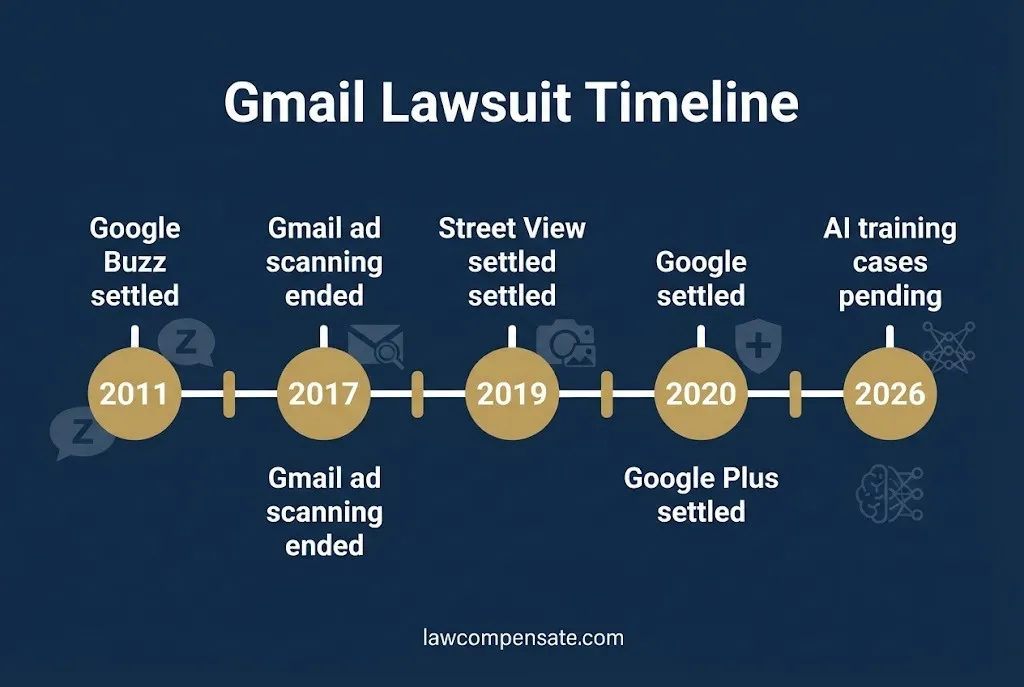
One key moment: Google announced in 2017 that it would stop scanning Gmail content for ad personalization. That announcement didn’t end the lawsuits. It changed the argument about whether earlier practices were legal.
What Gmail Lawsuits Have Settled?
Several Gmail-related cases have reached settlements over the years, but the amounts and eligibility vary widely.
The most notable settled case involved Google’s Street View vehicles collecting unencrypted Wi-Fi data, including emails, from unsecured networks. That case settled in 2019 for $13 million, with class members receiving small payments. It wasn’t a Gmail-only case, but Gmail users whose data was intercepted qualified.
Other settlements have involved Google’s use of student Gmail data in education settings, with smaller funds and narrower classes.
No settlement has ever covered “all Gmail users” for general privacy violations. The class definitions are always narrower than the headlines suggest.
| Settled Case | Year | Fund Size | Who Qualified |
|---|---|---|---|
| Street View Wi-Fi data collection | 2019 | $13 million | People whose unencrypted data was intercepted |
| Google Buzz privacy | 2011 | $8.5 million | Google Buzz users |
| Google Plus data exposure | 2020 | $7.5 million | Google Plus users affected by the 2018 bug |
These are historical settlements, not current opportunities. The deadlines for all of them have passed.
Reality Check: No one emails or texts you about a Gmail settlement you never heard of. No legitimate settlement asks for your Gmail password. Filing a claim is always free. If someone asks for money to “process” your settlement claim, it’s a scam.
How Much Could a Gmail Lawsuit Settlement Pay?
Not yet determined for most active cases. The amounts depend on which case you’re asking about and whether it settles.
For historical Gmail-related settlements, the payouts were modest:
- Street View case: class members received approximately $20 to $40 per person, though amounts varied.
- Google Buzz: similar small payouts after attorney fees.
- Google Plus: most claims paid under $12.
These are privacy class actions, not personal injury cases. The damages are often statutory or nominal, not based on actual financial loss. That keeps individual payouts low even when the total fund looks large.
If a new Gmail privacy settlement emerges in 2026 or 2027, the payout structure would likely follow the same pattern: a fund of several million dollars divided among millions of class members, producing small individual checks.
What Gmail Lawsuits Are Still Active in 2026?
Several cases remain in federal courts as of September 9, 2026. The status of each is different.
One active area involves Google’s data sharing practices with third-party developers. Lawsuits filed in 2021 and 2022 allege that Google allowed outside developers to access Gmail user data without proper disclosure. Some of these cases were consolidated, and motions to dismiss have been partially granted and partially denied.
Another active area involves claims that Google’s “Incognito mode” misrepresented privacy protections. That case is about Chrome, not Gmail specifically, but Gmail data was part of the discovery. A settlement in that case was announced in late 2023, but final approval and claim details are still working through the court.
A third area involves Google’s AI training on user data, including emails. Several lawsuits filed in 2023 and 2024 allege that Google used Gmail content to train AI models without consent. These cases are in early stages, with motions to dismiss pending.
Who Qualifies for a Gmail Lawsuit Claim?
It depends entirely on the case. No single set of criteria applies to all Gmail litigation.
For the Street View settlement, the class included people whose unencrypted Wi-Fi data was intercepted by Google’s vehicles. You qualified if you used Gmail or other services during the collection period and your data was exposed through an unsecured network.
For active cases, eligibility hasn’t been determined. If a case settles, the settlement notice will define the class, usually by time period, geographic location, and type of Gmail account.
The most useful thing you can do is keep your Gmail account active and check official court dockets or settlement websites if a notice arrives. But don’t expect a notice. Most class actions reach only a small fraction of eligible members.
How Do You File a Gmail Lawsuit Claim?
For settled cases, the process is standard. For active cases, there’s nothing to file yet.
When a settlement is approved, the steps usually look like this:
- Visit the official settlement website named in the court order.
- Review the class definition to confirm you’re included.
- Complete the claim form with your contact information and any required proof.
- Submit the form before the posted deadline.
- Wait for the court to approve the settlement and the administrator to process claims.
- Receive your payment, usually by check or digital transfer.
For active litigation with no settlement, there’s no claim form and no deadline. You wait, or you contact a lawyer to discuss filing your own case.
The official settlement website is always named in the court’s order. It’s never a random .com site advertising “Gmail settlement claims.”
Key Takeaway: Until a judge approves a settlement and a claims administrator posts a claim form, there is nothing for you to file.
What Is the Difference Between a Gmail Class Action and a Consumer Lawsuit?
A class action covers a group of people with similar claims, decided in one case. A consumer lawsuit is broader and can include individual claims, government enforcement, or regulatory actions.
The Gmail privacy cases are mostly class actions. That means lawyers file one lawsuit on behalf of a defined class, and the outcome applies to everyone in that class unless they opt out.
Government enforcement is different. The FTC and state attorneys general can sue Google directly for privacy violations, and those cases don’t require individual claims. Any penalties go to the government, not to individual users.
The FTC has taken action against Google multiple times, including a $170 million settlement in 2019 over YouTube’s data collection from children. That case involved Google properties but wasn’t a Gmail lawsuit.
What Did Google Actually Do Wrong?
The answer depends on which lawsuit you’re reading about.
In the Gmail scanning cases, the claim is that Google scanned email content to serve targeted ads without clear consent. Google stopped this practice for consumer Gmail in 2017.
In the data sharing cases, the claim is that Google allowed third-party developers to access Gmail data more broadly than users understood. A 2018 Wall Street Journal investigation found that third parties could read millions of users’ emails if users had connected certain apps.
In the AI training cases, the claim is that Google used Gmail content to train AI models without specific permission. These cases are too new to have produced verified findings.
The common thread: users believe their emails were used in ways they didn’t knowingly approve.
What Are the Best Alternatives to Gmail in 2026?
If the privacy concerns push you to consider alternatives, several options exist.
| Provider | Key Privacy Feature | Cost |
|---|---|---|
| Proton Mail | End-to-end encryption, zero-access to content | Free tier, paid plans from $4/month |
| Tutanota | Built-in encryption, no ads | Free tier, paid plans from $3/month |
| Fastmail | No ad scanning, paid service | From $5/month |
| Zoho Mail | Ad-free, privacy-focused | Free tier, paid plans available |
| iCloud Mail | Apple’s privacy stance, minimal data collection | Free with Apple ID |
End-to-end encryption means even the email provider can’t read your messages. Proton Mail and Tutanota are the leaders in this space. Gmail does not offer end-to-end encryption for consumer accounts.
The tradeoff is convenience. Gmail integrates with more services, has better search, and is free. Privacy-focused alternatives often cost money or lack features.
What Should Gmail Users Do Now?
If you’re concerned about Gmail privacy but can’t verify any active claim, here’s what you can do:
- Check your Gmail settings to see what third-party apps have access to your account.
- Revoke access for any app you don’t recognize or no longer use.
- Review Google’s privacy policy and activity controls.
- Consider a privacy-focused alternative for sensitive communications.
- Monitor official court dockets for active Gmail litigation.
- Save evidence if you believe your data was misused: screenshots, app permissions, dates.
- File an FTC complaint if you believe Google violated its privacy promises.
The most practical step is auditing your connected apps. Most people have granted Gmail access to dozens of services they no longer use. Each one is a potential data leak.
What Happens Next in the Gmail Litigation?
The active cases will follow the standard federal court timeline.
- Late 2026: Motions to dismiss in the AI training cases likely resolved.
- 2027: Discovery in the surviving cases, which could take 12 to 24 months.
- 2028 or later: Possible class certification and settlement talks.
- No guaranteed outcome: Cases could settle, get dismissed, or go to trial.
The Incognito mode settlement is further along. Final approval was granted, but appeals and claim processing may still be underway. If you used Chrome’s Incognito mode and believe you were affected, check the official settlement website for current claim information.
The most important deadline for you is whatever deadline applies to a specific settlement you’re part of. Without a settlement, there’s no deadline and no claim.
Frequently Asked Questions
Is the Gmail lawsuit real?
Yes, multiple Gmail lawsuits exist.
They cover privacy, data scanning, and data sharing.
No single lawsuit covers all Gmail users.
Can I get money from the Gmail lawsuit?
Only from settled cases with open claims.
No active Gmail case has a settlement fund.
Historical settlements have paid small amounts.
How do I file a Gmail claim?
Wait for a settlement to be approved.
Visit the official settlement website.
Complete the claim form before the deadline.
What is the Gmail privacy lawsuit about?
Claims that Google scanned or shared email content.
Legal theories include wiretapping violations.
Google argues users consented through terms of service.
Has Google settled any Gmail lawsuits?
Yes, several over the years.
The Street View case settled for $13 million.
Other cases involved education data and social features.
What is the Incognito mode lawsuit?
A case about Chrome privacy misrepresentations.
It settled, but final claim details vary.
Gmail data was part of the discovery, not the core claim.
Is Gmail reading my emails?
Google stopped scanning consumer Gmail for ads in 2017.
Automated processing still occurs for features like spam filtering.
Third-party apps may access data if you grant permission.
How do I protect my Gmail privacy?
Review connected apps and revoke unused access.
Check Google’s activity controls.
Consider encrypted email for sensitive messages.
If you’re hoping for a Gmail payout, the honest answer is that most people won’t get one. The settlements are small, the classes are narrow, and the deadlines pass quickly. The better use of your time is securing your account and watching for official notices only from the court-approved settlement website.
The most important fact: there is no active Gmail settlement you can claim today, but new cases are filed every year.