Gmail Lawsuit 2026: The Latest Verified Case Updates and Claim Deadlines
Quick Answer
- A Gmail lawsuit in 2026 refers to several active privacy cases, not one single settlement.
- No new global Gmail settlement fund has been approved in 2026, so payouts remain case-specific.
- The most important deadline is the claims filing cutoff for the Incognito mode settlement, which varies by notice date.
If you searched for “Gmail lawsuit 2026,” you want the current status. Not the old cases from 2019. Not the dead claims. You want to know what’s happening right now, in 2026, and whether any money is actually available.
This article gives you the verified 2026 picture. Which cases are active. Which settlements are paying. Which lawsuits are still too early to matter. No recycled headlines. No outdated claim links.
Here’s the part most articles skip: the biggest Gmail-adjacent settlement in recent years, the Incognito mode case, is still processing claims as of September 2026, and late claims may still be accepted in limited circumstances.
The Facts
| Item | Detail |
|---|---|
| Active 2026 Cases | AI training lawsuits, data sharing claims, Incognito settlement processing |
| Court / Jurisdiction | Multiple U.S. District Courts, Northern District of California primary |
| Current Status | Active litigation, no new global settlement |
| Total Settlement Fund | Varies by case, Incognito fund previously announced |
| Est. Per Person | Not yet determined for new cases |
| Claim Deadline | Incognito claims largely closed, late claims limited |
| Administrator | Separate administrators per settlement |
| Proof Needed | Account history, date ranges, sometimes specific usage evidence |
Is There a New Gmail Lawsuit in 2026?
Yes, new cases were filed in 2024 and 2025 that remain active in 2026. They center on Google’s use of Gmail data for AI training.
The core allegation in the newest cases is that Google used the content of users’ emails to train artificial intelligence models without specific, informed consent. Plaintiffs argue this violates privacy laws and Google’s own terms of service.
Google has moved to dismiss these cases, arguing that its terms allow the use of data for improving services, including AI features. As of September 9, 2026, those motions remain pending in the Northern District of California.
These cases are years away from any settlement. The earliest possible resolution is a dismissal, which Google is seeking, or a class certification ruling, which plaintiffs are pursuing.
Key Takeaway: The 2026 Gmail lawsuits are real but early. No settlement, no claim form, no deadline exists yet.
What Gmail Settlements Are Actually Paying in 2026?
Only one major Gmail-related settlement has active claim processing in 2026: the Chrome Incognito mode case.
That case alleged Google misled users about privacy in Incognito mode, suggesting their browsing wasn’t tracked when it was. Gmail data was part of the discovery, though the case focused on Chrome, not Gmail directly.
The settlement was announced in late 2023 and received final approval. The claims administrator has been processing claims through 2025 and 2026. Individual payouts depend on the number of valid claims filed.
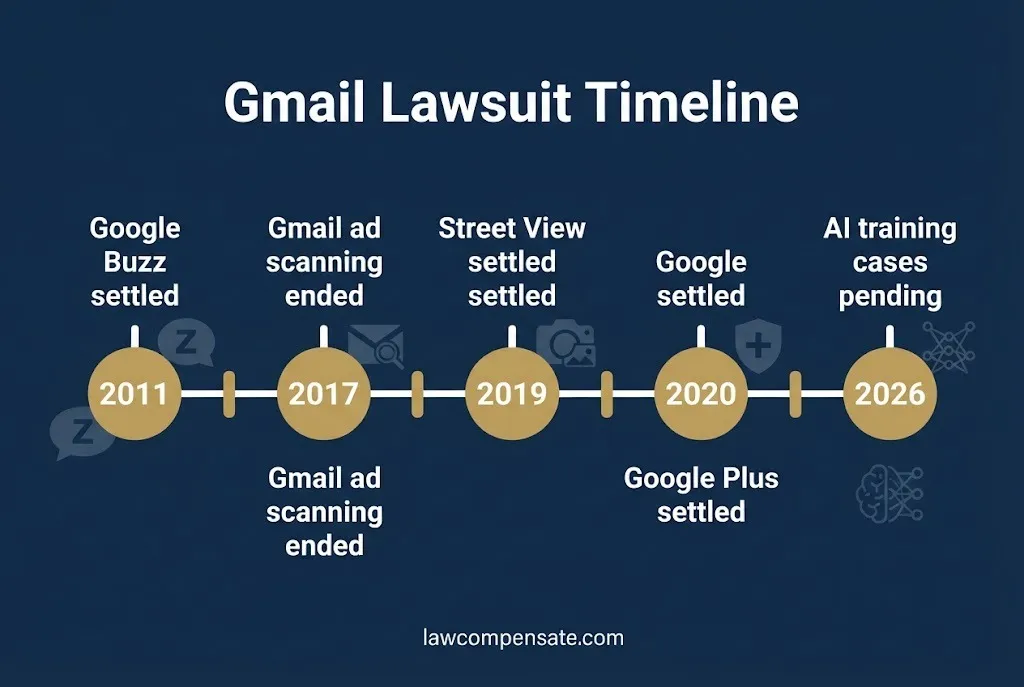
No other Gmail-specific settlement is actively paying as of September 9, 2026. Historical settlements from 2011 through 2020 are closed. Their deadlines passed years ago.
How Much Will the Incognito Settlement Pay Per Person?
The per-person amount depends on the total number of valid claims filed against the settlement fund.
The Incognito settlement did not require proof of damages. Class members could file a simple claim form. Because millions of people qualified, the per-person payout is expected to be small, likely in the range of a few dollars to perhaps $20 to $30 per claim, based on similar privacy settlements.
These are estimates based on the fund size and expected claim volume, not verified payout figures. The official administrator has not published a final per-person amount as of September 9, 2026.
If you filed a claim, you should receive communication from the settlement administrator. If you didn’t file by the deadline, your options are limited.
Reality Check: No one texts or calls about a Gmail settlement payment. The administrator sends email or postal mail from the official settlement domain. You never pay a fee to receive a settlement check. If someone asks for money to “release” your payout, it’s a fraud.
How Do You Check Your Gmail Lawsuit Claim Status?
For the Incognito settlement, you can check your status through the official settlement website.
The claims administrator maintains a portal where you can verify whether your claim was received and whether it’s under review. You’ll need the claim number or the email address you used when filing.
For other active Gmail lawsuits with no settlement yet, there’s no claim status to check. You wait for the court to rule on pending motions. That could take months or years.
The most common mistake is checking the wrong website. There are dozens of “Gmail settlement” lookalike sites that collect personal information. Always verify through the court’s official docket or the administrator named in the settlement order.
What Are the New Gmail AI Training Lawsuits About?
These lawsuits allege that Google used private email content to train large language models without explicit user consent.
The cases were filed after Google updated its privacy policy to state that it may use publicly available information and other data to train AI models. Plaintiffs argue that private Gmail content is not “publicly available” and that the policy change was insufficient.
The legal theories include violations of the Electronic Communications Privacy Act, state privacy laws, and breach of contract claims. Some cases also name Google’s Bard and Gemini AI products specifically.
These cases are in the earliest stages. No class has been certified. No discovery has been completed. Any resolution is at least two to three years away.
Key Takeaway: The AI training lawsuits are worth watching but offer no immediate path to compensation.
Who Qualifies for a Gmail Lawsuit in 2026?
Qualification depends entirely on the specific case.
For the Incognito settlement, the class included Chrome users who used Incognito mode during a defined period. Gmail users qualified only if they also used Incognito mode and met the class definition.
For the AI training lawsuits, no class has been defined. The proposed classes would likely include Gmail users during the AI training period, but the court hasn’t ruled on this yet.
For older Gmail privacy cases, the classes were narrow and time-limited. Most have closed.
The pattern across all these cases: broad eligibility sounds good in headlines, but the actual class definitions are specific and require evidence of use during defined periods.
What Is the Difference Between a Gmail Settlement and a Google Settlement?
Gmail is one Google product. Google faces lawsuits across many products, and settlements sometimes cover multiple services.
The Incognito settlement is a Chrome case. Gmail data was part of the evidence, but the settlement class was defined by Chrome usage, not Gmail usage.
A separate Google Plus settlement covered data exposure from the Google Plus bug. Gmail users qualified only if they also had Google Plus accounts affected by the bug.
The Street View settlement covered unencrypted Wi-Fi data collection. Gmail users qualified if their emails were intercepted through unsecured networks during the collection period.
The lesson: don’t assume you qualify for a Google settlement just because you have a Gmail account. The class definitions are product-specific and time-specific.
What Should You Do If You Get a Gmail Lawsuit Notice in 2026?
A legitimate class action notice will name the court, the case number, the claims administrator, and the official settlement website. It will never ask for your password or payment.
Here’s what to do:
- Verify the case number and court name on the notice.
- Check the official court docket to confirm the case exists.
- Visit the official settlement website directly, not through a link in the notice.
- Review the class definition to see if you’re actually included.
- File your claim before the posted deadline if you qualify.
- Save a copy of your claim confirmation.
- Watch for follow-up communications from the administrator.
The deadliest mistake is clicking a link in a fake notice. Scammers replicate real settlement notices with slight changes to steal personal information.
What Are the Risks of Joining a Gmail Class Action?
For class members, the main risk is minimal. You don’t pay legal fees out of pocket. Attorney fees come from the settlement fund.
The main tradeoff: if you join the class, you give up the right to sue Google separately over the same claims. For most people, that’s irrelevant. They wouldn’t sue individually anyway.
The opt-out decision matters only if you have significant individual damages and want to pursue your own case. For a privacy claim worth a few dollars, opting out makes no sense.
There’s no penalty for filing a claim. The worst outcome is your claim is denied, and you get nothing.
Key Takeaway: Joining a class action is low-risk for ordinary users, but verify the notice is real before acting.
What Are the Biggest Gmail Privacy Risks in 2026?
The lawsuit trends point to the real privacy concerns that Google is fighting over.
| Privacy Risk | Status |
|---|---|
| Email content used for AI training | Subject of active litigation |
| Third-party app access to Gmail | Google has restricted, but legacy access persists |
| Ad personalization based on email content | Stopped in 2017, but historical claims exist |
| Law enforcement access to Gmail data | Governed by warrants and Google’s disclosure policies |
| Data retained after account deletion | Subject of regulatory scrutiny |
The AI training issue is the newest and least settled. Google says it doesn’t use private Gmail content for AI training. Plaintiffs claim the privacy policy language allows it. That factual dispute is exactly what the litigation will resolve.
What Can You Do to Protect Your Gmail Data Right Now?
Don’t wait for a lawsuit to protect your data. These steps reduce your exposure today.
- Review connected third-party apps and revoke unused access.
- Enable two-factor authentication on your Google account.
- Check your Google activity controls and pause what you don’t need.
- Use a separate email address for sensitive communications.
- Consider encrypted email for confidential messages.
- Review Google’s privacy policy updates each year.
- Download and delete old emails you don’t need to retain.
The connected apps audit is the most important step. Most people have authorized dozens of apps to access their Gmail over the years. Each one is a potential data leak.
What Happens Next in the 2026 Gmail Litigation?
The active cases will follow the federal court timeline, which moves slowly.
- Late 2026: Motions to dismiss in the AI training cases likely resolved.
- 2027: If the cases survive, discovery begins and could last 12 to 24 months.
- 2028: Class certification motions likely filed.
- 2029 or later: Possible settlement or trial.
The Incognito settlement is further along. Claim processing should conclude by late 2026 or early 2027, with payments distributed after final claim validation.
For anyone hoping for a new Gmail settlement payout in 2026, the honest answer is: not yet. The new cases are too early, and the old ones are closed.
Frequently Asked Questions
Is there a new Gmail lawsuit in 2026?
Yes, AI training lawsuits filed in 2024 and 2025 are active.
No settlement exists for these cases yet.
Motions to dismiss remain pending.
Can I get money from a Gmail lawsuit in 2026?
Only from the Incognito settlement, if you filed a claim.
New Gmail lawsuits have no settlement fund.
Historical cases are closed.
How do I file a claim for a Gmail lawsuit?
Wait for a settlement to be approved.
Visit the official settlement website.
Complete the claim form before the deadline.
What is the Incognito settlement about?
Claims that Google misled users about privacy in Incognito mode.
It settled, with claim processing ongoing in 2026.
Gmail data was part of the evidence, not the core claim.
Are the Gmail AI training lawsuits real?
Yes, they’re filed in federal court.
The claims are serious but unproven.
No class has been certified.
How long do Gmail lawsuits take?
Years, typically.
New cases may not resolve until 2028 or later.
The Incognito case took over three years from filing to settlement.
What should I do if I get a Gmail settlement notice?
Verify the case number and court.
Check the official docket.
File through the official website, never through email links.
Can I opt out of a Gmail class action?
Yes, by the opt-out deadline.
Opting out preserves your right to sue individually.
Most people don’t opt out because individual claims aren’t worth pursuing.
If you’re waiting for a Gmail payout in 2026, check the Incognito settlement first. That’s the only active payment path. The new AI lawsuits are real but years from resolution. Your best action is securing your account and watching the official court dockets.
The most important fact: the only active settlement processing payments is Incognito mode, not Gmail itself.