How to Avoid Paying Taxes on Debt Settlement in 2026: Legal Strategies and the Insolvency Rule
Quick Answer
- Forgiven debt is generally taxable income, but the insolvency exclusion can eliminate the tax if your debts exceed your assets.
- Bankruptcy discharge is never taxable, making it the cleanest way to eliminate debt without a tax bill.
- The most important deadline is your tax filing date, because the insolvency calculation must be documented when you file.
If you searched for “how to avoid paying taxes on debt settlement,” you’ve probably just settled a debt, received a 1099-C, or you’re considering settlement and want to know the full cost before you sign.
This article gives you the verified tax rules as of September 9, 2026. It explains when forgiven debt is taxable, when it isn’t, and how the insolvency exclusion actually works in practice.
Here’s the part most articles skip: the insolvency exclusion isn’t automatic. You must calculate it correctly and document it on your tax return. Get it wrong, and the IRS will come looking.
The Facts
| Item | Detail |
|---|---|
| Taxable Threshold | Forgiven debt over $600 |
| Key IRS Form | Form 1099-C, Cancellation of Debt |
| Primary Exclusion | Insolvency, IRS Publication 4681 |
| Bankruptcy Exclusion | Always tax-free |
| Filing Deadline | April 15 of the year after settlement |
| Documentation Needed | Asset and liability statements at settlement date |
Is Forgiven Debt Always Taxable?
No, but the default rule is yes. Forgiven debt over $600 is taxable unless you qualify for an exclusion.
The IRS treats canceled debt as income because you received money you don’t have to pay back. From the IRS’s perspective, that’s the same as earning it.
The creditor files Form 1099-C when they forgive $600 or more. You’ll receive a copy, and the IRS gets one too. The amount on that form goes on your tax return unless you claim an exclusion.
The exclusions are specific: bankruptcy, insolvency, certain farm debts, certain student loan forgiveness programs, and a few others. If none apply, you owe tax on the forgiven amount.
Key Takeaway: The default is taxable. Avoiding the tax requires fitting into a specific exclusion and documenting it properly.
What Is the Insolvency Exclusion?
The insolvency exclusion is the most common way to avoid tax on forgiven debt outside bankruptcy.
You’re insolvent when your total debts exceed your total assets immediately before the debt is forgiven. The IRS calculates insolvency by comparing everything you own against everything you owe.
If you’re insolvent by $20,000 and $15,000 of debt is forgiven, none of that $15,000 is taxable. The exclusion covers forgiven debt up to the amount of your insolvency.
If you’re insolvent by $5,000 and $15,000 is forgiven, $5,000 is excluded and $10,000 is taxable.
The calculation happens at a specific moment: immediately before the settlement. That timing matters because asset values and debt balances change.
How Do You Calculate Insolvency for Tax Purposes?
The calculation is a snapshot of your financial life at the moment before settlement.
Here’s the step-by-step:
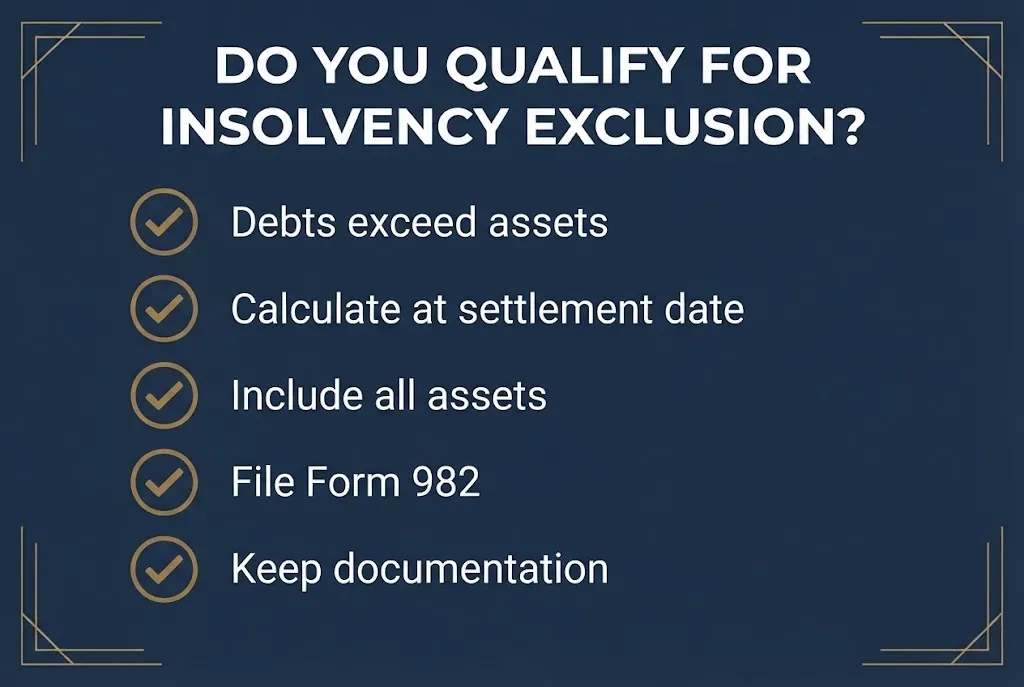
- List all your assets at fair market value immediately before settlement.
- List all your liabilities, including the debt being settled, at that same moment.
- Subtract total liabilities from total assets.
- If liabilities exceed assets, you’re insolvent by that amount.
- Your exclusion is limited to the amount of your insolvency.
Assets include cash, bank accounts, retirement accounts, real estate equity, vehicles, investments, and personal property with significant value.
Liabilities include credit card debt, mortgages, car loans, student loans, medical bills, and the debt being settled.
The calculation must be done as of the settlement date, not the date you file your taxes.
Reality Check: No one calls you about a “tax settlement” related to forgiven debt. The IRS communicates by mail, not phone or text. No legitimate tax professional charges a fee to “check your insolvency status” without preparing your return. If someone demands payment for a service you didn’t request, it’s a scam.
How Does Bankruptcy Avoid Debt Settlement Taxes?
Bankruptcy is the cleanest tax outcome for eliminating debt.
Debt discharged in bankruptcy is never taxable income. The IRS explicitly excludes it. You don’t need the insolvency calculation. You don’t need Form 982. The discharge simply isn’t income.
This is one of bankruptcy’s least understood advantages. Debt settlement saves you money on the debt but potentially costs you in taxes. Bankruptcy eliminates the debt and the tax problem together.
The tradeoff is the credit damage. Bankruptcy stays on your credit report for 7 to 10 years. Debt settlement negative marks also stay for 7 years. The difference isn’t as large as most people think.
If you’re considering debt settlement, run the tax numbers first. Bankruptcy might be cheaper overall once taxes are factored in.
What Forms Do You Need to File for the Insolvency Exclusion?
You’ll need two forms: Form 982 and your tax return.
Form 982, Reduction of Tax Attributes Due to Discharge of Indebtedness, is where you claim the insolvency exclusion. You attach it to your tax return for the year the debt was forgiven.
You’ll also need to keep documentation of your insolvency calculation. That includes:
- Bank statements showing balances at settlement date
- Credit card statements showing balances
- Mortgage statements showing loan balances
- Vehicle valuations
- Retirement account statements
- Any other documentation proving assets and liabilities
The IRS can ask for this documentation if it audits your return. Keep it for at least three years after filing.
What Are the Most Common Mistakes With the Insolvency Exclusion?
The mistakes are common and expensive.
- Filing without Form 982. The exclusion isn’t automatic. You must claim it.
- Calculating insolvency at the wrong time. It’s the moment before settlement, not the day you file.
- Undervaluing assets. The IRS expects fair market value, not what you wish assets were worth.
- Ignoring retirement accounts. These count as assets, even if you don’t want to touch them.
- Not keeping documentation. The IRS can disallow the exclusion if you can’t prove insolvency.
The retirement account mistake is particularly common. People think 401(k) and IRA balances don’t count because they’re “retirement money.” They do count. The IRS includes them in the asset calculation.
Key Takeaway: The insolvency exclusion requires paperwork and honest math. Guessing wrong or skipping the form means a tax bill.
How Much Tax Will You Owe Without an Exclusion?
The tax hit depends on your marginal tax rate.
| Forgiven Debt | 12% Bracket | 22% Bracket | 32% Bracket |
|---|---|---|---|
| $5,000 | $600 | $1,100 | $1,600 |
| $10,000 | $1,200 | $2,200 | $3,200 |
| $20,000 | $2,400 | $4,400 | $6,400 |
| $50,000 | $6,000 | $11,000 | $16,000 |
The forgiven amount is added to your taxable income for the year. If the settlement pushes you into a higher bracket, the effective tax rate could be higher than these examples.
This is the hidden cost of debt settlement that many companies don’t discuss. You save $15,000 on the debt and owe $3,300 in taxes. The net savings is still positive, but it’s smaller than advertised.
Can You Negotiate the 1099-C Amount?
No, you can’t negotiate with the IRS about the reported amount.
The creditor reports the forgiven amount on Form 1099-C. That number is what it is. You can’t ask the IRS to reduce it because you think it’s unfair.
What you can do is dispute the 1099-C if it’s factually wrong. If the creditor reports $20,000 forgiven but you only settled $15,000, you can contact the creditor to correct the form.
But if the amount is accurate, the taxable income is what it is. Your only options are the exclusions or paying the tax.
What Is the Difference Between Debt Settlement and Debt Forgiveness for Taxes?
The tax treatment is the same. The difference is in how the debt is eliminated.
Debt settlement means you paid less than the full balance, and the remainder was forgiven. The forgiven portion is taxable income.
Debt forgiveness means the entire debt was canceled without payment. The full amount is taxable income.
The 1099-C reporting is the same. The exclusions are the same. The only difference is the amount forgiven.
Key Takeaway: Settlement and forgiveness produce the same tax result. The forgiven amount, however it was forgiven, is income unless excluded.
What States Tax Forgiven Debt Differently?
Most states follow federal rules, but some have their own twists.
A few states don’t have an income tax at all, so forgiven debt isn’t a state tax issue. Those include Texas, Florida, Washington, Nevada, and others.
Some states with income taxes conform to federal exclusions automatically. Others require separate calculations or have different asset definitions.
The safest approach: check your state’s specific rules before assuming the federal exclusion applies at the state level. A tax professional licensed in your state can confirm.
What Should You Do Before Settling a Debt?
Do the tax math before you sign anything.
- Calculate your total debts and total assets as of today.
- Determine whether you’re insolvent and by how much.
- Estimate the forgiven amount for each debt you plan to settle.
- Calculate the potential tax liability if no exclusion applies.
- Compare the total cost of settlement against bankruptcy.
- Consult a tax professional if the numbers are significant.
- Get the insolvency calculation in writing before the settlement date.
The worst outcome is settling a debt, paying the settlement, then discovering you owe thousands in taxes you didn’t expect. The math is knowable in advance. Do it first.
What Happens Next With Debt Settlement Taxation?
The rules are stable, but enforcement is increasing.
- 2026: The IRS continues processing 1099-C forms and matching them against tax returns.
- 2027: Possible legislative changes to the insolvency exclusion remain uncertain.
- Ongoing: More taxpayers are claiming the exclusion, which means more IRS scrutiny.
- Watch: Any changes to student loan forgiveness tax treatment could affect broader rules.
For now, the insolvency exclusion remains the primary legal strategy for avoiding debt settlement taxes outside bankruptcy.
The most important date is your tax filing deadline. Miss it, and penalties and interest start accruing on any tax owed.
Frequently Asked Questions
Is forgiven debt always taxable?
No, but the default is yes.
The insolvency exclusion can eliminate the tax.
Bankruptcy discharge is always tax-free.
How do I claim the insolvency exclusion?
File Form 982 with your tax return.
Calculate your insolvency at the settlement date.
Keep documentation of assets and liabilities.
What counts as an asset for insolvency?
Cash, bank accounts, retirement accounts, real estate equity, vehicles.
Fair market value, not what you wish they were worth.
Everything you own counts.
Can I avoid tax on settled debt?
Yes, if you’re insolvent at the settlement date.
Yes, if the debt is discharged in bankruptcy.
No, if you have more assets than debts.
What if my 1099-C is wrong?
Contact the creditor to correct it.
Dispute the amount in writing.
The IRS relies on the creditor’s reporting.
Do I owe state tax on forgiven debt?
Depends on your state.
Most states follow federal rules.
Check with a local tax professional.
Is bankruptcy better than debt settlement for taxes?
For taxes, yes.
Bankruptcy discharge is never taxable.
Debt settlement forgiveness usually is.
How much tax will I owe on forgiven debt?
Your marginal tax rate times the forgiven amount.
Rates range from 10% to 37% federally.
State taxes may add more.
If you’re considering debt settlement, calculate your insolvency first. The tax savings from the exclusion can be thousands of dollars, but only if you document it correctly. Get the numbers before you sign.
The most important fact: the insolvency exclusion is legal, effective, and free, but it’s not automatic. You must claim it.