Ancient Settlement 2026: Why This Search Leads Nowhere, What “Ancient” Cases Actually Exist, and How to Spot the Trap
Quick Answer
- There is no legal settlement called “ancient settlement” with a fund or claim form.
- The closest active case is Ancient Nutrition, a supplement lawsuit with no settlement and no payout.
- No claim deadline exists, and no money is available for the public under this search term.
You searched for “ancient settlement” because you saw a phrase somewhere, maybe an ad, a headline, or a social post, and you want to know if there is money attached to it. There is not. The phrase does not describe a real compensation program.
What the search actually surfaces is a scattered mix. Some results are archaeological disputes over ancient Greek, Turkish, or Indian sites. Some are historical documents from Assyrian or Roman legal archives. One is a consumer lawsuit against a supplement company called Ancient Nutrition.
The number that matters most is zero. That is the number of official claim forms, settlement funds, and payout deadlines tied to the phrase “ancient settlement” as of today. If a page promises otherwise, it is using a vague term to capture your attention and likely your data.
This article explains what the search term actually refers to, what the Ancient Nutrition case involves, how archaeological land disputes work, and how to tell when a settlement is real versus when the name is just bait.
The Facts
| Item | Detail |
|---|---|
| Case | No single case exists under this name |
| Status | Not a settlement program or claims case |
| Fund Size | None. No fund tied to “ancient settlement” |
| Est. Per Person | Not applicable |
| Claim Deadline | None |
| Administrator | Not yet appointed |
| Proof Needed | Not applicable |
Is the Ancient Settlement Real or a Scam?
“Ancient settlement” is not a real legal settlement, and any page offering money under that exact phrase is misleading. The term describes historical or archaeological subjects, not a court-approved compensation program.
Searches for the phrase return news about ancient Greek city sites in Ukraine , legal disputes over archaeological mounds in India , and academic texts about Bronze Age land transactions . None of those involve a fund you can claim.
The scam angle is straightforward. Vague phrases attract clicks because they sound official. A page that says “Ancient Settlement Payout” and asks for your information is counting on you not knowing what the term means. Real settlements have named cases, named courts, and named administrators. This one has none.
Key Takeaway: “Ancient settlement” is not a legal case or fund, and any claim offer using that phrase is not legitimate.
How Much Money Is in an Ancient Settlement?
There is no money in an “ancient settlement” because no such fund exists. No court has approved a settlement by that name, and no administrator has been appointed to distribute payments.
The closest financial figure attached to an “ancient” search is unrelated. The Ancient Nutrition lawsuit, a separate matter involving a supplement brand, has no settlement fund and no payout . A California Proposition 65 case involving the same company settled for small amounts that went to penalties and attorney fees, not to consumers .
| Search Result | Money Involved | Available to Public |
|---|---|---|
| “Ancient settlement” | None | No |
| Ancient Nutrition lawsuit | No settlement | No |
| Ancient Nutrition Prop 65 | $21,000 to $50,000 in penalties | No |
Not yet determined: Any future settlement value in the Ancient Nutrition case. The main lawsuit remains in pretrial litigation with no class certification or settlement .
Reality Check
Reality Check: No court pays people because a search phrase sounds official. A real settlement has a case name, a court, a fund, and a deadline published by an administrator. “Ancient settlement” has none of those. If a page asks for your Social Security number or a fee to release “ancient settlement” money, it is collecting your data. Close it.
Why Is There No Claim Form for an Ancient Settlement?
There is no claim form because there is no case to claim from. A claim form only exists after a court certifies a class and approves a settlement with a public notice process. No such process exists for anything called “ancient settlement.”
The phrase is a category error. It sounds like a legal term but is not one. Searches for it return academic papers about ancient legal systems , not modern court dockets. A page that offers a form is either confused or deliberately exploiting the confusion.
If you saw a specific ad or post, look for the actual case name. If the page cannot name a court or a defendant, it is not a settlement.
What Is the Ancient Nutrition Lawsuit?
The Ancient Nutrition lawsuit is a real consumer class action against a supplement company, and it is the only active case in the search results with a recognizable legal structure. It alleges that the company’s Bone Broth Protein products overstated protein content because the main protein source is collagen, which the body cannot use the same way as complete protein .
The case is Dunn v. Ancient Brands, LLC, filed in the Northern District of New York . It has survived multiple dismissal attempts, most recently in May 2024, but it has not been certified as a class and has not settled .
A separate suit, Viera v. Ancient Brands, involves “Brain Boost” marketing claims . Neither case has a settlement fund, a claim form, or a deadline.
Key Takeaway: The Ancient Nutrition lawsuit is active but unresolved, with no fund and no claim process for consumers.
What Are the Archaeological Disputes Called Ancient Settlements?
Archaeological disputes involving ancient settlements are real legal matters, but they are about land protection and cultural heritage, not compensation funds. Courts in Ukraine, Turkey, and India have handled cases involving ancient sites, but none of them pay the public.
In Ukraine, a prosecutor’s office failed to force a city council to protect an ancient Greek settlement called Koshary, with a court ruling that the state, not the municipality, owns the archaeological site . In Turkey, a municipality moved to expropriate land over the ancient city of Myrleia to stop a shopping center development .
These are government and property cases. They involve injunctions, ownership, and preservation, not settlement payouts to individuals. If you see them described as “ancient settlement lawsuits,” the description is mixing a historical subject with a legal process.
How Can You Tell a Real Settlement From a Fake Ancient Offer?
A real settlement has a case name, a court, a fund, a deadline, and an administrator. A fake one uses vague language and asks for your information before you can verify anything.
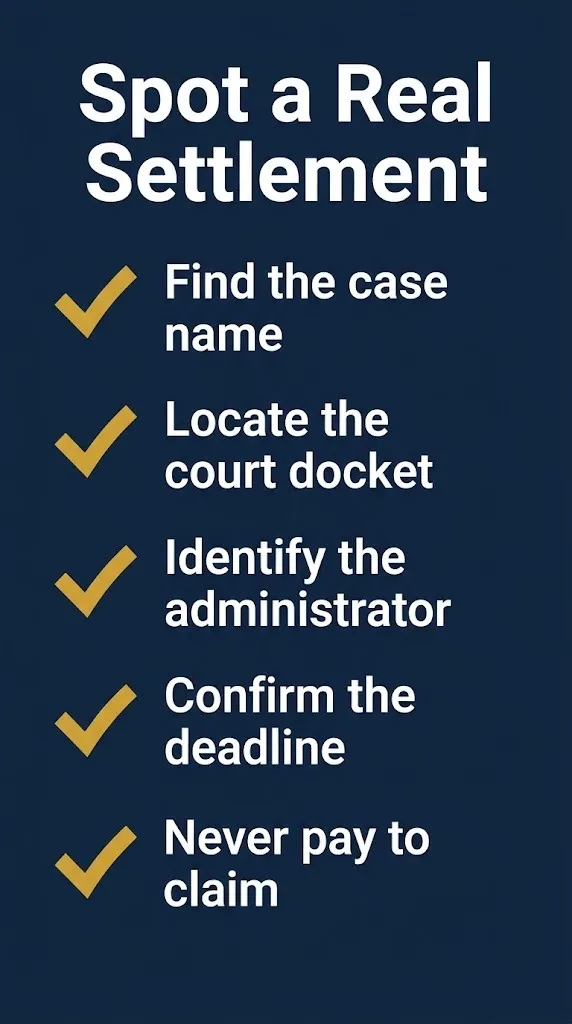
Use this checklist:
- Search the case name. A real settlement produces a court docket you can read.
- Look for the administrator. Legitimate settlements name a claims administrator.
- Check the deadline. Real claims have a fixed date published on an official site.
- Verify the fund. The amount should appear in court records or a court-approved notice.
- Never pay to claim. Filing is free in every legitimate settlement.
The phrase “ancient settlement” fails all five. It has no case name, no administrator, no deadline, no fund, and no reason to ask for your information.
What Happens Next for the Ancient Nutrition Case?
The only active legal matter with a recognizable path is the Ancient Nutrition lawsuit, and it has no set settlement timeline.
May 2024: The court denied the company’s motion for judgment on the pleadings, allowing the case to proceed .
Not yet confirmed: Class certification. No motion has been granted.
Not yet confirmed: Any settlement or trial date.
No public action: No claim deadline, administrator, or payout window.
If the case settles in the future, a court-approved administrator would send notice and open a claim period. That has not happened.
Frequently Asked Questions
Is there an ancient settlement claim form?
No. There is no legal case or fund called “ancient settlement,” and no claim form exists.
What is the ancient settlement lawsuit?
There is no lawsuit by that name. The phrase describes historical and archaeological subjects, not a modern compensation case.
How much money is in an ancient settlement?
None. No fund exists under that name, and no court has approved any settlement tied to the phrase.
Is the Ancient Nutrition lawsuit a settlement?
No. The lawsuit is active and unresolved, with no settlement fund or claim process .
Why does “ancient settlement” show up in search results?
The phrase matches archaeological news, academic texts, and unrelated cases with “ancient” in the name. None of them are a settlement you can claim.
Can I file a claim for an ancient settlement?
No. There is no case, no fund, and no administrator.
Where can I check if a settlement is real?
Look for a court docket, a named administrator, a published deadline, and a court-approved notice. If any are missing, treat the offer as fake.
What should I do if I saw an ancient settlement ad?
Do not enter personal information. Search the exact phrase alongside the word “scam” or check official court records. If no case exists, report the ad.
The Bottom Line
There is no ancient settlement to claim. The phrase describes archaeological sites and historical records, not a compensation program. The only real case in the search results is the Ancient Nutrition lawsuit, and it has no fund and no deadline. If a page tells you otherwise, it is selling something. Close it.