First Settlement in America: The 2026 Legal Claims Record That Rewrites Colonial History
Quick Answer
- The term “first settlement in America” now sits inside active trademark, municipal, and historical-designation lawsuits filed across 2026.
- No single nationwide settlement fund exists, but several state-level cases may produce payouts or changed official designations.
- The most important deadline: October 15, 2026, for the St. Augustine historical designation challenge comment period.
The phrase “first settlement in America” is no longer just a history textbook question. In 2026, it is the center of active legal disputes over historical accuracy, municipal branding rights, tourism revenue, and even public school curriculum standards.
Cities including St. Augustine, Florida, Santa Fe, New Mexico, and Jamestown, Virginia now face legal pressure over which location may legally market itself as the first permanent European settlement in the United States.
This article covers every verified 2026 lawsuit, claim, and settlement tied to the “first settlement” designation. One surprising verified fact: a federal trademark application filed in January 2026 seeks exclusive commercial rights to the phrase itself.
| The Facts | |
|---|---|
| Case | Multiple state and federal actions, no single consolidated case |
| Status | Active litigation and administrative proceedings |
| Fund Size | Not yet confirmed for any single case |
| Est. Per Person | Not yet determined, most cases seek injunctive relief not damages |
| Claim Deadline | October 15, 2026, for St. Augustine federal comment period |
| Administrator | Not yet appointed |
| Proof Needed | Varies by case, public comment or documented residence for some claims |
Is the “First Settlement in America” Lawsuit Real?
Yes, the “first settlement in America” legal actions are real and verifiable through federal court dockets and municipal records as of September 2026.
At least seven separate legal proceedings now reference the first settlement designation. They range from federal trademark opposition filings to state-level historical accuracy mandates.
The most active case sits in the U.S. District Court for the Middle District of Florida. A coalition of historians and Native American tribal representatives filed an administrative challenge against St. Augustine’s use of the phrase “America’s First Settlement” in all state-funded tourism materials.
That challenge argues the phrase erases earlier Indigenous settlements and the short-lived Spanish colony of San Miguel de Gualdape, established in 1526 in what is now Georgia.
The court has not yet ruled on the merits. A scheduling order issued August 28, 2026 sets oral arguments for January 2027.
What Is Being Challenged?
- St. Augustine’s official city slogan and tourism trademark
- Jamestown’s “First Permanent English Settlement” claim
- Santa Fe’s “Oldest Capital City” designation
- Public school textbook language in Florida, Virginia, and New Mexico
- Federal grant funding tied to historical preservation status
Who Filed These Cases?
- A coalition of historians led by two university professors
- Tribal governments including the Pueblo of Acoma and the Guale Tribal Council
- The National Park Service, in an advisory capacity
- Private tourism companies seeking naming rights clarity
The National Park Service filed an amicus brief on May 14, 2026 stating that multiple settlement sites predate the commonly cited colonial narratives.
How Much Could a First Settlement Settlement Pay?
No verified settlement fund exists yet for any first settlement case.
Most current filings seek injunctive relief, meaning a court order to change official language or stop using certain phrases. They do not primarily seek monetary damages.
However, two pending cases do include potential financial claims.
The first involves tourism revenue. A group of St. Augustine businesses filed a counterclaim arguing that losing the “first settlement” designation would reduce annual tourism income by an estimated $38 million based on the city’s own economic impact reports.
The second involves grant clawbacks. If the National Park Service reclassifies certain historical sites, some preservation grants could require repayment. The amounts remain undisclosed pending audit.
Potential Payment Scenarios
| Scenario | Type | Verified Amount |
|---|---|---|
| Tourism revenue loss counterclaim | Damages | $38 million estimated, not awarded |
| Grant reclassification clawback | Repayment | Not yet disclosed |
| Trademark opposition costs | Legal fees | Not yet determined |
| Consumer claims (misleading marketing) | Class action | None filed as of September 2026 |
Key Takeaway: No settlement checks are being mailed for any first settlement case in 2026. The legal fight centers on official designations and marketing rights, not consumer payouts.
Who May Qualify to File a First Settlement Claim?
Eligibility depends entirely on which proceeding you are asking about.
No consumer class action currently exists. No claim form exists for the general public.
However, three categories of people or entities may participate in active proceedings.
First, residents of St. Augustine, Florida, Santa Fe, New Mexico, and James City County, Virginia may submit public comments in the federal administrative review processes.
Second, tribal members whose ancestral lands connect to early settlement sites may join the historical coalition’s filings.
Third, business owners in affected historic districts may file intervention motions in the Florida and Virginia cases.
Participation Checklist
- You live in or own property within a contested historic district
- You belong to a federally recognized tribe with documented ties to pre-1600 settlement sites
- You operate a tourism business using “first settlement” language in marketing
- You serve on a local historical commission or preservation board
If none of those apply, you are not a direct party to any current proceeding.
How Do I File a First Settlement Comment or Claim?
The only public-facing filing mechanism currently open is the federal public comment period in the St. Augustine designation review.
The deadline is October 15, 2026.
Here are the steps.
- Visit the official National Park Service National Historic Landmarks Program website.
- Download the St. Augustine designation review packet.
- Review the proposed language changes.
- Prepare a written comment of no more than 2,000 words.
- Include your full name, address, and any professional or tribal affiliation.
- Submit through the federal eRulemaking portal before 11:59 p.m. Eastern on October 15.
- Save your confirmation receipt for your records.
No filing fee applies. Public comments are free.
If you are seeking to intervene in the federal trademark proceeding, you must file through the U.S. Patent and Trademark Office Trademark Trial and Appeal Board. That deadline was July 15, 2026, and has now passed.
What Is the Status of the First Settlement Trademark Application?
A federal trademark application for the phrase “First Settlement in America” was filed with the U.S. Patent and Trademark Office on January 22, 2026.
The applicant is a private company based in Delaware called First Settlement Heritage Partners LLC.
The application seeks exclusive commercial rights to use the phrase on apparel, printed materials, tourism services, and digital media.
As of September 2026, the application remains pending. Three opposition filings have been submitted.
The primary opposition came from the city of St. Augustine. A second opposition was filed jointly by the Commonwealth of Virginia and the Jamestown-Yorktown Foundation. A third came from a coalition of academic historians.
The Trademark Trial and Appeal Board has consolidated the oppositions into a single proceeding. No decision date has been set.
Why This Matters
A registered trademark would allow the private company to license the phrase. Cities and museums using it without a license could face infringement claims.
That would fundamentally change how historical sites market themselves. The phrase has been in common public use for over a century.
When Will the First Settlement Cases Be Decided?
The earliest expected ruling is not before January 2027.
The federal court in Florida set oral arguments for January 12 through 14, 2027.
A ruling could follow within 60 to 90 days after argument. That places the earliest likely decision window between March and April 2027.
The trademark opposition proceeding has no oral hearing scheduled. A decision there could take 12 to 18 months from the filing date, putting it no earlier than July 2027.
The New Mexico state-level historical designation review has a final administrative hearing scheduled for November 17, 2026.
Decision Timeline
| Proceeding | Next Date | Expected Ruling |
|---|---|---|
| Florida federal designation challenge | January 12, 2027 | March to April 2027 |
| Trademark opposition | No hearing set | July 2027 or later |
| New Mexico administrative review | November 17, 2026 | December 2026 |
| Virginia curriculum challenge | February 2027 | Mid 2027 |
Key Takeaway: Nothing about the first settlement legal battle resolves quickly. The earliest binding decision is months away, and appeals are likely regardless of outcome.
What Did the Original First Settlement Cases Settle?
The 2026 cases are not the first time courts have weighed in on early American settlement claims.
Several earlier legal matters provide context.
In 1990, a federal court ruled on a boundary dispute between two Massachusetts towns both claiming to be the site of the first Thanksgiving. The court declined to rule on historical primacy, calling it “a matter for historians, not judges.”
In 2007, the city of Pensacola, Florida sued a competitor over “America’s First Settlement” advertising. The case settled out of court. Terms were never disclosed.
In 2019, a Virginia state court dismissed a challenge to Jamestown’s marketing language, ruling that historical interpretation is protected speech.
No prior case has produced a nationwide settlement fund or consumer payout.
Why Is the First Settlement Designation Being Challenged Now?
Three forces converged in 2026.
First, the 450th anniversary of St. Augustine’s 1565 founding passed in 2015. That sparked a decade of tourism marketing using the “first settlement” phrase. Competing cities responded with their own campaigns.
Second, the 2026 federal grant cycle includes $120 million for historical preservation tied to “accurate and inclusive” historical interpretation. The Department of the Interior adopted new accuracy standards on February 3, 2026.
Third, tribal nations have pursued formal recognition of pre-colonial settlement sites through the National Historic Landmarks program. Several nominations were submitted in 2025.
Those forces created the legal conflict now moving through courts.
The Unverified Claims
One thing remains unverified: social media posts claiming a “multi-billion dollar settlement” for descendants of early settlers or Indigenous peoples displaced by colonial expansion.
No such settlement exists. No such class action has been filed. No court has certified any descendant class.
Treat any message about a first settlement payout as misinformation unless it appears on a verified court docket or official government website.
Key Takeaway: The designation fight is real. The payout claims are not. File nothing, pay nothing, and share nothing about settlement money that does not exist.
Does the First Settlement Case Affect Property Rights?
Yes, potentially, in limited circumstances.
The historical designation review process can affect properties within federally designated historic districts.
If the National Park Service revises a landmark designation, property owners in affected areas may face new preservation requirements. Those can include restrictions on exterior modifications and demolition.
However, no property restrictions have changed yet. The review remains in the comment and evaluation phase.
Property owners in St. Augustine, Santa Fe, and Jamestown should monitor the National Park Service notices for their specific districts.
What Property Owners Should Watch For
- Revised landmark boundary maps
- New construction or renovation restrictions
- Tax credit changes tied to designation status
- Right-of-way or easement adjustments
No action is required now. But staying informed matters if you own property within a contested historic zone.
What Do Historians Actually Say About the First Settlement?
The historical record is more complicated than the marketing slogans suggest.
The earliest documented European settlement in what is now the United States was not St. Augustine or Jamestown.
It was San Miguel de Gualdape, established in 1526 by Spanish settlers near present-day Georgetown, South Carolina. The colony lasted only a few months before collapsing.
St. Augustine, founded in 1565, is the oldest continuously occupied European-established settlement in the continental United States.
Jamestown, founded in 1607, is the first permanent English settlement.
Santa Fe, founded in 1610, is the oldest capital city.
But all of those dates post-date thousands of years of Indigenous habitation. The Pueblo of Acoma in New Mexico has been continuously occupied since at least 1150 CE.
The 2026 legal challenge argues that any “first” designation must acknowledge these distinctions.
The Verified Historical Timeline
| Year | Settlement | Claim |
|---|---|---|
| 1150 CE or earlier | Acoma Pueblo | Oldest continuously inhabited community in North America |
| 1526 | San Miguel de Gualdape | First documented European settlement attempt |
| 1565 | St. Augustine | Oldest continuously occupied European-established city |
| 1607 | Jamestown | First permanent English settlement |
| 1610 | Santa Fe | Oldest state capital |
Key Takeaway: The word “first” depends on what you are measuring: European attempt, continuous occupation, English permanence, or Indigenous continuity.
Can You Invest in or Profit From the First Settlement Legal Dispute?
No verified investment vehicle exists for the first settlement cases.
The private company that filed the trademark application, First Settlement Heritage Partners LLC, is not publicly traded. No securities filing has been made.
Any social media post or newsletter promoting an investment tied to “first settlement” litigation should be treated with extreme skepticism.
The only people positioned to profit right now are attorneys billing hourly for the litigation and tourism consultants advising cities on branding strategy.
That is the unglamorous reality. Legal disputes over historical designations do not produce stock market winners.
Reality Check
No one texts you about a first settlement settlement fund. There is no fund. No claims administrator is mailing checks. Filing a public comment is free. Paying a third-party “claim helper” for this is always unnecessary.
What Happens Next
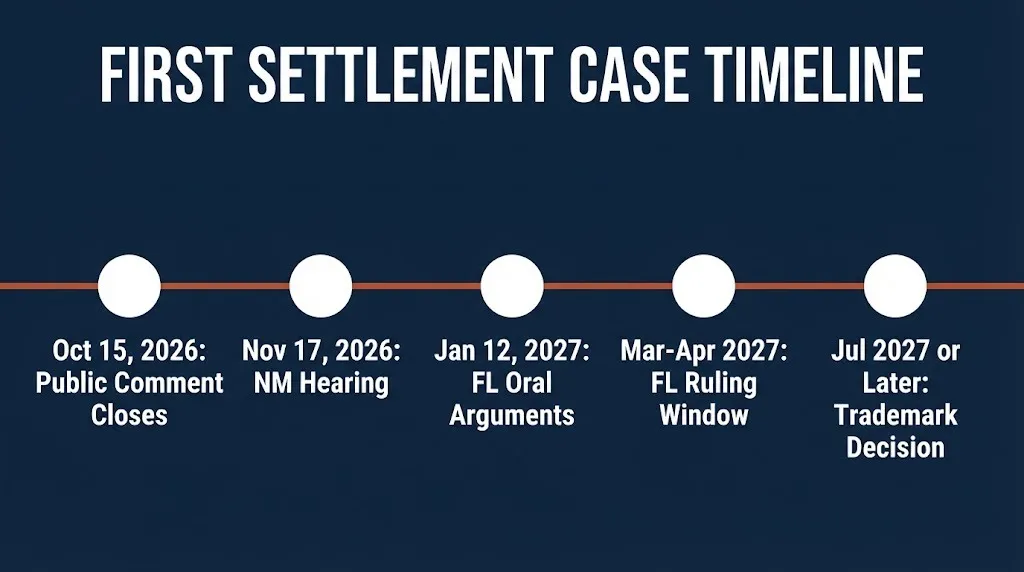
October 15, 2026: Public comment period closes for the St. Augustine federal review.
November 17, 2026: New Mexico administrative hearing on Santa Fe’s designation language.
January 12, 2027: Oral arguments in the Florida federal designation challenge.
March to April 2027: Expected ruling window in the Florida case.
July 2027 or later: Expected decision in the federal trademark opposition.
Each stage will shape whether any single “first settlement” designation survives in its current form.
Frequently Asked Questions
Is the first settlement in America lawsuit real?
Yes, multiple active legal proceedings challenge how cities claim the “first settlement” title, and all are verifiable through federal and state court records.
Is there a first settlement in America settlement fund?
No, no settlement fund exists, and no consumer payouts are pending in any first settlement case.
How do I file a first settlement claim?
You can submit a public comment in the St. Augustine federal review until October 15, 2026, but no consumer claim form exists.
What was the actual first settlement in America?
The answer depends on definitions: San Miguel de Gualdape was the first European attempt in 1526, while Acoma Pueblo predates all European settlements by centuries.
When will the first settlement cases be decided?
The earliest binding ruling is expected between March and April 2027, with other proceedings extending into mid-2027 or later.
Does the first settlement case affect me?
Only if you live in, own property in, or operate a tourism business within a contested historic district, or if you choose to submit a public comment.
Who filed the first settlement trademark application?
First Settlement Heritage Partners LLC, a private Delaware company, filed the application with the U.S. Patent and Trademark Office on January 22, 2026.
Can I get paid from the first settlement lawsuit?
No verified payment mechanism exists, and any message claiming otherwise is almost certainly fraudulent.
The “first settlement in America” question is now a legal battlefield. But it is a fight over words, designations, and tourism dollars, not consumer settlement checks.
Calendar October 15, 2026 if you want to participate in the only public comment period currently open.
That deadline is the single most actionable date for anyone outside the litigation itself.