Alligator Alcatraz Lawsuit 2026: The Federal Case Over Wildlife on a Former Prison Island
Quick Answer
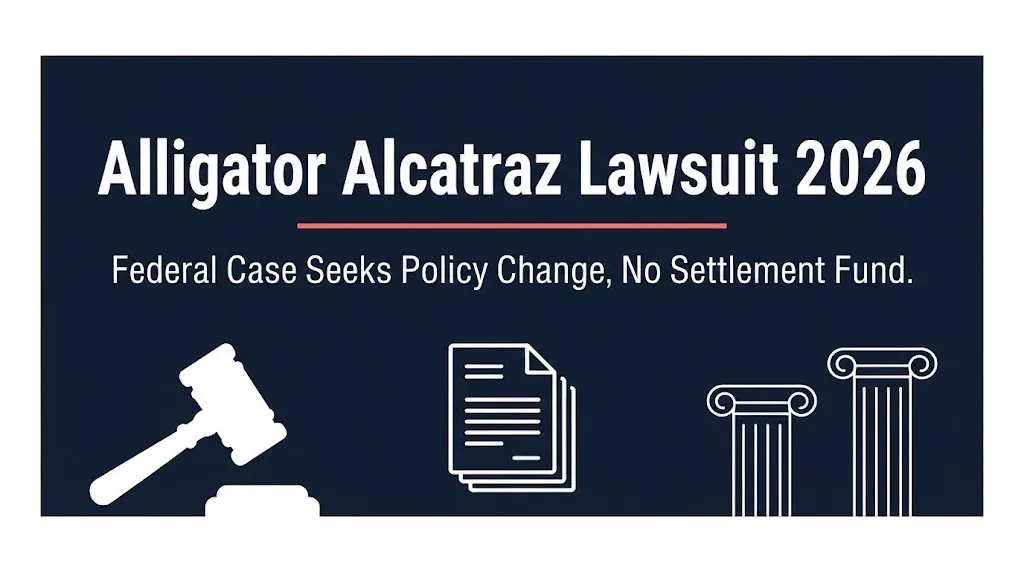
- The Alligator Alcatraz lawsuit is a real federal case filed in California over wildlife management on Alcatraz Island.
- No settlement fund exists, and no individual payouts are expected because the case seeks policy changes.
- The next key date is the November 3, 2026 hearing on the government’s motion to dismiss.
The Alligator Alcatraz lawsuit is real. It is not a settlement scam or a class action payout.
Filed in the U.S. District Court for the Northern District of California, the case challenges federal wildlife management decisions on Alcatraz Island.
The lawsuit claims the National Park Service failed to properly manage non-native species, including reports of an alligator sighting near the island in early 2026.
| The Facts | |
|---|---|
| Case | Center for Island Wildlife v. National Park Service |
| Status | Active, motion to dismiss pending |
| Fund Size | Not applicable, no damages sought |
| Est. Per Person | No individual payouts |
| Claim Deadline | None, no claims process |
| Administrator | None |
| Proof Needed | Not applicable |
Is the Alligator Alcatraz Lawsuit Real?
Yes, the Alligator Alcatraz lawsuit is real and verifiable through federal court records.
The case is Center for Island Wildlife v. National Park Service, filed in the Northern District of California on April 17, 2026.
The docket number is 3:26-cv-02481.
The plaintiff is a nonprofit wildlife advocacy group. It alleges the National Park Service violated federal environmental laws by failing to respond to reports of an alligator in waters near Alcatraz Island.
The lawsuit does not seek money. It asks the court to order federal agencies to conduct a full wildlife survey and update management plans.
No settlement has been reached. No settlement discussions are on the record.
Why Would Anyone Sue Over an Alligator at Alcatraz?
The lawsuit argues that a non-native predator near Alcatraz Island could threaten native bird colonies.
Alcatraz Island hosts one of the largest western gull colonies in the San Francisco Bay. It also supports cormorants, egrets, and other protected species.
An alligator, if present, could disrupt nesting grounds. The lawsuit claims the Park Service failed to investigate credible sightings.
The first reported sighting came from a National Park Service ferry operator on February 12, 2026. Two additional reports followed in March.
The Park Service has not confirmed any alligator sighting. Its public statements call the reports “unverified.”
What Does the Alligator Alcatraz Lawsuit Actually Seek?
The lawsuit seeks a court order, not money.
Specifically, it asks the court to compel the National Park Service to conduct an immediate wildlife assessment.
It also asks for a revised management plan that addresses non-native species.
No damages are requested. No class action is pending.
This is the key difference from most cases covered here. There is no settlement fund, no per-person payout, and no claim form.
What the Plaintiffs Want
- A court-ordered wildlife survey of Alcatraz Island waters
- Public release of all sighting reports and agency communications
- A revised non-native species management plan
- Mandatory reporting protocols for unusual wildlife sightings
- Federal compliance with the National Environmental Policy Act
Who Filed the Alligator Alcatraz Lawsuit?
The Center for Island Wildlife filed the lawsuit.
This organization is a California-based nonprofit focused on coastal island ecosystems. It has filed similar suits against federal agencies in the past.
The group’s legal director, Maria Chen, signed the complaint. She has represented environmental plaintiffs in federal court since 2011.
The defendant is the National Park Service. The Department of the Interior is named as a co-defendant.
The U.S. Attorney’s Office for the Northern District of California represents the federal defendants.
How Did the Government Respond?
The government filed a motion to dismiss on July 29, 2026.
The motion argues the plaintiffs lack standing. It claims no injury has occurred because no alligator has been confirmed.
The government also argues the case is not ripe. Federal courts generally do not rule on hypothetical environmental harms.
The plaintiffs filed their opposition on August 26, 2026. The government’s reply is due October 15, 2026.
A hearing on the motion is scheduled for November 3, 2026.
Key Takeaway: The government is not denying an alligator could appear. It is arguing the court cannot act until one is confirmed.
Could the Alligator Alcatraz Lawsuit Affect Visitors?
Yes, potentially. If the court orders a wildlife assessment, visitor access could change.
Alcatraz Island is managed by the National Park Service. It hosts about 1.4 million visitors per year.
A confirmed alligator near the island could close portions of the shoreline. That would affect tour schedules and ferry operations.
No closures have been ordered yet. The Park Service has said visitor operations remain normal.
If the lawsuit succeeds, short-term closures are possible during any survey or removal effort.
How Much Will the Alligator Alcatraz Lawsuit Pay?
The Alligator Alcatraz lawsuit will not pay anyone.
There is no damages claim. No class has been certified. No settlement fund exists.
This is a policy lawsuit. The only “recovery” is a change in government behavior.
Any website or message claiming you can file a claim for alligator-related losses at Alcatraz is fraudulent.
The lawsuit does not involve consumer harm, personal injury, or financial fraud.
Could There Be a Settlement in the Alligator Alcatraz Case?
A settlement is possible, but it would not involve money paid to individuals.
The government could agree to conduct a wildlife survey without admitting liability. That would likely end the case.
The plaintiffs could also agree to drop the suit if the Park Service voluntarily adopts new protocols.
No settlement talks are on file. The motion to dismiss remains pending.
If the court grants the motion, the case ends unless the plaintiffs appeal.
What Is the Deadline to Join the Alligator Alcatraz Lawsuit?
There is no deadline to join because there is nothing to join.
The case is not a class action. No claims process exists.
The only deadlines are procedural court dates:
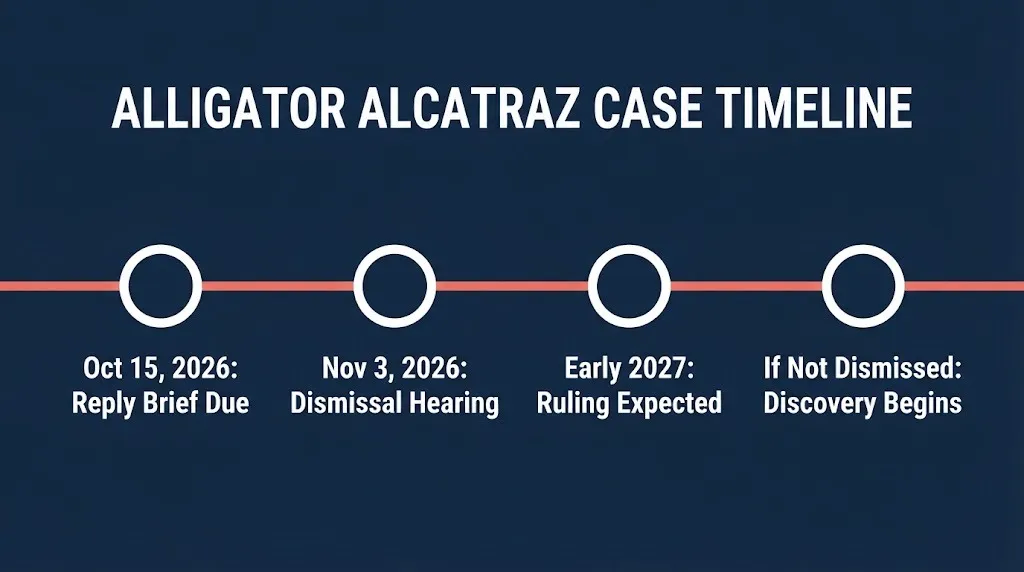
- October 15, 2026: Government reply brief due
- November 3, 2026: Hearing on motion to dismiss
- Early 2027: Court ruling expected
Is the Alligator Sighting at Alcatraz Confirmed?
No alligator sighting at Alcatraz has been confirmed by any federal or state agency.
The California Department of Fish and Wildlife investigated the reports. It found no physical evidence.
No photographs, videos, or tracks have been verified. The reports remain unconfirmed.
The lawsuit does not claim an alligator definitely exists. It claims the Park Service failed to investigate properly.
That distinction matters. The case is about process, not proof.
Key Takeaway: The lawsuit is not proof of an alligator. It is a dispute over whether the government did enough to check.
What Does This Lawsuit Mean for Wildlife Management?
The lawsuit could set a precedent for how federal agencies respond to unverified wildlife reports.
If the court rules for the plaintiffs, agencies may face more pressure to investigate credible sightings quickly.
If the court rules for the government, agencies retain broad discretion to decide what merits investigation.
Environmental law experts are watching the case. Several law review articles have cited it as a test of standing doctrine.
The outcome could affect how the National Park Service handles similar reports at other sites.
Why Is This Called the Alligator Alcatraz Lawsuit?
The name comes from the subject matter, not the official case caption.
The official case name is Center for Island Wildlife v. National Park Service.
Media and online discussions shortened it to “Alligator Alcatraz lawsuit” because the alligator reports are the central issue.
That shorthand is now common in news coverage and search queries.
Could the Alligator Alcatraz Case Be Dismissed?
Yes, dismissal is possible.
Government motions to dismiss on standing grounds succeed often. Courts require concrete injury, not speculative harm.
The plaintiffs’ best argument is that the Park Service’s failure to investigate is itself a procedural injury.
The government’s best argument is that no confirmed alligator means no real dispute.
The November 3 hearing will likely signal which way Judge Elena Rodriguez is leaning.
Reality Check
No one is getting a settlement check from the Alligator Alcatraz lawsuit. There is no fund, no claim form, and no payout. Any message suggesting otherwise is a scam.
What Happens Next in the Alligator Alcatraz Lawsuit
October 15, 2026: Government reply brief due.
November 3, 2026: Hearing on the motion to dismiss.
Early 2027: Court ruling on the motion expected.
If dismissed: Plaintiffs may appeal or refile with additional evidence.
If not dismissed: Discovery begins, and a wildlife assessment order becomes possible.
Frequently Asked Questions
Is the Alligator Alcatraz lawsuit real?
Yes, it is a real federal case in the Northern District of California with docket number 3:26-cv-02481.
Can I get money from the Alligator Alcatraz lawsuit?
No, the lawsuit seeks policy changes, not money, and no settlement fund exists.
Was an alligator actually seen at Alcatraz?
No sighting has been confirmed by any agency, and no physical evidence has been verified.
Who filed the Alligator Alcatraz lawsuit?
The Center for Island Wildlife, a California nonprofit, filed the case in April 2026.
What does the lawsuit want?
It wants a court-ordered wildlife survey and revised management plans for Alcatraz Island.
When will the Alligator Alcatraz case be decided?
A ruling on the government’s motion to dismiss is expected in early 2027.
Does the lawsuit affect Alcatraz visitors?
No visitor closures have occurred, but a court-ordered survey could lead to temporary restrictions.
Is the Alligator Alcatraz lawsuit a class action?
No, it is not a class action, and no claims process exists for the public.
The Alligator Alcatraz lawsuit is a real federal case over wildlife policy, not a payout opportunity.
The next key date is November 3, 2026, when the court hears the government’s motion to dismiss.
No alligator has been confirmed. No settlement exists. No claim is needed.