Why Is My Car Accident Settlement Taking So Long in 2026: Verified Reasons and Timelines
Quick Answer
- Is it normal? Yes. Most car accident settlements take months, not weeks, and delays are standard.
- How much longer? Minor cases settle in 1-3 months; serious injury cases can take 1-2 years or longer.
- Key deadline? Most states give you 2 years to file a lawsuit, but waiting can hurt your case.
The average car accident settlement takes anywhere from a few weeks to more than a year, depending on injury severity, liability disputes, and how aggressively the insurance company handles your claim. The single biggest reason for delay is that your attorney needs to wait until you reach maximum medical improvement (MMI), the point where your injuries have healed as much as they are going to. Settling before that point means you might accept less than your case is worth.
If you are sitting at home with bills piling up and wondering why the check has not arrived, you are not alone. Insurance companies know that financial pressure makes people accept low offers. That is not an accident. It is a strategy. The system is designed to test your patience, and the insurer has every financial reason to move slowly.
This article breaks down the verified reasons settlements take so long, what timelines you can realistically expect, and what you can do to keep your case moving. One fact that surprises most people: a survey found that claimants with attorney representation received an average of $77,600, compared to just $17,600 for those without a lawyer .
The Facts
| Factor | Typical Range |
|---|---|
| Case Type | Personal injury, auto accident claim |
| Status | Timeline varies by severity and liability |
| Fund Size | Not applicable (individual claims, not class settlement) |
| Est. Per Person | $10,000 to $5,000,000+ depending on injury severity |
| Claim Deadline | 2 years from accident date in most states |
| Administrator | Not applicable |
| Proof Needed | Police report, medical records, bills, wage loss documentation |
Why is my car accident settlement taking so long?
Your car accident settlement is taking so long primarily because your medical treatment has to stabilize before a final number can be calculated. Settling before you reach maximum medical improvement means locking in a value before anyone knows the full extent of your injuries .
This delay actually works in your favor. If you settle for $20,000 and then discover six months later that you need spinal surgery, you cannot go back and ask for more. The release you sign is permanent. Waiting until your medical picture is clear protects the actual value of your claim .
Evidence gathering adds more time. Your attorney needs police reports, medical records, witness statements, and sometimes accident reconstruction analysis. Some facilities take weeks to respond to records requests. Cutting corners on evidence rarely helps the victim .
Insurance companies also have incentives to slow things down. A drawn-out process creates pressure on people facing mounting bills. Some people accept lower offers simply because they are exhausted. That outcome benefits the insurer, not you .
How long does a car accident settlement usually take?
Most car accident settlements fall into one of three timelines: weeks to months for minor injuries, several months for moderate injuries, and a year or more for serious or disputed cases .
Here is a realistic breakdown:
| Case Type | Typical Timeline |
|---|---|
| Minor soft tissue injuries, clear liability | 1 to 3 months |
| Moderate injuries requiring ongoing treatment | 3 to 9 months |
| Serious injuries, surgery, or disputed fault | 12 months to 2+ years |
| Cases that go to trial | 2 years or longer |
A case with minor injuries and no dispute over fault can settle within a couple of months. But if your injuries are serious, if liability is contested, or if multiple parties are involved, expect a longer timeline .
There is no universal timeline. Every case is unique, and the amount of time it takes is unique too. Patience is difficult, but it is part of the process .
Key Takeaway: The severity of your injuries and whether fault is disputed are the two biggest factors determining how long your settlement takes.
What is maximum medical improvement and why does it matter?
Maximum medical improvement (MMI) is the point where your injuries have healed as much as they are going to, and doctors can predict your long-term prognosis. Waiting for MMI is the single biggest reason car accident settlements take months instead of weeks .
Before MMI, nobody knows if you will need more surgery, if chronic pain will persist, or if you will be able to return to work. Settling before that point means guessing at your future medical costs and lost earning capacity. Guessing usually costs you money.
If you hurt your back in an accident, you need to see how your treatment progresses. You need to know if the pain becomes chronic. You need to understand whether you can return to your job. That takes time, sometimes many months .
The insurance company knows this too. They may push for a quick settlement before your condition stabilizes, hoping you will take less than your case is worth. Do not fall for it .
Why do insurance companies delay car accident settlements?
Insurance companies delay settlements because slow payments save them money. The longer you wait for a check, the more pressure you feel to accept a low offer just to get something .
Common delay tactics include:
- Requesting excessive documentation repeatedly. They claim they need more records, then more, then more again .
- Claiming they need more time to investigate. They dispute liability long after the facts are clear .
- Making a low initial offer. They test whether you will accept less than your case is worth .
- Being generally unresponsive. They take weeks to return calls or emails, hoping you will give up .
These are not accidents. They are strategies. Insurers are for-profit businesses. Their goal is to pay as little as possible, as slowly as they can get away with .
The good news is that delay tactics often backfire when you have an attorney. Insurance companies adjust their approach based on the firm involved. Claims handled by trial-ready firms are often taken more seriously .
Reality Check: No legitimate insurance company texts you a settlement offer out of the blue. If someone contacts you demanding payment to “expedite” your settlement or asking for your bank information upfront, it is a scam. Real settlement payments come after a signed release, through official channels.
What factors make a car accident settlement take longer?
The factors that most commonly extend car accident settlement timelines are injury severity, disputed liability, multiple parties, and the need to file a lawsuit .
Severity of injuries is the biggest factor. Minor injuries resolve quickly. Serious injuries involving surgery, rehabilitation, or permanent impairment take much longer to reach a stable point for valuation .
Disputed liability adds significant time. If the other driver claims you were partly at fault, or if the accident facts are unclear, the insurer will investigate longer. Comparative fault rules can reduce your recovery if you share blame .
Multiple parties complicate everything. A pile-up crash with four vehicles and four insurance companies takes far longer to sort out than a simple two-car accident. Each insurer wants to minimize its share .
Filing a lawsuit extends the timeline further. Discovery, depositions, motions, and court calendars add months or years. Most cases still settle before trial, but the pressure of a filed case sometimes produces better offers .
Medical liens can also delay payment after settlement. If Medicare, Medicaid, or a hospital has a lien on your settlement, the check may be made payable to multiple parties. Resolving those interests takes time .
What can you do to speed up your car accident settlement?
You can speed up your car accident settlement by attending all medical appointments, following your treatment plan consistently, and responding promptly to your attorney’s requests .
Here are specific steps within your control:
- Do not skip medical appointments. The faster you reach MMI, the sooner your case can be valued .
- Keep copies of every medical bill and record. Missing documentation creates delays .
- Write down details of the accident while your memory is fresh. This helps if liability is disputed .
- Respond quickly to your attorney. Delays in communication slow the case .
- Avoid posting about your accident on social media. Insurers check, and anything you say can be used against you .
- Do not accept a quick lowball offer. Settling early for less than your case is worth is not “speeding things up,” it is losing money .
Hiring an attorney can also speed things up. Insurance companies may be less likely to play games when they know you have representation willing to go to trial .
How long does it take to get the check after settlement?
After you and the insurance company agree to a settlement in writing, most states require payment within a specific timeframe, often 5 to 30 days. California requires payment within 30 days . Florida requires payment within 20 days, with a 12 percent interest penalty for late payment . New York requires payment within 5 business days .
In practice, most checks arrive within one to two weeks after settlement, though delays happen. The longest delays usually occur before settlement, not after .
If medical liens exist, the check may be delayed while those are resolved. The check might be made payable to you, your attorney, and the lienholder. Everyone has to sign off before the money moves .
What happens next in your car accident settlement?
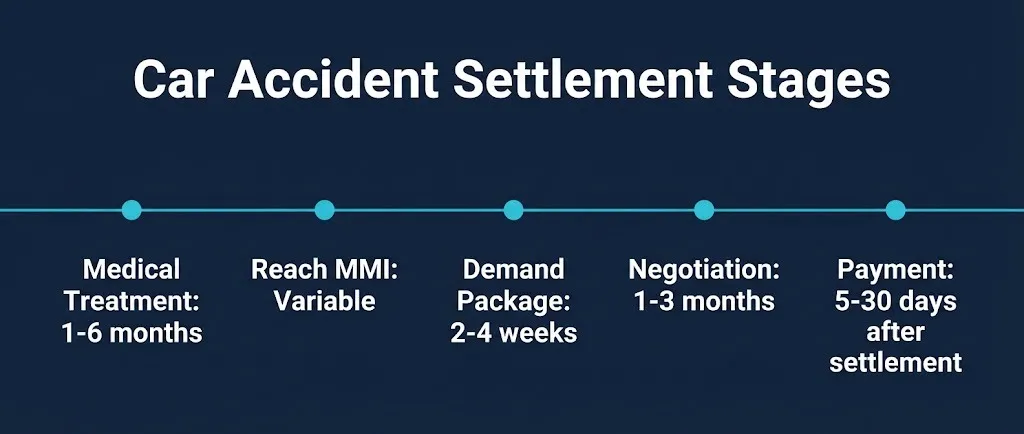
The next stage depends on where you are in the process. If you are still treating, the next step is reaching MMI. If you have reached MMI, your attorney will prepare a demand package. If negotiations stall, a lawsuit may be filed.
Here is the typical sequence:
- Medical treatment phase: You attend appointments and heal. Duration varies by injury.
- Demand package preparation: Your attorney compiles records, bills, and a settlement demand. Takes 2-4 weeks after MMI.
- Negotiation phase: Back-and-forth with the insurer. Typically 1-3 months .
- Lawsuit filing (if needed): Extends timeline by 6-18 months or more .
- Settlement and payment: Check issued within 5-30 days after agreement .
Frequently Asked Questions
Is it normal for a car accident settlement to take months?
Yes. Most car accident settlements take months, not weeks, especially when injuries require ongoing treatment or liability is disputed.
Can I speed up my car accident settlement?
You can help by attending all medical appointments, keeping records, and responding quickly to your attorney. But some delays are outside your control.
Why does the insurance company keep asking for more documents?
Repeated document requests are a common delay tactic. The insurer may be hoping you give up or accept a lower offer to end the process .
Should I accept a quick settlement offer?
No, not without understanding the full value of your claim. Quick offers are usually lower than your case is worth. You cannot reopen a settled case .
What if the other driver’s insurance denies liability?
If liability is disputed, your attorney may need to gather more evidence, hire experts, or file a lawsuit to force resolution .
How long after settlement do I get my check?
Most states require payment within 5 to 30 days after settlement. In practice, checks often arrive within 1 to 2 weeks .
What should you do right now?
Keep attending your medical appointments and following your treatment plan. That is the single most important thing you can do to move your case forward. Reach maximum medical improvement as quickly as your body allows.
Gather every document related to your accident: police report, medical bills, repair estimates, pay stubs showing lost wages. The stronger your documentation, the faster your attorney can build your demand package.
The single most important fact to remember: settling before you reach maximum medical improvement can permanently limit your compensation. Patience now protects your payout later.