Is the H&R Block settlement real?
Quick Answer
- H&R Block’s $7 million FTC settlement is real and finalized (January 2025), but it is not a class action claim fund you can currently apply to.
- No per-person payout amount or public claim form exists as of September 2026; any figure you see elsewhere is an estimate, not a confirmed number.
- A separate H&R Block data-sharing lawsuit is now on appeal at the 9th Circuit (filed July 2026), with no settlement reached in that case either.
There is a lot of noise online right now calling this an “H&R Block settlement” with dollar estimates attached. Some of that noise is not backed by anything in the court record or the FTC’s own filings.
Here’s the direct answer: the H&R Block settlement most people are searching for is a federal regulatory settlement, not a consumer class action you can file a claim in today. The FTC finalized an order in January 2025 requiring H&R Block to pay $7 million and change how it markets “free” filing and handles product downgrades.
That $7 million did not go out through a public claims website the way a typical class action settlement does. Separately, tens of millions of H&R Block customers are named in ongoing private lawsuits over tax data allegedly shared with Meta and Google, and those cases have not settled.
This article breaks down exactly what has been confirmed by the FTC, the courts, and the company, and what is still speculation. One detail that surprises most readers: H&R Block did not admit any wrongdoing in the FTC settlement, even while paying the $7 million.
The Facts
| Category | Details |
|---|---|
| Case | FTC administrative matter, “In the Matter of H&R Block” (Docket No. 9427); separately, Rios v. HRB Digital LLC, No. 25-7199 (9th Cir.) |
| Status | FTC order finalized January 2025; data-sharing appeal pending as of July 2026 |
| Fund Size | $7 million (FTC redress fund, confirmed). Private lawsuit fund: not yet confirmed |
| Est. Per Person | Not yet determined |
| Claim Deadline | Not yet confirmed, no public claim form identified |
| Administrator | Not yet appointed for any consumer-facing claims process |
| Proof Needed | Not applicable yet, check official FTC and court sources before filing anything |
Is the H&R Block settlement real?
Yes. The FTC’s settlement with H&R Block is real, and it is a matter of public record.
The Federal Trade Commission announced a proposed settlement in November 2024 and finalized the order in January 2025. It requires H&R Block to pay $7 million for consumer redress and to overhaul its advertising and downgrade practices for the 2025 and 2026 tax seasons.
The Commission voted 5-0 to approve the final order. H&R Block did not admit or deny the underlying allegations.
Key Takeaway: The $7 million FTC settlement against H&R Block is confirmed and finalized, but it works differently from a typical class action you can join online.
Is H&R Block being sued right now?
Yes, separately from the FTC matter. H&R Block, along with its subsidiaries HRB Digital LLC and HRB Tax Group, is a defendant in multiple private class actions over alleged tax data sharing with Meta and Google.
One of those cases, Rios v. HRB Digital LLC, reached the 9th U.S. Circuit Court of Appeals as of July 2026. H&R Block is appealing a district court ruling that refused to force the case into arbitration, which would let it proceed in open court instead.
That appeal, case No. 25-7199, was still active as of the opening brief filed July 20, 2026. No trial date or settlement has been reported in that case.
Why is H&R Block being sued?
The lawsuits trace back to a July 2023 congressional report that found tax prep companies shared sensitive taxpayer data with Meta and Google.
Lawmakers said H&R Block, TaxAct, and TaxSlayer used tracking pixels that sent details like income, refund amounts, filing status, and dependent information to Meta. That data reportedly helped train Meta’s advertising algorithms.
Separately, the FTC’s own case focused on different conduct entirely: deceptive “free” filing ads and data deletion during product downgrades. These are two distinct legal problems that both fall under the “H&R Block lawsuit” umbrella people search for.
Think of it like a store getting fined twice in the same year, once for false advertising and once for a data breach. Different violations, same company, same news cycle.
What did H&R Block do wrong, according to the FTC?
The FTC accused H&R Block of three specific unfair or deceptive practices under Section 5 of the FTC Act.
First, H&R Block advertised “free” tax filing in ways that buried eligibility limits in fine print. Many customers who started a return believing it was free discovered mid-filing that they did not qualify.
Second, when customers tried to downgrade from a paid product back to a cheaper or free one, H&R Block deleted their previously entered tax information. That forced people to start their entire return over.
Third, downgrading required contacting live customer service, while upgrading to a paid product required no such step. The FTC called this an unfair barrier designed to keep people locked into paid tiers.
What happened in the H&R Block data-sharing lawsuit?
Multiple lawsuits allege H&R Block installed tracking pixels that sent taxpayer data to Meta and Google without adequate consent.
One high-profile case, Hunt v. Meta, Google, Alphabet, H&R Block, was filed in the Northern District of California in September 2023 and includes RICO and federal wiretapping claims. A separate case, the “TRI” lawsuit, was filed in the Eastern District of New York in July 2023 under case number 2:23-cv-05363.
Key legal theories used across these filings:
- Racketeer Influenced and Corrupt Organizations Act (RICO) violations
- Federal wiretapping law
- California Invasion of Privacy Act (CIPA)
- State consumer protection statutes
None of these private cases has reached a settlement as of September 2026. They remain in the class certification and pretrial stage, with the Rios appeal specifically fighting over whether the case can go to court at all or must go to arbitration.
Key Takeaway: The FTC settlement and the data-sharing lawsuits are two separate legal tracks, and only one of them (the FTC matter) has actually resolved with a payment.
How much is the H&R Block settlement worth?
The only confirmed dollar figure tied to any H&R Block settlement is $7 million, paid under the FTC’s finalized order.
That figure covers consumer redress connected specifically to the downgrade and “free filing” allegations, not the separate data-sharing lawsuits. No court-approved settlement fund exists yet for the Meta and Google data-sharing claims.
| Legal Matter | Confirmed Amount | Status |
|---|---|---|
| FTC settlement (downgrade/ads) | $7 million | Finalized, January 2025 |
| Data-sharing class actions (Meta/Google) | Not yet confirmed | Pending, on appeal as of July 2026 |
Some outlets have speculated the data-sharing case could eventually resemble the 2022 Intuit/TurboTax settlement, which totaled roughly $141 million. That comparison is not confirmed by any court filing and should be treated as speculation, not fact.
How much money could you get from H&R Block?
Not yet determined. No per-person payout figure has been publicly confirmed for either legal matter.
The FTC’s $7 million is a regulatory redress fund, and the agency typically distributes this kind of money directly to identified affected consumers rather than through a public claims website. There is no confirmed evidence of a general public claim process tied to this fund as of September 2026.
For the data-sharing lawsuits, no settlement exists yet, so there is no fund to divide and no per-person estimate that can honestly be given. Any number you see quoted online right now is a guess based on other companies’ past settlements, not this case.
Reality Check: If you receive a text, email, or call claiming you’re guaranteed money from “the H&R Block settlement” and asking for a fee or your bank details, that is not how legitimate settlement administration works. Filing a real claim is always free, and no legitimate administrator asks for payment upfront to release your money.
Who qualifies for the H&R Block lawsuit?
Eligibility depends entirely on which legal matter is being discussed, since there are two separate tracks.
For the FTC matter, affected consumers would generally be H&R Block online filing customers who tried to downgrade products and had their entered tax data deleted, or who were misled by “free” filing advertising. No public eligibility form has been released.
For the data-sharing lawsuits, potential class members are generally described as people who used H&R Block’s online tax filing products during the period tracking pixels were active, reportedly since around 2015 through at least 2023.
Possible eligibility factors reported across these cases:
- Used H&R Block online DIY tax software (not necessarily in-person filing)
- Attempted to downgrade from a paid tier to a cheaper or free one
- Had a Meta (Facebook/Instagram) or Google account during the same period
- Filed taxes with H&R Block between roughly 2015 and 2023
None of this is a confirmed legal eligibility standard yet, since no class has been certified in the data-sharing cases.
How do you file a claim against H&R Block?
As of September 2026, there is no live, confirmed public claim form tied to either the FTC settlement or the data-sharing lawsuits.
If a claims process opens later, it typically follows this pattern in FTC and class action matters:
- A settlement or distribution plan gets finalized or court-approved.
- A claims administrator (or the FTC directly) sets up an official claim portal.
- Eligible consumers receive notice by email, mail, or public notice.
- You submit proof of eligibility through the official channel only.
- The administrator reviews claims and calculates payouts.
- Checks or electronic payments go out after any deadline or appeal period closes.
Until an official notice appears, avoid any third-party website or “claim helper” service asking for personal information or a processing fee related to this case.
What proof do you need for an H&R Block claim?
Check the claim form once one is officially released, since no proof requirements have been confirmed yet.
Based on how similar FTC and class action settlements have worked, useful documentation to keep on hand includes:
- Confirmation emails or receipts from H&R Block online filing
- Screenshots showing a downgrade attempt and any data loss
- Tax years you filed with H&R Block’s online products
- Any billing statements showing upgrade or downgrade charges
Key Takeaway: No claim form, proof requirement, or deadline has been publicly confirmed for either H&R Block legal matter as of September 2026.
What is the latest H&R Block lawsuit update?
The most recent confirmed development is the appeal filed in Rios v. HRB Digital LLC at the 9th U.S. Circuit Court of Appeals.
H&R Block filed its opening brief on July 20, 2026, arguing the lower court wrongly refused to send the data-sharing case to arbitration. If H&R Block wins the appeal, the underlying case could be pushed out of court entirely and into private arbitration, which typically limits payouts and public visibility.
If the plaintiffs win the appeal, the case continues in federal court, moving closer to possible class certification and eventual settlement talks.
Is H&R Block still fighting the lawsuit in court?
Yes. H&R Block is actively contesting the data-sharing case, both on the arbitration question and on the underlying allegations.
The company has not conceded liability in either the FTC matter or the pending private litigation. In its FTC settlement, H&R Block explicitly did not admit wrongdoing while still agreeing to pay $7 million and change its practices.
Is my tax data safe with H&R Block now?
The FTC’s order requires changes that should reduce some of the specific problems named in its complaint, but it does not address the separate data-sharing allegations tied to Meta and Google.
By the 2026 filing season, H&R Block must stop deleting a customer’s previously entered tax information when they downgrade products. The company must also disclose either what percentage of filers qualify for free filing, or state plainly that most do not.
Whether third-party data sharing practices have fully changed is not something confirmed in the sources reviewed for this article. That question remains at the center of the ongoing appellate litigation.
What Happens Next
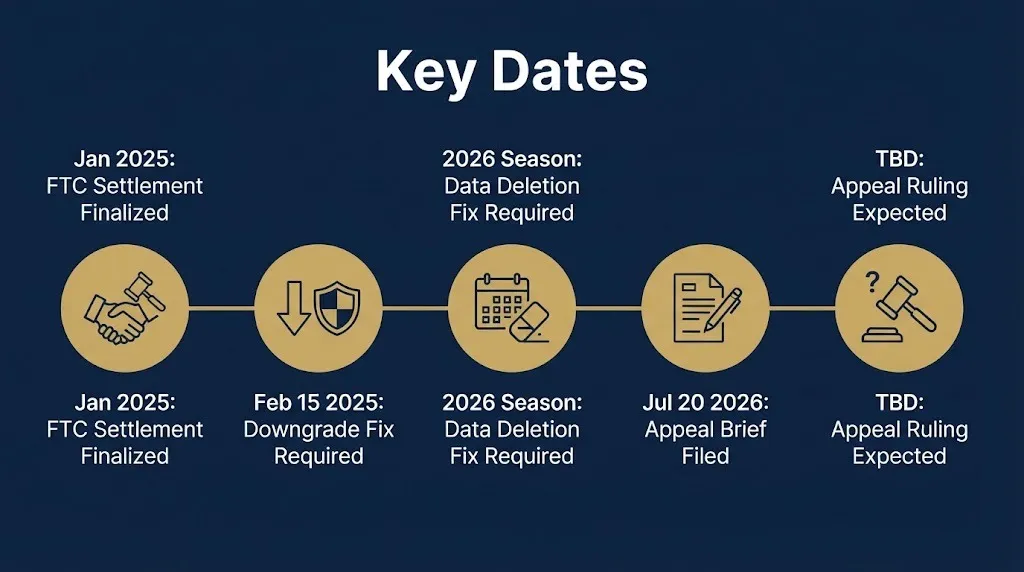
January 2025: FTC finalizes its $7 million settlement order against H&R Block.
By February 15, 2025: H&R Block required to allow self-service downgrades without contacting customer service.
By the 2026 tax filing season: H&R Block required to stop deleting customer data during downgrades.
July 20, 2026: H&R Block files its opening appellate brief in Rios v. HRB Digital LLC at the 9th Circuit.
Expected, no confirmed date: A 9th Circuit ruling on the arbitration question, which will determine whether the data-sharing case proceeds in open court.
Frequently Asked Questions
Is the H&R Block settlement legitimate?
Yes, the FTC’s $7 million settlement is a real, finalized federal order.
It is not, however, a class action you can currently file a claim in.
How much will I get from the H&R Block settlement?
Not yet determined for either the FTC matter or the pending data-sharing lawsuits.
Ignore any specific dollar figure you see online right now, since none has been officially confirmed.
What is the deadline to file an H&R Block claim?
No public claim deadline has been confirmed as of September 2026.
Check the official FTC settlement page and court dockets for updates before assuming a deadline exists.
Did H&R Block admit wrongdoing?
No. H&R Block agreed to pay $7 million and change its practices without admitting or denying the FTC’s allegations.
Is H&R Block being sued for sharing data with Facebook?
Yes, multiple pending lawsuits allege H&R Block shared tax data with Meta and Google through tracking pixels.
None of these cases has settled as of September 2026.
Can I still be part of the H&R Block lawsuit?
Class membership has not been finalized since no class has been certified in the data-sharing cases.
Watch official court notices rather than third-party sites for updates on your options.
Is there a claim form for H&R Block right now?
No official, confirmed public claim form exists as of this writing.
Be cautious of any site charging a fee to “help” you file, since legitimate claims processes are always free.
What should I do if I think I qualify?
Keep records of your H&R Block filing history and any downgrade issues you experienced.
Check the official FTC website and PACER court records periodically for updates rather than relying on unverified estimates.
There isn’t a live claim button to click on this one yet, and anyone telling you otherwise is guessing. Bookmark the official FTC settlement page and the appellate docket for Rios v. HRB Digital LLC, since the next real update will come from one of those two places.
Watch July 20, 2026, the date of H&R Block’s opening appellate brief, since the 9th Circuit’s eventual ruling will decide whether the data-sharing case moves toward a real settlement or gets pushed into arbitration.