What Is the Average Settlement for a Retaliation Lawsuit in 2026?
Quick Answer
- Is it legit? Yes. Retaliation is the most common EEOC charge, totaling 42,301 filings in FY 2024.
- How much? Typical settlements run $20,000 to $150,000. Severe cases with lost wages can exceed $500,000.
- Key deadline? EEOC charges generally must be filed within 180 to 300 days of the retaliation.
If you were fired, demoted, or punished after reporting misconduct at work, you’re probably asking one question: what is my case actually worth? The honest answer is that no single number fits every case. Retaliation settlements vary wildly because the harm varies wildly. A one-time written warning settles for far less than a career-ending termination with months of lost wages.
The data backs this up. Retaliation claims have been the most prevalent EEOC charge for seventeen consecutive years, totaling 42,301 filings in FY 2024 . The average EEOC retaliation settlement falls roughly between $40,000 and $100,000, with stronger cases reaching higher . Cases involving termination with strong documentation can settle for $75,000 to $150,000 or more .
This article breaks down the real payout tiers by retaliation severity, the damages that drive settlement values, the deadlines that can kill your claim, and the evidence that separates a $10,000 offer from a $250,000 one.
The Facts
| Case Type | Employment retaliation claims under Title VII, ADA, ADEA, and state law |
|---|---|
| Status | Ongoing. No universal settlement fund exists. Each claim is separate. |
| Fund Size | Not applicable. Individual settlements negotiated case by case. |
| Est. Per Person | $5,000 to $500,000+ depending on severity, wages lost, and evidence |
| Claim Deadline | 180 days (EEOC) or 300 days in deferral states. State laws vary. |
| Administrator | Not applicable. Claims handled through EEOC or private litigation. |
| Proof Needed | Protected activity, adverse action, causal connection, documentation |
What Is the Average Settlement for a Retaliation Lawsuit?
The average settlement for a retaliation lawsuit in 2026 falls between $40,000 and $100,000 for typical cases that resolve before trial . That range reflects the middle of the road: cases with documented harm, clear causation, and some economic loss.
But averages hide the real story. The actual settlement value depends on three things: how bad the retaliation was, how much money you lost, and how strong your evidence is. A retaliation claim involving a written warning that gets reversed might settle for $5,000. A claim involving a wrongful termination that destroyed your career can settle for $250,000 or more .
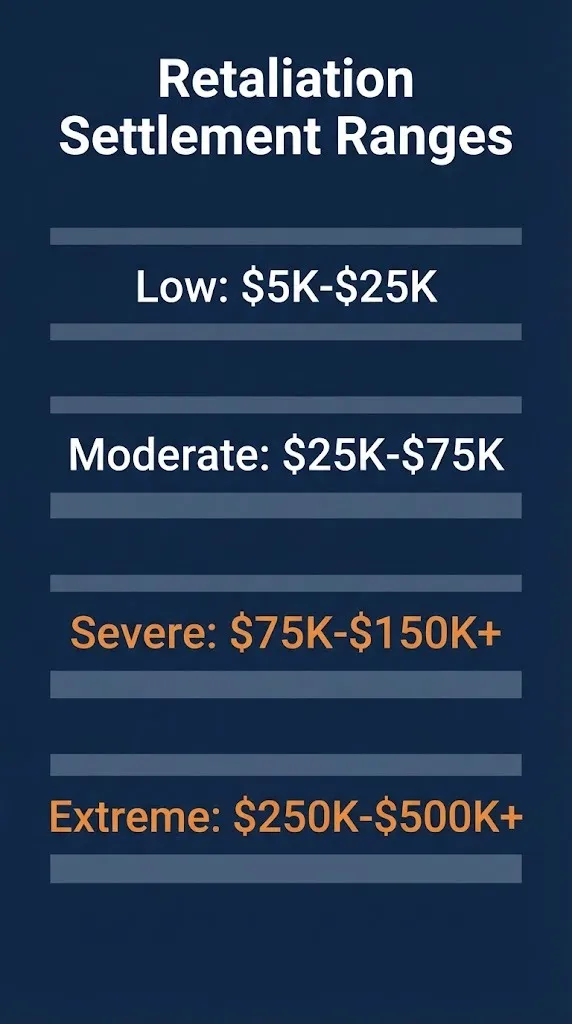
Here’s how the tiers break down based on severity:
| Retaliation Severity | Typical Settlement Range | Common Scenarios |
|---|---|---|
| Low | $5,000 to $25,000 | Minor discipline, reprimand, demotion without pay loss |
| Moderate | $25,000 to $75,000 | Suspension, denial of promotion, income loss |
| Severe | $75,000 to $150,000+ | Wrongful termination, blacklisting, career damage |
| Extreme | $250,000 to $500,000+ | Long-term unemployment, severe emotional harm, punitive conduct |
California cases tend to settle higher than the national average. Retaliation settlements in California typically range from $50,000 to $300,000, with severe cases reaching $500,000 to several million dollars .
Key Takeaway: The average retaliation settlement is roughly $40,000 to $100,000, but your case value depends on severity, documented losses, and evidence strength. Termination cases settle for far more than minor discipline.
How Much Can You Get for a Retaliation Lawsuit in 2026?
Your retaliation settlement equals your economic damages (back pay, front pay, lost benefits) plus non-economic damages (emotional distress, reputational harm), and in some cases punitive damages. The total depends on how much you lost and how badly the employer behaved.
Economic damages are the easiest to calculate. These include wages you lost from termination, benefits you didn’t receive, overtime you would have earned, and future income you’ll lose because of career damage. Courts calculate back pay from the date of termination to the date of verdict or settlement, minus any wages you earned elsewhere .
Non-economic damages cover the human cost. Emotional distress, anxiety, depression, humiliation, and reputational harm all count. In one federal case, a plaintiff received $10,000 for emotional and reputational injuries after being placed on a baseless Brady-Giglio list .
Punitive damages are available when the employer acted with malice or reckless indifference. These are not awarded as of right. They’re designed to punish and deter .
The employer’s size matters too. Larger companies settle for more because they have more to lose from a public trial and more resources to pay .
What Damages Can You Recover in a Retaliation Lawsuit?
You can recover back pay, front pay, emotional distress damages, lost benefits, attorneys’ fees, and in some cases punitive damages. The specific damages available depend on which statute your claim falls under.
Under Title VII, the ADA, and the ADEA, compensatory and punitive damages are capped based on employer size. The caps range from $50,000 for employers with 15 to 100 employees to $300,000 for employers with more than 500 employees. Back pay and front pay are separate from these caps and are not limited.
Here’s what you can typically recover:
- Back pay: Wages and benefits lost from the retaliation date to settlement or judgment
- Front pay: Future wages you’ll lose because of career damage
- Emotional distress: Compensation for stress, anxiety, depression, and humiliation
- Medical expenses: Therapy, counseling, and medical treatment caused by the retaliation
- Attorneys’ fees: Employers often pay your legal fees if you win
- Punitive damages: Available for malicious or reckless conduct
One court calculated a retaliation award using specific hourly wage differentials. The plaintiff lost $3.58 per hour from missed promotional opportunities over nearly three years, plus $94,950 in missed overtime, totaling over $114,000 in economic damages alone .
Reality Check: No one texts you settlement money first. Filing an EEOC charge is free. Third-party “claim helpers” charging fees to file retaliation claims are unnecessary. The EEOC does not charge for filing or investigating.
How Do You Prove a Retaliation Lawsuit?
To prove retaliation, you must show three things: you engaged in protected activity, your employer took adverse action against you, and there’s a causal connection between the two. The timing between your protected activity and the adverse action is often the most powerful evidence.
Protected activity includes reporting discrimination, filing a workers’ compensation claim, complaining about unpaid wages, participating in an investigation, or refusing to participate in illegal conduct . You don’t have to be right about the underlying complaint. You just have to reasonably believe the conduct was unlawful.
Adverse action means any action that would discourage a reasonable employee from complaining. Termination, demotion, suspension, pay cuts, and denial of promotion all qualify. Even a written warning can count if it affects your record.
Causal connection is where most cases are won or lost. Evidence that helps:
- Timing: Termination within days or weeks of a complaint carries significant weight
- Sudden shift in reviews: Performance ratings that drop immediately after you complain
- Inconsistent treatment: Discipline applied to you but not to colleagues in similar situations
- Communications: Emails or messages referencing your complaint
You don’t need a smoking gun. You need to show the retaliatory motive is the most plausible explanation. Employers often use performance issues or restructuring as cover. That’s called pretext, and the legal framework is designed to look past it .
What Is the Average EEOC Retaliation Settlement?
The average EEOC retaliation settlement is roughly $40,000, but settlements range from $10,000 to $100,000 in most cases . The EEOC resolves thousands of retaliation charges each year through mediation, conciliation, and litigation.
The EEOC’s process works differently than private lawsuits. You file a charge, the agency investigates, and if it finds reasonable cause, it attempts conciliation. If conciliation fails, the EEOC can sue on your behalf. You can also request a right-to-sue letter and file your own case.
EEOC settlement amounts tend to be lower than private litigation because the agency handles volume and prioritizes systemic cases. For individual claims, the commission often settles for $10,000 to $50,000 . Cases with strong documentation and clear economic loss settle higher.
A recent example shows how large EEOC settlements break down. Columbia University agreed to a $21 million settlement for antisemitism claims. After attorneys’ fees and administrative costs, roughly 30% to 40% goes to non-claimant expenses. If 2,000 claimants split the remaining fund, each would receive approximately $6,000 to $7,500 .
How Do You File a Retaliation Claim?
Filing a retaliation claim starts with an EEOC charge or a state agency complaint. You must file within 180 days of the retaliation, or 300 days if your state has a work-sharing agreement with the EEOC.
Here are the steps:
- Document the protected activity. Save emails, texts, and records showing you complained or reported misconduct.
- Document the adverse action. Keep termination letters, performance reviews, and pay records showing the retaliation.
- Note the timing. Write down the dates of your complaint and the adverse action. The gap matters.
- File an EEOC charge. You can file online, in person, or by mail. Filing is free.
- Wait for the investigation. The EEOC will investigate and may attempt conciliation.
- Request a right-to-sue letter. If the EEOC doesn’t resolve your case, you can request permission to sue.
- File your lawsuit. You have 90 days from receiving the right-to-sue letter to file in court.
- Prepare for mediation or trial. Most cases settle. But preparation for trial improves your settlement position .
What Is the Difference Between Retaliation and Wrongful Termination?
Retaliation and wrongful termination are related but distinct claims. Retaliation focuses on why your employer punished you after you engaged in protected activity. Wrongful termination focuses on whether your firing violated a law or public policy.
You can have both claims. If you were fired because you reported sexual harassment, that’s retaliation and possibly wrongful termination. If you were fired for refusing to break the law, that’s wrongful termination and possibly retaliation.
The practical difference matters for damages. Retaliation claims under Title VII allow punitive damages. Wrongful termination claims under state law may have different caps and procedures. Some cases layer multiple claims to maximize recovery.
California’s at-will employment rule doesn’t protect employers from retaliation claims. The Tameny doctrine holds that an employer cannot terminate an employee in a way that violates fundamental public policy .
What Happens Next in a Retaliation Case?
Immediately: Document everything. Save emails, texts, performance reviews, and termination letters. The paper trail drives case value.
Within 180 to 300 days: File your EEOC charge or state agency complaint. Missing this deadline bars your federal claim.
Within 6 to 12 months: The EEOC investigates. You may be offered mediation. Consider whether mediation serves your interests.
Within 90 days of right-to-sue: File your lawsuit in court if the EEOC doesn’t resolve your case.
Within 1 to 2 years: Most retaliation cases settle during discovery or mediation. Trials are rare but possible.
Frequently Asked Questions
What is the average settlement for a retaliation lawsuit?
The average settlement ranges from $40,000 to $100,000 for typical cases. Severe cases with wrongful termination can settle for $150,000 or more.
How much can I get for emotional distress in a retaliation case?
Emotional distress damages vary widely. One federal case awarded $10,000 for reputational and emotional harm . Cases with documented therapy or medical treatment can recover more.
Do I need a lawyer to file a retaliation claim?
You don’t need a lawyer, but unrepresented claimants often settle for less. An attorney can negotiate higher settlements and handle the EEOC process.
What is the deadline to file a retaliation lawsuit?
You have 180 days to file an EEOC charge, or 300 days in states with work-sharing agreements. After receiving a right-to-sue letter, you have 90 days to file a lawsuit.
Can I be fired for reporting my employer?
No. Firing an employee for reporting discrimination, harassment, or illegal conduct is retaliation and violates federal and state law. At-will employment does not protect retaliatory firings.
What evidence do I need for a retaliation claim?
You need evidence of protected activity (your complaint), adverse action (termination, demotion), and a causal link (timing, emails, inconsistent treatment). Documentation is critical.
How long does a retaliation case take?
EEOC investigations take 6 to 12 months. Private lawsuits take 1 to 2 years to resolve through settlement or trial.
Are retaliation settlements taxable?
Yes. Settlement payments for lost wages are typically taxed as ordinary income. Emotional distress damages may be tax-free if tied to physical injury or sickness.