What Is Debt Settlement? A 2026 Guide to How It Works, Costs, and Risks
Quick Answer
- Debt settlement is negotiating with creditors to pay less than you owe, often 30% to 60% of the balance .
- It severely damages your credit for up to seven years and creditors can still sue you during the process .
- Fees run 15% to 25% of enrolled debt, and forgiven amounts are taxed as income .
If you are drowning in credit card debt and minimum payments barely cover the interest, debt settlement sounds like a lifeline. The pitch is simple: stop paying, let the accounts go delinquent, then negotiate a lump-sum payoff for less than you owe. Sometimes it works. Often it leaves people worse off than when they started.
The Federal Trade Commission has warned about this industry for years. One 84-year-old woman sent over $2,000 to a settlement company believing it was paying her credit cards. The money went to the company instead, and her creditors kept calling .
This article explains how debt settlement actually works, what it really costs, who it is designed for, and the alternatives that most people should try first.
The Facts
Process | Negotiating with creditors to accept less than the full balance owed
Typical Settlement Range | 30% to 60% of original debt (varies by creditor and age of debt)
Typical Fees | 15% to 25% of enrolled debt
Credit Impact | Missed payments and “settled for less” marks stay on your report for 7 years
Tax Consequence | Forgiven debt over $600 is generally taxable income
Typical Timeline | 2 to 4 years to complete a program
Minimum Debt for Most Programs | $7,500 to $10,000 in unsecured debt
Best Candidates | People already severely delinquent who cannot repay in full and want to avoid bankruptcy
Is Debt Settlement a Scam or a Legitimate Option?
Debt settlement is a legitimate financial strategy, but the industry is full of bad actors. The concept itself is legal. You or a company you hire can negotiate with creditors to accept less than you owe .
The problem is the execution. The FTC has brought multiple enforcement actions against settlement companies for deceptive practices. The Consumer Financial Protection Bureau has warned that some companies collect money from you and treat it as their fees instead of using it to settle your debts .
The National Advertising Division opened monitoring cases against two national debt settlement companies in 2025. Both were making claims about speed and savings that their own data did not support. One advertised “50% before fees” savings when its typical results were far lower .
A legitimate debt settlement company should tell you:
- Exactly what fees it charges and when
- That creditors are not obligated to settle
- That your credit will suffer
- That any forgiven debt may be taxable
- That you can negotiate directly with creditors yourself
If a company guarantees results, pressures you to sign immediately, or charges fees before settling any debt, walk away .
How Much Does Debt Settlement Cost?
Debt settlement costs 15% to 25% of your enrolled debt, charged as a fee by the settlement company . On $20,000 of debt, that is $3,000 to $5,000 in fees alone.
Those fees come out of the money you save. If you settle a $10,000 debt for $5,000, you still owe the settlement company roughly $1,500 to $2,500 on that enrolled amount. Your net savings shrink considerably.
There is also a separate issue with the savings account. Many programs require you to deposit monthly payments into a dedicated account. That account may carry its own maintenance fees .
Then there is the tax bill. If a creditor forgives $8,000 of your debt, the IRS generally treats that as taxable income. You could owe federal income tax on money you never actually received .
Key Takeaway: Debt settlement fees are 15% to 25% of your enrolled debt, and the forgiven portion is usually taxable, so your actual savings are often much smaller than the advertised numbers suggest.
Who Should Consider Debt Settlement?
Debt settlement is designed for people in serious financial distress who cannot repay their debts in full. It is not for someone who is current on payments and just wants a lower interest rate .
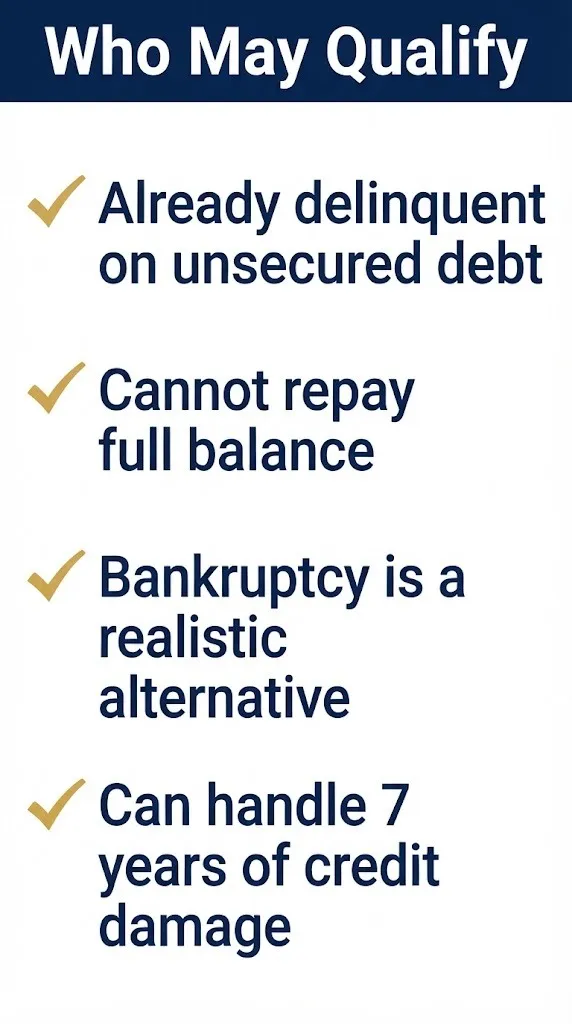
You may be a candidate if:
- You are already behind on payments or in danger of default
- You cannot afford to repay the full balance even with reduced interest
- Bankruptcy is a realistic possibility you want to avoid
- You can handle significant credit damage for several years
- You have or can build up lump-sum cash for settlements
Debt settlement is usually a bad idea if:
- You are current on payments and have decent credit
- Most of your debt is secured (mortgage, auto loan)
- Your income is stable and you can afford a repayment plan
- You need good credit soon for a home, car, or job
Most settlement companies require at least $7,500 to $10,000 in unsecured debt to enroll you . Below that threshold, the fees eat up too much of the potential savings.
What Are the Biggest Risks of Debt Settlement?
The biggest risk of debt settlement is that it damages your credit severely and does not guarantee results. You stop paying your creditors during the program, which means missed payments appear on your credit report. Each one can drop your score .
Even if a settlement succeeds, the account is marked “settled for less than the full balance.” That negative mark stays on your credit report for seven years from the date of first delinquency .
There is also the lawsuit risk. While you are saving up for a settlement, your creditors can send your accounts to collections. They can sue you. They can garnish your wages or seize money from your bank account .
The National Consumer Law Center has testified that debt settlement companies often encourage consumers to default, which increases the risk of lawsuits and collection activity. The companies charge fees based on the original debt amount, so they get paid the same whether they save you $1 or $1,000 .
Reality Check: No legitimate debt relief company can guarantee a specific settlement amount or timeline. Creditors are not required to negotiate. If someone promises to “eliminate” your debt or get you “debt free” in a specific number of months, that is a red flag .
How Does Debt Settlement Compare to Debt Consolidation?
Debt consolidation is usually better for people who can still afford their payments. Debt settlement is for people who cannot .
Consolidation means taking out a new loan or balance transfer card to pay off your existing debts at a lower interest rate. You still pay everything you owe, but you pay less interest and have one monthly payment .
Settlement means paying less than you owe, but wrecking your credit to do it.
Here is the difference:
| Feature | Debt Consolidation | Debt Settlement |
|---|---|---|
| Goal | Lower interest, simplify payments | Pay less than full balance |
| Credit Impact | Temporary dip, then improvement | Severe damage for 7 years |
| Fees | Loan origination or balance transfer fees | 15% to 25% of enrolled debt |
| Tax Impact | None | Forgiven debt is taxable |
| Best For | People who can still pay | People who cannot pay |
If you have good credit and can still make your minimum payments, consolidation is almost always the better choice. Settlement is a last resort before bankruptcy .
How Do You File for Debt Settlement Yourself?
You can negotiate with creditors directly without hiring a company. Here are the steps:
- List all your unsecured debts, balances, and interest rates.
- Save up a lump sum before contacting anyone.
- Call each creditor and ask for the hardship or settlement department.
- Offer a specific amount, typically 30% to 50% of the balance.
- Get any agreement in writing before paying.
- Never give a creditor direct access to your bank account.
- Keep records of every call, letter, and payment.
The CFPB notes that many lenders have standard policies about how much they will forgive based on how long the account has been delinquent. A settlement company often cannot get you a better deal than you can get yourself .
What Happens If a Creditor Sues You During Settlement?
If you stop paying and a creditor sues you, you must respond. Ignoring a lawsuit leads to a default judgment against you .
You typically have 20 to 30 days to file a written answer with the court. You must respond to the court, not just the creditor. If you do not, the creditor can ask for a default judgment .
A judgment allows the creditor to garnish your wages or levy your bank account, depending on your state’s laws. Some income, like Social Security and VA benefits, is protected from garnishment. But your regular paycheck may not be .
If you are sued, consider talking to a consumer law attorney or legal aid office. Many offer free consultations.
Frequently Asked Questions
Is debt settlement worth it?
Debt settlement may be worth it if you are severely delinquent, cannot repay in full, and want to avoid bankruptcy. It is usually not worth it if you can still afford payments or have decent credit you want to protect.
How much does debt settlement cost?
Debt settlement companies typically charge 15% to 25% of the total debt you enroll. On $20,000 of debt, that is $3,000 to $5,000 in fees alone, before any tax consequences.
Can I negotiate debt settlement myself?
Yes. You can contact creditors directly and negotiate a settlement without a company. Many creditors have standard policies, so you may get the same deal without paying a middleman.
Does debt settlement hurt your credit?
Yes, debt settlement can significantly damage your credit. Missed payments during the program and the “settled for less” notation stay on your report for seven years.
Do you pay taxes on debt settlement?
Generally, yes. Forgiven debt over $600 is treated as taxable income by the IRS. There is an insolvency exception if your total debts exceed your assets, but you may need professional help to claim it.
How long does debt settlement take?
Most programs take 2 to 4 years to complete, depending on how much you owe and how much you can save each month. There is no guaranteed timeline.
What is the difference between debt settlement and debt management?
Debt management is a repayment plan through a nonprofit credit counselor. You pay back what you owe, often with lower interest rates. Debt settlement is paying less than you owe, with more credit damage and tax consequences.
What should I do if a debt settlement company scams me?
Report it to the FTC at ReportFraud.ftc.gov. You can also contact your state attorney general and a nonprofit credit counseling agency for help.
What Happens Next
Ongoing 2026: CFPB and FTC continue enforcement against deceptive debt settlement practices.
Ongoing 2026: NAD continues monitoring debt relief advertising claims .
Before you enroll: Talk to a nonprofit credit counselor. Many offer free sessions.
Before you sign: Get every fee, timeline, and guarantee in writing.