How Long Does a Civil Lawsuit Take? 2026 Timeline and What to Expect
Quick Answer
- Most civil lawsuits take 18 months to 2 years to resolve, from filing to settlement or trial.
- Simple cases may settle in 6 months; complex cases can last 5 years or longer.
- The discovery phase is usually the longest part, often lasting 6 to 18 months.
If you’re considering a lawsuit or you’ve just been served with one, the first question is almost always about time. How long will this take? Will it drag on for years? Can I move it faster?
The honest answer is that it depends. Civil litigation in the United States is a marathon, not a sprint. Some cases settle in weeks. Others grind through discovery, motions, trial, and appeals for half a decade. The court system is slow by design, and the parties themselves often slow it down further.
This article breaks down each stage of a civil lawsuit, gives realistic timelines for common case types, and explains the factors that speed up or slow down your case. You’ll also learn what you can actually control and what you can’t.
The Facts
| Case Type | Typical Duration |
|---|---|
| Small claims court | Few months |
| Simple personal injury | 1 to 3 years |
| Contract dispute | 1 to 3 years |
| Complex commercial litigation | 3 to 5+ years |
| Class action | 5+ years |
| Cases that go to trial | Longer than settled cases |
| Appeals (added on) | 6 months to 2+ years |
How Long Does a Civil Lawsuit Take to Settle?
Most civil lawsuits settle within 18 months to 2 years from filing, according to attorney estimates . Cases where both parties are motivated to resolve quickly can settle in 6 months to a year.
Settlement can happen at any stage. Some cases resolve during the pre-filing investigation, before a complaint is even filed. Others settle during discovery, at mediation, or even during trial. Courts encourage settlement because it saves everyone time and money.
If the parties are open to negotiation, a case can settle much faster than one destined for trial . The willingness of both sides to compromise is the single biggest factor in how fast a case ends.
How Long Does a Civil Lawsuit Take to Go to Trial?
A civil lawsuit that goes all the way to trial typically takes 2 to 5 years from filing. Complex cases can take longer. Federal court data shows the median time from filing to disposition varies significantly by court and case type .
Trials themselves are usually short. Most civil trials last a few days to a few weeks, depending on the complexity of the case and the number of witnesses . But getting to trial is the slow part.
Court schedules are a major bottleneck. Busy jurisdictions often have trial dates booked 6 to 12 months in advance. A case ready for trial might still wait months for an available courtroom and judge .
How Long Does Discovery Take in a Civil Lawsuit?
Discovery is usually the longest phase of a civil lawsuit, often lasting 6 months to 2 years. This is when both sides exchange evidence, take depositions, and request documents .
In straightforward cases, discovery might wrap up in 6 months. In complex commercial litigation involving thousands of documents or multiple expert witnesses, discovery can stretch well over a year .
Modern e-discovery adds time. Courts now require review of emails, databases, and digital messages. Technology has sped up some review, but it’s also expanded the volume of material to process .
Disputes over what must be turned over can slow things down even more. Each discovery fight requires a motion, a hearing, and a ruling.
What Factors Slow Down a Civil Lawsuit?
Several factors can extend a civil lawsuit well beyond the typical timeline. Court backlog is one of the biggest. Many jurisdictions have heavy caseloads that push hearings and trial dates months into the future .
Complex evidence is another factor. Cases requiring review of financial records, technical data, or medical histories naturally take longer. More witnesses and experts mean more scheduling conflicts and longer proceedings.
Uncooperative parties can drag things out too. Delayed responses, repeated adjournment requests, or difficulty locating defendants all add time .
Multiple parties make everything slower. Each additional plaintiff or defendant means more lawyers, more schedules to coordinate, and more opportunities for delay.
Strategic delays are a real tactic. Sometimes one side intentionally slows the process to pressure the other into settling on unfavorable terms.
Key Takeaway
The length of your case depends most on complexity, court backlog, and whether the other side wants to settle or fight. You control your own responsiveness, not the pace of the system.
What Are the Stages of a Civil Lawsuit?
Every civil lawsuit follows a similar path, though the timing varies. Here’s the typical sequence:
| Stage | Typical Duration |
|---|---|
| Pre-filing investigation | Weeks to months |
| Filing and service | Days to weeks |
| Defendant’s response | 20 to 30 days |
| Discovery | 6 to 18 months |
| Pre-trial motions | Several months |
| Settlement negotiations | Ongoing |
| Trial | Days to weeks |
| Post-trial motions and appeal | Months to years |
The complaint starts the case. The defendant responds, usually with an answer or a motion to dismiss. Then discovery begins. Motions and settlement talks follow. Most cases settle before trial. If not, trial happens. Appeals can follow .
Can You Speed Up a Civil Lawsuit?
You can’t control the court’s schedule or the other side’s tactics, but you can avoid adding delays. Respond promptly to your attorney’s requests. Be organized with documents and evidence. Show up to hearings and depositions on time.
Being open to settlement discussions helps too. Cases that settle are always faster than cases that go to trial .
Alternative dispute resolution, like mediation or arbitration, can resolve disputes in months instead of years. These options are generally faster and cheaper than traditional litigation .
How Long Do Appeals Take in a Civil Lawsuit?
An appeal adds 6 months to 2 years or more to the total timeline. Appeals focus on legal errors, not re-hearing facts. The appellate court reviews the record and issues a decision .
If the appellate court sends the case back for further proceedings, that adds even more time. In some cases, the entire process can stretch 5 years or longer from the original filing.
Reality Check: No One Can Promise You an Exact Timeline
Any lawyer who guarantees your case will finish by a specific date is misleading you. Court schedules change. Opposing counsel may delay. New evidence can emerge. The best your attorney can do is give you a realistic estimate based on experience and current court conditions. If someone promises a fast, guaranteed result, be skeptical. The legal system doesn’t work that way.
What Happens Next
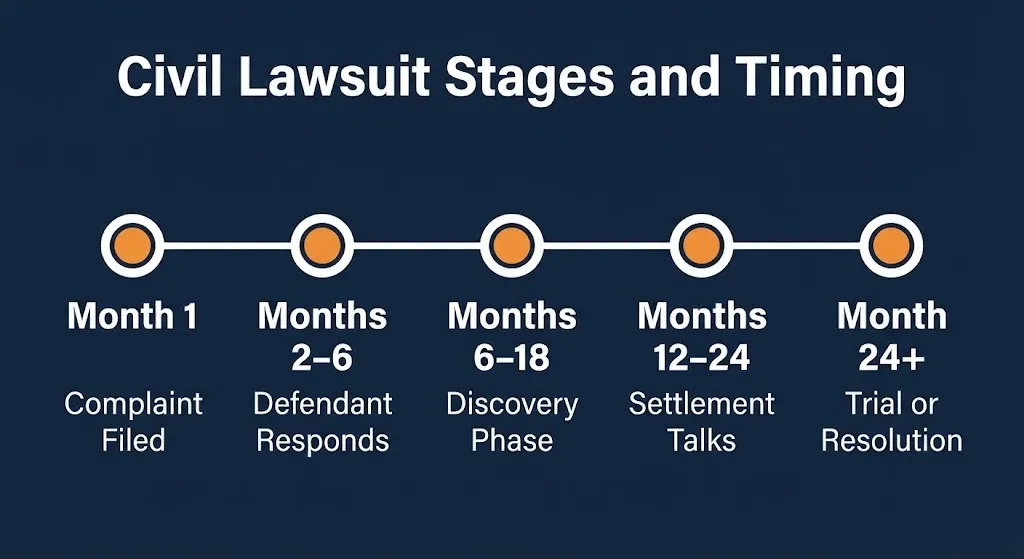
Months 1-3: Pre-filing investigation, complaint drafted and filed, defendant served.
Months 4-12: Defendant responds, discovery begins. Document exchanges and depositions start.
Months 12-18: Discovery continues. Settlement discussions often intensify during this period.
Months 18-24: Pre-trial motions filed. Mediation or settlement conference may be scheduled.
Month 24+: If no settlement, case proceeds to trial or continues toward a trial date.
Frequently Asked Questions
How long does a civil lawsuit take to settle?
Most civil lawsuits settle within 18 months to 2 years. Cases where both sides want to resolve quickly can settle in 6 months to a year.
How long does a civil lawsuit take to go to trial?
A case that goes to trial typically takes 2 to 5 years from filing. Complex cases can take longer.
What is the longest part of a civil lawsuit?
Discovery is usually the longest phase, often lasting 6 to 18 months. This is when both sides exchange evidence and take depositions.
Can I speed up my civil lawsuit?
You can’t control the court’s schedule, but you can avoid delays by responding promptly to requests, being organized, and staying open to settlement discussions.
How long do appeals take in a civil case?
An appeal adds 6 months to 2 years or more. If the case is sent back to the trial court, it can take even longer.
Do most civil lawsuits go to trial?
No. Most civil cases settle before trial, either through negotiation, mediation, or a settlement conference.
What is the statute of limitations for a civil lawsuit?
Statutes of limitations vary by case type and jurisdiction. Missing the deadline can bar you from suing. The “discovery rule” may extend deadlines if you didn’t know about the harm.
How much does a civil lawsuit cost?
Costs vary widely by case complexity, attorney fees, and court expenses. Many attorneys work on contingency for plaintiff cases, meaning they get paid only if you win.
Your Next Move
If you’re involved in a civil lawsuit, the most important thing is to consult an attorney early. Deadlines matter, and missing one can hurt your case. Gather your documents, write down your timeline of events, and be honest about what you can afford.
The single most important fact: most civil lawsuits take 18 months to 2 years. Plan for that timeline. Court dates get moved. Discovery takes time. But with the right preparation, you can keep your case moving forward.