Business Litigation Lawyer 2026: Costs, Process, and How to Choose the Right Attorney
Quick Answer
- Business litigation lawyers handle contract, partnership, and commercial disputes, and 2026 rates typically run $300 to $900 per hour.
- Total case costs depend on discovery scope, since e-discovery in complex commercial cases alone can cost $50,000 to $200,000.
- New York breach of contract claims carry a six-year statute of limitations, one of the longer windows in the country.
You’re staring down a contract dispute, a partner who won’t pay out, or a competitor who crossed a legal line. Now you’re pricing out a business litigation lawyer and the numbers online don’t agree with each other.
That’s because business litigation costs swing harder than almost any other legal category. Corporate litigation attorneys average $460 an hour nationally, the highest average rate of any legal specialty tracked in 2026, but your actual bill depends on where you’re located, how complex the dispute is, and how much discovery the other side forces.
This guide breaks down what business and corporate litigation lawyers actually cost in 2026, how commercial disputes move through court, which deadlines apply to common claim types, and what separates a firm worth hiring from one that’s just good at marketing. One detail worth knowing up front: e-discovery alone, just the process of exchanging digital records, can run $50,000 to $200,000 in a serious commercial case before trial even starts.
The Facts
| Category | Details |
|---|---|
| Average national hourly rate (corporate litigation) | $460, the highest average among tracked legal specialties in 2026 |
| Typical range | $300 to $900 per hour depending on market and experience |
| Typical retainer | $5,000 to $25,000 to open a commercial litigation matter |
| E-discovery cost in complex cases | $50,000 to $200,000 |
| Federal civil filing fee | $405 as of 2026 |
| NY breach of written contract deadline | 6 years under CPLR 213(2) |
| NY fraud claim deadline | 6 years from the fraud, or 2 years from discovery, whichever is later |
| Fee structures used | Hourly (most common), flat fee for defined tasks, contingency (less common in business disputes) |
Every figure above traces to attorney fee disclosures, state bar cost surveys, and New York procedural law checked for this article. Where a number depends on your specific state or case type, that’s flagged directly in the relevant section below rather than estimated.
Is a Business Litigation Lawyer the Right Attorney for My Dispute?
A business litigation lawyer is the right choice when a commercial disagreement has moved past negotiation and toward a legal claim, whether that’s a breach of contract, a partnership dispute, or a business tort like fraud or unfair competition.
This is a different specialty from a general business or transactional attorney, who drafts contracts and structures deals but doesn’t typically appear in court. Litigation attorneys step in once a deal or relationship breaks down and one side needs to enforce rights or defend against a claim.
Common triggers for hiring a business litigation lawyer include:
- A customer, vendor, or partner who breached a written or verbal agreement
- A former employee or competitor accused of stealing trade secrets or clients
- A shareholder or partner dispute over control, profits, or buyout terms
- A supplier who delivered defective goods or failed to deliver at all
- Allegations of fraud, misrepresentation, or breach of fiduciary duty between business partners
- A landlord-tenant commercial lease dispute that escalated past mediation
Key Takeaway: If the dispute involves money, contracts, or business relationships and informal resolution has failed, you need litigation counsel, not just a business lawyer who reviews paperwork.
What Does a Business Litigation Attorney Actually Do?
A business litigation attorney investigates the dispute, files or defends the lawsuit, manages discovery, and represents your business through settlement negotiations or trial.
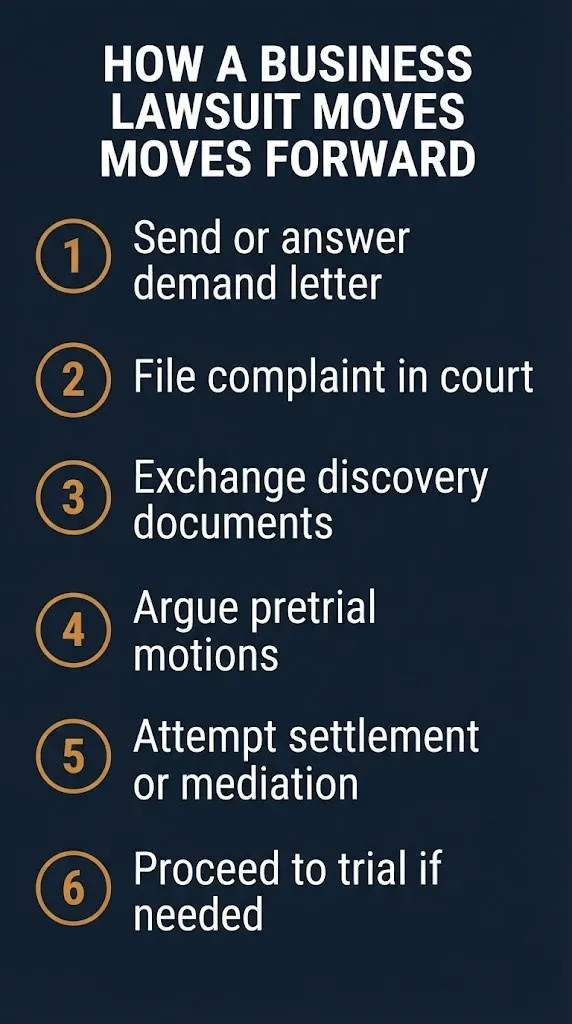
The work generally follows a predictable arc, though timing and intensity vary by case:
- Case evaluation, reviewing contracts, communications, and financial records
- Sending a demand letter or responding to one, often the last step before filing
- Filing the complaint or answer in state or federal court
- Exchanging discovery: documents, depositions, interrogatories
- Filing and arguing pretrial motions, including motions to dismiss or for summary judgment
- Attempting settlement or mediation, which resolves the large majority of commercial cases
- Litigating at trial if no settlement is reached
In commercial litigation, the discovery and pretrial motion phases are typically the most time-intensive stages of the process, and that’s usually where the bulk of legal fees accumulate. A straightforward contract review costs far less than multi-year commercial litigation involving competing experts and thousands of documents.
Think of it like a warranty dispute with a contractor who won’t fix defective work. A polite letter sometimes solves it. When that fails, you’re into inspections, expert opinions, and possibly court, and the cost climbs at every step.
How Much Does a Business Litigation Lawyer Cost in 2026?
A business litigation lawyer in 2026 typically costs $300 to $900 per hour, with corporate and commercial litigation specialists averaging $460 an hour nationally, the highest average of any tracked legal specialty this year.
Rate ranges shift heavily by market and attorney experience level.
| Experience / Market Level | Typical Hourly Rate (2026) |
|---|---|
| Newer attorney, smaller market | $150 to $350 |
| Mid-level attorney, standard market | $350 to $500 |
| Senior litigator, major metro (NYC, LA, SF, DC) | $500 to $900+ |
| National average, corporate litigation specialty | $460 |
Not yet determined: your total case cost, since it depends almost entirely on how much discovery the dispute generates and whether the other side settles early or fights to trial. No firm can price that accurately at intake.
A newer lawyer actively building a caseload might charge on the lower end around $350 an hour, while a seasoned litigator with a strong trial record can charge $1,000 an hour or more in a major market. Most commercial litigation attorneys require a retainer of $5,000 to $25,000 just to open a case, and that retainer is a deposit against future hourly work, not a flat fee. Once it’s exhausted, you replenish it.
Beyond attorney time, expect these separate cost categories:
| Cost Category | Typical Range |
|---|---|
| Federal court filing fee | $405 |
| State court filing fee | Varies by state and claim type |
| E-discovery in complex cases | $50,000 to $200,000 |
| Expert witness fees | Case-dependent, often $10,000+ per expert |
| Deposition transcripts | $1,000 to $5,000+ per deposition |
Fee structure matters as much as the rate. Hourly billing is the standard for business litigation, though some firms offer flat fees for narrowly defined tasks like drafting a single motion, and contingency arrangements exist but are less common here than in personal injury work. When contingency is offered in a business dispute, attorneys often take 30 to 40 percent of any financial recovery.
Key Takeaway: Budget for the retainer as a starting deposit, not the total cost, and ask your attorney for a written estimate covering discovery specifically, since that’s where most business litigation budgets blow past initial expectations.
How Long Does Business Litigation Take?
Business litigation typically takes one to three years to resolve from filing to trial or settlement, though straightforward contract disputes can settle in months while complex multi-party commercial cases can run longer.
Duration depends on court backlog, how contentious discovery becomes, and whether either side files dispositive motions that get appealed.
| Case Type | Typical Timeline |
|---|---|
| Simple contract dispute, early settlement | 3 to 9 months |
| Standard commercial litigation to trial | 1 to 2 years |
| Complex, multi-party commercial dispute | 2 to 4+ years |
| Appeal after trial verdict | Add 1 to 2 years |
The large majority of commercial cases settle before trial, often during or right after the discovery phase once both sides see the strength of the other’s evidence. Cases that do reach trial in a busy commercial court, such as the New York Supreme Court’s Commercial Division, can face scheduling delays that add months to the timeline regardless of how prepared either side is.
Compare it to a delayed tax refund tied up in review. The paperwork alone doesn’t take long, but once it’s flagged for deeper review, the wait stretches out unpredictably.
What Is the Deadline to File a Business or Contract Lawsuit?
The deadline to file a business or contract lawsuit is set by your state’s statute of limitations, and it varies by claim type, with breach of written contract claims commonly allowing several years.
This deadline question comes up constantly because business disputes often surface years after the underlying deal, once a relationship sours or a payment stops.
In New York specifically, several key deadlines apply:
| Claim Type (New York) | Statute of Limitations |
|---|---|
| Breach of written contract | 6 years (CPLR 213(2)) |
| Breach of oral contract | 6 years to enforce terms, 3 years for quasi-contract money damages |
| Fraud | 6 years from the fraud, or 2 years from discovery, whichever is later |
| Professional malpractice (non-medical) | 3 years (CPLR 214(6)) |
| Unjust enrichment / quantum meruit | 3 years |
New York’s statute of limitations to recover on a breach of contract is six years, and that clock generally starts running at the moment of the breach, not when you happened to discover it, except in specific fraud scenarios. Contracts for the sale of goods can follow a different rule under the Uniform Commercial Code, so the exact trigger date depends on what kind of agreement is at issue.
Reality Check: No legitimate law firm will tell you a lawsuit deadline is negotiable or that a filing fee can be waived for a faster court date through a side payment. Filing a claim is always a fixed-cost court process, and any “guaranteed settlement” pitch before a complaint is even filed is a red flag, not a shortcut.
Deadlines for other states differ significantly, so this table applies specifically to New York. If your dispute is based elsewhere, confirm the applicable statute with local counsel before assuming you have years to act.
Key Takeaway: New York’s six-year window for written contract claims is generous compared to many states, but fraud and malpractice claims move on shorter, more urgent clocks.
How Do You Find a Business Litigation Lawyer Near You?
You find a business litigation lawyer near you by searching state bar referral directories, asking for referrals from a transactional attorney or accountant, and confirming the firm has specific experience in your type of commercial dispute before scheduling a consultation.
Practical steps that actually narrow the search:
- Search your state bar association’s certified specialist directory for business or commercial litigation
- Ask any existing business attorney, accountant, or banker for a direct referral
- Check the firm’s track record in your specific dispute type, contract, partnership, fraud, or trade secrets
- Confirm the attorney is licensed and in good standing in the state where you’ll file
- Read case results or published outcomes, not just marketing copy
- Schedule consultations with at least two firms before committing
Local matters more in business litigation than people expect. An attorney who regularly appears before your local Commercial Division or business court understands the judge’s preferences, local motion practice, and settlement conference norms, which can meaningfully affect both cost and timeline.
What Should You Ask a Corporate Litigation Attorney Before Hiring?
You should ask a corporate litigation attorney about their fee structure, their experience with cases like yours, and a realistic budget range before signing an engagement agreement.
Specific questions worth asking at the first consultation:
- What is your hourly rate, and does it change based on the type of task?
- How often will I receive itemized billing statements?
- What is your estimated total cost range for a case like mine, through discovery and through trial?
- Have you handled this specific type of dispute (contract, partnership, trade secret, fraud) before?
- Who else at the firm will work on my case, and at what rate?
- What is your assessment of the strength of my claim or defense?
Transparent billing is a sign of a trustworthy firm, and any attorney unwilling to give a written fee agreement or a budget range before starting work is worth a second look. Ask upfront how often you’ll receive billing statements and what level of detail they include, since surprise invoices are one of the most common complaints in business litigation.
What Are the Most Common Types of Business Litigation Cases?
The most common types of business litigation cases are breach of contract disputes, partnership and shareholder disagreements, employment-related business claims, and business tort claims like fraud or unfair competition.
Breaking down the most frequent categories:
| Case Type | What It Typically Involves |
|---|---|
| Breach of contract | Failure to perform, pay, or deliver under a written or oral agreement |
| Partnership / shareholder disputes | Disagreements over control, profit distribution, or forced buyouts |
| Business torts | Fraud, misrepresentation, tortious interference, unfair competition |
| Trade secret / non-compete disputes | Former employees or partners misusing confidential business information |
| Landlord-tenant commercial disputes | Lease violations, unpaid rent, property condition disagreements |
| Vendor and supply chain disputes | Defective goods, late delivery, non-payment |
Breach of contract remains the single most common category by volume, largely because so much of business runs on written and unwritten agreements that eventually get tested when money is tight or a relationship deteriorates.
Should You Try Mediation or Arbitration Before Filing a Lawsuit?
You should consider mediation or arbitration before filing a lawsuit if your contract includes a dispute resolution clause requiring it, or if both sides are open to a faster, lower-cost path to resolution.
Alternative dispute resolution methods can provide faster, less expensive resolution than traditional court proceedings. Mediation uses a neutral third party to help negotiate a resolution, while arbitration produces a binding decision from an arbitrator instead of a judge.
Many commercial contracts already include mandatory arbitration clauses, and courts generally enforce them. New York strongly favors arbitration and enforces arbitration clauses under both state law and the Federal Arbitration Act, meaning a judge will typically compel arbitration even if one side later prefers going to court instead.
Before filing, check your contract for:
- A mandatory arbitration clause naming a specific arbitration provider
- A mediation requirement as a precondition to filing suit
- A forum selection clause dictating which state’s courts or laws apply
- A limitation of liability clause capping potential damages
- An attorney’s fees clause, since many states follow the rule that each side pays its own fees absent a contract provision saying otherwise
New York follows the American Rule, meaning each party generally pays their own attorney’s fees regardless of who wins, unless the contract specifically states otherwise. That single clause can significantly change the economics of whether litigation makes financial sense.
What Happens Next
Before filing: Send or respond to a demand letter, and check your contract for mandatory arbitration or mediation clauses.
Filing stage: Complaint or answer gets filed in state or federal court, with the federal filing fee at $405 as of 2026.
Discovery phase (typically 6 to 18 months): Document exchange, depositions, and expert reports, the stage most likely to drive costs up sharply.
Pretrial motions: Either side may file motions to dismiss or for summary judgment, which can resolve the case or narrow the issues before trial.
Resolution: Most commercial cases settle during or after discovery; cases that proceed to trial typically resolve within one to four years of filing depending on complexity.
Frequently Asked Questions
How much does a business litigation lawyer cost per hour in 2026?
Corporate litigation attorneys average $460 per hour nationally in 2026, the highest average among tracked legal specialties.
Rates range from roughly $300 to $900 depending on experience and market.
Major metro markets like New York and Los Angeles sit at the higher end of that range.
What is the statute of limitations for breach of contract in New York?
New York gives six years to file a breach of written contract claim under CPLR 213(2).
Oral contract claims also generally allow six years to enforce terms, though quasi-contract money damages claims are limited to three years.
The clock typically starts at the date of the breach, not the date you discovered it.
Do business litigation lawyers work on contingency?
Contingency fee arrangements exist in business litigation but are less common than hourly billing.
When available, contingency fees in business disputes commonly run 30 to 40 percent of any recovery.
Most commercial litigators still prefer hourly billing because outcomes and timelines are harder to predict than in personal injury cases.
How long does a typical business lawsuit take to resolve?
Simple contract disputes can settle in three to nine months, while standard commercial litigation to trial often takes one to two years.
Complex, multi-party commercial cases can run two to four years or longer.
Most business cases settle before ever reaching trial.
Can I be forced into arbitration instead of court?
Yes, if your contract contains a valid arbitration clause, New York courts will generally enforce it and compel arbitration.
This applies even if one side later prefers to litigate in court instead.
Check your contract for an arbitration clause before assuming you can file a traditional lawsuit.
What’s the difference between a business litigation lawyer and a corporate lawyer?
A corporate or transactional lawyer drafts contracts, structures deals, and handles compliance work outside of court.
A business litigation lawyer represents your company once a dispute becomes an active legal claim.
Some firms offer both services, but litigation typically involves a different attorney or team within the firm.
Who pays attorney’s fees in a business lawsuit?
New York follows the American Rule, meaning each side generally pays its own attorney’s fees regardless of who wins.
This changes if your contract includes a specific attorney’s fees clause shifting costs to the losing party.
Review your contract’s fee provisions before assuming a win will cover your legal costs.
How much does e-discovery add to a commercial litigation case?
E-discovery in complex commercial cases can cost $50,000 to $200,000 on its own.
This covers collecting, reviewing, and producing electronic documents, emails, and financial records.
Ask your attorney early how they plan to manage discovery costs, since this is typically the largest expense driver in business litigation.
If you’re facing a business dispute with a real deadline attached, confirm your state’s specific statute of limitations before anything else. Get a written fee agreement and a discovery budget estimate before signing with any firm.
Six years is the standard New York window for written contract claims, but fraud and malpractice deadlines move faster, so don’t assume you have time you don’t.