SNAP Lawsuit 2026: 22 States Win Permanent Block on Federal Penalties, What It Means for Benefits
Quick Answer
- A 22-state coalition led by Oregon and New York won a permanent injunction against federal SNAP penalties and unlawful eligibility guidance .
- The ruling confirms states cannot be fined for missing a retroactive 120-day deadline that expired before the USDA issued guidance .
- Lawful permanent residents who were previously refugees or asylees do not face the standard five-year waiting period for SNAP benefits .
The SNAP lawsuit is a major multi-state legal victory that permanently blocks the federal government from punishing states for how they administered the Supplemental Nutrition Assistance Program. The case, led by Oregon and New York, was joined by 22 states and the District of Columbia .
If you rely on SNAP benefits or you’re a state official worried about federal fines, this ruling matters. It confirms two things. First, states cannot be penalized for missing a deadline that was imposed retroactively and before the federal government even explained the new rules. Second, certain immigrants who are lawful permanent residents remain eligible for food assistance without the standard five-year waiting period .
This article explains who brought the lawsuit, what the court decided, what it means for benefits, and what happens next.
The Facts
| Item | Detail |
|---|---|
| Case Name | State of Oregon, et al. v. United States Department of Agriculture, et al. |
| Court | U.S. District Court for the District of Oregon |
| Judge | Mustafa Kasubhai |
| Status | Summary judgment granted for plaintiffs, permanent injunction issued September 17, 2026 |
| Plaintiffs | 22 states and the District of Columbia, led by Oregon and New York |
| Key Ruling | USDA’s retroactive 120-day deadline and noncitizen eligibility guidance are unlawful |
| Impact | States cannot be fined; refugees and asylees who become LPRs remain eligible for SNAP |
Is the SNAP Lawsuit Real or a Scam?
The SNAP lawsuit is real and it’s already resolved. A federal judge issued a permanent injunction on September 17, 2026, siding with 22 states and the District of Columbia on every claim .
This isn’t a class action settlement where consumers file claims for money. It’s a government lawsuit brought by state attorneys general against the U.S. Department of Agriculture. The outcome affects state agencies and SNAP recipients, not individual payout claimants.
If you see texts or emails claiming you can file a claim for money from a “SNAP lawsuit settlement,” that’s a scam. There is no claims process for individuals in this case.
Key Takeaway: This is a government-versus-government case. The victory protects SNAP benefits and blocks state fines. No individual claim form exists.
What Did the SNAP Lawsuit Decide?
The court permanently blocked the Trump administration from enforcing two unlawful policies: a retroactive deadline that put states at risk of massive fines, and guidance that wrongly excluded certain immigrants from SNAP .
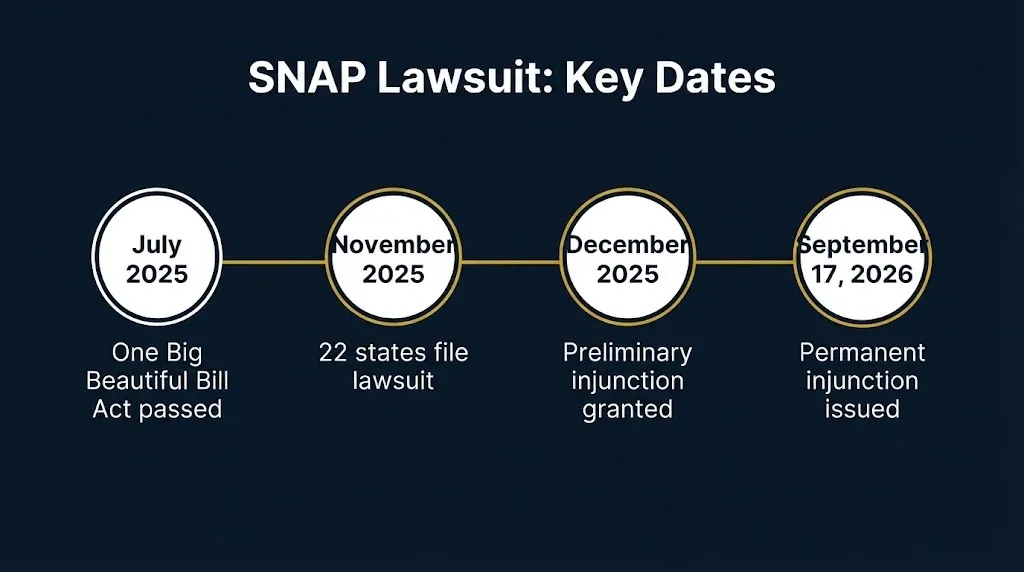
The Deadline Problem: Congress passed SNAP changes in July 2025 as part of the One Big Beautiful Bill Act. Federal rules give states 120 days to implement certain changes before errors count against them. The USDA said the clock started when the law took effect. But the agency didn’t release guidance until October 31, 2025, just one day before the 120-day period was set to end .
Judge Kasubhai called this an “impossible situation” and ruled the deadline unlawful under the Administrative Procedure Act .
The Eligibility Problem: The USDA’s guidance left refugees, asylees, and certain Afghan and Ukrainian parolees off lists of people eligible for SNAP after becoming lawful permanent residents. The court found these groups qualify for exemptions from the standard five-year waiting period .
Who Brought the SNAP Lawsuit Against the Trump Administration?
Oregon and New York co-led the coalition of 22 states and the District of Columbia that sued the Trump administration in November 2025 .
The participating states included California, Colorado, Connecticut, Delaware, Hawaii, Illinois, Maine, Maryland, Massachusetts, Michigan, Minnesota, Nevada, New Jersey, New Mexico, North Carolina, Rhode Island, Vermont, Washington, and Wisconsin .
The lawsuit was filed after the administration moved to cut off SNAP benefits for tens of thousands of lawful permanent residents and set a retroactive deadline that threatened states with hundreds of millions of dollars in penalties .
What Does the SNAP Lawsuit Ruling Mean for Immigrants?
The ruling confirms that lawful permanent residents who were previously refugees, asylees, or other humanitarian immigrants do not face the standard five-year waiting period for SNAP benefits .
The USDA’s guidance had excluded these groups from exemption lists, effectively treating them as subject to the five-year bar. The court found that interpretation contrary to federal law .
Who Benefits:
- Former refugees who became lawful permanent residents
- People granted asylum who later obtained LPR status
- Certain Afghan and Ukrainian parolees who adjust status
If you fall into these categories, you may qualify for SNAP without waiting five years. Check with your state SNAP agency to confirm your eligibility.
What Does the SNAP Lawsuit Ruling Mean for States?
States cannot be penalized under the unlawful retroactive deadline the administration tried to impose .
The financial stakes were enormous. North Carolina told the court that if its SNAP error rate stayed above 10%, the state could have to pay as much as $420 million a year toward the program by 2028. State officials said that could force North Carolina to end SNAP, which serves about 1.4 million people .
Maryland reported a 25% increase in calls from people affected by the new rules for noncitizens .
The permanent injunction means states can continue administering SNAP without fear of retroactive fines tied to a deadline that never made practical sense.
What Happens If Your State Was Not Part of the SNAP Lawsuit?
The ruling applies nationwide as a practical matter. The court’s interpretation of USDA’s statutory authority affects all states, not just the 22 that sued .
Other states that received SNAP waivers or faced similar deadlines now operate under the same legal framework. The court found USDA exceeded its authority and violated procedural requirements. That reasoning applies broadly.
If your state wasn’t a plaintiff, you still benefit from the ruling. The federal government cannot enforce an unlawful deadline against any state.
What Other SNAP Lawsuits Are Active in 2026?
A separate SNAP lawsuit in the District of Columbia struck down USDA waivers that allowed five states to restrict food purchases with SNAP benefits .
On June 22, 2026, Judge Amy Berman Jackson vacated waivers for Colorado, Iowa, Nebraska, Tennessee, and West Virginia. Those waivers would have banned SNAP purchases of soda, candy, and other specified products .
The court found USDA lacked authority to approve the waivers under the pilot project provision it cited. Health and nutrition-focused projects fall under a different, stricter statutory section that does not allow waiving the definition of “food” .
Reality Check: SNAP benefits are not a settlement you claim. They’re a federal nutrition program. No one texts you money to “release” SNAP benefits. Anyone asking for payment to help you get SNAP or a SNAP lawsuit payout is running a scam.
What Happens Next for SNAP Benefits in 2026?
The permanent injunction is in place. The Trump administration could appeal, but no appeal has been announced as of September 22, 2026 .
Expected Timeline:
- September 17, 2026: Permanent injunction issued .
- Expected October 2026: Deadline for any notice of appeal.
- Ongoing: States continue administering SNAP under the corrected eligibility rules.
- Ongoing: USDA must comply with the injunction or seek appellate review.
For SNAP recipients, the practical impact is continuity. Benefits continue. Eligibility rules for lawful permanent residents with humanitarian backgrounds remain as Congress intended.
Frequently Asked Questions
What is the SNAP lawsuit about?
It’s a multi-state lawsuit challenging federal penalties against states and unlawful eligibility restrictions for certain immigrants in the SNAP program.
Did the states win the SNAP lawsuit?
Yes. A federal judge in Oregon ruled for the 22-state coalition on every claim and issued a permanent injunction on September 17, 2026.
Can I file a claim for money from the SNAP lawsuit?
No. This is a government lawsuit, not a class action settlement. There is no individual claims process or payout.
Who is eligible for SNAP after this ruling?
Lawful permanent residents who were previously refugees, asylees, or certain humanitarian immigrants do not face the five-year waiting period.
Can states still be fined for SNAP errors?
No. The court permanently blocked the retroactive deadline that would have triggered fines for states.
What was the $420 million figure about?
North Carolina estimated it could face up to $420 million in annual penalties if its SNAP error rate stayed high under the unlawful deadline.
Is the SNAP lawsuit over?
The case reached a final judgment in the district court. An appeal is possible but has not been filed as of September 22, 2026.
How do I apply for SNAP benefits?
Contact your state SNAP agency. Eligibility depends on income, household size, and immigration status.
What Should You Do If You Rely on SNAP Benefits?
Check with your state SNAP agency to confirm your eligibility, especially if you’re a lawful permanent resident who was previously a refugee or asylee.
The permanent injunction protects benefits and blocks state fines. The ruling is final at the district court level unless appealed.
The most important fact to remember: the court sided with the states on every claim and made the protections permanent on September 17, 2026.