Paramount Settlement 2026: The $110 Billion Merger Deal That Reshaped Hollywood
Quick Answer
- The Paramount settlement resolves a 12-state antitrust lawsuit that temporarily blocked the $110 billion Warner Bros. Discovery merger.
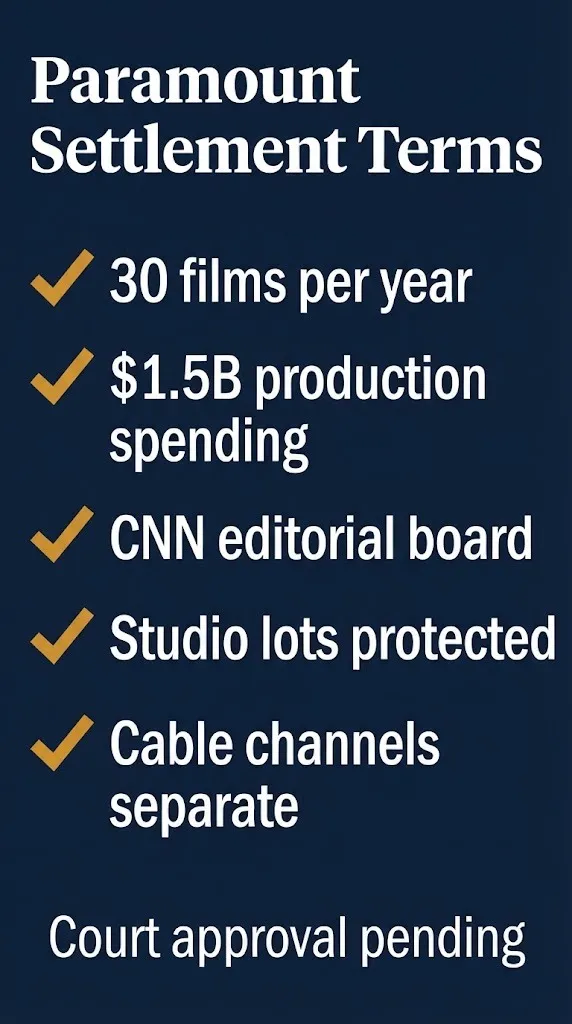
- The proposed consent decree requires $1.5 billion in U.S. film production spending, at least 30 theatrical releases per year, and a CNN editorial oversight board.
- The settlement still requires federal court approval and does not include cash payments to consumers.
The Paramount settlement is not a consumer class action payout. It is a regulatory settlement between a corporation and state governments. That means there is no claim form, no per-person payout, and no deadline for individuals to file anything.
But the deal matters to anyone who works in entertainment, owns Warner Bros. Discovery stock, or pays a cable bill. The consent decree filed in federal court on September 21, 2026, sets enforceable production commitments, editorial independence rules for CNN and CBS News, and potential divestiture triggers if Paramount falls short .
This article breaks down the verified terms, the timeline, and what happens next.
The Facts
| Item | Detail |
|---|---|
| Case Name | The State of California v. Paramount Skydance Corporation |
| Court | U.S. District Court, Northern District of California |
| Case Number | 4:26-cv-07116 |
| Status | Settlement reached September 21, 2026; consent decree pending court approval |
| Deal Value | $110 billion Warner Bros. Discovery acquisition |
| Settlement Fund | No cash fund; behavioral and structural commitments |
| Consumer Payout | None; this is not a consumer class action |
| Key Deadline | October 1, 2026 ticking fees of $7 million per day begin if deal not closed |
| Administrator | Not applicable; state attorneys general negotiated directly |
| Proof Needed | Not applicable; no claims process for individuals |
Is the Paramount Settlement Legit or a Scam?
The Paramount settlement is legitimate and was announced by California Attorney General Rob Bonta at a press conference on September 21, 2026 . It resolved a real antitrust lawsuit filed by 12 states in July 2026.
No legitimate settlement administrator is collecting personal information from consumers in connection with this case. If you receive a text or email asking for your Social Security number or a fee to “claim your Paramount settlement payout,” that is a scam. There is no consumer payout in this case.
The settlement was negotiated by state attorneys general, not by a court-appointed claims administrator. The proposed consent decree was filed in the U.S. District Court for the Northern District of California and must be approved by Judge Araceli Martínez-Olguín before it takes effect .
Connecticut Attorney General William Tong said in a statement that his state sought full divestiture of CNN and CBS News and was “deeply disappointed that the coalition could not obtain more” . That criticism confirms the settlement is real, but also shows it is a compromise, not a complete victory for either side.
Key Takeaway: The Paramount settlement is a real regulatory agreement between the company and 12 states, but it creates no consumer payout and no claims process for individuals.
How Much Is the Paramount Settlement Worth?
The Paramount settlement does not include a cash payment. The value comes from enforceable commitments that could total more than $1.5 billion in production spending and $30 million per film in penalties if Paramount misses release targets .
The consent decree requires Paramount to spend at least $300 million more per year on U.S. film production than the two companies spent in 2025, for a total increase of at least $1.5 billion over five years .
If Paramount releases fewer than 30 films in the first two years, or fewer than 32 films in the following three years, it must pay $30 million per film into designated funds. If a shortfall is not remedied within six months, the company could be required to divest its entire interest in Miramax Studios .
Here is the breakdown of the settlement’s financial and structural terms:
| Commitment | Requirement | Penalty |
|---|---|---|
| Theatrical Releases | 30 films/year (years 1-2), 32 films/year (years 3-5) | $30 million per film shortfall |
| Production Spending | $300 million/year above 2025 baseline | Potential Miramax divestiture |
| Studio Lots | Paramount and Warner Bros. lots cannot be sold or closed for 5 years | Not specified |
| Cable Channels | Must be offered separately to distributors | Divestiture of BET, VH1, Comedy Central if breached |
The $1.5 billion figure is not a payment to consumers or to the states. It is a production spending floor that Paramount must meet or face penalties .
Who Pays for the Paramount Settlement?
Paramount Skydance and Warner Bros. Discovery bear the cost through compliance with the consent decree. No taxpayer money and no consumer money funds this settlement.
The states did not receive a cash payment from Paramount as part of the deal. The value to the states comes from behavioral commitments designed to preserve competition in theatrical film distribution and cable television licensing .
Paramount also absorbed significant legal costs during the litigation. The company was facing $7 million per day in ticking fees starting October 1, 2026, if the merger did not close . Those fees were a major incentive to settle before the deadline.
The Writers Guild of America filed a separate lawsuit against the merger, arguing it would eliminate jobs for Hollywood screenwriters . That case was not resolved by the September 21 settlement and remains pending.
Who Qualifies for the Paramount Settlement?
No individual qualifies for a payout because this is not a consumer class action. The settlement applies to Paramount Skydance and Warner Bros. Discovery as corporate entities.
The parties affected by the settlement are:
- Paramount Skydance shareholders, who benefit from the merger closing without further delay
- Warner Bros. Discovery shareholders, who receive $31 per share under the deal terms and avoid extended ticking fees
- Film production workers in California, who benefit from the $1.5 billion production commitment
- Cable subscribers, who may see some competitive benefit from the cable channel provisions
If you own Warner Bros. Discovery stock, your shares will be acquired at $31 per share when the merger closes . That is the shareholder payout, not a settlement claim.
The settlement does not create any eligibility for consumers who bought movie tickets or cable subscriptions.
How Do You File a Claim for the Paramount Settlement?
You do not file a claim because there is no claims process. The settlement is a consent decree between Paramount and state governments, not a class action with a claims administrator.
If you were a Warner Bros. Discovery shareholder, your shares will be automatically acquired at the deal price when the merger closes. You do not need to file anything.
If you are a consumer who believes you were harmed by the merger, there is no claims process under this settlement. A private antitrust lawsuit from streaming video consumers was filed separately, but Judge Martínez-Olguín denied their request to temporarily block the deal in July 2026, saying the plaintiffs “failed to submit a single item of evidence” in support of their request .
The Writers Guild of America lawsuit is also separate and remains pending. If that case produces a settlement with a claims process for writers, it will be announced separately .
Key Takeaway: There is no claim form, no deadline, and no administrator for individuals in the Paramount settlement; only Warner Bros. Discovery shareholders receive a direct payment through the merger closing.
What Are the Key Dates in the Paramount Settlement?
The key dates center on the October 1, 2026 ticking fee trigger and the pending court approval of the consent decree.
September 21, 2026: Settlement announced by California Attorney General Rob Bonta
October 1, 2026: Ticking fees of approximately $7 million per day begin accruing if the merger has not closed
Ongoing: Federal court review of the proposed consent decree; no approval date set
March 2, 2027: The antitrust trial date that is now likely moot if the settlement is approved
The ticking fees were the primary financial pressure driving the settlement. Paramount agreed to pay Warner shareholders $0.25 per share per quarter for every quarter the deal was delayed, which adds up to roughly $650 million per quarter . By settling before October 1, Paramount avoids at least one quarter of those fees.
The consent decree requires the combined company to establish the News Editorial Independence Board within 180 days of the merger’s closing . The board would oversee CNN and CBS News editorial standards.
What Happens Next
September 21, 2026: Settlement announced; consent decree filed in federal court
Expected late 2026: Federal court review and potential approval of the consent decree
October 1, 2026: Ticking fee deadline; merger expected to close if court approval is granted before this date
Within 180 days of closing: News Editorial Independence Board established for CNN and CBS News
Ongoing: Writers Guild of America lawsuit remains pending; separate resolution possible
Frequently Asked Questions
Is there a Paramount settlement payout for consumers?
No. The Paramount settlement is a regulatory agreement with 12 states, not a consumer class action. There is no cash payout for individuals.
How much is the Paramount settlement worth?
The settlement includes at least $1.5 billion in production spending commitments and potential penalties of $30 million per film if release targets are missed . No cash changes hands between Paramount and the states.
Who gets money from the Paramount settlement?
Warner Bros. Discovery shareholders receive $31 per share when the merger closes . No other individuals receive payment under the settlement.
Is the Paramount settlement related to a class action?
No. It is a state antitrust settlement, not a class action. A separate private antitrust lawsuit from streaming consumers was filed but denied a temporary block in July 2026 .
What does the Paramount settlement mean for cable subscribers?
The consent decree requires Paramount to offer basic cable channels separately to distributors unless a distributor requests otherwise. A material breach could trigger divestiture of BET, VH1, or Comedy Central .
When will the Paramount merger close?
The merger is expected to close after the consent decree receives federal court approval, with October 1, 2026, as the financial deadline for avoiding ticking fees .
Do I need to file anything for the Paramount settlement?
No. There is no claims process for individuals. Shareholders receive payment automatically through the merger closing.
Is the Writers Guild lawsuit still active?
Yes. The WGA filed a separate antitrust lawsuit against the merger, and that case remains pending .
Closing
The Paramount settlement cleared the final major obstacle to the $110 billion Warner Bros. Discovery acquisition. The deal avoids $7 million per day in ticking fees that would have started October 1, 2026. Watch for federal court approval of the consent decree, because that is the last step before the merger closes.