Roundup Lawsuit Attorney in 2026: Settlement Tiers, Deadlines, and How to Find a Lawyer
Quick Answer
- Roundup lawsuit attorneys work on contingency, meaning you pay nothing upfront and fees come from any settlement.
- Settlement tiers range from $10,000 for claimants over 78 to $165,000 average for younger occupational claimants with aggressive NHL .
- The most critical date is June 4, 2026, the opt-out deadline for the class settlement.
If you’ve been diagnosed with non-Hodgkin lymphoma after using Roundup, you’re probably getting bombarded with ads from law firms promising huge payouts. Some of those ads are honest. Some are not.
The reality is that Roundup litigation entered a new phase in 2026. The Supreme Court dealt plaintiffs a major blow in June, and a massive class settlement is moving through Missouri courts right now.
This article breaks down what’s actually confirmed about the settlement, how attorney fees work, what qualifications matter when choosing a lawyer, and the deadlines you cannot afford to miss.
The Facts
| Case Name | King v. Monsanto (class settlement); In Re: Roundup Products Liability Litigation (federal MDL) |
| Court | City of St. Louis Circuit Court, Missouri; U.S. District Court for the Northern District of California |
| Case Number | 2622-CC00325 (Missouri); 16-md-02741 (California MDL) |
| Status | Settlement preliminarily approved; final hearing set for September 14, 2026 |
| Fund Size | Up to $7.25 billion |
| Est. Per Person | $10,000 to $165,000+ depending on exposure, age, and NHL type |
| Claim Deadline | January 5, 2027 (registration); varies for future claims |
| Exclusion Deadline | June 4, 2026 |
| Administrator | Not yet confirmed |
| Proof Needed | Medical diagnosis records, exposure documentation |
Is the Roundup Lawsuit Settlement Real or a Scam?
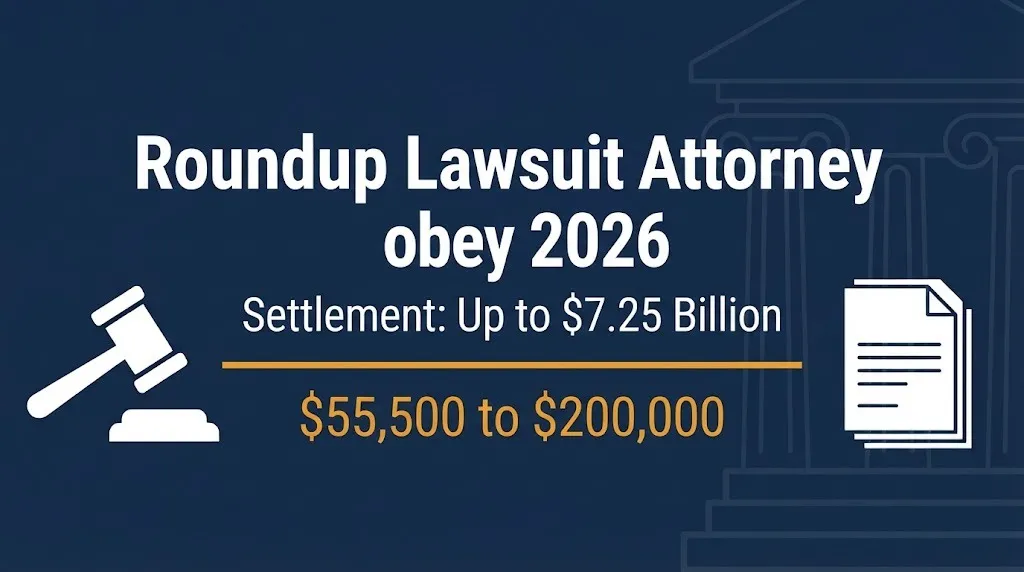
The Roundup lawsuit settlement is real and court-approved. Bayer’s Monsanto unit agreed to pay up to $7.25 billion to resolve current and future claims that Roundup caused non-Hodgkin lymphoma .
That doesn’t mean every claim gets paid automatically. The settlement is structured as a claims program with tiers, scoring, and annual payment cycles spread over up to 21 years .
The scam risk isn’t the settlement itself. It’s the predatory marketing around it. Some firms are cold-calling cancer patients with inflated promises. Others are charging fees for services that should be free.
Here’s what’s verified: the settlement received preliminary approval from a Missouri judge in March 2026, and a final approval hearing is set for September 14, 2026 . If approved, claims processing will begin.
Key Takeaway: The settlement is legitimate and court-supervised. Any attorney or “claim service” promising you a specific dollar amount before reviewing your records is not being honest with you.
How Much Can You Get from the Roundup Lawsuit?
Settlement amounts range from $10,000 to over $165,000, depending on your exposure type, age at diagnosis, and the aggressiveness of your cancer . There is no single average payout because the program assigns claimants to nine separate tiers.
The tiers work like this:
| Claimant Type | Age/Subtype | Average Award |
|---|---|---|
| Occupational (farmer, landscaper) | Under 60, aggressive NHL | Up to $165,000 |
| Occupational | Varies | $60,000 to $165,000 |
| Residential (home gardener) | Varies | $20,000 to $40,000 |
| Residential Quick-Pay Option | Varies | $7,700 to $14,500 |
| Diagnosed at Age 78+ | All types | $10,000 |
The Quick-Pay option is only available to Residential claimants in Tiers 5 through 9 who filed a lawsuit or signed a tolling agreement before February 13, 2026 . It’s a faster but smaller payment.
Your actual award can range from 80% to 120% of your tier average, based on a claim score that weighs treatment intensity, proof of exposure, medical history, and prior lawsuit status .
Reality Check: The $7.25 billion figure is a funding cap, not a per-person promise. Bayer pays declining annual amounts over up to 21 years. If the money runs out, later claimants may receive less or nothing . That’s why filing early matters.
Do You Need a Roundup Lawsuit Attorney to File a Claim?
You don’t need an attorney to file a claim in the class settlement, but most claimants benefit from having one. The claims process involves tier assignment, scoring, medical documentation, and appeal rights that are easier to handle with legal help.
The settlement is structured as a class action. If you do nothing, you’re automatically included and bound by its terms . That means you give up your right to sue Monsanto individually for Roundup-related claims.
Here’s when an attorney adds real value:
- If you have an occupational exposure history. Farmers, landscapers, and groundskeepers often qualify for the highest tiers. An attorney can help document that exposure.
- If your diagnosis is aggressive or your treatment was intensive. Claim scoring rewards stronger evidence. An attorney knows what proof moves the needle.
- If you want to opt out and pursue an individual lawsuit. The opt-out deadline was June 4, 2026. If you missed it, you’re likely bound by the settlement.
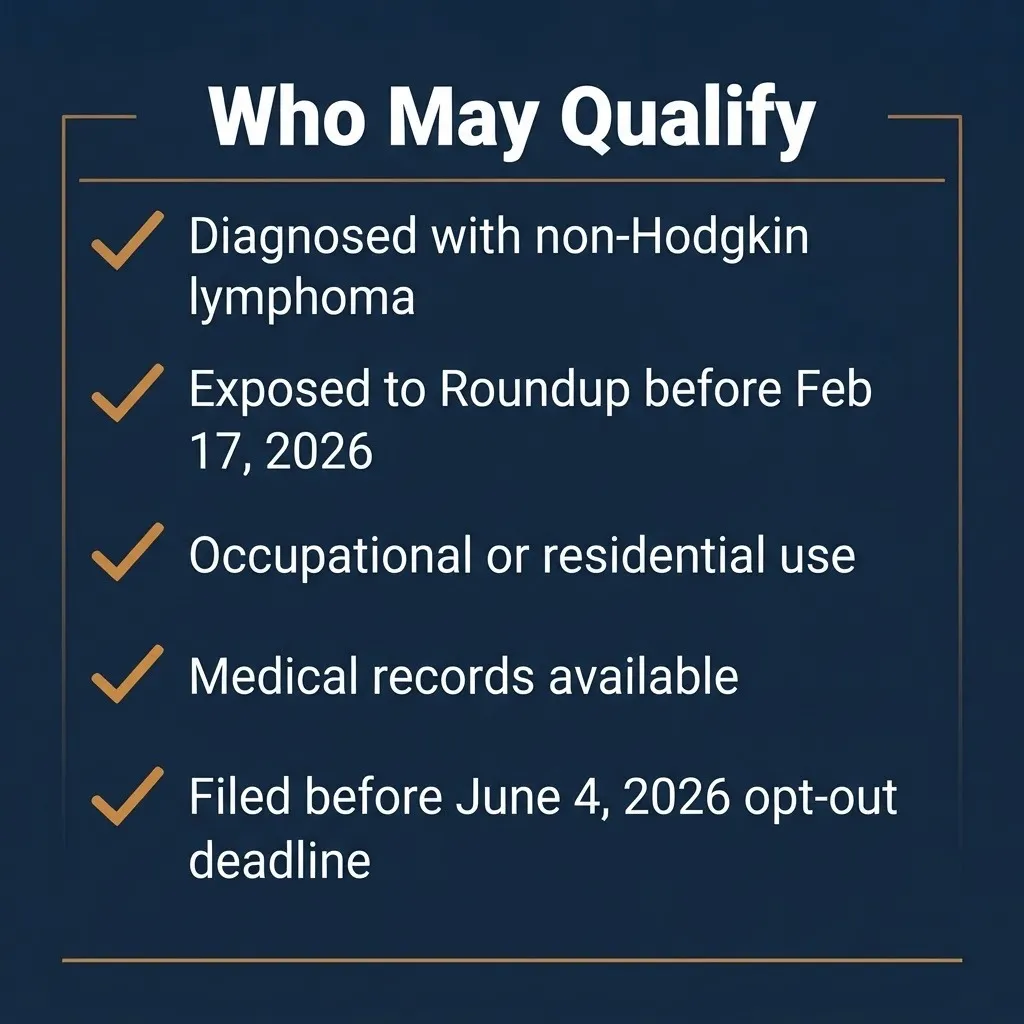
- If you’re considering a future claim. People exposed before February 17, 2026, who later develop NHL may still have options, but the rules are complex.
Contingency fees in Roundup cases typically range from 25% to 40% of the recovery . You pay nothing upfront.
How to Find a Roundup Lawsuit Attorney Near You
Finding a Roundup lawsuit attorney near you means looking for specific experience, not just a local address. Roundup litigation is concentrated in federal MDL 2741 and Missouri state court, so geographic proximity matters less than case experience.
Here’s what to look for:
Qualifications That Matter
- MDL 2741 experience. The federal Roundup cases are consolidated in the Northern District of California. Attorneys familiar with that court have an edge.
- Scientific network. Roundup cases rely on toxicologists and oncologists as expert witnesses. Ask who they work with.
- Trial record. Some cases go to verdict. You want an attorney who has been in a courtroom, not just a settlement negotiator.
- Transparent fee structure. Ask exactly what percentage they take and what costs you’re responsible for.
- Communication history. Mass torts take years. You need updates, not silence.
Questions to Ask Before Hiring
- How many Roundup cases have you handled?
- Have you tried a glyphosate case to verdict?
- What percentage of my settlement do you take?
- Who pays for expert witnesses and filing fees?
- How often will you update me on my case?
The best attorneys will answer these directly. If they dodge, walk away.
How Do Roundup Lawsuit Attorney Fees Work?
Roundup lawsuit attorney fees are almost universally structured as contingency fees, meaning you pay nothing out of pocket and the attorney takes a percentage of any settlement or verdict . The standard range is 25% to 40%, depending on the firm and case complexity.
Here’s how the money flows:
- Settlement or verdict is reached.
- Case costs are deducted first. These include filing fees, expert witness fees, deposition costs, and administrative expenses.
- Attorney contingency fee is deducted. Usually 33% to 40% for mass tort cases.
- Remaining amount goes to you.
A $60,000 settlement with a 40% fee and $5,000 in costs would net you roughly $31,000. The exact split depends on your agreement.
Some firms charge lower percentages for cases that settle early and higher percentages if the case goes to trial. That’s standard. What’s not standard is asking for money upfront.
Key Takeaway: Legitimate Roundup attorneys never charge upfront fees. If someone asks for a retainer before reviewing your case, that’s a red flag.
What Is the Roundup Lawsuit Claim Deadline?
The most important deadline for current NHL claimants is January 5, 2027, which is the registration deadline for the class settlement . The opt-out deadline was June 4, 2026, and it has passed.
Here’s the full timeline:
| Action | Deadline | Status |
|---|---|---|
| Exclude yourself (opt out) | June 4, 2026 | Passed |
| Object to settlement | June 4, 2026 | Passed |
| Register for benefits (current NHL) | January 5, 2027 | Open |
| File claim (after appeals resolved) | 180 days after appeals | Pending |
| Future NHL diagnosis | Within 6 years of diagnosis | Open |
If you were diagnosed with NHL but didn’t file a lawsuit or tolling agreement before February 13, 2026, you may still qualify if your state’s statute of limitations hasn’t expired . That’s a narrow exception, and you’ll need to prove it.
For people exposed to Roundup before February 17, 2026, who haven’t developed cancer yet, the settlement still covers you. You don’t need to register now. If you’re diagnosed later, you file within six years .
What Happens If You Miss the Roundup Settlement Deadline?
Missing the opt-out deadline means you’re bound by the settlement terms. You cannot sue Monsanto individually for Roundup-related claims covered by the class action .
Missing the registration deadline for current NHL claimants is more serious. If you don’t register by January 5, 2027, you may forfeit your right to a Program Award.
The settlement does allow for one exception: if you can prove your state’s statute of limitations hasn’t expired, you may still apply even without prior legal action . But that’s a high bar.
If you’re unsure whether you’ve missed a deadline, contact an attorney immediately. Some deadlines can be extended or excused for good cause. Most cannot.
Roundup Lawsuit Settlement vs Individual Lawsuit: Which Is Better?
Settling through the class action is faster and simpler. Filing an individual lawsuit offers potentially higher recovery but carries significant risk, especially after the Supreme Court’s June 2026 ruling.
The Supreme Court decided Monsanto Co. v. Durnell on June 25, 2026, holding that federal pesticide law preempts state-law failure-to-warn claims . That ruling gutted the legal theory behind most large Roundup verdicts.
The practical impact:
- Class settlement: Guaranteed payment if your claim qualifies, but capped by tier averages.
- Individual lawsuit: Potentially higher award, but failure-to-warn claims are now barred in most courts. Design defect and negligence claims remain, but they’re harder to win.
The opt-out window closed on June 4, 2026. If you didn’t opt out, you’re in the class. If you did opt out, you’re now pursuing a much harder path in court.
What Happens Next: Roundup Settlement Timeline
- September 14, 2026: Final approval hearing in Missouri state court .
- Expected late 2026: If approved, claims processing begins.
- January 5, 2027: Registration deadline for current NHL claimants .
- 2027 and beyond: Annual payment cycles begin, spread over up to 21 years.
- Ongoing: Appeals could delay payments. Bayer has said the settlement isn’t final until all appeals conclude .
The settlement is designed to pay claims annually, not in one lump sum. If you’re expecting a check in 2027, you may be waiting longer than you think.
Frequently Asked Questions
Do I need a Roundup lawsuit attorney to file a claim?
No, you can file directly with the settlement administrator. But an attorney can help document exposure, maximize your tier score, and handle appeals if your claim is denied.
How much do Roundup lawsuit attorneys charge?
Most charge contingency fees between 25% and 40% of the recovery, plus case costs. You pay nothing upfront .
What is the deadline to file a Roundup lawsuit?
The opt-out deadline was June 4, 2026. The registration deadline for current NHL claimants is January 5, 2027 .
Can I still file a Roundup lawsuit in 2026?
New individual lawsuits face major hurdles after the Supreme Court’s June 2026 ruling. The class settlement is the primary path for most claimants now .
How long does a Roundup lawsuit take to pay out?
The settlement pays over up to 21 years. Initial payments depend on when final approval is granted and appeals are resolved .
What proof do I need for a Roundup claim?
You need medical records confirming your NHL diagnosis and documentation of Roundup exposure. Photos, receipts, and employment records strengthen your claim .
What happens if Bayer appeals the settlement?
Appeals delay payments. Bayer has said the settlement doesn’t become final until all appeals conclude, which could take years .
Can family members file a Roundup claim for a deceased person?
Yes, representatives of deceased class members may be included in the settlement .
The single most important date is September 14, 2026. That’s when the Missouri court decides whether to grant final approval to the $7.25 billion settlement. If you have a current NHL diagnosis, register by January 5, 2027. Gather your medical records and exposure documentation now. Check the official settlement website for updates before filing.