The Plaintiff in a Lawsuit Is the Party Who Files the Case: Full 2026 Guide
Quick Answer
- The plaintiff is: The party who starts a lawsuit by filing a complaint in court.
- The defendant is: The party being sued, who must respond to the allegations.
- Key fact: In criminal cases, the government is always the plaintiff, not a private citizen.
The plaintiff in a lawsuit is the person, business, or organization that files the case and asks the court for a remedy. If you sue someone for a car accident, you are the plaintiff. If a company sues you over a contract dispute, the company is the plaintiff.
Every civil lawsuit has at least one plaintiff and one defendant. The plaintiff starts the process by filing a document called a complaint, which states the facts and the relief sought. The defendant then responds and defends against the claims.
This guide explains exactly who the plaintiff is, how plaintiffs differ from defendants, what a plaintiff must prove, and what happens if a plaintiff loses. One detail stands out: the plaintiff has the burden of proof in a civil case, meaning they must convince the court their version of events is more likely true than not .
The Facts
| Plaintiff Definition | The party who initiates a lawsuit by filing a complaint |
| Defendant Definition | The party against whom the lawsuit is filed |
| Who Can Be Plaintiff | Individuals, businesses, organizations, government entities |
| Burden of Proof | On the plaintiff in civil cases (preponderance of evidence) |
| Criminal Case Plaintiff | Always the government (state or federal) |
| Case Name Order | Plaintiff first, defendant second (e.g., Smith v. Jones) |
Who Is the Plaintiff in a Lawsuit?
The plaintiff is the party who starts a lawsuit by filing a formal complaint with the court . The term comes from the Latin word “plangere,” meaning to complain or lament.
In a civil case, the plaintiff can be an individual person, a business, a corporation, a partnership, a government entity, or even an unincorporated association . There can be multiple plaintiffs in a single lawsuit if several people suffered similar harm from the same defendant.
The plaintiff’s role is active. They file the initial paperwork, serve the defendant with notice, present evidence, and ask the court for a specific remedy, usually money damages or an injunction . If the plaintiff wins, the court enters judgment in their favor and may award the requested relief.
If the plaintiff loses, the case ends and the defendant owes nothing. The plaintiff cannot appeal simply because they are unhappy with the outcome. They must show a legal error occurred.
What Does the Plaintiff Do in a Lawsuit?
The plaintiff drives the lawsuit from start to finish. Their main responsibilities include filing the complaint, serving the defendant, presenting evidence, and proving their case at trial .
Here’s what the plaintiff does at each stage:
| Stage | Plaintiff’s Action |
|---|---|
| Filing | Drafts and files the complaint with the court |
| Service | Ensures the defendant receives legal notice of the lawsuit |
| Discovery | Requests documents, takes depositions, gathers evidence |
| Trial | Presents witnesses and evidence first, bears burden of proof |
| Judgment | If successful, collects the awarded damages or relief |
The plaintiff goes first at trial. They call witnesses, present exhibits, and make the opening statement and closing argument . The defendant then has the opportunity to cross-examine and present their own case.
This first-mover advantage comes with a burden. The plaintiff must prove every element of their claim. If they fail on even one element, the defendant wins.
What Is the Difference Between a Plaintiff and a Defendant?
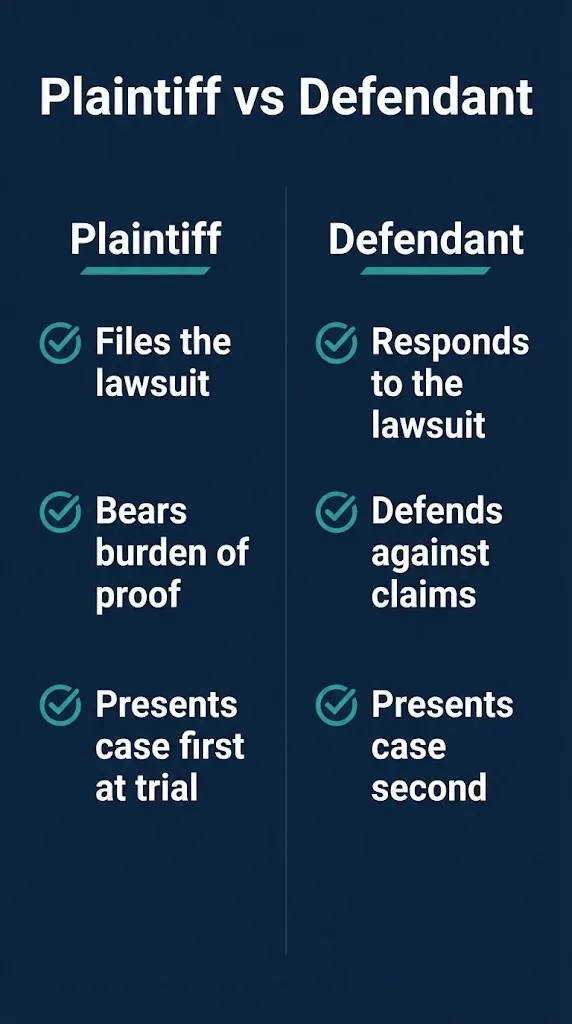
The plaintiff files the lawsuit and seeks relief. The defendant is the party being sued and must respond to the claims .
The distinction is structural. In a case name like “Smith v. Jones,” Smith is the plaintiff and Jones is the defendant. The “v.” stands for versus, indicating who is suing whom .
Here’s how the two roles compare:
| Plaintiff | Defendant | |
|---|---|---|
| Role | Initiates the lawsuit | Responds to the lawsuit |
| Filing | Files the complaint | Files an answer or motion |
| Burden | Must prove the case | Must defend against claims |
| Trial Order | Presents first | Presents second |
| Case Name | Listed first | Listed second |
The defendant can also file a counterclaim, which turns the tables. If the defendant counterclaims, they become a plaintiff for that specific claim, and the original plaintiff must respond .
Key Takeaway: The plaintiff starts the case and carries the burden of proof. The defendant responds and defends. Either party can become both plaintiff and defendant if counterclaims are filed.
Who Is the Plaintiff in a Criminal Case?
In a criminal case, the plaintiff is always the government, not a private individual. The state or federal prosecutor files charges on behalf of the public .
The case caption reflects this. A criminal case is styled “State of Arkansas v. Defendant” or “United States v. Defendant.” The government is the plaintiff, and the accused person is the defendant .
Private citizens don’t file criminal lawsuits. They can report crimes to law enforcement, but the decision to prosecute rests with the government. If a private person is harmed by criminal conduct, they may file a separate civil lawsuit for damages, but that’s a different proceeding.
This distinction matters because the burden of proof is higher in criminal cases. The government must prove guilt beyond a reasonable doubt, while civil plaintiffs only need to prove their case by a preponderance of the evidence.
What Is the Burden of Proof for a Plaintiff?
The burden of proof for a plaintiff in a civil case is the preponderance of the evidence. This means the plaintiff must show their claims are more likely true than not true .
It’s a lower standard than criminal cases, where the government must prove guilt beyond a reasonable doubt. In civil court, if the evidence tips even slightly in the plaintiff’s favor, they win.
Different types of civil claims have different standards:
| Claim Type | Burden of Proof |
|---|---|
| Most civil claims | Preponderance of the evidence (more likely than not) |
| Fraud claims | Clear and convincing evidence (some states) |
| Punitive damages | Clear and convincing evidence |
| Criminal charges | Beyond a reasonable doubt |
The plaintiff must prove every element of their claim. In a negligence case, that means proving duty, breach, causation, and damages. If any element fails, the entire claim fails.
What Happens If the Plaintiff Loses a Lawsuit?
If the plaintiff loses, the court enters judgment for the defendant. The plaintiff receives nothing and may be ordered to pay the defendant’s court costs .
Losing doesn’t automatically mean the plaintiff pays the defendant’s attorney fees. In most U.S. civil cases, each side pays their own attorney. But some statutes and contracts include fee-shifting provisions that require the losing party to pay the winner’s legal costs.
The plaintiff can appeal if they believe the judge made a legal error. Appeals aren’t retrials. The appellate court reviews the record for mistakes, not new evidence.
If the plaintiff wins but the defendant can’t pay, the plaintiff may struggle to collect. Winning a judgment doesn’t guarantee payment. The plaintiff must enforce the judgment through wage garnishment, bank levies, or property liens .
Reality Check: No one texts you about being a plaintiff in a lawsuit you didn’t file. If someone contacts you claiming you’re a plaintiff in a settlement you know nothing about, it’s a scam. Legitimate lawsuits start with formal court filings, not text messages.
Can a Plaintiff Be a Business or Organization?
Yes, a plaintiff can be a business, corporation, partnership, government entity, or any legal organization . The law treats these entities as “persons” capable of suing and being sued.
Common non-individual plaintiffs include:
- Corporations suing over breach of contract or trademark infringement
- Government agencies enforcing regulations
- Nonprofits pursuing claims related to their mission
- Partnerships seeking damages from third parties
- Estates represented by executors or administrators
When a business is the plaintiff, it must be properly named in the complaint. A corporation sues in its legal name, not a trade name. An estate sues through its personal representative .
The same rules apply whether the plaintiff is a person or an entity. The plaintiff must have standing, meaning a real stake in the outcome, and must prove their case with evidence.
What Happens If There Are Multiple Plaintiffs?
Multiple plaintiffs can join a single lawsuit if their claims arise from the same event or involve common legal issues. This is called joinder, and it’s common in mass torts and class actions .
Joinder serves efficiency. Instead of 50 separate trials for a bus crash, one trial can resolve all claims. The plaintiffs share discovery costs and present evidence together.
Each plaintiff still has their own claim. If one plaintiff settles, the others continue. If one loses at trial, the others can still win.
In a class action, one or a few lead plaintiffs represent the entire class. The lead plaintiffs must have claims typical of the class and must adequately represent the group’s interests.
What Happens Next in a Lawsuit?
The path forward depends on whether the case settles or goes to trial.
Filing: Plaintiff files the complaint. Court issues summons.
Response: Defendant files an answer or motion to dismiss.
Discovery: Both sides exchange evidence and take depositions.
Resolution: Settlement talks, mediation, or trial.
Judgment: Court enters judgment for plaintiff or defendant. Collection follows if plaintiff wins.
Frequently Asked Questions
Who is the plaintiff in a lawsuit?
The plaintiff is the party who files the lawsuit by submitting a complaint to the court. They seek a legal remedy from the defendant.
Who is the defendant in a lawsuit?
The defendant is the party being sued. They must respond to the plaintiff’s claims and defend against them.
What is the difference between plaintiff and defendant?
The plaintiff starts the case and bears the burden of proof. The defendant responds and defends. In the case name, the plaintiff is listed first.
Can the plaintiff be a company?
Yes. Businesses, corporations, partnerships, and government entities can all be plaintiffs. They sue in their legal names.
Who is the plaintiff in a criminal case?
The government is always the plaintiff in a criminal case. A prosecutor files charges on behalf of the state or federal government, not a private citizen.
What happens if the plaintiff loses?
The court enters judgment for the defendant. The plaintiff receives nothing and may be ordered to pay court costs. Each side typically pays their own attorney fees.
Can there be more than one plaintiff?
Yes. Multiple plaintiffs can join a single lawsuit if their claims arise from the same event or share common legal issues.
What is the burden of proof for a plaintiff?
In most civil cases, the plaintiff must prove their claims by a preponderance of the evidence, meaning more likely true than not true.
What Should You Do If You’re Considering a Lawsuit?
Identify who caused your harm and whether you have legal grounds to sue. Gather evidence, including documents, photos, and witness information. Contact a licensed attorney in your state for a consultation about your specific situation.
If you’re being sued, don’t ignore the complaint. Deadlines are strict. Consult an attorney immediately to understand your options and file a timely response.
The single most important fact: the plaintiff is the party who files the lawsuit and carries the burden of proof. The defendant responds and defends. In criminal cases, the government is always the plaintiff.