What Does Nonemployee Compensation Mean in 2026? IRS Rules, 1099-NEC Thresholds, and Worker Classification
Quick Answer
- Nonemployee compensation is money paid to independent contractors and freelancers who are not on your payroll.
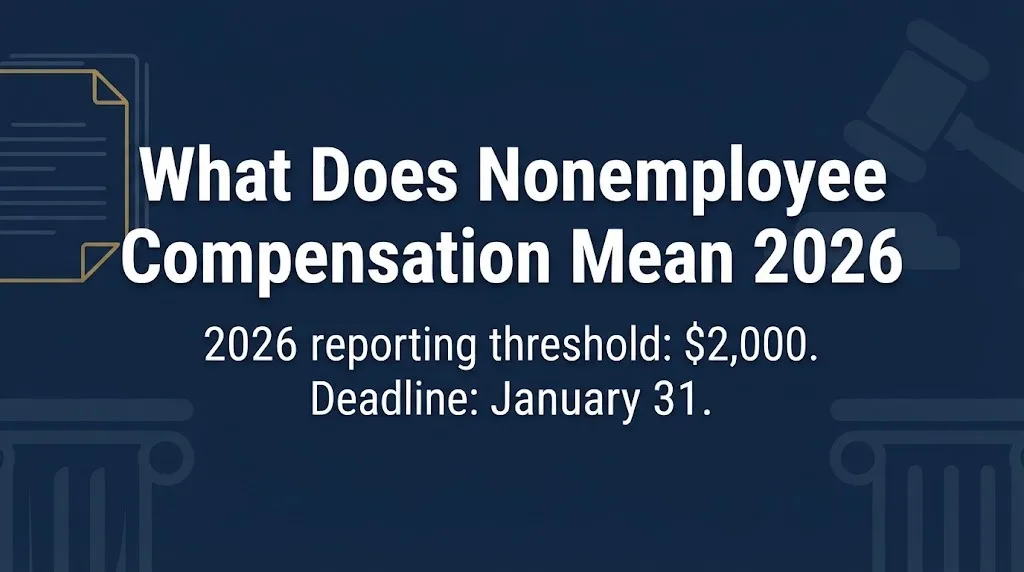
- The 2026 Form 1099-NEC filing threshold is $2,000, up from $600 for prior years.
- The January 31 filing deadline still applies, and the 1099-NEC has no automatic 30-day extension.
What Does Nonemployee Compensation Mean?
Nonemployee compensation means payment for services rendered by someone who is not your employee. The IRS defines it as compensation paid to independent contractors, freelancers, consultants, and other self-employed individuals who provide services to a business but are not on the payroll .
You pay nonemployee compensation to workers who control how they do their work. They set their own hours, use their own equipment, and can work for multiple clients. The business pays for a result, not for time spent .
The distinction matters because it changes your entire tax obligation. For employees, you withhold income tax, Social Security, and Medicare. For nonemployees, you do none of that. The worker handles their own taxes, including the full self-employment tax of 15.3% .
Common examples of nonemployee compensation include freelance writing fees, consulting payments, graphic design invoices, commissions paid to sales agents, and payments to gig workers .
Key Takeaway: Nonemployee compensation is payment for services to a worker you do not control like an employee. You report it on Form 1099-NEC, and the worker pays their own taxes.
How Much Is the 2026 Nonemployee Compensation Reporting Threshold?
The 2026 Form 1099-NEC reporting threshold is $2,000 for payments made after December 31, 2025. This is a major change from the $600 threshold that had been in place since 1954 .
The One Big Beautiful Bill Act raised the threshold for both Form 1099-NEC and Form 1099-MISC. The change is effective for payments made in calendar year 2026, and starting in 2027 the threshold will be indexed for inflation and adjusted annually .
Here is how the threshold changed:
| Tax Year | Form 1099-NEC Threshold | Form 1099-MISC Threshold |
|---|---|---|
| 2025 and prior | $600 | $600 |
| 2026 | $2,000 | $2,000 |
| 2027 and beyond | Indexed for inflation | Indexed for inflation |
The threshold applies to the total paid to a single payee across the entire calendar year, not to individual invoices . If you pay a contractor $1,200 in March and $900 in September, the total is $2,100 and you must file a 1099-NEC. If the total is $1,900, you do not have to file, even though the old $600 rule would have required it.
The new threshold is a filing threshold, not an income exclusion. A contractor still owes tax on $1,900 even if no 1099 is filed .
Key Takeaway: The 2026 1099-NEC threshold is $2,000. You track the total paid to each contractor across the year, and you only file if that total hits $2,000 or more.
Reality Check
A higher 1099 threshold does not mean your contractor income is tax-free. It only means the business that paid you is not required to report it to the IRS on a 1099-NEC. You still owe income tax and self-employment tax on every dollar you earn, whether or not you receive a form. The IRS receives payment data from other sources, including bank records and state filings. Not getting a 1099 does not make the income invisible.
What Is Form 1099-NEC and Who Gets One?
Form 1099-NEC is the IRS form used to report nonemployee compensation. The IRS brought the form back in 2020 after nearly four decades of reporting this income on Box 7 of Form 1099-MISC .
You must file Form 1099-NEC for each person to whom you paid at least $2,000 during 2026 for services performed in your trade or business. The form goes to the contractor and to the IRS .
Who receives a 1099-NEC:
- Independent contractors who provide services to your business
- Freelancers in writing, design, programming, photography, and similar fields
- Consultants who advise your business for a fee
- Attorneys who receive payments from your business (included even if incorporated in some cases)
- Gig workers who provide services through platforms or directly
Corporations are generally exempt from 1099-NEC reporting, with exceptions for attorneys and medical or health care payments. Payments made with a credit card or third-party network are also exempt because the processor reports them .
If you do not receive a 1099-NEC that you expect, contact the business that paid you. The form should arrive by January 31. You still must report the income even without the form .
Key Takeaway: Form 1099-NEC reports nonemployee compensation to both the contractor and the IRS. It is due January 31, and there is no automatic extension.
How Do You File Form 1099-NEC in 2026?
Filing Form 1099-NEC requires you to gather payment records, verify taxpayer information, and submit by the January 31 deadline. The form must be filed with the IRS and furnished to the recipient by the same date .
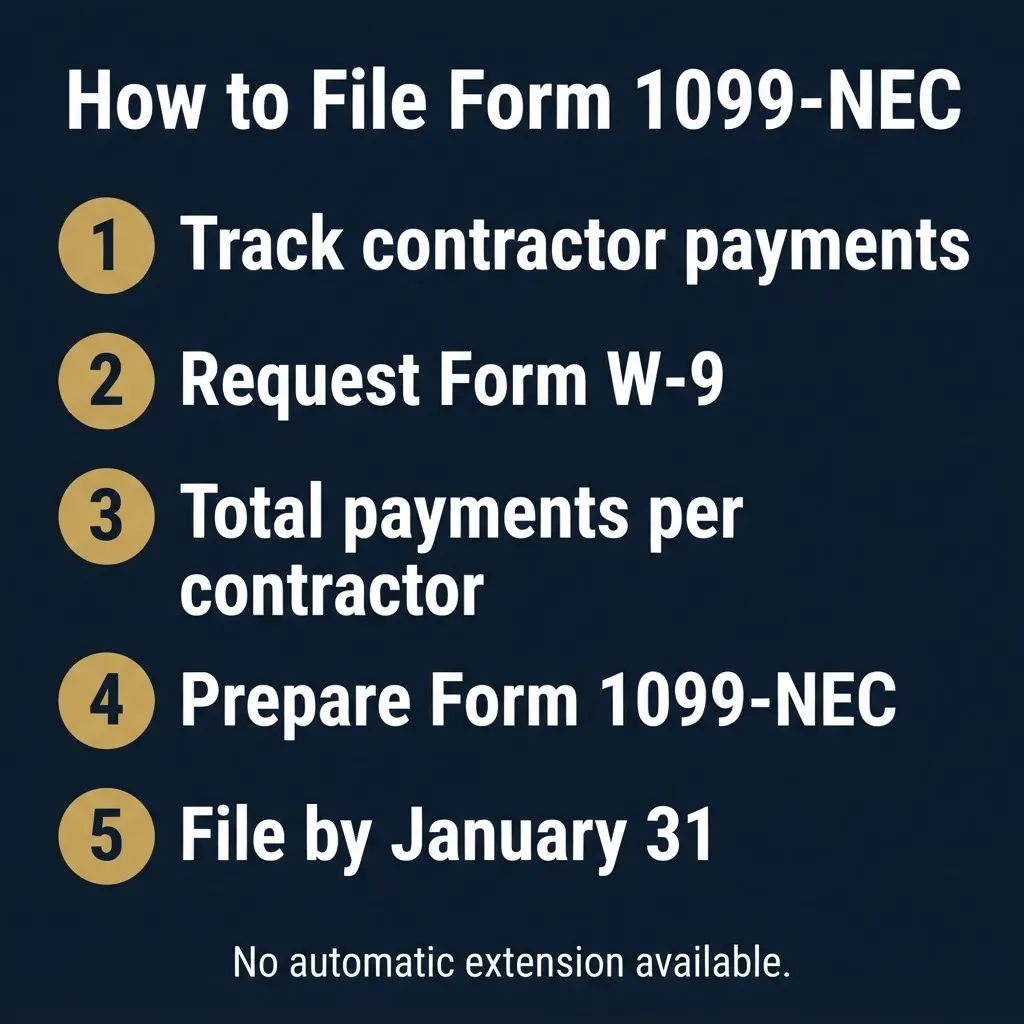
Here are the steps to file:
- Track payments all year. Record every payment to each contractor, including the method and date.
- Request Form W-9 from each contractor. This gives you their legal name, address, and Taxpayer Identification Number.
- Total payments per contractor. Add every payment made during the calendar year to see if it hits $2,000.
- Prepare Form 1099-NEC for each qualifying contractor. Copy A goes to the IRS, Copy B to the recipient, and Copy C is your record.
- File Copy A with the IRS by January 31. Electronic filing is required if you file 10 or more information returns.
- Furnish Copy B to each contractor by January 31. This is the same deadline as the IRS filing.
- Keep your records. Retain copies for at least three years.
The January 31 deadline is a hard deadline. Unlike other information returns, Form 1099-NEC does not qualify for the automatic 30-day extension. You can only request a non-automatic extension under certain hardship conditions by filing a paper Form 8809 before the deadline .
Key Takeaway: File Form 1099-NEC by January 31. There is no automatic extension, so late filing triggers penalties that start at $60 per form.
What Is Backup Withholding and When Does It Apply?
Backup withholding is a 24% tax the payer must withhold when a contractor fails to provide a valid Taxpayer Identification Number. The IRS made the 24% rate permanent under the One Big Beautiful Bill Act .
You must apply backup withholding if the contractor does not give you a TIN, or if the IRS notifies you that the TIN provided does not match the contractor’s name. The withholding continues until the contractor provides correct certification or the IRS tells you to stop .
Backup withholding is reported on Form 945, Annual Return of Withheld Federal Income Tax. You also report the withheld amount in Box 4 of the contractor’s Form 1099-NEC .
Here is when backup withholding applies:
| Situation | Backup Withholding Required? |
|---|---|
| Contractor provides valid TIN | No |
| Contractor refuses to provide TIN | Yes, 24% |
| IRS says TIN does not match name | Yes, 24% |
| Contractor is a corporation | Generally no |
| Payment made by credit card | No, processor reports it |
The contractor can claim credit for the withheld amount when filing their tax return. The backup withholding ensures the IRS receives tax on the income even if the contractor does not report it .
Key Takeaway: Backup withholding is a 24% safety net for the IRS. You only withhold it when a contractor fails to provide a valid Taxpayer Identification Number.
How Do You Classify Workers as Employees or Contractors?
Worker classification determines whether you pay nonemployee compensation or employee wages. The IRS uses a three-part test to evaluate the relationship between the worker and the business .
The IRS test considers behavioral control, financial control, and the type of relationship. Behavioral control looks at whether you direct how the work is done. Financial control looks at whether the worker can profit or lose money, and whether they have their own business. The relationship factor looks at whether there is a written contract and whether the work is a key part of your business .
The Department of Labor uses an economic reality test with six factors. No single factor is decisive. The overall picture determines the classification.
Here is a simplified comparison:
| Factor | Employee | Nonemployee |
|---|---|---|
| Control over work | Business directs how, when, where | Worker controls methods |
| Financial risk | No profit or loss potential | Can profit or lose money |
| Tools and equipment | Business provides | Worker provides |
| Benefits | Eligible | Not eligible |
| Tax withholding | Business withholds | Worker pays own taxes |
| Work duration | Ongoing, indefinite | Project-based or temporary |
Misclassifying an employee as a contractor carries serious penalties. You can owe back taxes, unpaid overtime, benefits, and penalties. Some states impose additional fines for misclassification .
Key Takeaway: Classification is about control, not job title. If you direct how, when, and where the work is done, the worker is likely an employee, and you cannot pay them as a nonemployee.
How Do Contractors Report Nonemployee Compensation on Their Taxes?
Contractors report nonemployee compensation as self-employment income on their tax return. The amount in Box 1 of Form 1099-NEC goes on Schedule C if you are a sole proprietor, or on Form 1065 if you operate as a partnership .
You must also complete Schedule SE to calculate self-employment tax. The self-employment tax rate is 15.3%, covering Social Security and Medicare. This is the employer and employee share combined, which employees split with their employer .
If you receive nonemployee compensation, you likely need to make quarterly estimated tax payments. The IRS expects you to pay tax as you earn it, not just at the end of the year. Use Form 1040-ES to calculate and submit estimated payments .
The IRS matches Form 1099-NEC data against tax returns. If you receive a 1099-NEC and do not report the income, the IRS automated matching system will flag the discrepancy. Underreporting triggers penalties and interest.
Key Takeaway: Nonemployee compensation is self-employment income. You report it on Schedule C, pay 15.3% self-employment tax, and make quarterly estimated payments to avoid penalties.
What Happens Next
January 31, 2027: Form 1099-NEC filing deadline for tax year 2026 payments. No automatic extension is available.
Expected early 2027: IRS will publish updated Form 1099-NEC instructions reflecting the $2,000 threshold and any inflation adjustments.
January 2028: The $2,000 threshold will be indexed for inflation for the first time, with the new amount announced by the IRS.
Ongoing: IRS enforcement of worker classification continues, with particular focus on gig economy platforms and industries with high contractor usage.
Frequently Asked Questions
What does nonemployee compensation mean in simple terms?
It means money you pay to a worker who is not your employee. The worker is an independent contractor, freelancer, or consultant.
What is the 2026 threshold for reporting nonemployee compensation?
The threshold is $2,000 for payments made after December 31, 2025. It was $600 for prior years.
Do I have to send a 1099-NEC if I paid a contractor less than $2,000?
No. You only file Form 1099-NEC if you paid a contractor $2,000 or more during the calendar year.
What is the difference between Form 1099-NEC and Form 1099-MISC?
Form 1099-NEC reports nonemployee compensation for services. Form 1099-MISC reports rent, prizes, attorney fees, and other miscellaneous payments.
What happens if I do not file Form 1099-NEC?
You face IRS penalties that start at $60 per form. The penalty increases with the delay and can reach $310 per form.
Can I get an extension to file Form 1099-NEC?
No automatic extension is available. You can only request a non-automatic extension under hardship conditions using Form 8809.
Do I need to withhold taxes from nonemployee compensation?
Generally no. But you must apply 24% backup withholding if the contractor does not provide a valid Taxpayer Identification Number.
How do I know if a worker is an employee or a contractor?
The IRS looks at behavioral control, financial control, and the relationship type. If you control how, when, and where the work is done, the worker is likely an employee.