How to Get a Debt Lawsuit Dismissed in Texas 2026: Defenses, Deadlines, and Docket Reality
Quick Answer
- Creditors must sue within 4 years of your last payment or the debt becomes time-barred.
- Missing your answer deadline in Texas Justice Court means automatic default judgment for the collector.
- Harris County JP courts dismissed multiple debt cases by nonsuit in 2026 when collectors failed to prosecute.
Getting a debt lawsuit dismissed in Texas usually happens one of two ways. Either the collector gives up, or you give the court a legal reason to throw the case out.
The collector giving up is more common than most people realize. Harris County Justice of the Peace courts dismissed cases against Maria Elena Lackey, Terrina Thomas, and Nathan Gonzales in 2026, all by nonsuit or plaintiff motion . In each case, the debt buyer walked away.
But you can’t count on that. If you ignore the lawsuit, you lose by default. The real work starts the day you’re served. This guide covers the verified defenses, the deadlines that actually matter, and the procedural mistakes that get cases dismissed.
The Facts
| Item | What to Know |
|---|---|
| Statute of Limitations | 4 years for most consumer debt in Texas |
| Answer Deadline (District/County Court) | Monday after 20 days from service |
| Answer Deadline (Justice Court) | 14 days from service |
| Most Common Dismissal Path | Plaintiff nonsuit or failure to prosecute |
| Key Defense | Debt buyer cannot prove ownership |
| Default Judgment Risk | High if you do not answer |
| Court Fee for Filing an Answer | None in Justice Court |
How Long Does a Debt Collector Have to Sue Me in Texas?
A debt collector has 4 years to file a lawsuit against you in Texas. After that, the debt is time-barred and the collector loses the right to sue .
The 4-year clock is set by Section 16.004 of the Texas Civil Practice and Remedies Code. It applies to most consumer debts, including credit cards, medical bills, and personal loans .
When does the clock start? That depends on your contract. Some contracts say the account defaults when you miss a payment. Others use the date of your last payment. The statute does not specify a single rule .
Texas law also protects you from “zombie debt.” Before 2019, making a partial payment could restart the 4-year clock indefinitely. A 2019 law now says a payment or acknowledgment cannot restart the clock. Collectors must also send written notice if they try to collect after the period ends .
If the debt is past 4 years, you can tell the court it is time-barred. The burden is on the collector to show the suit was timely.
What Happens If I Ignore a Debt Lawsuit in Texas?
If you ignore a debt lawsuit in Texas, the court will enter a default judgment against you. This means the collector wins automatically .
Texas Justice Court Rule 508.3 says the judge must render a default judgment if you do not file an answer by the deadline . The collector does not need to prove its case at trial. It only needs to submit evidence of the debt amount.
The consequences are serious. A default judgment can lead to bank account garnishment, property liens, and wage garnishment. The collector can also recover court costs and attorney’s fees .
Your answer deadline depends on the court. In District and County Courts, you must file an answer by the Monday after 20 days from the date you were served. In Justice Court, you have 14 days .
Filing an answer is free. You do not need a lawyer to file one. A handwritten letter to the court saying you dispute the debt can count as an answer .
How Do I Prove a Debt Buyer Doesn’t Own My Debt?
A debt buyer must prove it owns your debt and has the right to collect it. If it cannot, the case should be dismissed .
Most collection lawsuits in Texas are filed by debt buyers, not the original creditor. Companies like LVNV Funding, Midland Credit Management, and Jefferson Capital buy old debts for pennies on the dollar .
Under Texas Justice Court Rule 508.3, the plaintiff must prove four things to win a default judgment: the account was issued to you, you breached the agreement, the amount due is correct, and the plaintiff owns the account .
The rule also requires documentation. For a credit card debt, the plaintiff must attach at least one monthly statement. If the plaintiff is not the original lender, it must attach a bill of sale or affidavit showing ownership .
A debt buyer that cannot produce a chain of ownership has a problem. You can demand proof of the assignment. If the collector cannot show it bought your specific account, the case may fail .
What Are the Best Defenses to a Texas Debt Lawsuit?
The strongest defenses in a Texas debt lawsuit challenge the collector’s proof, not the underlying debt. You do not have to prove you don’t owe the money. The collector must prove its case .
Here are the defenses that get cases dismissed:
- Statute of limitations. The debt is more than 4 years old .
- Lack of standing. The debt buyer cannot prove it owns your account .
- Incorrect amount. The balance includes unauthorized fees or is simply wrong .
- Identity error. The debt is not yours, or you were a victim of identity theft.
- Improper service. You were not properly notified of the lawsuit .
- Failure to comply with the Texas Debt Collection Act. The collector used deceptive or harassing practices .
You do not need to prove every defense. One strong defense can end the case. But you must raise it in your answer or you may waive it.
What Is a Motion to Dismiss and When Should I File One?
A motion to dismiss asks the judge to throw out the case before trial. You file it when the collector’s petition or evidence has a fatal flaw .
Common grounds for dismissal in Texas debt cases include:
- The petition does not state a valid claim.
- The plaintiff failed to attach required documents.
- The court lacks jurisdiction.
- The case has been abandoned (no action for months).
Texas courts can dismiss a case for “want of prosecution” if no action is taken. This is a common reason cases end . If the collector files and then does nothing, you can ask the court to dismiss.
In practice, many cases end when the plaintiff files a nonsuit. This is a voluntary dismissal by the collector. It often happens when the collector cannot find evidence or decides the case is not worth pursuing .
Key Takeaway: The most common way debt lawsuits end in Texas is the collector giving up, not a courtroom victory. Harris County JP courts dismissed cases against Lackey, Thomas, and Gonzales in 2026, all by nonsuit or plaintiff motion. But you must answer to preserve your rights.
How Do I Answer a Debt Lawsuit in Texas?
You answer a debt lawsuit in Texas by filing a written response with the court and serving a copy on the collector. The deadline is tight, so act immediately .
Here are the steps:
- Read the citation to find your answer deadline.
- Write a response admitting or denying each claim.
- Include any defenses, like statute of limitations or lack of standing.
- File the answer with the court clerk.
- Mail a copy to the collector’s attorney.
- Keep proof of everything you filed and mailed.
- Show up to any scheduled hearing.
In Justice Court, you can represent yourself. The rules allow individuals to appear without a lawyer . You can also be assisted by a family member or friend who is not being paid .
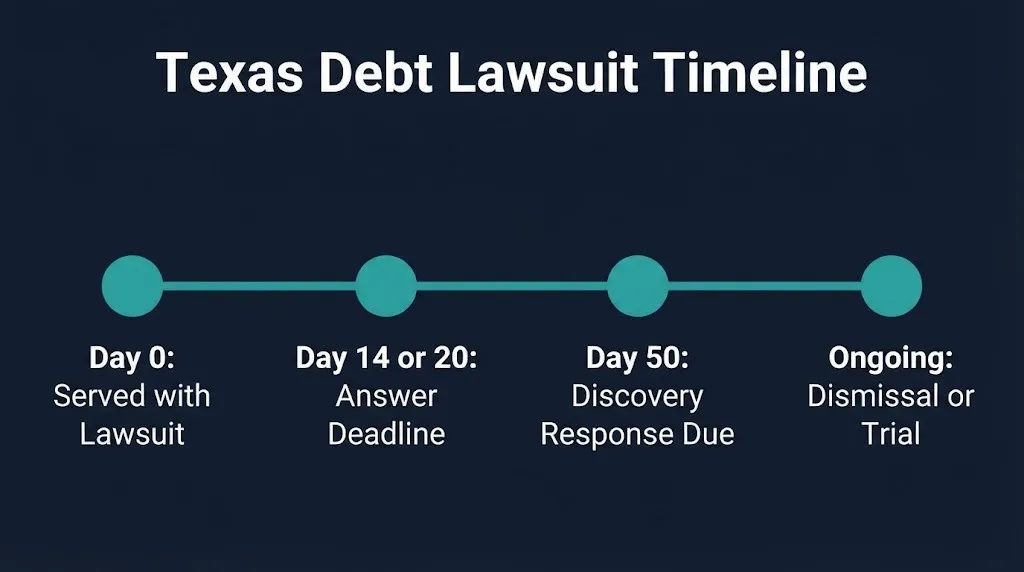
The collector may send discovery requests, like requests for admissions. You have 50 days to respond. If you fail to respond to a request for admission, you automatically lose that issue .
Reality Check: No legitimate court or collector demands payment by gift card, wire transfer, or cryptocurrency to “settle” a debt lawsuit. Legitimate settlements go through the court or a written agreement. Anyone threatening arrest or immediate bank seizure over the phone is violating the Texas Debt Collection Act.
What Happens Next?
Day 1 to 14: You receive the lawsuit. Find your answer deadline immediately.
Day 14 to 20: File your answer. Include every defense you have.
30 to 90 days: Discovery period. The collector may send requests for admissions.
90 to 180 days: The court may set a hearing or trial date.
Ongoing: If the collector takes no action, ask the court to dismiss for want of prosecution.
Frequently Asked Questions
How do I get a debt lawsuit dismissed in Texas?
You can get it dismissed by showing the collector cannot prove its case, sued too late, or violated procedure. The collector giving up is also common.
What is the statute of limitations for debt in Texas?
Four years for most consumer debt under Texas Civil Practice and Remedies Code Section 16.004.
How long do I have to answer a debt lawsuit in Texas?
In Justice Court, 14 days. In District or County Court, the Monday after 20 days from service.
Can I go to jail for ignoring a debt lawsuit in Texas?
No. But ignoring it means the collector wins by default. That leads to garnishment and liens, not jail.
Do I need a lawyer to fight a debt lawsuit in Texas?
No. You can represent yourself in Justice Court. But a lawyer can spot defenses you might miss.
What happens if the debt collector doesn’t show up to court?
If you answered and the collector does not appear, the court may dismiss the case. If you did not answer, the collector wins by default.
Can a debt collector sue me after 4 years in Texas?
No. Texas law prohibits lawsuits on time-barred debt. You must raise the defense in your answer.
What is a nonsuit in a Texas debt case?
A nonsuit is a voluntary dismissal by the plaintiff. The collector walks away without a judgment. It is common when collectors lack evidence.
Pull out the citation you received and find your answer deadline. Write down the date of your last payment on the debt. If it is more than 4 years ago, you have a statute of limitations defense. File your answer before the deadline. That single step preserves every other defense you have.