Medication Error Lawsuit 2026: Verdicts, Settlements, and What Victims Recover
Quick Answer
- Medication error lawsuits are medical malpractice claims. You must prove a provider breached the standard of care.
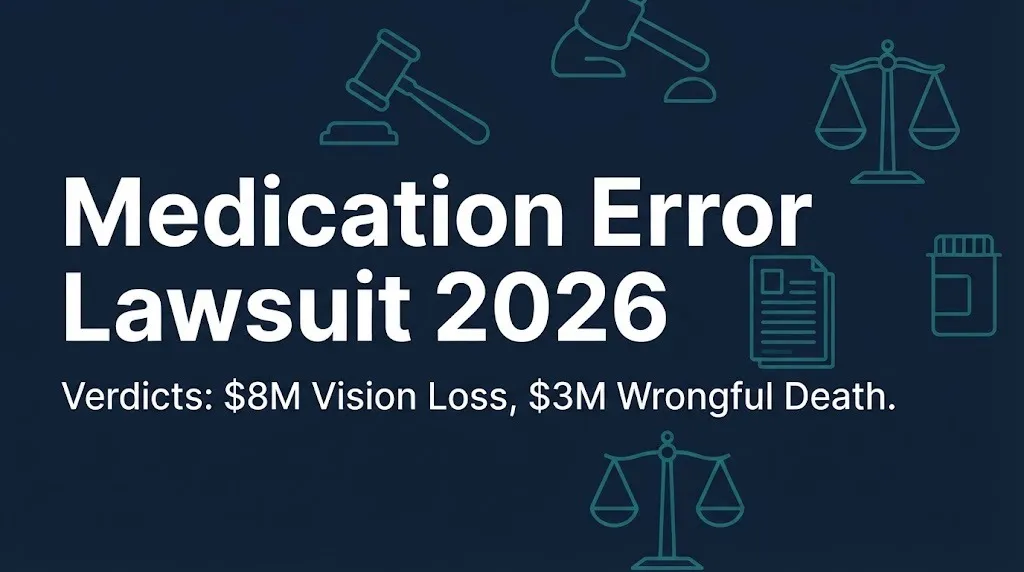
- Recent jury verdicts include $8 million for vision loss and $3 million for a fatal blood clot.
- Every state has a filing deadline, often 2 to 3 years. Missing it bars your claim permanently.
A medication error lawsuit is a medical malpractice claim against a doctor, nurse, pharmacist, or facility that gave you the wrong drug, the wrong dose, or failed to monitor you. These cases require proof that the mistake caused real harm.
You may be searching because something went wrong with your prescription or hospital care. Maybe you got the wrong medication. Maybe a nurse missed a critical dose. Maybe a pharmacist filled a prescription that sent you to the emergency room.
The good news is that victims do recover. Recent verdicts and settlements show real numbers. This guide covers verified 2025 and 2026 case results, what you must prove, who can be sued, and the deadlines that end your rights.
The Facts
| Item | What to Know |
|---|---|
| Case Type | Medical malpractice / professional negligence |
| Standard of Proof | Breach of care that caused harm |
| Recent High Verdict | $8 million (Jan 2025, Massachusetts) |
| Recent Wrongful Death Verdict | $3 million (March 2025, Virginia) |
| Recent Settlement | $2.4 million (March 2026, California) |
| Key Deadline | 2 to 3 years from injury, varies by state |
| Who Can Be Sued | Doctors, nurses, pharmacists, hospitals, facilities |
What Is the Average Medication Error Settlement or Verdict?
There is no published national average for medication error lawsuits. Case results depend on injury severity, jurisdiction, and the strength of the evidence.
Real 2025 and 2026 results show the range:
| Case | Outcome | Injury |
|---|---|---|
| Massachusetts teen with epilepsy | $8 million verdict | Permanent vision loss |
| Virginia rehab patient | $3 million verdict | Death from pulmonary embolism |
| California hip surgery patient | $2.4 million settlement | Permanent neurologic deficits |
| UK hospital patient | £120,000 settlement | Death after missed heart medication |
| UK ERCP patient | £550,000 award | Necrotising pancreatitis, permanent bowel damage |
The Massachusetts verdict included $2 million for past pain and suffering and $6 million for future pain and suffering . The Virginia verdict awarded each of four adult beneficiaries $750,000, plus medical and funeral expenses .
These numbers are not averages. They are individual outcomes. Your case value depends on your specific facts.
What Are Real Medication Error Lawsuit Verdicts from 2025 and 2026?
Real medication error verdicts from 2025 and 2026 show juries will award significant damages when the evidence is clear. Here are three verified cases.
The $8 Million Massachusetts Vision Loss Verdict
A teenager with epilepsy suffered permanent vision loss after a medication error. A Massachusetts jury deliberated for about four hours before returning an $8 million verdict on January 17, 2025. The award split into $2 million for past pain and suffering and $6 million for future pain and suffering .
The $3 Million Virginia Wrongful Death Verdict
A 68-year-old woman entered a Lynchburg rehabilitation facility after ankle and knee surgery. Her hospital records stated she needed Lovenox, a blood thinner, to prevent clots. The facility never entered the medication into her chart. She never received it. Eleven days later, she died from a pulmonary embolism. A Lynchburg Circuit Court jury awarded $3 million in March 2025 .
The £550,000 UK Pancreatitis Award
A patient underwent an ERCP procedure at a London hospital. The consultant intended to prescribe a Diclofenac suppository to prevent post-procedure pancreatitis. He failed to communicate the instruction to nursing staff. The medication was never given. The patient developed necrotising pancreatitis and now has permanent bowel damage and insulin-dependent diabetes. The High Court awarded £550,000 in 2026 .
Key Takeaway: Medication error verdicts in 2025 and 2026 have reached $8 million for permanent harm and $3 million for wrongful death. The strongest cases combine clear medical records, expert testimony, and documented causation.
Who Can Be Sued for a Medication Error?
Multiple parties can be liable for a medication error. The responsible party depends on where the mistake happened in the chain of care.
Potential defendants include:
- Doctors who prescribed the wrong drug or dose
- Nurses who administered the wrong medication or missed a dose
- Pharmacists who dispensed the wrong drug or failed to catch a dangerous interaction
- Hospitals that failed to maintain safe medication systems
- Nursing homes that understaffed or failed to train caregivers
- Pharmacy chains whose employees made dispensing errors
The Virginia case shows how facility failures create liability. The rehab center never entered Lovenox into the patient’s chart. It also failed to give her almost all her other medications for the first few days due to pharmacy problems. The facility never alerted her doctors. The jury held it responsible .
A California case settled for $2.4 million against both an anesthesiologist and a surgery center. The facility had no policies to prevent “look-alike, sound-alike” medication risks. Two drugs were packaged in nearly identical vials .
What Must You Prove in a Medication Error Lawsuit?
You must prove four elements in a medication error lawsuit: duty, breach, causation, and damages.
Duty: The healthcare provider owed you a professional standard of care.
Breach: The provider failed to meet that standard. This usually requires expert testimony.
Causation: The breach caused your injury. You must connect the medication error to your harm.
Damages: You suffered actual losses, such as medical bills, lost wages, pain, or disability.
The standard is not whether the provider made any mistake. The standard is whether a reasonable provider in the same situation would have acted differently. If the answer is no, there is no malpractice .
You also need to show you followed instructions. If you took the medication incorrectly against your doctor’s orders, the defense may argue contributory negligence. But courts generally recognize that patients without medical training reasonably rely on pharmacists to dispense correctly .
How Do You Prove a Medication Error Caused Your Injury?
You prove causation with expert medical testimony and a clear timeline. The medication error must be the reason your condition worsened.
Experts review your medical records to establish the connection. In the Virginia case, the plaintiff’s experts testified that the missed Lovenox caused the fatal blood clot . In the UK pancreatitis case, the court accepted expert evidence that the missed Diclofenac suppository would have reduced the risk of pancreatitis by more than 62% .
Documentation is critical. You need:
- Medical records showing the error
- Records showing your condition before and after
- Expert testimony linking the error to the harm
- Bills and wage records showing your losses
Gaps in medical treatment give the defense room to argue your injuries came from something else.
What Damages Can You Recover?
You may recover economic and non-economic damages if you prove your case. The categories depend on your losses and your state’s law.
Economic damages cover:
- Medical bills, past and future
- Lost wages and lost earning capacity
- Rehabilitation and long-term care costs
- Funeral expenses in wrongful death cases
Non-economic damages cover:
- Pain and suffering
- Emotional distress
- Loss of enjoyment of life
- Loss of consortium for spouses
The Massachusetts verdict allocated $2 million to past pain and suffering and $6 million to future pain and suffering . The Virginia verdict gave each beneficiary $750,000 plus expenses .
Some states cap non-economic damages in malpractice cases. Check your state’s rules. Caps vary widely.
What Is the Deadline to File a Medication Error Lawsuit?
The deadline to file is usually 2 to 3 years from the date of injury, but it varies by state. Some states use the discovery rule, which starts the clock when you knew or should have known about the error.

In Missouri, the medical malpractice statute of limitations is two years . In California, it is generally three years from injury or one year from discovery, whichever comes first .
The discovery rule can help if you did not know immediately. But courts are strict. You must investigate once you suspect something went wrong. If a reasonable investigation would have revealed the error, the clock starts then .
Missing the deadline almost always bars your claim permanently. If you suspect a medication error, act now.
Reality Check: No one can promise you a specific settlement amount. Verdicts like $8 million make headlines, but most cases settle for less. A lawyer who guarantees a number before reviewing your records is not being honest with you.
What Happens Next?
Immediately: Request your complete medical records, including medication administration records.
Within days to weeks: Consult a medical malpractice attorney. Most offer free consultations.
Within the filing deadline: Your attorney must file the lawsuit before the statute of limitations expires.
6 to 18 months: Discovery phase. Experts review records and issue reports.
12 to 24 months: Trial or settlement. Most malpractice cases resolve before trial.
Frequently Asked Questions
What is a medication error lawsuit?
It is a medical malpractice claim against a provider who gave you the wrong drug, wrong dose, or failed to monitor you. You must prove the error caused harm.
How much can I get from a medication error lawsuit?
There is no standard amount. Verdicts in 2025 and 2026 range from $120,000 to $8 million. Your recovery depends on your injury and evidence.
Who can I sue for a medication error?
You can sue the doctor who prescribed it, the nurse who administered it, the pharmacist who dispensed it, and the hospital or facility that employed them.
What is the deadline to file a medication error lawsuit?
Most states have a 2 to 3 year deadline. Some use the discovery rule. Missing the deadline bars your claim.
Do I need an expert witness for a medication error case?
Yes. You need a medical expert to testify that the provider breached the standard of care and that the error caused your injury.
Can I sue if the medication error didn’t kill anyone?
Yes. You can sue for any harm caused by the error, including injury, disability, or prolonged suffering.
What if the pharmacist gave me the wrong medication?
You can sue the pharmacist and the pharmacy. Courts generally hold that patients reasonably rely on pharmacists to dispense correctly .
How long does a medication error lawsuit take?
Most cases take 1 to 2 years to resolve. Complex cases with disputed causation can take longer.
Request your medical records today. Write down the date of the error and the date you first realized something was wrong. Call a malpractice attorney before your state’s deadline passes. The most important date is the one that ends your right to sue.